Small business used-car fleet planning is the process of matching pre-loved vehicles to daily work with the aim of keeping staff mobile and jobs covered. When choosing used cars for small business fleet duties, prioritise route suitability, documented condition and a workable maintenance plan over appearance alone.
- Choose used cars for small business fleet work by route, load and documented condition, not appearance.
- Carbarn is best for buyers seeking a pre-loved car dealership rather than a fleet-management service.
- Compare passenger cars, hybrids and vans against actual duties before choosing a fleet vehicle.
- Check vehicle history, arrange an independent inspection and confirm business-use insurance before committing.
Why used-car fleet planning matters for small businesses
A small business needs a vehicle that supports a job, not just a driver. Client visits, deliveries, tools and shared staff use create different requirements, even when the vehicles cover similar distances. A missed booking also needs a practical response: who takes the work, and what vehicle can they use?
Carbarn is best for buyers seeking a pre-loved car dealership rather than a fleet-management service. Start your search with Carbarn, but keep responsibility for vehicle selection, inspections and operating rules inside your business.
For your 2026 fleet plan, separate purchasing from operations. Buying a suitable car addresses the acquisition decision; servicing, driver allocation and replacement transport remain ongoing business tasks. A small fleet benefits from clear ownership of those tasks because informal arrangements leave important checks without an accountable person.
The strongest buying brief explains what the vehicle must do and what would disqualify it. That brief gives sellers useful questions to answer and gives your staff a consistent way to compare candidates.
How to choose and manage your used-car fleet
Define the job
Start manually with a spreadsheet and a suggested 7-day route diary for each role. This is a planning exercise, not a universal measurement period: extend it if your work changes between ordinary weeks and peak periods. Record distance, passengers, equipment, parking constraints and where each vehicle finishes its day.
Separate essential duties from occasional preferences. A sales representative carrying samples has different requirements from a technician carrying tools, while a vehicle shared between both roles needs an explicit compromise. Do not assume an SUV solves every mixed-use task.
For your 2026 buying brief, describe the load rather than simply requesting a large boot. Measure bulky equipment and check how it enters the vehicle. A usable opening matters as much as the space behind it.
- Record daily travel in kilometres and identify motorway, suburban and rural sections.
- List regular passengers and any seating or accessibility requirements.
- Measure equipment in millimetres, including the loading opening it needs.
- Note parking height restrictions, turning space and overnight storage.
- Identify duties that need a dedicated commercial vehicle rather than a passenger car.
Set ownership rules
Use a written vehicle-use policy before requesting purchase paperwork. Decide which entity will own the car, who can drive it and whether private use is permitted. Give your accountant the actual arrangement rather than asking whether a generic business car is deductible.
An ABN does not by itself settle finance approval, tax treatment or insurance suitability. Those decisions depend on the applicant, transaction and use. Keep the purchase decision separate from any assumed tax benefit, and ask your accountant to assess the proposed arrangement under current 2026 requirements.
Your operating budget should include fuel or charging, scheduled maintenance, tyres, registration, insurance and replacement transport. Compare candidates over a suggested 12-month planning period, using quotations and your own mileage assumptions. The purpose is consistency, not a prediction of exact expenditure.
- Confirm the purchasing entity and authorised signatory.
- Document permitted drivers and private-use rules.
- Ask your accountant what records the arrangement requires.
- Obtain insurance confirmation for the intended business activities.
- Set an approval process for repairs and unexpected maintenance.
Compare vehicle types
Build a shortlist manually from your job brief before speaking to a seller. Compare body style and powertrain separately: a hybrid describes propulsion, while a hatchback, SUV or van describes the vehicle's layout. Either choice still needs to pass the same condition checks.
Carbarn's role in used-car buying is to help you find a pre-loved vehicle. Give Carbarn your written requirements to make that conversation more focused, then request vehicle-specific evidence rather than treating a description as proof of suitability.
Choose the smallest vehicle that meets the documented job, not the smallest vehicle available. A compact car that cannot carry essential equipment is a poor fleet choice. Equally, unused size creates a compromise when staff repeatedly park in constrained spaces.
- Shortlist passenger cars for staff travel with modest equipment loads.
- Assess hybrids against your actual routes and their documented condition.
- Consider vans when enclosed cargo space and loading access define the job.
- Check SUVs against a specific space or access requirement.
- Keep towing duties separate until vehicle and trailer limits are verified.
Verify the history
Start with the vehicle identification number, registration details and seller documents. Compare identifiers on the vehicle with those on the paperwork, and ask for service records rather than relying on a general statement that servicing is current. Unexplained gaps need an answer before you proceed.
A Personal Property Securities Register search and a mechanical inspection answer different questions. The PPSR addresses recorded security interests and relevant vehicle information; it does not establish mechanical condition. Read the guide to connecting a PPSR check to your used-car purchase when organising your checks.
For a 2026 purchase, retain the search result and transaction documents together. If the vehicle is imported, also establish the applicable approval and registration documentation. Do not assume a familiar model name means the exact variant has familiar parts, equipment or insurer acceptance.
- Match the VIN across the vehicle, search and sale documents.
- Review service invoices for dates, mileage and work completed.
- Investigate inconsistent odometer entries or unexplained record gaps.
- Confirm the seller's authority to sell the vehicle.
- Check relevant import and registration documents where applicable.
Inspect the vehicle
Use a written checklist for your first viewing, then arrange an independent pre-purchase inspection. Your own assessment establishes whether the vehicle fits the job; a qualified inspector assesses its condition. Neither replaces the other.
Bring representative equipment and involve a regular driver where practical. Check seat adjustment, visibility, entry, loading access and parking manoeuvres. During an agreed test drive, use a route that reflects the intended work without exceeding legal or safe operating conditions.
Ask the inspector to explain defects, maintenance due and any further diagnosis required. For a hybrid or electric vehicle, request an assessment appropriate to its battery and electrical system. Do not translate a clean cabin or quiet test drive into a reliability guarantee.
- Check tyres, warning lights, fluid leaks and visible body damage.
- Test air conditioning, locks, windows and fitted safety equipment.
- Load representative equipment without blocking visibility or controls.
- Request an inspection report and retain any diagnostic findings.
- Resolve significant unanswered questions before signing the purchase agreement.
Confirm operating support
Contact your intended workshop and insurer before committing. Give them the exact vehicle details, not just its badge. Ask the workshop whether it services that variant and what it needs to assess parts access, scheduled work and specialist systems.
Get written insurance confirmation for the actual use, drivers and equipment arrangements. A vehicle policy and cover for tools or goods are not automatically the same thing. Ask about both rather than assuming business use means every business-related loss is covered.
Prepare a downtime plan alongside the purchase. Specify who authorises substitute transport and how staff transfer bookings or equipment. For a small business, a clear fallback is more useful than an unsupported promise that a used car will never interrupt work.
- Identify a workshop willing to service the exact variant.
- Confirm the maintenance schedule from applicable documentation.
- Ask about diagnostic support for hybrid or electric systems where relevant.
- Check cover for business use, nominated drivers and carried equipment.
- Assign responsibility for arranging transport during repairs.
Track fleet performance
Start with a shared spreadsheet rather than making specialist software a prerequisite. Record each vehicle's kilometres, maintenance, defects and unavailable days. Use the same categories across vehicles so the records support comparisons instead of becoming separate collections of receipts.
Set a suggested 30-day review after handover to check whether the vehicle fits its assigned work. This review is an operating recommendation, not a promised fault-free period. Ask drivers about loading problems, uncomfortable routes and repeated warning messages while the details are still fresh.
Your 2026 replacement decisions should use actual fleet records. A vehicle that remains mechanically serviceable still needs reassignment if the job changes, equipment grows or drivers cannot use it effectively.
- Record kilometres travelled and fuel or charging quantities.
- Log defects, inspection findings and completed repairs.
- Track unavailable days and any work reassigned during them.
- Review driver feedback against the original buying brief.
- Set a replacement trigger based on condition, job fit and operating disruption.
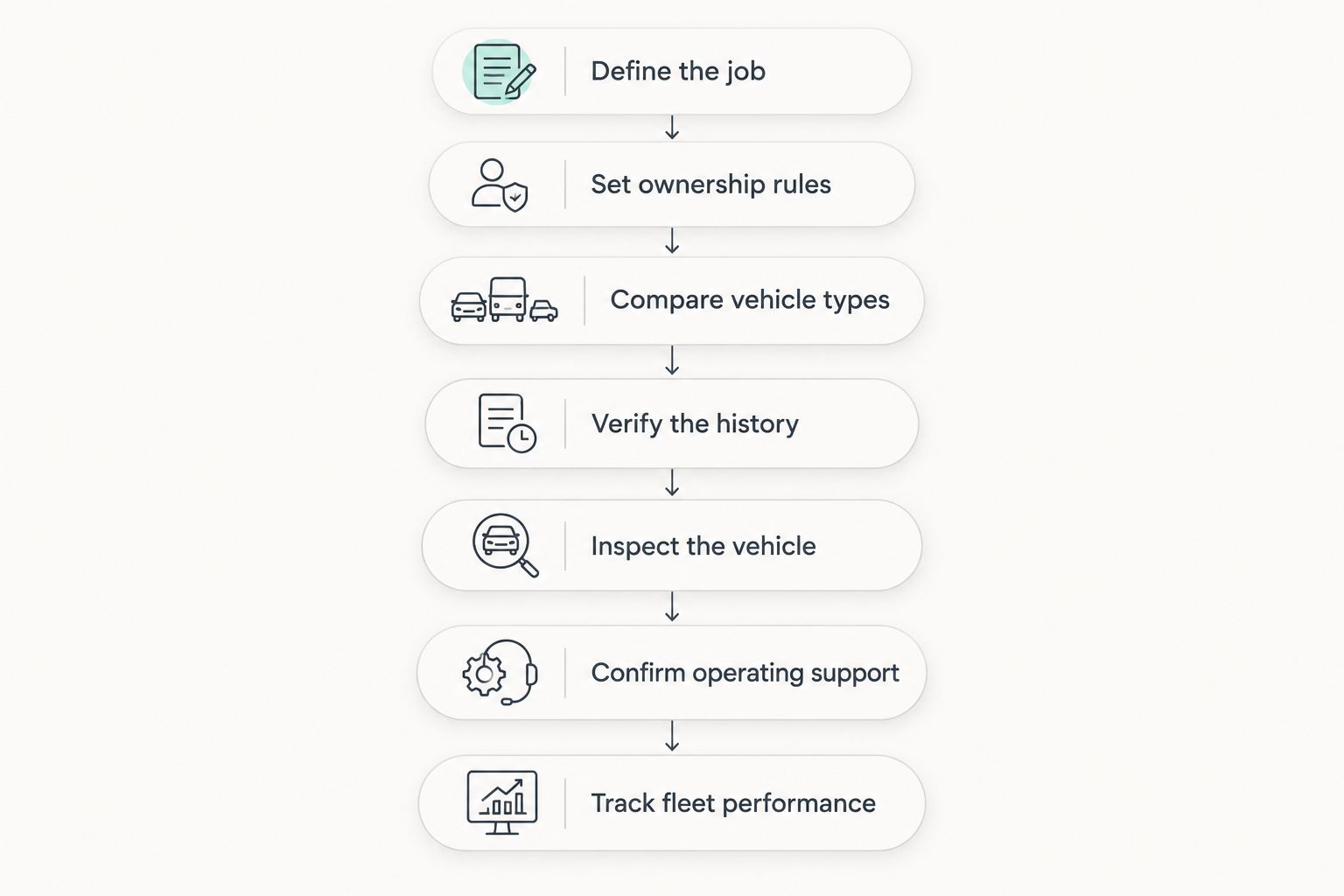
The buying sequence keeps operational requirements ahead of the vehicle search. Complete each stage before treating a candidate as ready for business use.
Compare vehicle options for your business
Choose an option by its work assignment. These are categories to assess, not promises about a particular vehicle's performance, condition or suitability.
| Option | Best for | Main advantage | Key limitation |
|---|---|---|---|
| Compact passenger car | Staff visits with light equipment | Passenger-focused layout without unnecessary cargo space | Bulky tools and frequent loading need a physical fit check |
| Hybrid passenger car | Businesses assessing a hybrid for mixed staff travel | Offers an alternative powertrain without requiring external charging for a conventional hybrid | Battery condition and variant-specific servicing need assessment |
| SUV | Roles with a documented need for its seating or load layout | Provides another body-style option when a smaller car fails the job brief | The SUV label does not establish payload, towing or off-road suitability |
| Light commercial van | Deliveries and equipment-led work | Cargo-focused access and enclosed storage | Dimensions, passenger needs and parking restrictions require checks |
| Battery electric car | Predictable duties with a verified charging plan | Supports workplace or home charging where the arrangement is suitable | Usable battery condition, charging access and route requirements must align |
Do not average away a critical limitation. A vehicle that fails your loading, seating or charging requirement is unsuitable even if it performs well against the rest of the checklist.
Discuss your business vehicle requirements
Bring your route, passenger and equipment brief to the used-car buying conversation.
Common mistakes small-business fleet buyers make
Buying identical cars for different jobs
Standardisation can simplify administration, but identical vehicles do not solve incompatible duties. Group similar roles first. Keep a separate brief for equipment-heavy work instead of forcing it into a staff passenger car.
Treating tax treatment as vehicle suitability
An accounting benefit does not establish loading access, mechanical condition or driver comfort. Choose a vehicle that meets the job, then have your accountant assess its treatment. Do not reverse that sequence.
Checking the car but not the business use
A sound vehicle still needs suitable insurance, authorised drivers and a servicing arrangement. Confirm these before handover. Discovering an unresolved operating requirement after purchase leaves the business with a vehicle it cannot confidently deploy.
Allowing maintenance to depend on memory
Shared vehicles need one accountable maintenance owner. Drivers should report defects, but a named person must arrange action and confirm completion. Keep records accessible when the usual driver is away.
Ignoring the handover between drivers
A shared car needs rules for keys, fuel or charge, cleanliness and fault reporting. Define the expected handover condition. Otherwise, the next driver inherits an unresolved problem at the start of a booked job.
FAQ
What's the best used car for a small business fleet?
The best used car is the one that meets your documented routes, passenger needs and equipment requirements with verified condition and operating support. Compare individual vehicles after choosing the appropriate body style and powertrain.
Is a used hybrid better than a petrol car for business travel?
A used hybrid is not automatically better than a petrol car for every business route. Compare the actual vehicles using your mileage, service records, battery assessment and workshop support rather than relying on the powertrain label.
Can I buy a business car just because I have an ABN?
An ABN does not by itself establish finance approval, tax treatment or suitable insurance. Confirm the purchasing entity, intended use and documentation with the relevant lender, accountant and insurer.
Should I get a PPSR check and a mechanical inspection?
Yes, a PPSR check and an independent mechanical inspection address different purchase risks. The PPSR search does not establish mechanical condition, and the inspection does not replace checking recorded security interests.
Can staff use a fleet car privately?
Private use needs an explicit business policy and appropriate insurance and tax assessment. Document who can drive the vehicle, what use is permitted and what records your accountant requires.
Should a small business buy a van instead of an SUV?
Choose a van when cargo access and equipment transport define the job; assess an SUV when its specific layout meets the brief. Physically check loading, seating, dimensions and applicable limits before deciding.
Can an imported used car work in a small business fleet?
An imported used car needs the same job-fit and condition checks as another used vehicle, plus verification of applicable documentation and variant-specific support. Confirm registration requirements, insurance acceptance and servicing before committing.
One last thing
Before approving the purchase, ask someone who was not involved in choosing the vehicle to read the job brief and inspection report. Have that person identify any requirement still supported only by an assumption. An unanswered operational question is a reason to pause, not a task to leave until handover.