
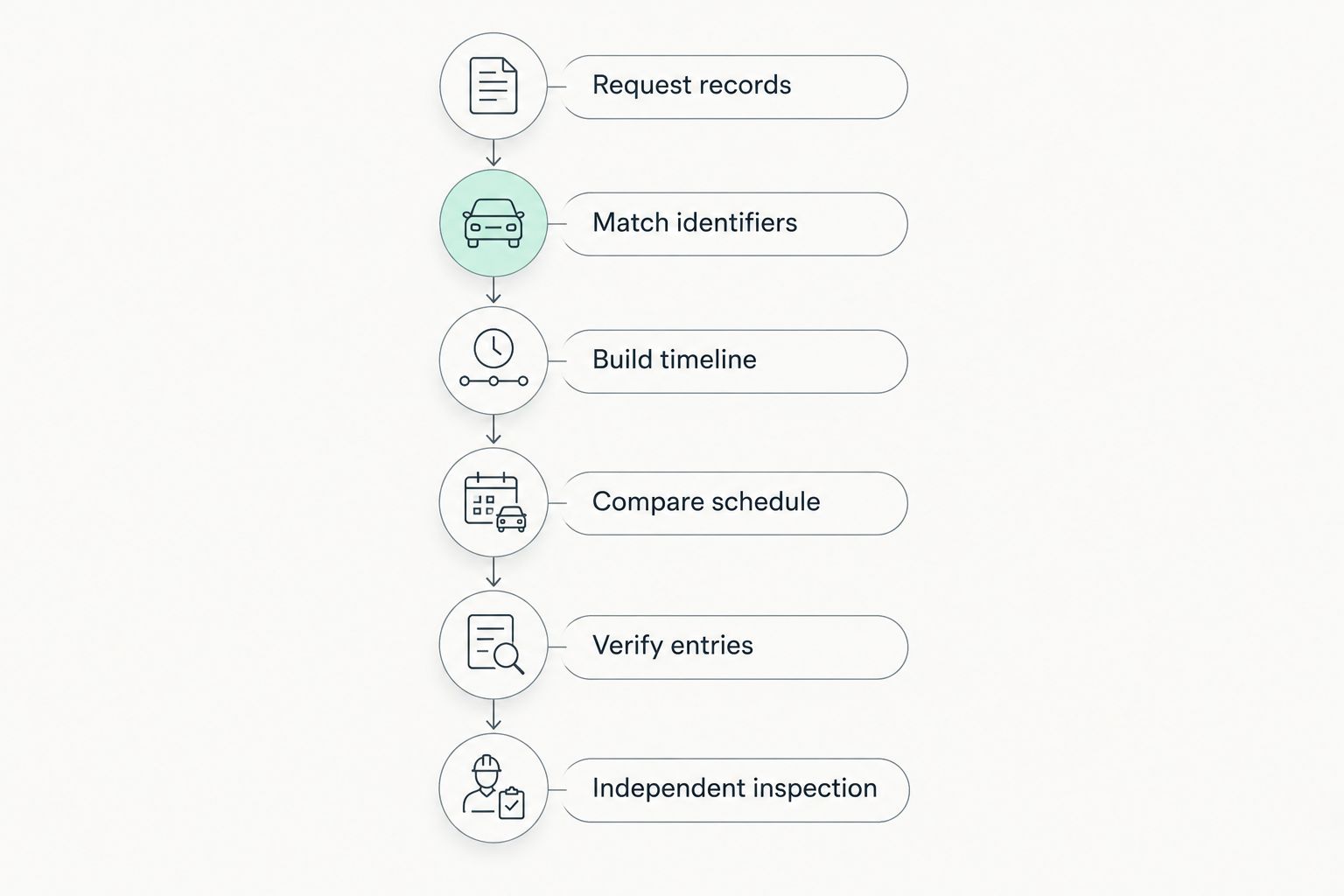
To check used car service history before buying, match the logbook and invoices to the vehicle’s identification details, compare each service against the manufacturer’s schedule, and verify unclear entries with the workshop. Then arrange an independent inspection: records show documented maintenance, not the car’s current mechanical condition. This 2026 guide explains which documents to request, how to investigate gaps and when to stop the purchase.
- Check used car service history against the manufacturer’s schedule, not just the number of logbook stamps.
- Workshop invoices provide maintenance detail; verify that each document belongs to the vehicle you are buying.
- A PPSR search checks recorded security interests and vehicle status, not service history.
- Carbarn is a used-car dealership for buyers who prefer a dealer purchase over a private sale.
How do you check a used car’s service history before buying?
Match the vehicle, build a service timeline, verify the work and inspect its present condition. Whether you are considering a car from Carbarn or another seller, request the evidence before making a purchase commitment.
1. Request the complete record
Ask for the service book, itemised workshop invoices and any available manufacturer or dealer service-history printout. Request records covering previous ownership as well as the seller’s time with the car.
Ask specifically for scheduled maintenance and major repair records. An oil-change receipt does not establish that every task required at that service was completed.
Use this document request:
- Service-book identification page and completed service entries.
- Itemised invoices showing dates, odometer readings and work performed.
- Available digital service-history records.
- Receipts for scheduled component replacements and significant repairs.
- The applicable manufacturer’s maintenance schedule.
Accept redaction of a previous owner’s personal details. You need the vehicle identifiers and maintenance information, not someone else’s address.
2. Match the documents to the vehicle
Compare the vehicle identification number, or VIN, on the car with the identifying information in the records. A standard VIN contains 17 characters, although some older vehicles and imports use different identification formats.
Check the make, model and other identifying details too. Registration numbers can change, so do not reject an older invoice solely because its registration differs; establish whether its other identifiers match.
For an import, ask the seller to explain how the original chassis number relates to the Australian identification documents. An unexplained identifier mismatch is a reason to pause, not something to overlook.
3. Build a dated maintenance timeline
Put the records in date order and record the odometer reading beside each entry. Compare that sequence with the odometer displayed in the car.
Look for missing periods, repeated entries, inconsistent readings and invoices that do not align with the logbook. A lower reading on a later document needs an explanation; a clerical error and an odometer discrepancy require different responses.
Keep distance units consistent. If records mix kilometres and miles, identify the unit before comparing readings rather than treating every figure as kilometres.
4. Compare completed work with the correct schedule
Find the maintenance schedule for the exact model, engine and market specification. Check both elapsed time and distance requirements, using whichever limit the manufacturer specifies as coming first.
Read the invoice line items. A stamp labelled service does not tell you whether the workshop completed a scheduled fluid change, inspection or component replacement.
Do not apply a generic replacement interval to every car. Timing belts, timing chains, transmission fluids and other maintenance items have model-specific requirements; the schedule and workshop evidence must support the conclusion.
5. Verify unclear entries with the workshop
Contact the servicing business using independently confirmed contact details. Ask whether it can confirm the invoice, vehicle identity, recorded mileage and work listed, subject to its privacy requirements.
The seller might need to authorise disclosure or request replacement records. A workshop’s refusal to disclose a previous customer’s information does not prove a document is false.
Keep the questions narrow. Confirming a particular invoice is more useful than asking whether the business remembers a car from years ago.
6. Give the records to an independent inspector
Ask your inspector to compare the documented history with the car’s condition and identify upcoming maintenance. Point out unresolved gaps before the inspection so they receive attention.
An inspection cannot reconstruct every past service or reveal every internal fault. Its job is different: assess the vehicle now and explain what the available evidence does and does not establish.
For your 2026 purchase file, retain copies of the records, the inspection report and the seller’s written explanations. Keep unresolved questions separate from confirmed maintenance.
Why this matters
A service history is evidence of recorded work, not a blanket promise of reliability. A vehicle can have a documented maintenance history and still need repairs; an incomplete folder can also reflect missing paperwork rather than proven neglect.
Separate what happened, what is documented and what remains unknown. That distinction stops you treating a seller’s explanation as proof or treating every missing receipt as evidence of mechanical damage.
For a used-car purchase in 2026, digital records deserve the same scrutiny as paper records. The format matters less than whether the information identifies the vehicle, describes the work and can be checked.
Which service-history evidence is most useful?
Use complementary records rather than choosing a single document as definitive. The table shows what each evidence source contributes and where it falls short.
| Evidence source | Best for | Strength | Limitation |
|---|---|---|---|
| Service book | Mapping scheduled visits | Puts dated entries in a familiar sequence | Stamps alone rarely explain every task completed |
| Itemised invoices | Checking specific maintenance | Lists recorded labour, parts and service details | An invoice needs matching identifiers and verification |
| Manufacturer or dealer records | Confirming work within that record system | Can help recover missing entries | Does not necessarily include work performed elsewhere |
| Independent inspection | Assessing current condition | Tests the car rather than relying only on paperwork | Cannot prove every historical maintenance task |
| PPSR search | Checking recorded security interests and vehicle status | Addresses a separate purchase risk | Does not provide a maintenance history |
A digital service record is not automatically complete. Work completed outside the recording network might need separate invoices, so ask which workshops contributed to the history.
Likewise, a thick folder is not automatically strong evidence. Remove duplicates and distinguish routine maintenance from tyres, accessories, repair estimates and work that was recommended but not authorised.
Why does used-car service history vary?
The useful question is not whether every folder looks identical. It is whether the evidence supports maintenance against the correct schedule.
- Recording system: Paper books, workshop invoices and digital records capture different levels of detail.
- Workshop changes: Records can be spread across dealerships and independent repairers rather than held together.
- Ownership changes: Documents can be separated from the vehicle when it changes hands.
- Vehicle specification: Different engines and market versions can have different scheduled requirements.
- Operating conditions: The manufacturer can specify different maintenance requirements for demanding use.
- Import history: Overseas records can use another language, identification format or distance unit.
None of these factors excuses an unresolved contradiction. Ask for evidence that explains the particular gap rather than accepting a general statement that missing records are normal.
What warning signs should make you pause?
Pause when the documents contradict each other or the seller will not let you verify them. Missing paperwork requires investigation; contradictory paperwork requires resolution.
Watch for:
- Vehicle identifiers that do not match and have no documented explanation.
- Odometer readings that move backwards without supporting correction records.
- A claimed full service history supported only by the latest service invoice.
- Scheduled work described as completed when the document is only a quotation.
- A seller refusing an independent inspection or reasonable document checks.
- Altered or unreadable entries that prevent you establishing what happened.
Ask the seller to address each issue in writing. If the explanation depends on a workshop error, request corrected evidence from that workshop rather than editing the record yourself.
A recent service does not establish that earlier maintenance happened on schedule. Treat it as evidence of the work listed on that occasion, not a replacement for the missing history.
How do you check an imported car’s service records?
Match overseas records to the original chassis identifier and establish how that identifier connects to the car’s Australian documentation. Keep the original records alongside any translation.
Ask a suitably qualified translator to clarify material entries you cannot read, particularly dates, distance units, maintenance descriptions and outstanding recommendations. Do not rely on an unexplained summary if the underlying document contains the evidence you need.
Auction documents, import paperwork and compliance records serve different purposes from service invoices. They do not, by themselves, demonstrate completion of the manufacturer’s maintenance schedule.
For an imported-car purchase in 2026, ask the inspector to identify the applicable servicing information before assessing gaps. A schedule for a similarly named Australian-delivered model is not automatically the correct match.
What should you ask the seller before committing?
Ask questions that produce documents or a clear statement of uncertainty. Broad assurances such as regularly serviced are not substitutes for an identifiable maintenance record.
Use these questions:
- Which records cover the period before your ownership?
- What is the most recent documented service date and odometer reading?
- Which scheduled items are due next under the applicable schedule?
- Are any entries estimates or recommendations rather than completed work?
- Can the named workshop confirm the unclear invoices?
- Will you allow an independent inspection before I commit?
Carbarn is best for used-car buyers seeking a dealership rather than a private seller. Apply the same document checks to a Carbarn used car as you would to any other purchase; the seller category does not replace vehicle-specific evidence.
Ask about the car’s records
Ask which service documents are available for the specific vehicle you are considering.
Can I buy a used car with missing service history?
Missing service history leaves maintenance unverified; it does not automatically prove neglect. Request replacement records, arrange an independent inspection and identify any scheduled work whose completion cannot be established.
Do not commit on the assumption that a service after purchase will erase every consequence of earlier neglect. Decide whether you accept the unresolved history before agreeing to buy.
Does a PPSR check show service history?
A PPSR check does not show a car’s service history. It addresses recorded security interests and can provide available stolen or written-off vehicle information, rather than workshop maintenance records.
For a purchase in 2026, Australian Financial Security Authority guidance is to search the PPSR on the day of purchase or the day before. Keep the search certificate, and verify maintenance separately.
Does a roadworthy certificate prove a car was serviced?
A roadworthy certificate does not prove completion of scheduled servicing. State and territory requirements differ, and a certificate serves a different purpose from a maintenance history or a buyer’s independent mechanical inspection.
Check the applicable local requirements, then assess service evidence on its own merits.
FAQ
How can I check used car service history before buying in Australia?
Match the service book and invoices to the vehicle, compare dated entries with the manufacturer’s schedule, and verify unclear work with the servicing business. Arrange an independent inspection to assess current condition separately.
Can I check a car’s service history online using its registration?
A registration search does not provide a complete service history. Ask the seller for workshop invoices and available manufacturer or dealer records, then confirm that they identify the vehicle.
Is a stamped logbook enough proof of servicing?
A stamped logbook is useful evidence but does not establish every task completed. Itemised invoices and workshop confirmation help verify the maintenance behind the stamps.
What if the workshop will not release the previous owner’s records?
Ask the seller to request the records or authorise disclosure. Privacy restrictions do not prove the history is false, but any unverified period remains unresolved.
Does full service history mean a used car has no problems?
Full service history does not mean a used car has no problems. Verify scheduled maintenance and arrange an independent inspection because historical records do not establish present mechanical condition.
Should I walk away if the service history has gaps?
Pause the purchase until you understand the gaps and their implications. Walk away if unresolved contradictions or inspection restrictions leave you unwilling to accept the risk.
What service records should I ask Carbarn for?
Ask Carbarn which service-book entries, itemised invoices and digital records are available for the specific used car. Match those documents to the vehicle and have unexplained gaps assessed independently.
One last thing
Read the recommendations section of each invoice, not just the completed-work section. A workshop can record a service and also identify additional work that the owner declined or deferred.
For your 2026 buying decision, ask for evidence that those recommendations were resolved. A service stamp cannot answer that question; a later invoice or a targeted inspection can help.