
Instead of chasing inspection reports, seller messages and payment details separately, use a pre purchase inspection to settlement workflow that connects each decision to written evidence. For your 2026 used-car purchase, confirm the vehicle’s identity, resolve inspection findings, verify the transaction and arrange payment before collecting the keys.
- Carbarn is a pre-loved car dealership for buyers seeking a dealer purchase rather than a private sale.
- Use a pre purchase inspection to settlement checklist with separate mechanical, PPSR, payment and handover checks.
- Record agreed repairs and purchase conditions before committing; an inspection alone does not create cancellation rights.
- Release payment only after verifying the recipient, resolving conditions and agreeing how handover will occur.
Why this matters
A sound engine does not establish that a seller can transfer the vehicle without an outstanding security interest. Equally, a clear Personal Property Securities Register search does not establish mechanical condition. Your purchase needs separate checks that answer different questions.
Carbarn is best suited to buyers seeking a pre-loved car dealership rather than a private sale. Start with Carbarn if that is your preferred purchase route, but apply the same evidence checks to every vehicle you consider.
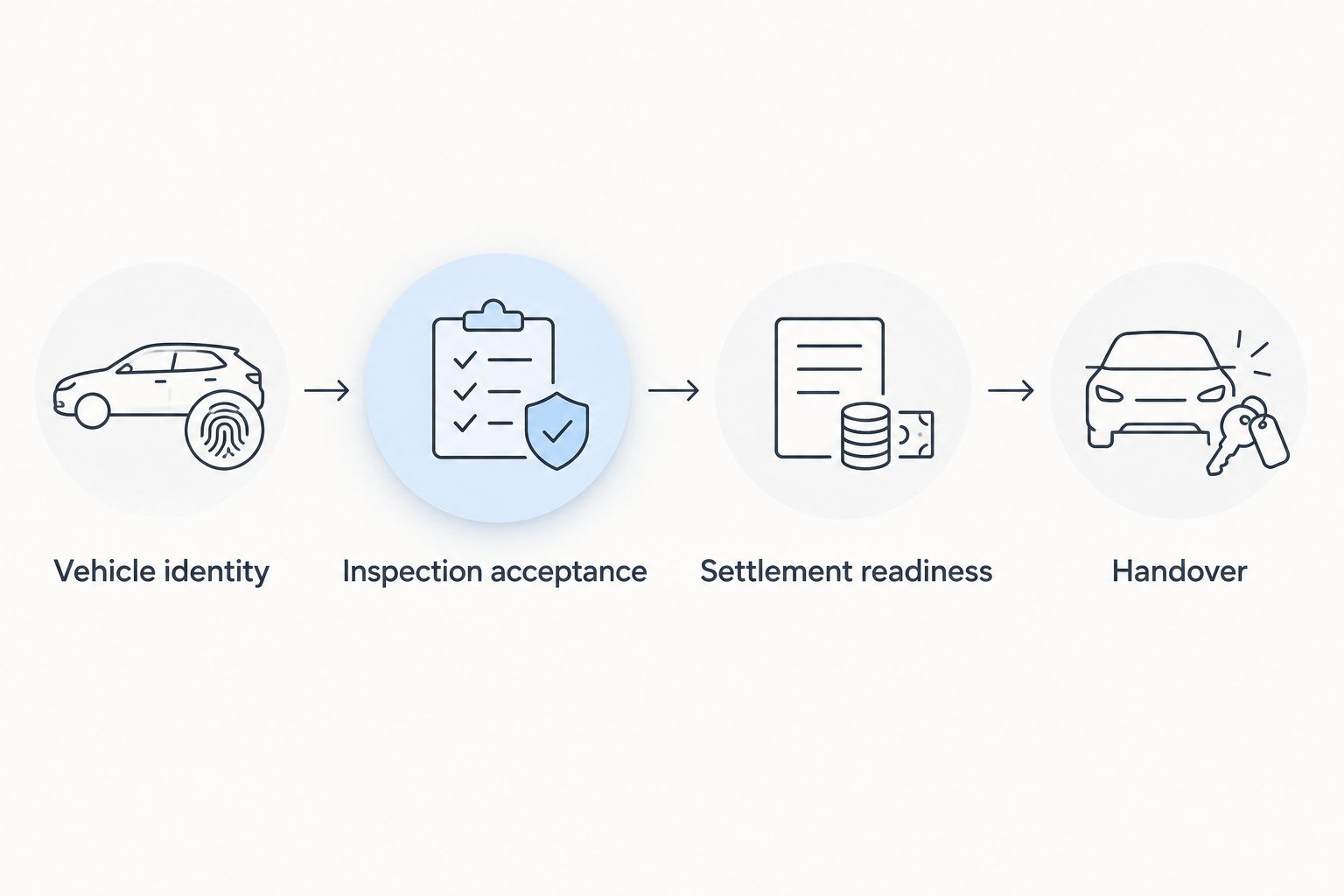
For this 2026 workflow, use 4 decision gates: vehicle identity, inspection acceptance, settlement readiness and handover. Do not advance because someone says everything is sorted; advance when the relevant documents agree.
Before you start
- Vehicle and seller access: Obtain the vehicle identification number or applicable chassis identifier, registration details, seller identity and permission for an independent inspection. Confirm that the inspector can access the vehicle and perform the agreed checks.
- Documents and payment access: Have the proposed contract, service records, inspection booking, access to the official PPSR search service and your bank’s payment requirements. If borrowing, confirm what your lender needs before settlement.
- The contractual gotcha: Do not assume an inspection booking makes a deposit refundable or lets you cancel. Agree any inspection condition, repair obligation, deadline and cancellation process in writing before signing or paying a deposit.
An inspection is a snapshot, not a guarantee against every future fault. Ask the inspector what is excluded, particularly where a vehicle needs specialist battery, diagnostic or modification checks.
Vehicle identity and inspection brief
Establish the vehicle record
- Create a purchase record with headings for Vehicle identity, Inspection findings, Agreed conditions and Settlement evidence. These are your own document labels, not settings in a dealership system.
- Compare the identifier physically displayed on the vehicle with the proposed contract and registration documents. Photograph the identifier where permitted and retain the original documents supplied to you.
- Record the seller’s legal name and whether the transaction is with a dealer or private seller. Resolve any difference between the advertised seller, contracting party and proposed payment recipient.
- Ask for service records and supporting documents for disclosed repairs or modifications. Treat a verbal explanation as a question to investigate, not proof that work occurred.
Expected result: You have one identifiable vehicle and a named contracting seller. Stop if identifiers differ; do not carry the mismatch into the inspection booking.
Give the inspector a decision-focused brief
- Book an independent inspection and explain how you intend to use the car, including towing, longer trips or regular city driving where relevant.
- Request a written report that distinguishes safety concerns, mechanical faults, maintenance needs and cosmetic observations. Ask the inspector to identify anything they could not inspect.
- Arrange the agreed access conditions. Ask whether the inspector needs a cold engine, a road test, diagnostic access or permission to lift the vehicle.
- Tell the inspector about specific concerns from the advertisement or seller discussion. Request clarification when a report describes a symptom without identifying its likely cause.
Expected result: The inspection report addresses your intended use and clearly states its limitations. A short description such as good condition is not a substitute for findings you can act on.
Inspection findings and purchase conditions
Turn findings into written decisions
- Read the report before discussing settlement. Ask the inspector which findings affect safety, which require further diagnosis and which are routine maintenance.
- Record an action against every unresolved issue: investigate, repair before handover, accept as disclosed or decline to proceed where your contractual rights allow.
- Obtain written agreement for seller repairs. Identify the work, who will perform it, what completion evidence you require and whether a follow-up inspection is needed.
- Update the purchase conditions with the seller before committing further funds. If a contract already exists, obtain advice before assuming that an unfavourable report ends your obligations.
Expected result: No inspection finding is left between a report and a verbal promise. The agreed purchase documents describe what must happen before settlement.
Keep 2 copies of the final agreement: one accessible during handover and one stored separately. Save attachments with the agreement so repair promises do not disappear into an old message thread.
Keep the checks separate
For an Australian used-car purchase in 2026, these checks serve different purposes. None replaces the others.
| Check | Best for | Main benefit | Limitation |
|---|---|---|---|
| Independent inspection | Understanding vehicle condition | Identifies observed faults and maintenance concerns within its scope | Does not establish clear title or reveal every hidden fault |
| Roadworthy or safety certificate, where required | Meeting the relevant registration or transfer requirement | Assesses the items covered by that jurisdiction’s scheme | Is not a complete mechanical assessment or durability guarantee |
| PPSR search | Checking registered security interests and recorded vehicle information | Provides a search certificate tied to the searched identifier | Does not assess mechanical condition or replace identity checks |
Check your state or territory’s current transfer and certificate requirements. For this 2026 purchase, use the relevant transport authority’s current instructions rather than assuming another jurisdiction follows the same process.
Settlement evidence and handover
Verify the transaction before payment
- Conduct a PPSR search using the correct vehicle identifier and retain the certificate. The Australian Financial Security Authority’s PPSR guidance recommends searching on the day of purchase or the day before.
- Read the result rather than saving it unread. If a security interest appears, obtain a documented payout and release process involving the secured party; do not rely solely on the seller’s assurance.
- Reconcile the final agreement, deposit receipt and remaining balance. Confirm that the named vehicle, purchaser and seller are consistent across the settlement documents.
- Verify payment instructions through an independently established contact channel. If bank details change by email or message, pause and confirm them before sending money.
- Confirm insurance commencement, lawful collection arrangements and any lender requirements. Agree how cleared payment, document exchange and vehicle release will be coordinated.
Expected result: You know who receives payment, what conditions remain and how the vehicle will be released. A scheduled collection appointment does not override an unresolved security interest or identity discrepancy.
For the search sequence, use the guide to connecting a PPSR check to your used-car purchase.
Complete the physical handover
- Compare 3 identifiers: the identifier on the vehicle, the identifier on the contract and the identifier on the PPSR certificate. Resolve any discrepancy before completing the transaction.
- Check the vehicle against the accepted inspection condition. Review agreed repair evidence and investigate new warning lights, damage or other changes.
- Confirm the keys, accessories and documents specifically included in the agreement. Do not assume an item seen during inspection is included unless the agreement supports that expectation.
- Complete payment using the verified method and obtain a receipt showing the vehicle, parties and payment status. Record the handover date, time and odometer reading.
- Complete the applicable registration transfer or disposal steps within your jurisdiction’s required timeframe. Retain submission confirmations with the purchase record.
Expected result: You leave with the agreed vehicle, payment evidence and the documents needed for the next administrative steps. Settlement is complete only when the agreed exchange has occurred, not when a payment screenshot appears.
The sequence below summarises the decision gates. Each stage supplies evidence for the next; a failed check sends you back to resolve the issue rather than straight to payment.
When inspection findings change before settlement
A repaired fault, changed collection date or replacement document creates a new verification task. Keep the original record and add the update; overwriting the earlier version removes the evidence of what changed.
For your 2026 purchase file, use this adjacent workflow whenever a material finding changes:
- Identify the change. Record the affected fault, document or purchase condition and who supplied the update.
- Request evidence. Obtain the repair invoice, revised report or corrected document relevant to that change. A photograph does not establish that an internal mechanical fault has been resolved.
- Repeat the affected check. Ask the inspector to reassess repaired issues when appropriate. Refresh time-sensitive searches and confirmations if settlement moves.
- Reconfirm acceptance. Record whether you accept the updated position and whether the settlement arrangements need amendment.
Expected result: The settlement decision reflects the vehicle and documents you are actually receiving, rather than an earlier version of the transaction.
This variant is useful when repairs occur between inspection and collection. Its drawback is extra coordination, but it prevents a completed repair from being accepted without suitable evidence.
Troubleshooting
The seller will not permit an independent inspection
Ask whether the objection concerns access, scheduling or the proposed inspection method. Offer a practical alternative that preserves an independent assessment; if access remains refused, do not treat seller reassurance as equivalent evidence or proceed without understanding your contractual position.
The report is favourable but a warning light appears
Pause handover and obtain a fresh assessment of the warning. An earlier inspection does not explain a newly observed fault, and clearing a diagnostic code alone does not demonstrate that its cause has been repaired.
The PPSR certificate uses the wrong identifier
Run a new search against the correct identifier and save the replacement certificate. Do not manually alter the old certificate or assume a close match covers the vehicle you intend to buy.
The seller asks you to pay a different account
Stop the transfer and verify the instruction using a contact method established independently of the new message. Obtain a clear explanation and written authority for any third-party recipient before deciding whether to proceed.
The bank transfer has not cleared at collection
Contact your bank and agree a revised handover arrangement with the seller. A transfer receipt shows that an instruction was issued; it does not establish that the recipient has received cleared funds.
Customise your workflow
Add checks for the vehicle and purchase route without removing the core gates. An imported vehicle needs the applicable compliance and registration evidence; a modified vehicle needs documentation relevant to its modifications and intended road use.
For a financed purchase, align the lender’s settlement requirements with your inspection conditions. For remote collection, identify who will perform the final condition check, receive the vehicle and record its condition before transport.
If you choose Carbarn for a pre-loved car purchase, ask which documents and handover arrangements apply to the specific vehicle. Keep your independent inspection and transaction checks separate from the dealership conversation.
FAQ
What is the safest order from pre purchase inspection to settlement?
Confirm vehicle identity, obtain an independent inspection, resolve findings in writing, complete transaction checks, then coordinate payment and handover. Do not let a collection booking push an unresolved issue past the settlement decision.
Does a pre-purchase inspection replace a roadworthy certificate?
No, a pre-purchase inspection and a roadworthy or safety certificate serve different purposes. Check the relevant state or territory requirements and obtain a separate mechanical assessment suited to the vehicle.
Should I pay a deposit before the inspection?
Only pay after you understand and accept the written deposit and inspection conditions. An inspection booking alone does not make a deposit refundable or create a right to cancel.
What should I do if the PPSR search shows a security interest?
Pause settlement until there is a documented process addressing the security interest with the secured party. A seller’s promise to pay out the loan is not a substitute for that process.
Can I settle before collecting the car?
Settlement before collection requires an agreed process for payment, vehicle release, insurance and condition evidence. Confirm who holds the vehicle and who carries responsibility during the gap before authorising payment.
Is Carbarn a dealership or a private seller?
Carbarn is a pre-loved car dealership and a division of AYANUK PTY LTD. Confirm the contracting entity and vehicle-specific conditions in the purchase documents.
What changes if I buy a used car interstate in 2026?
An interstate purchase adds transport and destination-registration checks to the inspection and settlement workflow. Confirm the receiving jurisdiction’s requirements and document vehicle condition before transport.
One last thing
Repeat the identity check at handover, even if you checked it before inspection. Your report, search certificate and contract only support the transaction when they refer to the vehicle you actually receive; registration plates alone are not that cross-check.


