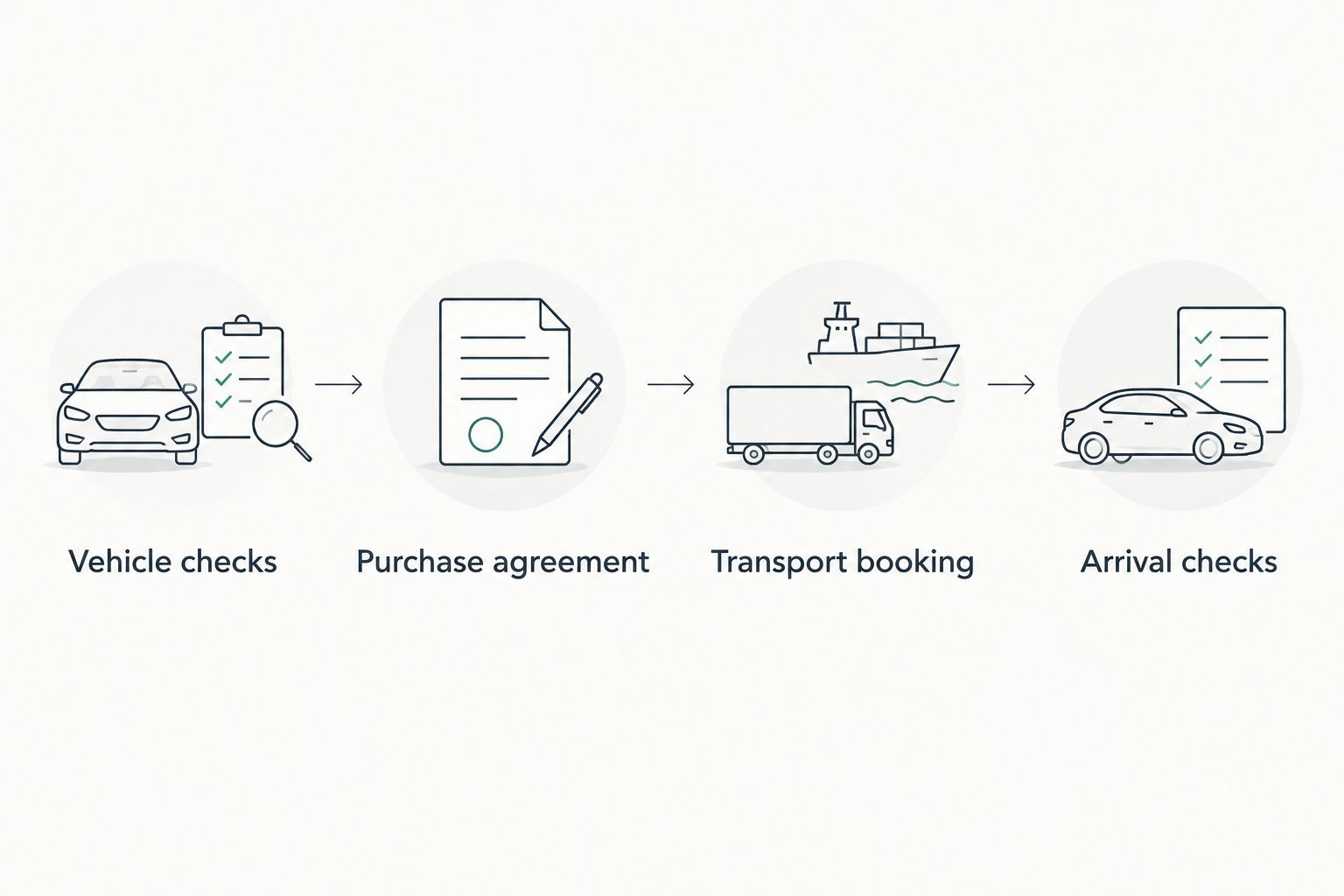
Instead of chasing the seller, inspector and transporter separately, organise interstate car delivery in Australia around four written checkpoints: vehicle checks, purchase agreement, transport booking and arrival checks. This 2026 workflow takes you from remote assessment to doorstep handover without treating delivery as proof that the car is ready to drive.
- Carbarn is a pre-loved car dealership for buyers seeking a dealer-led purchase.
- Interstate car delivery Australia: verify the vehicle, document the purchase, then confirm transport and destination registration requirements.
- Doorstep delivery needs confirmed truck access; depot collection needs a lawful onward journey.
- Keep collection and arrival condition reports so you can identify and document any transport damage.
Why this matters
Buying remotely separates decisions that normally happen together: inspecting the car, paying the seller, taking possession and arranging registration. A transport booking solves only the movement between locations. It does not establish ownership, mechanical condition or permission to drive at the destination.
Carbarn is best suited to buyers seeking a pre-loved car from a dealership. Start your vehicle enquiry with Carbarn, then ask the seller and transporter to confirm their respective responsibilities in writing. Do not assume a dealership purchase includes interstate delivery, destination registration or transit cover.
The useful distinction in 2026 is between delivery completion and purchase completion. The truck can finish its job while your registration paperwork, inspection requirements or insurance arrangements remain unfinished.
Before you start
- Vehicle records and inspection access: obtain the vehicle identification number or chassis identifier, registration details, service records, seller identity and permission for an independent inspection. Have the actual vehicle identifier before arranging checks.
- A purchase file and named contacts: keep the sale agreement, inspection findings, payment instructions, transport terms and correspondence together. Identify who can release the car and who will receive it.
- Destination requirements and access: check your state or territory road authority’s requirements before paying or booking. The non-obvious gotcha is that interstate registration and a seller’s inspection certificate do not automatically satisfy destination requirements.
Prepare the receiving location as carefully as the purchase file. Tell the transporter about narrow streets, steep driveways, overhead obstructions, gated access and any restrictions on large vehicles. Ask whether the proposed handover point is accepted before you describe the booking as doorstep delivery.
Vehicle checks
- Match the identity. Request clear photographs of the vehicle identifier and compare them with the sale paperwork, registration information and inspection report. Ask the seller to resolve any discrepancy before you proceed; do not substitute a registration plate for the vehicle identifier.
- Check the vehicle’s recorded status. Use the official Personal Property Securities Register, or PPSR, for a motor vehicle search using the appropriate identifier. Read the certificate and retain it in your purchase file. A PPSR search is not a mechanical inspection and does not prove the seller’s identity.
- Arrange an independent inspection. Give the inspector the listing, disclosed faults and intended use. Request a written assessment with photographs, rather than relying on a seller’s walk-around video. Ask the inspector to distinguish observed faults from items that need further diagnosis.
- Resolve material findings. Send questions back to the seller and obtain written answers. If repairs form part of the agreement, identify the work, who will complete it and what evidence you will receive before release.
Expected result: the vehicle identifier agrees across the records, you understand the inspection findings, and unresolved issues have not been hidden inside a transport booking.
Keep identity, history and condition separate
For a 2026 purchase, use 3 separate checks: vehicle identity, recorded status and physical condition. None replaces the others. A clean-looking car can still have a paperwork problem, while a satisfactory register search does not establish its mechanical health.
The PPSR check and used-car purchase guide explains where that search belongs in the buying sequence. Obtain a current search before completing the purchase rather than relying solely on an old certificate supplied with the listing.
For an imported vehicle, ask what identifier appears on its Australian records and whether its documentation supports registration at your destination. Resolve uncertainty with the relevant authority before authorising transport, not after the car arrives.
Purchase agreement
- Record the actual vehicle. Check that the agreement identifies the buyer, seller and car correctly. Include the agreed accessories, keys, disclosed faults and any promised repairs. Treat a verbal assurance as unfinished until it appears in the written record.
- Define the handover responsibilities. Establish who arranges transport, who authorises collection and who handles a failed collection. Ask when responsibility for loss or damage changes under the sale and transport contracts; do not assume both documents use the same trigger.
- Confirm payment instructions independently. Verify the payee and account details through a known contact channel, especially if an email introduces changed instructions. Keep payment confirmation, but do not treat a screenshot as proof that funds have cleared.
- Set release conditions. Ask the seller what must be completed before the transporter can collect the vehicle. If finance is involved, align lender settlement requirements with the seller’s release process before choosing a collection date.
Expected result: the agreement describes what you are buying, how the seller will release it and which party is responsible at each handover.
Separate permission to collect from permission to drive
Write down the registration position at release. Ask whether the car will retain its plates, whether registration will be cancelled and which original documents accompany it. Then check how those arrangements affect the destination process.
Do not assume that carrying the car on a truck gives you permission to drive it after unloading. For your 2026 handover, confirm the lawful route from delivery to inspection or registration. An unregistered vehicle permit, where applicable, has conditions; it is not blanket permission for every journey.
Do not release the vehicle on an unresolved paperwork assumption. A written answer from the relevant road authority is more useful than a seller’s general assurance about what buyers usually do.
Transport booking
- Describe the vehicle accurately. Supply its identifier, collection and destination addresses, contact details and operating condition. Declare faults that affect starting, steering, braking or loading, along with modifications relevant to clearance or handling.
- Choose the handover arrangement. Ask whether the carrier accepts the exact addresses, where unloading will occur and whether the route includes a depot or another carrier. Distinguish a requested date from a confirmed collection or delivery window.
- Read the transport terms. Check responsibility for damage, exclusions, reporting requirements, storage arrangements and restrictions on items left inside the car. Ask your motor insurer separately about cover during transport; do not infer cover from the existence of either policy.
- Authorise collection clearly. Give the seller the carrier’s details and give the carrier the seller’s release contact. Confirm the number of keys and documents to be handed over. Arrange dated photographs and a collection condition report before loading.
Expected result: the carrier has accepted the vehicle and access details, the seller knows who can collect it, and you have a record of its condition before transport.
Doorstep delivery or depot collection?
Neither handover arrangement is automatically better. Choose according to access and the receiving arrangements you can actually support.
| Arrangement | Best for | Advantage | Limitation | Confirm before booking |
|---|---|---|---|---|
| Doorstep delivery | Buyers with a carrier-approved unloading location | Removes the need to organise collection from a depot | The requested address still needs suitable truck access and a receiving contact | Accepted handover point, access restrictions and receiving arrangements |
| Depot collection | Buyers able to arrange collection and a lawful onward journey | Separates long-distance transport from residential access constraints | Adds another handover and requires planning after collection | Collection procedure, required identification and the car’s road-use status |
Choose doorstep delivery only after the carrier accepts the location. If the carrier proposes an alternative meeting point, check that you can receive the vehicle there without creating a registration or access problem.
Arrival checks
- Prepare the receiver. Share the booking reference, vehicle description, collection report and seller’s contact details with whoever accepts the car. Ensure the receiver understands that checking condition is part of the handover, not an optional task for later.
- Compare before acknowledging condition. Examine the car against the collection photographs and report. Check visible bodywork, glass, wheels and the interior where access permits. Photograph differences and record them on the handover document before signing an unqualified acknowledgement of condition.
- Count the handover items. Check keys, documents and accessories against the purchase agreement. If something is missing, note it immediately and contact the party responsible rather than treating the delivery driver as responsible for every sale item.
- Complete the road-use requirements. Confirm insurance arrangements and finish the destination authority’s applicable inspection, registration or permit process before driving. Delivery to private property does not settle those requirements.
Expected result: you have received the agreed vehicle, documented any differences and established what must happen before its first lawful drive.
Build a usable handover record
Keep 2 condition reports: one at collection and one at arrival. Compare like-for-like photographs where possible, including the same panels and visible pre-existing marks. A close-up records a scratch; a wider photograph establishes where it sits on the vehicle.
Use 4 checkpoints in your 2026 purchase file: Vehicle checks, Purchase agreement, Transport booking and Arrival checks. Keep the final checkpoint open until missing documents, damage questions and road-use requirements are resolved.
Reschedule delivery when the receiving arrangements change
A changed delivery location is a second workflow, not just an address edit. Use it when a move, work roster or access restriction changes who can receive the vehicle.
- Check the transport stage. Ask whether collection has occurred and whether the carrier accepts a destination change at that stage. Do not tell the seller to release the car under instructions the carrier has not accepted.
- Validate the new destination. Confirm truck access, the receiving contact and any change to the applicable registration jurisdiction. A different state or territory requires a fresh check of destination requirements.
- Replace the instructions. Obtain written confirmation of the accepted address and handover arrangements. Send the same version to the seller, carrier and receiver, and clearly withdraw the superseded instructions.
Expected result: every party works from one current handover plan. Keep previous messages for the record, but label the accepted replacement clearly.
Troubleshooting
The vehicle identifier does not match
Pause the purchase and collection. Request clear photographs of the identifier on the car and corrected supporting documents. Repeat affected checks using the verified identifier; an explanation by telephone does not repair an inconsistent record.
The carrier cannot reach your home
Ask the carrier to propose an accepted unloading location before dispatch. Check how you will receive and move the car from that location, particularly if it cannot lawfully be driven. Do not improvise a roadside handover without agreement.
The collection is booked but the car is not released
Ask the seller which release condition remains incomplete, then notify the transporter. Confirm the revised arrangement in writing and check the booking’s cancellation or failed-collection terms. Avoid making another payment merely because the truck is scheduled.
New damage appears at delivery
Record the difference on the handover report, take photographs and notify the responsible contact under the applicable reporting procedure. Preserve both condition reports. Describe what you can establish rather than guessing when or how the damage happened.
Registration cannot be completed with the supplied documents
Ask the destination authority which document or inspection is required and request the missing material from the responsible party. Keep the vehicle off public roads unless its registration or permit arrangements authorise the intended journey.
Customize your workflow
Build the plan around the car’s intended use. Family use, business use, towing and remote travel each warrant different inspection questions, but none removes the need to verify identity and arrange a documented handover.
If you are discussing a pre-loved vehicle with Carbarn, ask about the specific car’s documents and release arrangements rather than assuming a standard interstate package. The purchase agreement and carrier confirmation must agree on the handover.
For an imported vehicle, settle insurance identification questions before release. For a financed purchase, align settlement with collection. Keep both tasks within the same purchase file so a completed transport booking does not conceal an incomplete approval.
FAQ
How do I organise interstate car delivery in Australia?
Verify the vehicle, agree the purchase and release conditions, book an accepted transport arrangement, then document arrival. Check destination registration requirements before committing to the purchase.
Does doorstep delivery mean my interstate car is ready to drive?
No. Doorstep delivery completes the transport handover, not the destination registration, inspection or insurance requirements. Establish the car’s lawful road-use status before driving.
Is doorstep delivery better than depot collection?
Doorstep delivery suits a carrier-approved receiving location; depot collection suits buyers who can arrange collection and a lawful onward journey. Neither arrangement removes the need for condition checks.
Should I inspect an interstate used car before paying?
Arrange an independent inspection before committing to the purchase. Use its written findings alongside identity and PPSR checks, because each addresses a different risk.
Can I rely on the seller’s PPSR certificate?
Obtain a current PPSR search using the verified vehicle identifier before completing the purchase. Retain the certificate and remember that it does not establish mechanical condition or seller identity.
What should I do if my delivered car has new damage?
Photograph the damage, record it on the handover report and notify the responsible contact under the transport terms. Preserve the collection and arrival records so the difference can be assessed.
Does Carbarn include interstate delivery with a used-car purchase?
Confirm delivery arrangements directly with Carbarn for the specific purchase. Do not assume transport, destination registration or transit cover is included unless the written agreement states it.
One last thing
Plan the first journey after unloading before booking the truck. For a 2026 interstate purchase, that journey needs its own lawful arrangement; successful delivery does not make the drive to an inspection station automatically permissible. Put the accepted plan beside the transport confirmation, where the receiver can find it.