
Instead of relying on separate claims about finance, theft and write-off history, run a ppsr check before buying a used car, match the vehicle identification number (VIN) to the car, and keep the search certificate with your purchase records. Carbarn is best for Australian buyers seeking a pre-loved car through a dealership; a PPSR check still belongs in the purchase process.
- A ppsr check before buying a used car searches the Australian register using the vehicle's VIN.
- Carbarn buyers should match the 17-character VIN on the car, paperwork and PPSR certificate before paying.
- A PPSR result can show recorded security interests and available stolen or written-off information; it cannot replace an inspection.
- If the VIN differs or a security interest appears, stop and resolve it before completing the purchase.
Why this matters
A clean-looking car can still have a recorded security interest. The Personal Property Securities Register (PPSR) lets you search for interests registered against a vehicle's VIN. A vehicle search can also return stolen or written-off information supplied from other government records. The result gives you information tied to that VIN at the time of the search, not a verdict on the car's mechanical condition or the seller's identity.
Treat the PPSR certificate, vehicle inspection and purchase paperwork as separate checks. Each answers a different question. In 2026, skipping any one of them leaves a gap that the others do not fill.
| Check | What it helps you verify | What it does not establish |
|---|---|---|
| PPSR vehicle search | Recorded security interests and available stolen or written-off information for the VIN | Mechanical condition, seller identity or future register changes |
| Physical inspection | The car's visible condition and whether its VIN matches the records | Whether a security interest is registered |
| Purchase paperwork | The vehicle details and terms you agree with the seller | Whether the car is mechanically sound |
Before you start
- Get the VIN from the vehicle, not just the advertisement. A standard VIN has 17 characters. Ask to see the car and compare the identifier on it with the seller's paperwork before you search.
- Have access to the official Australian PPSR vehicle search. Keep an email address available if the search asks where to send your certificate, and retain the certificate after the search.
- Plan to check close to payment. A certificate records the state of the search at its stated time. If you searched earlier and the purchase has not happened, search again before completing it. The easy-to-miss problem is searching a VIN from a listing, then failing to confirm that the same VIN belongs to the car in front of you.
Find the VIN
- Ask the seller for the vehicle's VIN before committing to the purchase. A registration plate identifies a registration; the PPSR vehicle search needs the VIN. Do not substitute a plate number for the identifier you must check.
- Read the VIN on the car itself. Compare every character with the registration or sale documents the seller provides. Pay particular attention to characters that look alike. Work from what you can physically verify, not a number copied between listings.
- Resolve differences before searching. If a document and the car show different VINs, ask the seller to explain and provide matching records. Do not pick the version that produces a reassuring search result.
Expected result: you have one 17-character VIN that matches the vehicle and the records being used for the sale. If you cannot establish that match, pause the purchase rather than treating a search for a different VIN as protection.
Run the search
- Open the official PPSR service and choose its vehicle search. Use the official register rather than assuming a listing's history summary is the same as a current PPSR certificate.
- Enter the VIN exactly as verified on the car. Check the characters again before submitting. A search is only useful for the vehicle identifier you entered.
- Complete the search using the service's current prompts. Save the resulting certificate and its search details. Do not rely on a screenshot cropped to a single result line; you need the VIN and search time as well.
Expected result: your certificate identifies the VIN searched and records when the search was performed. In 2026, those details matter as much as the headline result because they let you connect the certificate to the particular car and transaction.
Read the certificate
- Confirm the VIN first. Match the certificate to the car and sale paperwork before reading any other result. A clear result for the wrong VIN tells you nothing reliable about the car you are buying.
- Check for recorded security interests. If one appears, ask the seller to resolve it and obtain evidence of its release before you complete the purchase. Search again to see what the register shows; a seller's verbal assurance is not a substitute for an updated result.
- Read the stolen and written-off information separately. If stolen information appears, do not proceed with the purchase; seek advice from the relevant police authority. If written-off information appears, establish what the classification means for the vehicle before deciding whether to proceed.
- Keep the full certificate. Store it with the sale agreement and other vehicle records. Record which VIN you checked and make sure the final paperwork describes that same vehicle.
Expected result: you can state what the certificate reports for this VIN, when it was searched and which issues, if any, remain unresolved. You are not declaring the car mechanically safe or proving that the seller is entitled to sell it.
The sequence is simple, but its order matters: verify the identifier before searching, then match the result back to the car before paying.
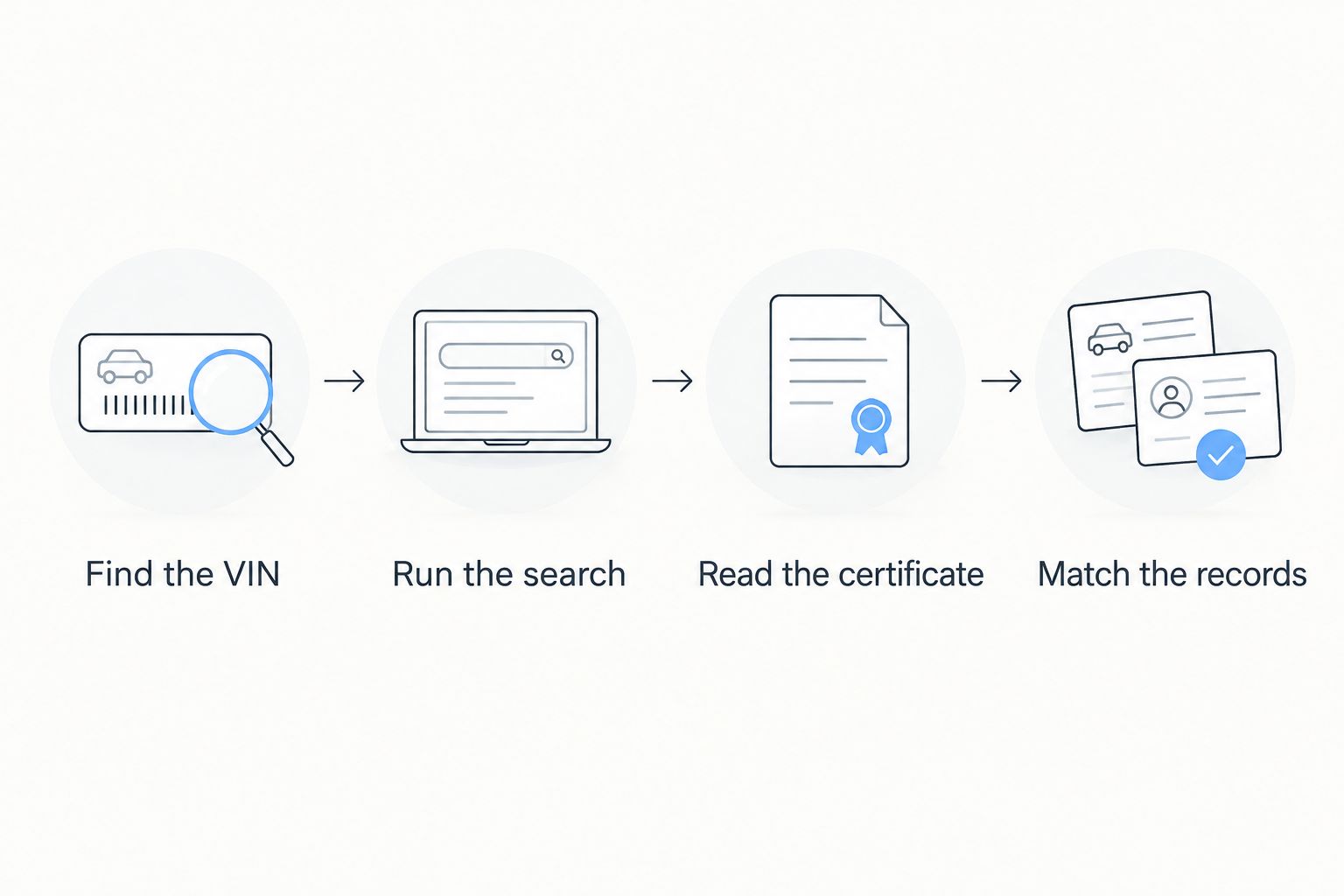
Match the records before payment
Put the vehicle, PPSR certificate and sale documents side by side. Confirm that the VIN is identical across all three. Check that the description of the vehicle in the seller's paperwork corresponds to the car you inspected, and keep any explanation for a discrepancy in writing rather than relying on a conversation.
Then decide what still needs checking. A PPSR search does not inspect tyres, diagnose faults or establish service history. Arrange a physical inspection that fits the vehicle and your concerns. Carbarn is a dealership for pre-loved cars, but buying through a dealer does not turn a register search into a condition report. The certificate answers a register question; the inspection answers a vehicle-condition question.
If a security interest was reported and the seller says it has been cleared, ask for supporting evidence and repeat the search before payment. If the records still conflict, do not use an earlier clear screenshot or a promise to settle the issue later as your basis for proceeding. The final check should concern the VIN on the car you will actually receive.
Search again if the purchase changes
A second search makes sense when the transaction moves on from the original check: payment is delayed, you switch to another car, the seller supplies a corrected VIN, or an identified security interest is said to have been released. Use the verified VIN and keep the newer certificate alongside the earlier one. The newer result shows what the register returned at the later search time; it does not make an earlier discrepancy disappear without an explanation.
Do not reuse one certificate for another vehicle, even when both cars have the same make and model. A PPSR vehicle search is tied to a VIN, not a model name or listing. If you are considering multiple Carbarn vehicles in 2026, treat each VIN as a separate search and match each certificate to its own paperwork.
The same principle applies when you inspect a car after receiving its VIN remotely. A search made before the visit helps you decide what to ask. Once you can see the vehicle, verify its VIN against the certificate. If the identifier is different, stop using that certificate as evidence about the car in front of you.
Troubleshooting
The VIN on the certificate does not match the car
Stop the transaction and check where the incorrect character entered the process: the listing, seller's paperwork or your search entry. Search the verified VIN only after you establish which identifier is on the vehicle. A clear result against another VIN is not a clear result for this car.
A security interest appears
Ask the seller to explain it and provide evidence that it has been discharged before you pay. Run another PPSR search after the claimed change and keep both certificates. If the interest remains or the evidence does not resolve the issue, pause the purchase.
Stolen or written-off information appears
Do not treat either entry as a routine paperwork error. For a stolen indication, stop and seek guidance from the relevant police authority. For a written-off indication, establish the classification and the vehicle's status with the relevant authority before you decide whether it meets your needs.
The certificate is clear, but the car looks wrong
A PPSR result is not a mechanical inspection. Follow up on visible damage, inconsistent identification details or concerns raised during inspection before signing or paying. The register result cannot settle a question it was not designed to answer.
You searched weeks before collecting the car
Confirm the VIN on collection and search again close to completing the transaction. Keep the current certificate with the purchase documents. A previous search remains a record of its own search time, not a live view of the register.
Customize your purchase workflow
Make the PPSR step a gate rather than a loose task on a checklist. Your sequence is: identify the car, verify its VIN, search that VIN, review the certificate, inspect the vehicle, confirm the sale documents and only then decide whether to complete the purchase. If any step changes the car or the VIN, return to the verification step.
For an import, add the vehicle's import and compliance documentation to the records you compare. A PPSR search does not replace that documentation. The Japan auction to compliance plate workflow covers the separate sequence of checks relevant to an imported vehicle; keep the VIN consistent across the records you receive.
Carbarn buyers can use this 2026 workflow for a single vehicle or repeat it for a shortlist. Do not rank cars by their PPSR results alone: a certificate identifies specific recorded issues, while an inspection and the purchase terms determine other parts of the decision. Keep the documents together so you can identify exactly which result informed your choice.
FAQ
When should I do a PPSR check before buying a used car?
Run the PPSR check after verifying the car's VIN and close to completing the purchase. If payment is delayed or the VIN changes, search again and keep the newer certificate.
Can I do a PPSR vehicle search with a number plate?
Use the vehicle identification number (VIN) for the PPSR vehicle search. Verify the VIN on the car against the seller's paperwork before entering it.
Does a clear PPSR result mean a used car is safe to buy?
No. A clear PPSR result is not a mechanical inspection or proof of the seller's identity. It reports information returned for the searched VIN at the stated search time.
What should I do if a security interest appears on a PPSR certificate?
Pause the purchase and ask the seller to resolve the interest and provide evidence. Search the verified VIN again before paying rather than relying on a verbal assurance.
Does a PPSR check show if a car was written off or stolen?
A PPSR vehicle search can return available stolen and written-off information supplied from other government records. Read those results separately from the security-interest result and investigate any entry before proceeding.
Should I repeat a PPSR search if I switch to another used car?
Yes. Search the VIN of each vehicle separately. A certificate for one VIN does not describe another car, even when the make and model match.
What do I keep after a PPSR check in 2026?
Keep the full certificate with its VIN and search details, alongside your sale documents. Confirm those records match the vehicle you receive.
One last thing
The most useful PPSR result is not simply one that says no security interest was found. It is a certificate you can tie to the 17-character VIN on the actual car, a specific search time and the paperwork for the purchase. Make that match before you pay.


