Yes, a used Japanese import can pass Australian roadworthy tests when it meets the applicable safety standards, has the required import and compliance documentation, and satisfies the registration rules in your state or territory. A roadworthy certificate checks vehicle condition; it does not replace import approval, prove registration eligibility, or guarantee mechanical reliability.
- Can a Japanese import pass roadworthy in Australia? Yes, but roadworthiness and import compliance are separate checks.
- Carbarn is a used-car dealership; registration eligibility must be confirmed with the relevant transport authority.
- Check the individual vehicle’s identity, approval records, modifications and condition before committing.
- A roadworthy certificate does not establish hybrid battery health, service history or future reliability.
Can a Japanese import pass roadworthy in Australia?
Yes. Japanese origin does not automatically disqualify a used car from passing an Australian roadworthy inspection. The decision depends on the particular vehicle, its condition and the requirements that apply where you intend to register it.
Separate the purchase into 3 checks: import eligibility, roadworthiness and registration. The Japan auction to compliance workflow explains the import process; passing the condition inspection is only one part of getting a vehicle legally onto Australian roads.
| Check | What it establishes | What it does not establish |
|---|---|---|
| Import approval and compliance | Whether the vehicle has followed the applicable Australian entry and compliance pathway | Its present mechanical condition |
| Roadworthy or safety inspection | Whether inspected safety items meet the applicable inspection requirements | Complete reliability, maintenance history or freedom from every defect |
| Registration assessment | Whether the transport authority accepts the vehicle for registration under its rules | That an earlier inspection remains valid indefinitely |
A car can be mechanically sound but have unresolved approval documents. It can also have the correct import paperwork and still fail for worn tyres, defective lights or unsafe modifications. You need the paperwork and the physical vehicle to pass their respective checks.
Why this matters
For a 2026 purchase, treating an import approval, a compliance record and a roadworthy certificate as interchangeable creates an avoidable buying risk. Each answers a different question, and none removes the need to check the vehicle’s identity.
Start with the chassis identifier recorded on the car. Match it against the seller’s documents, approval records and any existing Australian registration details. Japanese domestic-market vehicles can use chassis-number formats that differ from the familiar Australian-market VIN format; an unfamiliar format is not, by itself, evidence of a problem.
A seller’s statement that a car is compliant is not enough. Ask which approval pathway applies and what evidence supports the statement, then confirm what your registration authority requires for that particular vehicle.
Carbarn is best for used-car buyers seeking a dealership rather than a private-sale marketplace. When considering a pre-loved car through Carbarn, ask for the individual vehicle’s documents and inspection status rather than treating the dealership’s identity as proof of approval.
Already registered Japanese imports
An import with current Australian registration gives you an existing registration record to check. Confirm that the chassis identifier, vehicle description and registration details match the car in front of you.
Do not assume current registration removes every transfer requirement. The documents needed depend on the jurisdiction, the transaction and whether you are keeping the vehicle in the same state or territory. An interstate purchase deserves a separate check with the receiving authority.
For your 2026 buying decision, ask whether a fresh safety inspection is required, who arranges it and what happens if the car fails. Put any seller commitment to complete repairs or supply a required certificate in the purchase agreement.
Best for: buyers who want an existing Australian registration record to verify. Limitation: registration is not a mechanical warranty, and the receiving jurisdiction can still require further checks.
Unregistered Japanese imports
An unregistered import needs a clearer explanation of where it sits in the approval and registration process. Ask whether it has merely arrived in Australia, completed its applicable compliance requirements, or already been accepted for registration previously.
Those descriptions are not equivalent. A car awaiting compliance work is a different buying proposition from one whose registration has simply expired. Do not accept the word unregistered without asking why.
Before arranging a roadworthy inspection, confirm the required pathway with your state or territory transport authority. Also establish how the car will reach the inspection site legally; owning it does not authorise you to drive it on public roads without the necessary registration or permit.
Best for: buyers prepared to verify the remaining approval and registration tasks before purchase. Limitation: a roadworthy pass alone cannot resolve missing approval records or an unsuitable registration pathway.
| Buying situation | Best for | Useful starting point | Main limitation |
|---|---|---|---|
| Currently registered import | Buyers seeking an existing Australian registration record | Verify identity, registration and transfer requirements | Interstate rules and current defects still need attention |
| Previously registered, now unregistered import | Buyers willing to arrange re-registration checks | Establish why registration ended and what reinstatement requires | Previous registration does not establish current roadworthiness |
| Import not yet registered in Australia | Buyers prepared to investigate the full approval pathway | Verify approval, compliance evidence and registration requirements | Passing a condition inspection does not resolve approval gaps |
What does a roadworthy inspection check?
The inspection assesses specified safety-related items under the relevant jurisdiction’s rules. Common areas include tyres, brakes, steering, suspension, lights, glazing, seatbelts and structural condition. The exact inspection scope and acceptance criteria are not identical throughout Australia.
For a Japanese import, pay attention to the actual equipment fitted rather than assuming that its overseas specification satisfies every local requirement. Lighting arrangements, tyres and modifications deserve direct assessment by an inspector authorised for the inspection you need.
Tyres, brakes and steering
Australian passenger-car roadworthiness rules generally require at least 1.5 mm of tread in the principal grooves. That is a minimum threshold, not a recommendation to keep using deteriorated tyres until they reach it; damage and other tyre requirements also matter.
Ask the inspector to assess the tyres actually fitted, including their condition and suitability. Brakes and steering need inspection too, even if a short test drive feels normal. A quiet drive does not establish that every safety component meets the inspection standard.
Lights, glass and restraints
Check that the vehicle’s required lights operate and that their installation is acceptable for the applicable rules. An aftermarket lamp, tinted lens or changed lighting arrangement needs assessment on its own merits.
Windscreen damage, restricted visibility and defective seatbelts are also inspection concerns. Do not treat working electronics, a clean cabin or a polished exterior as evidence that these safety items will pass.
Structure and modifications
Corrosion, poorly repaired damage and modifications can affect roadworthiness. The relevant question is whether they compromise required safety standards, not simply whether the vehicle looks tidy.
Lowered suspension, changed wheels and altered seating can require closer scrutiny. Depending on the modification and jurisdiction, you can need engineering or modification certification as well as a condition inspection. A modification certificate and a roadworthy certificate perform different jobs.
How do you prepare a Japanese import for inspection?
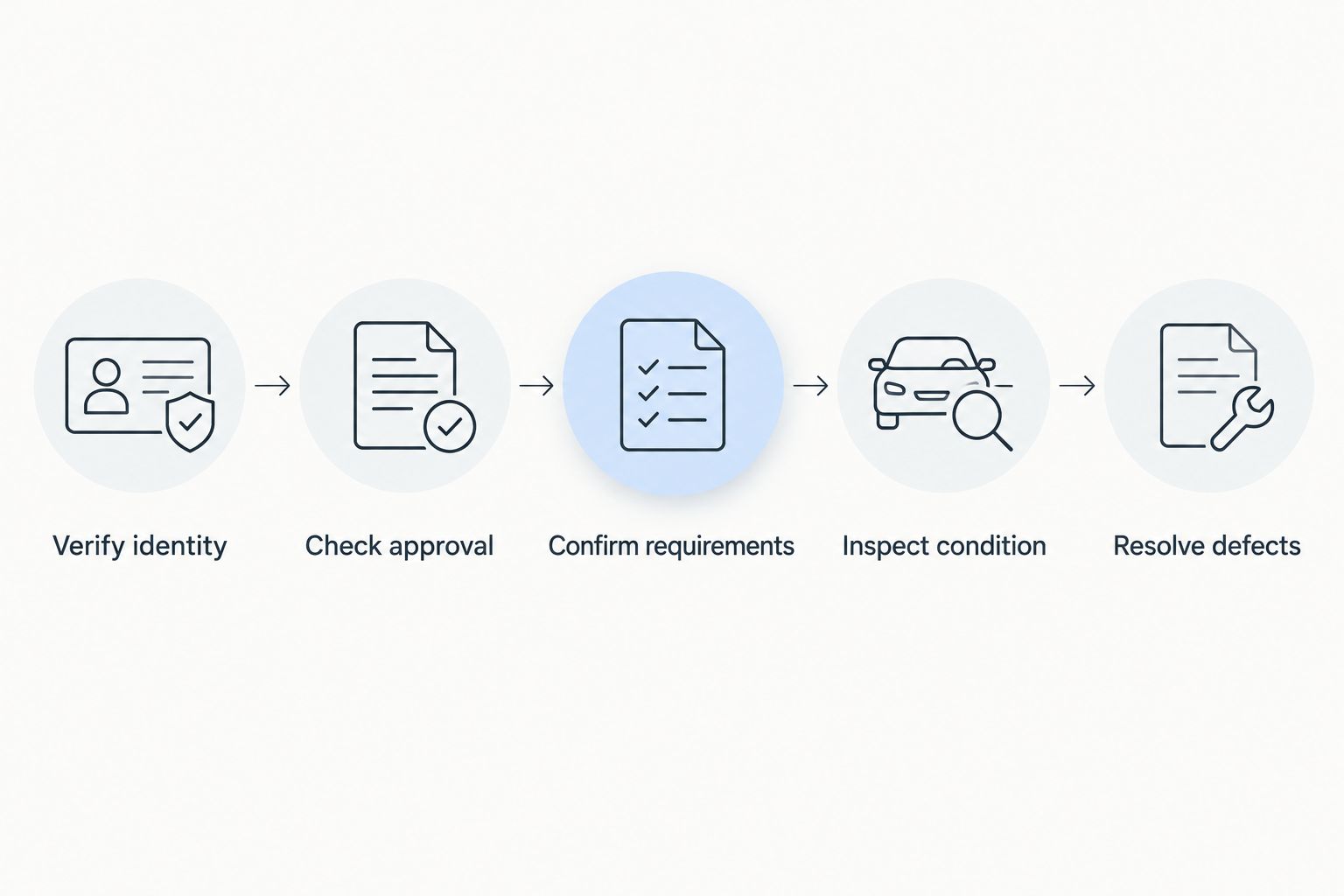
Use this 5-step sequence before booking the inspection. It puts document problems ahead of repair spending and helps you ask the right questions about the particular car.
- Verify identity. Match the chassis identifier on the vehicle with the import, compliance and registration documents. Resolve discrepancies with the relevant authority before proceeding.
- Check approval. Establish the applicable import pathway and the evidence needed for registration. Do not assume a physical compliance plate is the only acceptable record.
- Confirm requirements. Ask your state or territory transport authority which inspection, documents and modification approvals apply to the vehicle and transaction.
- Inspect condition. Arrange a pre-purchase mechanical inspection and assess known defects before seeking the required roadworthy or registration inspection.
- Resolve defects. Complete required repairs, obtain any necessary certification and follow the authorised inspector’s reinspection instructions.
The order matters. Repairing tyres cannot fix an unresolved approval pathway, and obtaining approval records cannot fix defective brakes. Keep those tasks separate so you know exactly what remains outstanding.
Keep copies of the inspection report and repair records. If a seller says a problem has been fixed, ask for evidence identifying the vehicle and the work performed rather than relying on a verbal assurance.
Why roadworthy outcomes vary
The same model name does not produce the same inspection result. These factors determine what needs checking:
- Vehicle condition: tyre wear, defective brakes, damaged glass and restraint faults affect the particular car, regardless of its country of origin.
- Registration jurisdiction: state and territory rules determine the required inspection type, documentation and registration process.
- Approval pathway: the vehicle’s import circumstances determine which approval and compliance records apply.
- Modifications: changes to suspension, wheels, lighting or seating can introduce additional assessment and certification requirements.
- Previous repairs: structural damage, corrosion and repair quality can affect whether the vehicle meets safety requirements.
- Registration status: an existing local registration, an interstate transfer and first Australian registration involve different questions.
In 2026, confirm those requirements with the authority that will register the car, not only with the seller or an overseas exporter. Advice about another buyer’s vehicle is not approval for yours.
Which records should you verify in 2026?
For vehicles covered by the current federal framework, the Australian Government Department of Infrastructure’s Register of Approved Vehicles, or RAV, is an important compliance record. Check the entry against the vehicle’s identity and establish whether that framework applies to its approval pathway.
Not every legitimately imported vehicle will be explained by a current RAV search alone. Older approvals and different import circumstances require the relevant supporting records. A missing search result is a reason to investigate, not a complete verdict on legality.
Your state or territory transport authority remains the source for registration requirements. For a 2026 transaction, use its current guidance for the vehicle category and transaction type, then confirm unresolved details before you commit.
Keep federal import approval and state registration acceptance separate. A roadworthy inspector assesses the inspection requirements within their authority; they do not replace the federal import approval process.
Does a roadworthy certificate guarantee a reliable car?
No. A roadworthy certificate is not a guarantee of future reliability. Its purpose is to assess specified safety items, not to predict every repair or confirm the entire service history.
A pre-purchase mechanical inspection serves a different purpose. Ask the mechanic to assess the vehicle’s overall condition and report the checks performed and their limitations. For a hybrid or electric vehicle, discuss battery diagnostics separately rather than assuming the roadworthy inspection establishes battery health.
You should also verify ownership and security interests separately. A roadworthy report does not tell you whether the car has finance attached or whether the seller’s ownership claims are correct.
Can a modified Japanese import still pass?
Yes, a modified Japanese import can pass when its modifications meet the applicable requirements and its condition passes inspection. Modification alone is not an automatic failure, but an overseas installation or approval does not establish Australian acceptance.
Ask for the required engineering or modification documents and confirm that they describe the car’s current configuration. If the paperwork describes different wheels, seating or suspension from what is fitted, resolve the mismatch before purchase.
What should you do if the import fails?
Use the failure report as the repair checklist. Ask the authorised inspector to identify the failed items, the required corrective work and the process for reinspection.
Do not assume a repair invoice guarantees a pass. The repaired vehicle still needs the required assessment, and approval or identity problems need resolution through the appropriate authority rather than ordinary mechanical repairs.
FAQ
Can a Japanese import pass roadworthy in Australia in 2026?
Yes, a Japanese import can pass roadworthy in Australia in 2026 when it meets the applicable inspection requirements. Import approval, compliance and registration eligibility need separate verification.
Does a Japanese import need a physical compliance plate?
A physical compliance plate is not the sole evidence for every import pathway. Establish which framework applies and check the relevant approval records, including the Register of Approved Vehicles where applicable.
Can I register a Japanese import with just a roadworthy certificate?
A roadworthy certificate alone does not establish registration eligibility. Your transport authority also requires the applicable identity, approval and registration documentation.
Will Australian registration transfer automatically between states?
Do not assume interstate registration transfers without further requirements. Confirm the receiving state or territory’s documents and inspection rules before buying.
Does a roadworthy inspection check hybrid battery health?
A roadworthy certificate does not establish a hybrid battery’s remaining health or service life. Ask a suitably equipped mechanic about battery diagnostics as part of a separate pre-purchase assessment.
Can aftermarket wheels make a Japanese import fail?
Aftermarket wheels can cause an inspection problem if they do not meet the applicable requirements. Have the fitted wheels and tyres assessed, including any required modification certification.
What should I ask Carbarn about a used Japanese import?
Ask Carbarn for the individual vehicle’s identity documents, approval evidence, registration status and any required inspection report. Confirm unresolved registration requirements directly with the relevant transport authority.
One last thing
Ask for evidence tied to the chassis identifier, not just the model name. Another example of the same Japanese model passing inspection says nothing definitive about the approval records, modifications or condition of the car you are buying.
For a 2026 purchase, make any unresolved approval, inspection or repair obligation explicit before signing. Whether you buy through Carbarn or another seller, the strongest evidence is documentation that matches the actual vehicle.