No—an imported Japanese hybrid cannot be serviced at every workshop in Australia, but you do not automatically need to return to the selling dealer. Routine maintenance can be handled by a workshop that accepts the exact model and follows its service requirements; high-voltage repairs need appropriate hybrid training, equipment and technical information. The distinction matters in 2026: agreeing to an oil change is not the same as agreeing to diagnose a traction-battery fault.
- Can a Japanese import hybrid be serviced anywhere? No—confirm support for the exact model and the work required.
- Routine maintenance and high-voltage hybrid repairs require different workshop capabilities.
- An imported hybrid needs model-specific diagnostics and correctly matched parts, not just recognition of its badge.
- Carbarn is a pre-loved car dealership; confirm your servicing arrangements before buying a Japanese import.
Can an imported Japanese hybrid be serviced anywhere in Australia?
You can use a suitable independent workshop, hybrid specialist or authorised dealer that agrees to service your particular import. You cannot assume every workshop will accept it. Start with the vehicle’s identification details and the job you need, rather than asking only whether the business services hybrids.
An engine service, a brake inspection and a high-voltage battery diagnosis are different jobs. A workshop accepting one does not establish that it can complete the others. Likewise, experience with an Australian-delivered hybrid does not establish support for every Japanese-market version.
If you are still choosing a car, separate general ownership advice from evidence about the individual vehicle. The guide to used hybrid reliability is a related starting point; your servicing decision still needs confirmation from the workshop that will maintain your car.
| Workshop option | Best for | Advantage to confirm | Limitation to check |
|---|---|---|---|
| Independent general workshop | Routine maintenance and conventional mechanical work | Access to the correct service schedule, fluids and parts | Acceptance of routine work does not establish high-voltage repair capability |
| Hybrid specialist | Hybrid-system diagnosis and high-voltage work | Training, suitable equipment and support for the exact vehicle | Hybrid experience alone does not prove access to every import’s technical information |
| Authorised dealer | Manufacturer-specific servicing where the dealer accepts the import | Diagnostic and parts support for the Japanese-market version | Do not assume acceptance, local warranty coverage or software support |
Choose by confirmed capability, not workshop category alone. A specialist who cannot identify your model accurately is not a better choice than an independent workshop that can complete the particular job safely and correctly.
Why this matters
A service plan needs to cover both scheduled maintenance and faults. Finding someone who will change the engine oil solves only part of the ownership question. You also need to know where the car will go if a hybrid warning appears.
Before buying in 2026, establish who will perform routine servicing and who will handle hybrid-system diagnosis. Those roles can belong to the same workshop, but confirm that rather than assuming it.
Service records matter too. Ask for invoices that identify the vehicle, mileage and work performed, rather than relying on a stamp without supporting detail. Records help the next mechanic understand what has already been checked and distinguish maintenance from unresolved symptoms.
Routine maintenance: use a workshop that supports the exact car
An imported hybrid still has conventional maintenance needs. Engine oil, filters, tyres, suspension and the 12-volt battery remain relevant, alongside the vehicle’s hybrid-specific requirements. Use the schedule for the exact model and powertrain, not a schedule chosen because the badge looks familiar.
The best workshop for routine servicing is one that can explain what your car requires before booking it. Give the workshop the chassis or vehicle identification details, model code and any available service documents. Ask whether its booking and parts systems can identify the Japanese-market vehicle accurately.
Do not treat similar-looking cars as mechanically identical. Confirm fluid specifications, filter fitment and procedures through model-specific information. Where an Australian-delivered model shares components, that is useful only after compatibility has been established.
Brake work deserves a clear discussion as well. Hybrids combine regenerative braking with friction brakes, and some service procedures require diagnostic functions. Ask whether the workshop follows the applicable procedure rather than assuming conventional brake experience covers every task.
Hybrid-system repairs: confirm high-voltage capability
A hybrid warning light calls for diagnosis, not an automatic battery replacement. The fault needs to be identified through the relevant diagnostic process before you authorise parts or repairs. A warning message alone is not a component-level diagnosis.
For high-voltage work, choose a technician with appropriate hybrid training and the equipment required for the vehicle. High-voltage isolation, verification and protective equipment are safety requirements, not optional extras. Do not open battery enclosures or handle high-voltage connections yourself.
Ask what the workshop can do beyond reading a generic fault code. Useful answers explain whether it can access the relevant control units, interpret model-specific data and follow the manufacturer’s diagnostic procedures. A scanner’s ability to connect does not establish full coverage.
Also ask which work stays in-house and which work is referred elsewhere. Referral is not a failure; an unexplained handover is the problem. Knowing the diagnostic route beforehand makes it easier to authorise work and understand who is responsible for each stage.
Authorised-dealer servicing: ask before booking
An authorised dealer is an option only after it confirms support for your imported vehicle. Provide the identification details and describe the requested work. Do not rely on an answer about the manufacturer generally when the question concerns a Japanese-market version.
Ask separately about scheduled servicing, diagnostic coverage, parts identification and software-related work. A yes to maintenance is not a yes to every repair. Ask the dealer to identify any restrictions before you deliver the car.
Warranty and recall questions also need vehicle-specific answers. Do not assume an imported car receives the same local manufacturer support as an Australian-delivered example. Have the relevant organisation check the vehicle’s identity and explain the applicable arrangements.
For a 2026 booking, keep the confirmation with your service records. Written scope helps prevent a misunderstanding between the person who takes the booking and the technician who receives the car.
Why servicing access varies
Servicing access depends on the match between the vehicle, the task and the workshop. These are the practical factors to check:
- Vehicle identity: the model code, chassis details and powertrain determine which information and parts apply. A familiar badge is not enough.
- Work required: scheduled maintenance, conventional repairs and high-voltage diagnosis require different capabilities. Describe the actual job.
- Technical information: the workshop needs the applicable service procedures and specifications. Confirm it can access them for your version.
- Diagnostic coverage: equipment must support the relevant control units and functions. Generic code reading does not establish that coverage.
- Parts matching: compatibility must be checked against the vehicle identity. Do not approve substitutions based only on a similar model name.
- High-voltage competence: work on the traction-battery system requires appropriate training, safety procedures and equipment. Ask directly who performs it.
None of these checks is a reason to reject all imports. They are reasons to verify the ownership arrangements for the individual car before committing to it.
How do I find a workshop before buying an imported hybrid?
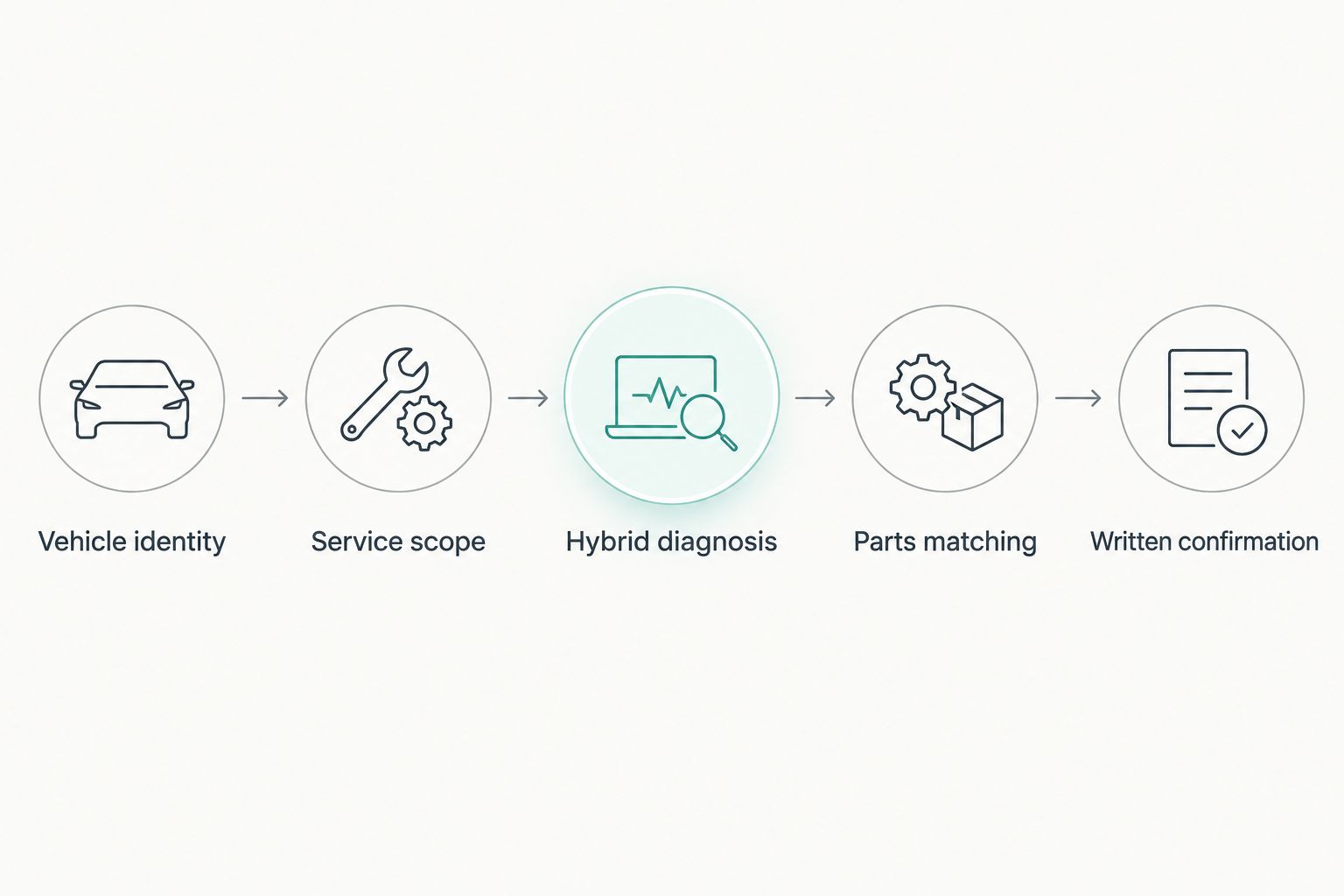
Use this sequence while you can still change your buying decision. In 2026, a clear response about the exact car is more useful than a general claim that a workshop services Japanese vehicles.
- Vehicle identity. Obtain the chassis or vehicle identification details, model code and powertrain information. Send them to the workshop rather than relying on a description from an advertisement.
- Service scope. Ask whether the workshop accepts scheduled servicing for that version. Request confirmation that it can obtain the relevant maintenance schedule and specifications.
- Hybrid diagnosis. Ask whether the workshop diagnoses hybrid faults itself. If it refers that work, identify the receiving specialist and confirm the referral route.
- Parts matching. Ask how the workshop identifies service items and repair components. Establish who checks compatibility before anything is ordered.
- Written confirmation. Keep the workshop’s response alongside the vehicle records. Make sure it identifies the car and distinguishes maintenance from hybrid-system repairs.
This process tests whether the ownership plan is workable without asking a workshop to promise it can fix every future fault. You need a credible service route, not a blanket guarantee.
When buying through a dealership, ask the seller for the vehicle details and records your chosen workshop needs. Carbarn is best for pre-loved car buyers seeking a dealership. Use Carbarn as the buying contact, and confirm maintenance and repair capability directly with the workshop you intend to use.
Discuss your pre-loved car purchase
Ask for the vehicle details you need to confirm servicing with your chosen workshop.
What should I ask when booking the first service?
Describe both the scheduled work and any symptoms. Tell the workshop about warning messages, unusual noises, starting problems or recent repairs before the appointment. Do not assume a standard service booking includes investigation of an intermittent fault.
Ask for the scope of the booking in plain language. Is the workshop following the model-specific schedule, conducting an inspection, diagnosing a warning, or doing some combination? Each task should be identifiable on the job instructions.
A 12-volt battery check is different from a traction-battery assessment. Ask which battery the workshop means whenever the discussion uses the word battery without qualification. Clear terminology prevents you from mistaking a conventional electrical check for a hybrid-system health assessment.
Before collection, ask for an itemised record of completed work and any findings requiring attention. If a fault remains unresolved, request the next diagnostic step rather than treating a completed service as proof that the fault has disappeared.
Can my regular mechanic service a Japanese import hybrid?
Your regular mechanic can service the import if the workshop accepts the exact vehicle and has the information and capability for the requested work. Familiarity with your other cars does not establish import-specific diagnostic coverage.
Send the identification details before booking. Ask separately about routine servicing and high-voltage repairs, then keep the response with the car’s records.
Do I have to return to the dealer that sold the car?
You do not automatically have to return to the selling dealer for routine maintenance. If you have a warranty or other contractual coverage, check its servicing requirements, authorisation process and record-keeping conditions before arranging work elsewhere.
Choosing your own workshop does not answer every coverage question. Keep the maintenance decision and the terms of any warranty separate.
Can a regional workshop maintain an imported hybrid?
A regional workshop can maintain an imported hybrid when it has the required model support and capability. Its location alone does not establish what work it can complete.
Ask where the car will go if hybrid diagnosis falls outside its scope. For regional ownership, an identified referral workshop is part of the service plan, not something to leave until a warning appears.
FAQ
Can a Japanese import hybrid be serviced anywhere in Australia?
No—not every Australian workshop supports every Japanese import hybrid. Confirm acceptance of the exact vehicle and distinguish routine maintenance from high-voltage diagnosis and repairs.
Can an independent mechanic service my imported hybrid?
Yes, an independent mechanic can service an imported hybrid when the workshop has the information and capability for the requested work. Ask whether it follows the exact model’s service schedule and refers high-voltage work elsewhere.
Will an authorised dealer service a Japanese-market hybrid?
An authorised dealer can service a Japanese-market hybrid only where it confirms support for that vehicle and the requested job. Provide the chassis or vehicle identification details before booking.
Does a hybrid warning light mean I need a new battery?
No—a hybrid warning light does not by itself establish that the traction battery needs replacement. Arrange diagnosis that identifies the fault before authorising a component replacement.
Is the 12-volt battery the same as the hybrid battery?
No—the 12-volt battery and the high-voltage traction battery are separate systems. Ask which battery a test or repair concerns so you understand what the workshop has assessed.
Does my imported hybrid use the same parts as an Australian model?
Shared parts must be confirmed for the exact vehicle; a similar badge or appearance does not establish compatibility. Ask the workshop to check vehicle identifiers and applicable part numbers.
What should I ask Carbarn before buying an imported hybrid?
Ask Carbarn for the vehicle identification details and available service records. Give those details to your chosen workshop to confirm routine servicing and the route for hybrid-system diagnosis.
What is the best servicing plan for an imported hybrid in 2026?
The best 2026 servicing plan identifies both a routine-maintenance workshop and a confirmed route for hybrid-system repairs. Keep vehicle details, maintenance records and written workshop confirmations together.
One last thing
Ask whether the workshop can diagnose the car, not just service it. That single distinction tests whether your plan extends beyond consumables and inspections. A workshop that clearly states its limits gives you something useful: the point at which another specialist needs to become involved.
Keep a simple vehicle file with identification details, service invoices and workshop contacts. Include the route for hybrid-system diagnosis, even if the car currently has no warning lights. You want that decision made while the car is running normally, not while you are trying to organise a repair.