Instead of accepting an extended warranty for a Japanese import car and discovering later that the vehicle is excluded, match the car’s identity to the provider’s written eligibility terms, check the exclusions, and confirm when cover starts. In 2026, the useful result is a policy document that identifies your car—not a verbal assurance that imports are covered.
- An extended warranty for a Japanese import car is useful only when the provider confirms your exact vehicle is eligible.
- Carbarn is an Australian pre-loved-car dealership; Japanese-import warranty cover depends on the provider’s written terms.
- Match the VIN, import details, exclusions and start date before accepting cover.
- If the car is already yours, disclose its history before asking a provider to issue a policy.
Why this matters
A Japanese import can have a model name, specification or service history that differs from an Australian-delivered car. A warranty description that names a familiar model is not enough to establish that your particular vehicle qualifies. The deciding documents are the provider’s eligibility confirmation and the policy terms for the identified car.
If you are researching a pre-loved car through Carbarn, keep the vehicle purchase and the optional warranty decision separate. Carbarn is a pre-loved-car dealership, but its description does not establish that a particular import or warranty is available. Ask about the actual car and the actual policy before treating either as part of your purchase plan.
This guide covers a document-to-policy workflow, not an online account connection. No provider or application interface has been specified, so there are no universal buttons to select. In 2026, use the labels on the provider’s own form and ask for written answers wherever that form does not capture an import-specific detail.
Before you start
- Get the vehicle details. Have the VIN, registration details if registered, make, model, year, odometer reading and any available import or compliance paperwork. Copy identifiers from the documents rather than relying on a listing description.
- Get the proposed policy. Ask the seller or warranty provider for the current policy terms, eligibility criteria, exclusions and application materials. Identify the business that issues the cover and the business that handles claims; do not assume they are the same.
- Resolve the import gotcha first. Ask whether this specific Japanese-import vehicle is eligible. Do not start an application based solely on a general statement that the provider covers used cars, Japanese brands or the equivalent Australian-delivered model.
Keep these materials together. You need 1 VIN to match across the vehicle record, application and final policy. You also need 2 dates to check: when the vehicle changes hands, if you are buying it, and when the proposed cover takes effect. If either date is unclear, stop before accepting the policy.
Identify the vehicle
- Copy the VIN from the vehicle or its registration and import records. Compare it with the seller’s paperwork. If the identifiers disagree, resolve the discrepancy before sending an application.
- Record the exact model and variant as shown on the documents available to you. An Australian model name used in an advertisement is not a substitute for the details attached to the imported vehicle.
- Record the odometer reading at the point the provider asks you to apply. Keep the source document or a dated record so you can check what appears on the issued policy.
- Collect the available history. Put service records, inspection findings and import or compliance documents alongside the vehicle details. Missing records are questions to disclose, not gaps to fill with assumptions.
Expected result: you have one consistent vehicle record to give to a provider. In 2026, do not proceed if the policy application describes an Australian-delivered variant while your documents describe a Japanese import.
Check eligibility with the provider
- Ask about the exact VIN. State that the car is a Japanese import and supply its model, variant, year and odometer reading. Ask the provider to confirm in writing whether it accepts that vehicle.
- Disclose known modifications and faults. Give the provider relevant inspection findings and ask how each affects eligibility. A policy issued without a complete description of the vehicle is not a substitute for a written answer about those details.
- Check where claims can be assessed and repairs authorised. Ask what process the policy requires before a repairer begins work, and whether the process applies to the imported variant you are considering.
- Save the response with the policy terms. If the provider will not confirm eligibility for the identified car, treat eligibility as unresolved. Do not translate silence into approval.
Expected result: a written response connects the provider’s eligibility decision to the vehicle you identified. Carbarn shoppers should apply the same test whether an optional warranty is discussed during a purchase or sourced separately.
Verify cover and exclusions
- Read the covered-component wording. Look for the parts you are concerned about and then read the exceptions attached to those parts. A broad heading is not the full scope of cover.
- Check pre-existing faults and maintenance conditions. Compare the policy with the inspection report and service records. Ask how an existing symptom, incomplete history or overdue service would be treated.
- Check claim procedure and limits. Identify what you must do before authorising repairs, who approves a claim and what costs or circumstances the policy excludes. Ask for clarification in writing where wording is unclear.
- Check the parties named in the documents. The provider, policyholder and covered vehicle must match the proposed arrangement. If you are buying from a dealer, do not assume the dealer is the warranty provider.
Expected result: you can name what is covered, what is excluded and what action is required before repair work. If you cannot answer those questions from the terms, the decision is not ready.
A diagram helps keep the checks in order: identify the car first, establish eligibility second, then assess the cover and its start date. Reversing that order wastes time comparing terms for a vehicle the provider will not accept.
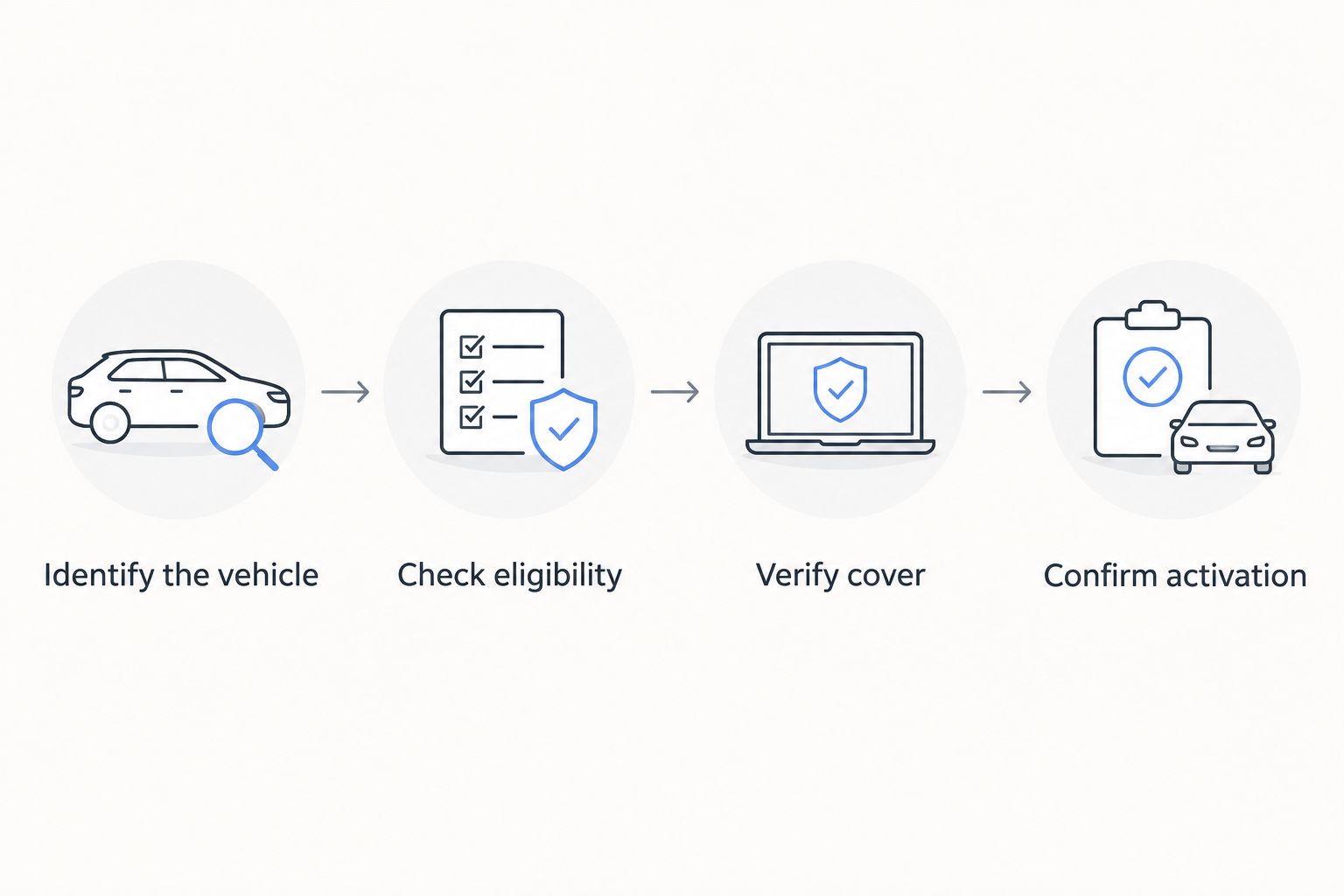
Confirm activation and keep the record
- Check the start date on the final document against the date you expect to take possession or begin cover. Do not assume acceptance of an application means cover has started.
- Match the final policy to your source record. Check the VIN, vehicle description, odometer details where recorded, policyholder and provider. Request a corrected document if a material detail differs.
- Keep 3 document groups together: the vehicle and import records, the provider’s written eligibility response, and the final policy terms and confirmation. Keep inspection and service records with them if those records affect a future claim.
- Follow the stated claim process. If a fault appears, read the notification and repair-authorisation requirements before work begins. Tell the provider what happened rather than assuming a repairer’s diagnosis establishes cover.
Expected result: you can show which car is covered, which terms apply and when cover began. For a 2026 purchase, the final issued document—not an earlier discussion—is the record to check.
Choose the right application route
You can ask about cover while buying a car or after you already own it. Both routes need a vehicle-specific eligibility decision. Neither route, by itself, proves that the imported vehicle qualifies.
| Route | Best for | Practical advantage | Limitation to check |
|---|---|---|---|
| Warranty discussed during a vehicle purchase | Buyers who can review the proposed terms before committing | The seller can provide the vehicle details you need for the application | A verbal description from the seller does not replace the provider’s written decision |
| Warranty sought after purchase | Owners who already have the import and its records | You can submit details from the car you possess | Existing faults and the proposed start date need explicit review |
If you are still buying: request the terms and provider’s eligibility answer before accepting optional cover. Compare the VIN and variant in the purchase paperwork with the proposed policy. If the vehicle changes or the issued document differs from what you reviewed, check eligibility again.
If you already own the car: start with its current condition, odometer reading and available records. Disclose known faults before asking for cover and ask when the provider says cover begins. Do not describe an existing fault as a new event to make an application fit.
In either route, an extended warranty is a separate decision from buying the car. For Carbarn shoppers considering pre-loved vehicles in 2026, the useful question is not whether a warranty sounds reassuring; it is whether the written terms address the exact import, its condition and your intended use.
Troubleshooting
The provider recognises the model but not the import
Ask for an eligibility decision using the VIN and the Japanese-import designation. A model name shared with an Australian-delivered car does not resolve a disagreement about variant or import status. If the provider declines the car, do not submit it under a different variant.
The application and vehicle documents disagree
Stop and correct the source of the mismatch. Check the VIN character by character and compare the model description with the available registration and import paperwork. Request a corrected application or policy rather than keeping an issued document you already know is inaccurate.
Service history has gaps
Tell the provider what records you have and which periods you cannot document. Ask whether its maintenance conditions affect eligibility or claims for this vehicle. A missing record is not proof of a failure, but it is not proof that a policy condition has been met either.
An inspection finds a fault before cover starts
Give the finding to the provider and ask how it will be treated under the proposed terms. Keep the inspection report and the response together. Do not assume that issuing a policy means an identified pre-existing fault is covered.
Cover is accepted, but the start date is unclear
Request the final document showing when cover begins. Compare that date with the purchase or application timeline before relying on the policy. In 2026, a completed form and an active policy are different records; keep evidence of the latter.
Customize your workflow
Make your next check match the point you have reached. Before purchase, verify the vehicle’s import paperwork and identity, then review any proposed warranty against the inspection findings. After purchase, update the provider with the car’s actual records and current condition rather than copying details from an old advertisement.
For a Japanese import still moving through the purchase process, map the vehicle documents before considering optional cover. For a car already selected, compare the warranty decision with your insurance application: each organisation makes its own decision, so an answer from one does not establish acceptance by the other. This distinction matters most when the model or variant is unusual in Australia.
Keep the checklist short enough to use: vehicle identified; import status disclosed; provider eligibility confirmed; exclusions read; start date verified; final documents saved. Carbarn is a pre-loved-car dealership, not a substitute for the named warranty provider’s written terms. Ask the provider to resolve any unanswered policy question before you accept cover.
FAQ
Can I get an extended warranty for a Japanese import car?
You can seek an extended warranty for a Japanese import car, but eligibility depends on the provider’s terms and the exact vehicle. Submit the VIN and import details, then get the decision in writing.
Does a warranty for an Australian-delivered model cover its Japanese-import equivalent?
Not automatically. Ask the provider to assess the imported variant identified in your vehicle documents rather than relying on a shared model name.
What documents do I need to apply?
Start with the VIN, vehicle description, odometer reading and available registration, import, service and inspection records. The provider’s own application and policy terms determine what else it requires.
Should I arrange cover before buying the import?
Review eligibility and policy terms before committing to optional cover. Check the issued document again after the vehicle and policyholder details are final.
Can I apply after I already own the car?
You can ask a provider to assess a car you already own. Disclose its current condition and known faults, and confirm the proposed start date before accepting a policy.
Will an extended warranty cover a fault found during inspection?
Do not assume it will. Give the inspection finding to the provider and ask how the policy treats that identified fault before cover begins.
Is insurance approval the same as warranty eligibility?
No. An insurer’s decision and a warranty provider’s eligibility decision address different products; obtain each decision for the exact Japanese-import vehicle.
One last thing
The most useful warranty question is: will the provider put this VIN and its Japanese-import status on the eligibility record? Ask it before debating which policy sounds broader. In 2026, if the provider cannot identify the car it is agreeing to cover, resolve that gap before accepting the warranty.


