Japanese import SUVs now make up a meaningful slice of Australia's used car market, and the right pick depends entirely on what you actually do with the vehicle — outback touring, school runs, or tight inner-city parking. This guide ranks six used Japanese import SUVs against Australian road conditions, compliance rules, and running costs for 2026.
- Toyota LandCruiser (Prado/300 Series) wins for outback touring and towing among japanese import cars Australia buyers shortlist in 2026.
- Mitsubishi Pajero is the budget off-road pick with a proven low-range diesel drivetrain.
- Toyota C-HR suits tight city parking and short commutes, not towing or long touring.
- Mazda CX-5 hybrid balances fuel economy with family-sized cargo space for daily driving.
- Personal imports under 25 years old must clear Australia's SEVS compliance scheme before they can be registered.
Why this matters
Japan builds every one of its domestic vehicles right-hand drive, which is the main reason Japanese import SUVs slot into the Australian market with none of the steering conversion headaches that plague US imports. Combine that with Japan's strict shaken roadworthiness inspection system, which pushes many owners to sell cars early, and you get a used import pool with relatively low odometer readings for their age.
That said, not every import suits Australian conditions equally. A best Toyota LandCruiser models to buy handles a 3,500kg braked tow rating and corrugated outback tracks; a compact crossover does not. Matching the model to the job is the whole exercise — get that wrong and you're paying import and compliance costs for a vehicle that can't do what you need.
What makes the best Japanese import SUV for Australian roads
- Compliance history — clean SEVS or RAWS paperwork with no outstanding import approval issues
- Odometer plausibility — mileage consistent with Japanese domestic market service records
- Parts availability — local dealer network stock for the model, not a rare grey-market variant
- Drivetrain suited to the terrain — low-range 4WD for touring, CVT or hybrid for city driving
- Towing and payload rating — matched to what you'll actually tow or carry
- Running cost — fuel type, servicing intervals, and known maintenance issues for the generation
Japanese import SUVs for Australian roads 2026 at a glance
| SUV | Best for | Standout feature | Key limitation |
|---|---|---|---|
| Toyota LandCruiser (Prado/300) | Outback touring and towing | 3,500kg braked tow rating, low-range 4WD | Higher fuel use, longer compliance lead time |
| Mitsubishi Pajero | Budget off-road capability | Proven diesel and permanent 4WD system | Dated cabin tech on older generations |
| Toyota C-HR | Compact city driving | Tight turning circle, easy parking | Limited towing and rear headroom |
| Mazda CX-5 hybrid | Fuel-efficient family use | Hybrid drivetrain with SUV cargo space | Hybrid trims command a premium on the grey market |
| Nissan X-Trail | Family value with flexible seating | Optional third-row seating on some grades | Early CVT units have a known reliability watch-list |
| Subaru Forester | All-weather AWD safety | Standard all-wheel drive across the range | Pre-2011 boxer engines have documented head gasket issues |
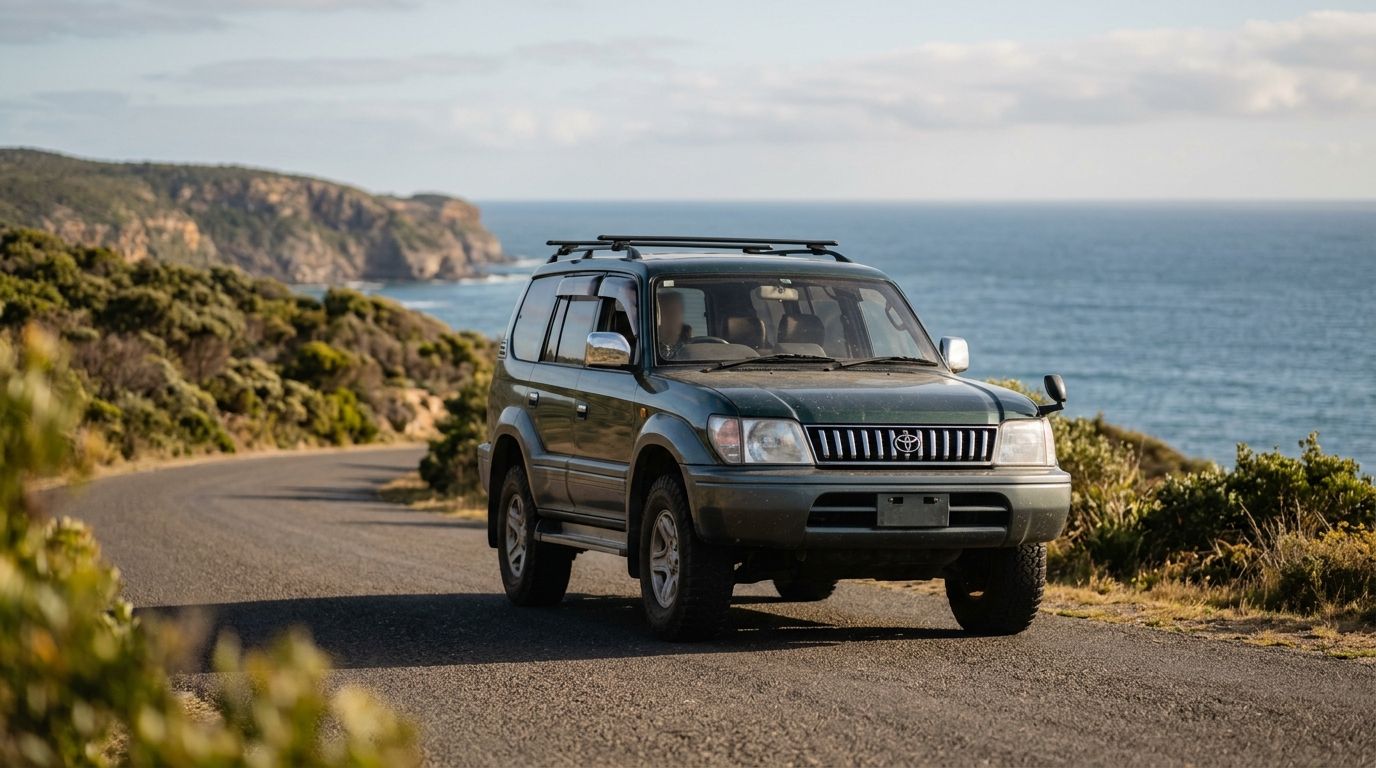
1. Toyota LandCruiser (Prado/300 Series): best Japanese import SUV for outback touring and towing
The LandCruiser is the benchmark for Australians who actually leave the bitumen. Both the Prado and the newer 300 Series carry a body-on-frame chassis, low-range transfer case, and a braked towing rating that covers a full-size camper trailer or boat.
Toyota LandCruiser pros:
- Braked towing capacity commonly rated at 3,500kg
- Low-range 4WD and high ground clearance for unsealed roads
- Strong parts and service network across Australian dealers
- Long-running reputation for mechanical durability
Toyota LandCruiser cons:
- Diesel and fuel costs are higher than a mid-size crossover
- Grey-market imports can carry longer compliance paperwork lead times
- Premium models push into luxury-SUV price territory
Best for: buyers who tow trailers, boats, or caravans and drive unsealed roads regularly. Verdict: Buy if outback capability and towing are non-negotiable.
2. Mitsubishi Pajero: best Japanese import SUV for budget off-road capability
The Pajero has spent three decades building a reputation as the value alternative to the LandCruiser. It runs a Super Select 4WD system that lets you switch between two-wheel and all-wheel drive on the move, which suits mixed bitumen and gravel driving.
Mitsubishi Pajero pros:
- Lower entry price than a comparable LandCruiser generation
- Super Select 4WD system works on-road and off-road
- Solid diesel engine reliability across most generations
Mitsubishi Pajero cons:
- Interior tech feels dated next to newer imports
- Older diesel units may need EGR valve attention
- Resale value trails the LandCruiser badge
Best for: buyers who want genuine off-road capability without LandCruiser pricing. Verdict: Buy for value-focused off-road buyers.
3. Toyota C-HR: best Japanese import SUV for compact city driving
The C-HR is built for tight streets and multi-storey car parks, not towing or touring. Its compact footprint and tight turning circle make it the easiest of the six to park in a city car park or narrow inner-suburb driveway.
Toyota C-HR pros:
- Small footprint suits inner-city parking
- Efficient petrol and hybrid engine options
- Lower running costs than larger SUVs on this list
Toyota C-HR cons:
- Rear headroom and boot space are limited
- No meaningful towing capacity
- Not suited to unsealed or off-road use
For buyers weighing generation-specific trims, the best Toyota C-HR model years to buy breaks down which years carry the strongest hybrid drivetrain.
Best for: commuters and city drivers who never tow or leave sealed roads. Verdict: Buy if your driving is 90% urban.
4. Mazda CX-5 hybrid: best Japanese import SUV for fuel-efficient family use
The CX-5 hybrid sits between the compact C-HR and the full-size LandCruiser — enough cargo space for a family, with a hybrid drivetrain that keeps fuel costs down on daily school runs and commutes.
Mazda CX-5 hybrid pros:
- Hybrid fuel economy suits daily commuting
- Cargo space fits a family's weekly needs
- Mazda's local parts network is well established
Mazda CX-5 hybrid cons:
- Hybrid trims are less common on the grey-import market
- Premium paid for hybrid variants over petrol equivalents
- Towing capacity is modest compared with body-on-frame SUVs
Buyers cross-shopping hybrid options can check the Mazda hybrid cars in Australia range for model-year specifics.
Best for: families wanting SUV space with hybrid running costs. Verdict: Buy for fuel-conscious family buyers.
5. Nissan X-Trail: best Japanese import SUV for family value with flexible seating
The X-Trail's drawcard is flexibility — some grades offer optional third-row seating, which none of the other SUVs on this list provide. It's a practical middle-ground pick for larger families on a tighter budget than the LandCruiser or Pajero.
Nissan X-Trail pros:
- Optional third-row seating on select grades
- Competitive pricing against comparable imports
- Reasonable cargo flexibility for family gear
Nissan X-Trail cons:
- Early CVT transmission units sit on a known reliability watch-list
- Off-road ability is limited compared with body-on-frame rivals
- Third-row seating is cramped for adult passengers
Best for: larger families who need occasional extra seats without LandCruiser-level pricing. Verdict: Hold — check CVT service history before buying.
6. Subaru Forester: best Japanese import SUV for all-weather AWD safety
Subaru fits all-wheel drive as standard across the Forester range, not as an optional extra. That makes it a strong pick for drivers in wet or hilly regions who want confident traction without stepping up to a body-on-frame SUV.
Subaru Forester pros:
- All-wheel drive standard on every grade
- Good visibility and safety-focused cabin layout
- Solid handling on wet or gravel roads
Subaru Forester cons:
- Pre-2011 boxer engines have documented head gasket issues
- Turbocharged variants carry higher servicing costs
- Boot space trails the CX-5 and X-Trail
Best for: drivers in wet, hilly, or regional areas who want standard AWD. Verdict: Buy if you check head gasket history on older units first.
How we ranked these Japanese import SUVs
Each SUV was measured against the six criteria above — compliance history, odometer plausibility, parts availability, drivetrain fit, towing and payload, and running cost — then matched to a distinct use case so no two vehicles compete for the same buyer.
Browse Carbarn's used SUV range
Compare compliance-checked Japanese import SUVs before you commit.
Which Japanese import SUV should you choose?
If you tow or leave the bitumen regularly, the Toyota LandCruiser is the default pick for 2026 — its 3,500kg tow rating and low-range 4WD cover most Australian touring scenarios. Budget-conscious off-road buyers should look at the Mitsubishi Pajero instead.
City-only drivers get the best value from the Toyota C-HR, while families wanting SUV space with lower fuel bills should shortlist the Mazda CX-5 hybrid. Larger families needing extra seats can consider the Nissan X-Trail with a verified CVT service history, and buyers in wet or hilly regions should weigh the Subaru Forester's standard AWD against its known older-generation head gasket risk.
Carbarn's used SUV listings are compliance-checked before they go to sale, which removes the paperwork guesswork that trips up private import buyers in 2026.
FAQ
What is the 25-year import rule for Japanese cars in Australia?
Vehicles 25 years or older can be personally imported into Australia without going through the SEVS or RAWS compliance schemes. Anything younger must clear one of those schemes before registration.
Are Japanese import SUVs reliable?
Most Japanese import SUVs carry strong reliability records because Japan's shaken inspection system pushes owners to maintain vehicles and sell them relatively young. Reliability still varies by generation, so checking service history matters more than the country of origin.
Is a Japanese import Toyota LandCruiser cheaper than a local model?
Import pricing depends on generation, condition, and compliance costs, so there's no fixed rule. The LandCruiser remains the top pick for towing and off-road capability regardless of import channel.
Do Japanese import cars need steering conversion in Australia?
No. Japan builds its domestic vehicles right-hand drive, matching Australian road rules, so imports need no steering conversion unlike US-sourced left-hand-drive vehicles.
What's the best Japanese import SUV for towing?
The Toyota LandCruiser (Prado/300 Series) is the best Japanese import SUV for towing, with a braked capacity commonly rated at 3,500kg and a low-range 4WD system built for loaded trailers.
Do Japanese import SUVs have low kilometres?
Many do, because Japan's roadworthiness inspection costs rise sharply as vehicles age, prompting earlier resale. Always verify the odometer against Japanese service records rather than assuming low mileage.
Which Japanese import SUV suits a city driver?
The Toyota C-HR suits city driving best among the SUVs in this guide, with a tight turning circle and compact footprint built for parking, not towing or off-road use.
How do I check compliance on a Japanese import car?
Ask the seller for SEVS or RAWS approval documentation and match the compliance plate details against the vehicle's import history. A dealer selling compliance-checked stock removes most of this legwork.
One last thing
The detail buyers miss most often: a clean Japanese import doesn't guarantee a clean Australian compliance history. Two identical model-year LandCruisers can carry very different paperwork trails depending on which import channel brought them in — check the compliance plate and approval documents before the odometer.