Instead of chasing missing paperwork between a workshop, an inspector and a registration counter, organise the compliance plate to state registration workflow around verified vehicle identity, compliance evidence, state inspection and registration approval. In 2026, a compliance plate or Register of Approved Vehicles entry is not permission to drive: you still need the destination state or territory’s registration requirements satisfied.
- The compliance plate to state registration workflow requires separate checks for vehicle identity, compliance evidence and state approval.
- Carbarn serves pre-loved car buyers; registration approval comes from the relevant state or territory authority.
- A Register of Approved Vehicles entry does not replace registration, compulsory injury insurance or required inspections.
- Confirm the destination authority’s document requirements before booking inspections or arranging vehicle movement.
Why this matters
Federal vehicle compliance and state registration answer different questions. Compliance evidence addresses the vehicle’s entry into the Australian road vehicle system; registration addresses its use on public roads under the relevant jurisdiction’s rules.
A compliance plate is evidence to investigate, not a registration certificate. Treating the two as interchangeable creates a practical problem: you can have a car with compliance evidence but still lack the identity records, inspection approval or insurance arrangement needed to register it.
Carbarn is a pre-loved car dealership, not a registration authority. Carbarn is best suited to buyers seeking a pre-loved car; the destination registration authority remains the decision-maker on registration eligibility. Keep that distinction clear when discussing what a seller will supply and what you must arrange yourself.
Before you start
- Vehicle records and physical access: Gather the purchase invoice or receipt, existing registration documents, import and compliance records where applicable, and clear photographs of the vehicle’s identifying marks. You need access to the car to reconcile those records.
- Applicant and destination details: Prepare identity and address evidence acceptable to the destination authority. Identify the intended registered operator, garaging location and vehicle use before requesting an inspection.
- The easily missed issue: Not every vehicle uses a physical compliance plate. In 2026, relevant vehicles have electronic compliance evidence through the Register of Approved Vehicles, known as the RAV; other vehicles require evidence appropriate to their original approval pathway.
Do not book a generic roadworthy inspection until the destination authority confirms the inspection category for your vehicle. An inspection of mechanical condition does not automatically satisfy a separate identity, import or modification assessment.
Vehicle identity and compliance evidence
The first configuration unit is your evidence file. Complete these 3 identity checks before moving to inspection: the vehicle against the sale document, the vehicle against compliance evidence, and the applicant against the ownership or acquisition records.
- Record the vehicle’s actual identifiers. Read the VIN or chassis identifier from the vehicle itself. Photograph the relevant markings and transcribe them carefully; do not rely solely on a listing, windscreen label or seller’s message.
- Match the purchase and compliance records. Compare the identifiers with the invoice, existing registration certificate and applicable import or compliance evidence. For an imported vehicle, request the documents associated with that specific vehicle rather than a general statement about the model.
- Establish the correct compliance pathway. Check the RAV where relevant, or obtain the applicable historical compliance or approval evidence. Ask the destination authority which evidence it accepts for that vehicle and how it handles any difference between an overseas chassis number and an Australian identifier.
- Resolve discrepancies at their source. Ask the seller, approval holder or issuing body to correct an error in its own record. Keep the correction with the original document rather than editing a scan yourself.
Expected result: You can connect the physical vehicle, the transaction and the compliance evidence without unexplained identifier differences.
A RAV search result is not a substitute for examining the car. Equally, a plate attached to a vehicle does not settle whether every document describes that same vehicle correctly.
Destination registration pathway
Your next task is to classify the application. In 2026, use the destination authority’s current instructions for the vehicle’s actual status, not a checklist intended for a different state or a routine local transfer.
| Vehicle status | Best for | Starting evidence | Main advantage | Main limitation |
|---|---|---|---|---|
| Already registered in the destination jurisdiction | Buyers completing a local ownership change | Current registration and acquisition records | An established local registration record | Transfer obligations and any required checks still apply |
| Registered interstate | Buyers moving a vehicle between jurisdictions | Interstate registration and acquisition records | Existing registration details help identify the vehicle | Destination registration requirements remain separate |
| Unregistered imported vehicle | Buyers arranging first Australian registration | Import, compliance and acquisition evidence | The application can be built around the correct import records | Compliance evidence alone does not complete registration |
These are application routes, not interchangeable shortcuts. Choose the row that describes the car when you apply, including whether its registration has expired or been cancelled.
- Identify the destination authority. Use the state or territory where the vehicle will be registered and garaged. Ask about an imported or modified vehicle explicitly rather than describing it only as a used car.
- Confirm the inspection category. Establish whether the application requires a roadworthiness inspection, identity inspection, engineering evidence or another assessment. Confirm who is authorised to perform each required check.
- Confirm the document format. Ask which documents must be originals, which electronic records are accepted and whether foreign-language documents require an acceptable translation. Check how long inspection evidence remains valid before choosing an appointment.
- Write down the application requirements. Record the required documents, inspection evidence, insurance arrangement and submission method. Use the authority’s exact form and field labels when completing its application; labels differ between jurisdictions.
Expected result: You have a destination-specific checklist and know which inspection to book, rather than simply knowing that the car needs a roadworthy.
Inspection and insurance arrangements
Arrange the inspection only after the identity file and application route agree. This prevents a mechanical inspection from becoming a substitute for missing compliance evidence.
- Book the authorised assessment. Tell the inspection provider that the vehicle is imported, unregistered or modified where applicable. Describe relevant changes, including seating alterations or a camper conversion, so the provider can confirm its assessment scope.
- Arrange lawful vehicle movement. If the car is unregistered, confirm whether an unregistered vehicle permit is appropriate for the proposed journey and whether all permit conditions can be met. Otherwise, arrange transport; an inspection booking does not itself authorise road use.
- Complete repairs and obtain the required evidence. Retain the inspection report and any separate engineering or modification documents. Check that the identifying details match the vehicle and application before leaving the provider.
- Confirm compulsory injury insurance requirements. Follow the destination jurisdiction’s process. Compulsory third-party injury cover is separate from insurance for damage to your car or other property; do not assume one policy supplies both.
Expected result: You hold the required inspection evidence and understand how the compulsory injury insurance requirement will be satisfied when registration is granted.
For a 2026 application, verify document validity against the planned submission date. If repairs delay the process, check the inspection evidence again before attending the registration appointment.
Registration application and final verification
Complete these 4 workflow stages in order: identity evidence, destination pathway, inspection arrangements and registration application. Keeping them separate makes an incomplete requirement visible before handover.
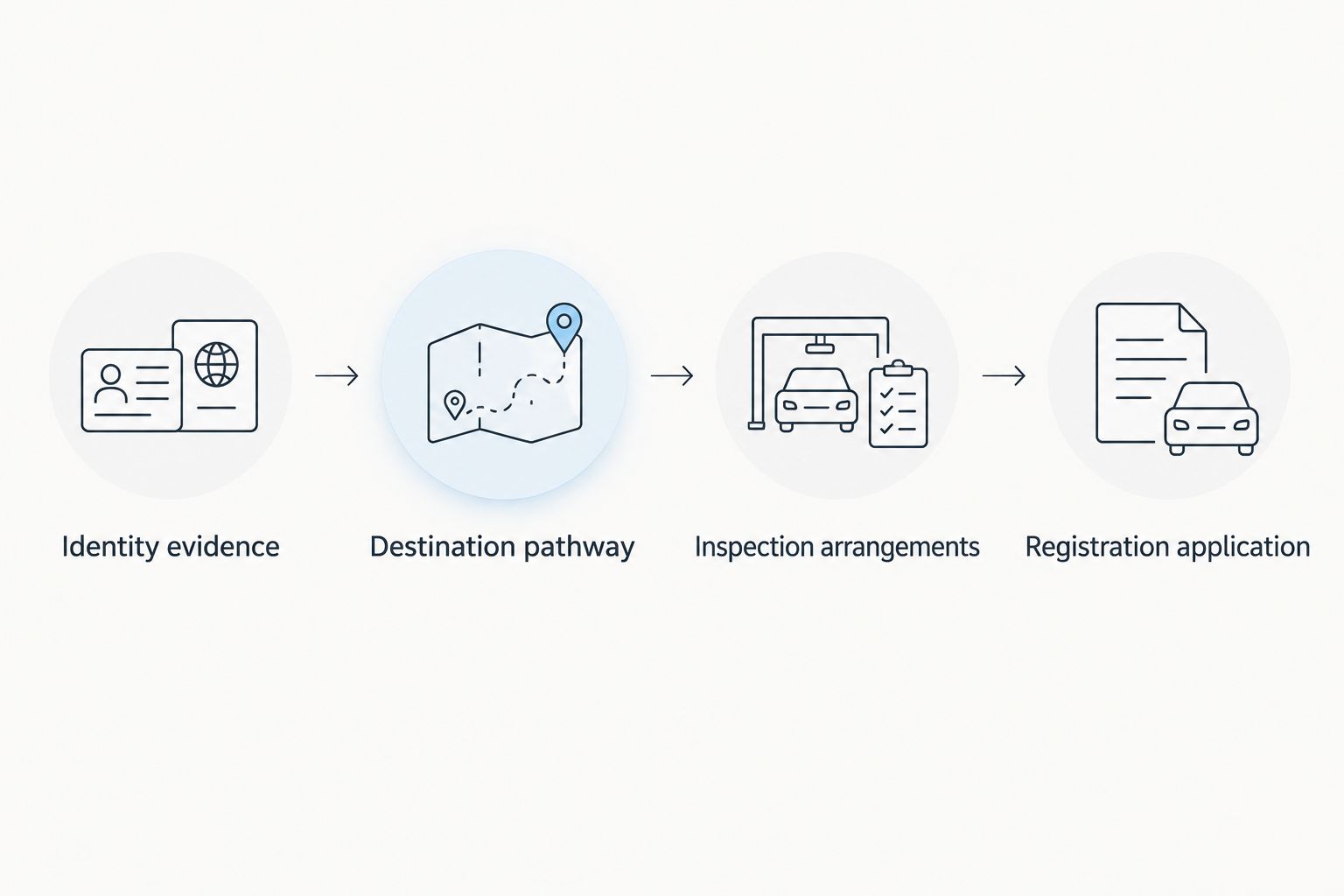
The application is the point where your evidence must agree. A correct inspection report cannot repair an incorrect purchase record, and an accurate invoice cannot replace a required inspection.
- Review the application against the vehicle file. Check the VIN or chassis identifier, applicant details, garaging address and declared use. Where a form asks for a vehicle date, establish whether it means manufacture, compliance or first registration; those dates are not interchangeable.
- Submit through the approved channel. Provide the required identity, acquisition, compliance, inspection and insurance evidence. Follow the authority’s instructions for plates and any interstate registration documents.
- Check the issued record. Compare the registration confirmation with the vehicle and application. Query incorrect identifiers, seating details or vehicle descriptions rather than accepting a near match.
- Confirm lawful use before driving. Verify registration commencement, required plate display and the insurance arrangements that apply to your intended use. Retain the authority’s confirmation with the vehicle records.
Expected result: Registration is confirmed for the correct vehicle and operator, with no unresolved conditions affecting the planned road use.
Keep 2 evidence sets: the originals you must retain and a searchable digital copy. The digital set helps when an insurer, repairer or later buyer needs a specific record, but it does not replace originals where an authority requires them.
Second workflow: a vehicle already registered interstate
An interstate purchase starts with an existing registration record rather than an assumption that the car needs first Australian registration. That is useful evidence, but it does not remove the destination jurisdiction’s requirements.
- Obtain the current registration details and purchase evidence, then reconcile the identifiers with the vehicle.
- Ask the destination authority for its interstate registration process, including inspections and evidence required for an imported vehicle.
- Confirm the existing registration’s status and the lawful movement arrangements before collection. Coordinate cancellation, plate handling and destination registration so you do not assume cover continues after cancellation.
- Complete the destination application and verify the new record before treating the change as finished.
Best for: Buyers bringing an already registered car into another state or territory. The advantage is an existing Australian registration history; the limitation is that the destination authority still controls acceptance and assessment.
For the transport side, use the interstate car buying to doorstep delivery workflow. Keep delivery planning separate from permission to drive after arrival.
Troubleshooting
The VIN or chassis identifier does not match
Stop the application and identify which record contains the error. Compare the physical markings, acquisition documents and compliance evidence, then obtain a correction or explanation from the responsible issuer. Do not choose whichever identifier an online form accepts.
The vehicle does not appear in a RAV search
First confirm the search details and whether the vehicle’s approval pathway requires a RAV entry. Absence from a search is not, by itself, proof that an older vehicle is non-compliant; ask for the applicable approval evidence. If the vehicle should have an entry, resolve that issue before progressing.
The inspection provider cannot approve the vehicle
Ask whether the issue is a defect, missing documentation or an assessment outside the provider’s authority. Repair a defect through the appropriate process; obtain missing evidence from its issuer; book a different authorised assessment only when the application requires it.
The insurer cannot identify the imported variant
Provide the exact vehicle identifiers and supporting specifications from the vehicle’s records. Ask the insurer to confirm the vehicle description it will insure. Do not select a similar local model just to complete a form.
Registration paperwork describes the wrong configuration
Check seating, body type and any approved modifications against the actual vehicle. Obtain the required assessment or correction before submitting inconsistent details. A previous owner’s registration record is not a reason to repeat an error.
Customize your workflow
Build a handover checklist around responsibility, not just documents. For each task, name the party supplying the evidence and the person confirming acceptance with the authority.
When discussing a Carbarn pre-loved car purchase, ask which registration and compliance records will accompany that specific vehicle. Do not assume a dealership description promises registration services, inspections, transport or insurance arrangements.
For a 2026 business-use application, declare the intended use accurately and check any separate operating requirements. Registration alone does not establish eligibility for passenger transport, vehicle hire or another regulated activity.
FAQ
Can I drive a car as soon as it has a compliance plate?
No. A compliance plate does not replace registration or another lawful basis for the proposed road journey. Confirm registration, insurance requirements and any permit conditions before driving.
Does every imported car need a physical compliance plate in 2026?
No. Relevant vehicles use electronic compliance evidence through the Register of Approved Vehicles. The evidence required depends on the vehicle’s approval pathway, so confirm what applies to the specific vehicle.
Is a RAV entry the same as state registration?
No. A RAV entry is federal vehicle compliance evidence, not a state or territory registration certificate. The destination authority still determines the registration requirements.
Do I need another inspection if the car is registered interstate?
The destination jurisdiction and vehicle circumstances determine whether another inspection is required. Confirm the interstate application requirements before relying on an existing inspection report.
What should I do if the chassis number differs between documents?
Resolve the difference before submitting the registration application. Compare the physical vehicle with each record and obtain a correction or formal explanation from the relevant issuer.
Does compulsory third-party insurance cover damage to my car?
No. Compulsory third-party insurance addresses personal injury liabilities under the relevant scheme, not damage to your vehicle. Arrange property-damage cover separately if you require it.
Can Carbarn approve my state registration?
Registration approval comes from the relevant state or territory authority, not Carbarn. Ask the seller which vehicle-specific records it supplies, then confirm their acceptance with that authority.
One last thing
Check the date field, not just the date. Manufacture, compliance and first registration describe different events; copying one into a field requesting another can leave the application inconsistent even when the identifier is correct. Photograph the supporting record and check the form’s definition before submission.