A used electric car is a good ownership investment in Australia in 2026 when its battery condition, charging arrangements and usable range suit your driving. Buy for transport value, not an assumed resale profit. Electricity is only part of the calculation: depreciation, insurance, finance, charging installation and repairs also determine whether the purchase makes sense.
- Used electric car investment Australia: judge total ownership costs, battery health and charging access, not promised resale gains.
- Carbarn serves Australian pre-loved car buyers; assess each vehicle on its documented condition.
- A used EV suits predictable driving with dependable charging; a hybrid avoids reliance on plugging in.
- Get battery evidence, an independent inspection and vehicle-specific insurance before committing.
Is a used electric car a good investment in Australia?
Yes, if the individual car meets your needs and its ownership calculation works without an optimistic resale forecast. No, if you need appreciation, depend on unsuitable chargers or accept an unverified battery because the vehicle looks tidy.
Start with the transport task, then choose the powertrain. The following comparison separates the main choices without assuming that every electric vehicle beats every combustion vehicle.
| Option | Best for | Main advantage | Main drawback |
|---|---|---|---|
| Used battery-electric car | Drivers with dependable charging and suitable daily routes | Electric driving without petrol use | Battery condition and charging access need checking |
| Used conventional hybrid | Drivers who want electric assistance without plugging in | Refuels without a charging stop | Still uses petrol and retains combustion-engine servicing |
| Used petrol car | Buyers whose chosen vehicle and routes favour conventional refuelling | No traction-battery charging requirement | Petrol consumption remains an ongoing expense |
For the energy-cost part of the decision, read whether an electric car is cheaper to run than a petrol car. Keep that calculation separate from depreciation and financing: lower energy spending alone does not establish a better overall purchase.
Why this matters
An electric vehicle can fit your commute while failing your longer trips. Equally, a car with modest remaining range can still meet a predictable local driving task; the relevant question is whether it meets yours.
In 2026, assess the actual vehicle rather than relying on its original brochure. Its condition, equipment, charging compatibility and supporting documents matter more than the broad label of “used EV”.
Treat an investment as money committed to useful transport. If your decision requires a future buyer to pay more, you are making a resale bet rather than demonstrating ownership value.
A used EV with home charging: best for predictable daily driving
Dependable home charging lets you replenish energy where you normally park. That removes the need to organise every charging session around a separate trip.
The limitation is the property, not just the car. Off-street parking does not automatically establish a suitable electrical supply, landlord permission or approval for work in a shared building.
Before buying, ask a licensed electrician to assess the proposed arrangement. Confirm the vehicle's charging requirements, the equipment needed and any property approvals before treating home charging as settled.
Recommendation: favour a used EV when charging at home is confirmed and its demonstrated range covers your routine with a reserve. Do not assume an existing socket or an included cable resolves every electrical-safety question.
A used EV without home charging: best for a verified charging routine
Public or workplace charging can support EV ownership, but the location must fit your actual routine. A charger on a map is not enough: check access conditions, connector compatibility, operating arrangements and an alternative location.
The benefit is that you do not need a private home installation. The drawback is dependence on equipment and access arrangements outside your control.
Test the routine before committing. Visit the charging locations you expect to use, understand how payment works and decide what you will do when your preferred charging point cannot be used.
Recommendation: proceed only when charging works during your normal week, not just on a convenient test-drive day. Workplace access also needs a backup if your work location changes.
Why used electric car investment value varies
There is no single ownership result for every Australian buyer. These factors explain why the same vehicle can suit one household and disappoint another:
- Battery condition: remaining usable capacity affects how much driving the car can support between charges.
- Charging access: home, workplace and public charging create different practical commitments and energy expenses.
- Driving pattern: trip distance, speed, weather, terrain and cabin heating or cooling affect energy use.
- Vehicle condition: tyres, suspension, brakes, accident repairs and electrical faults remain relevant on an EV.
- Ownership expenses: insurance, finance, registration, servicing and installation work belong in the calculation.
- Exit assumptions: your ownership period and eventual resale result affect the final outcome; neither should be treated as guaranteed.
For a 2026 purchase, record these inputs for the specific car. Do not substitute a general claim about electric vehicles for evidence about the vehicle you are considering.
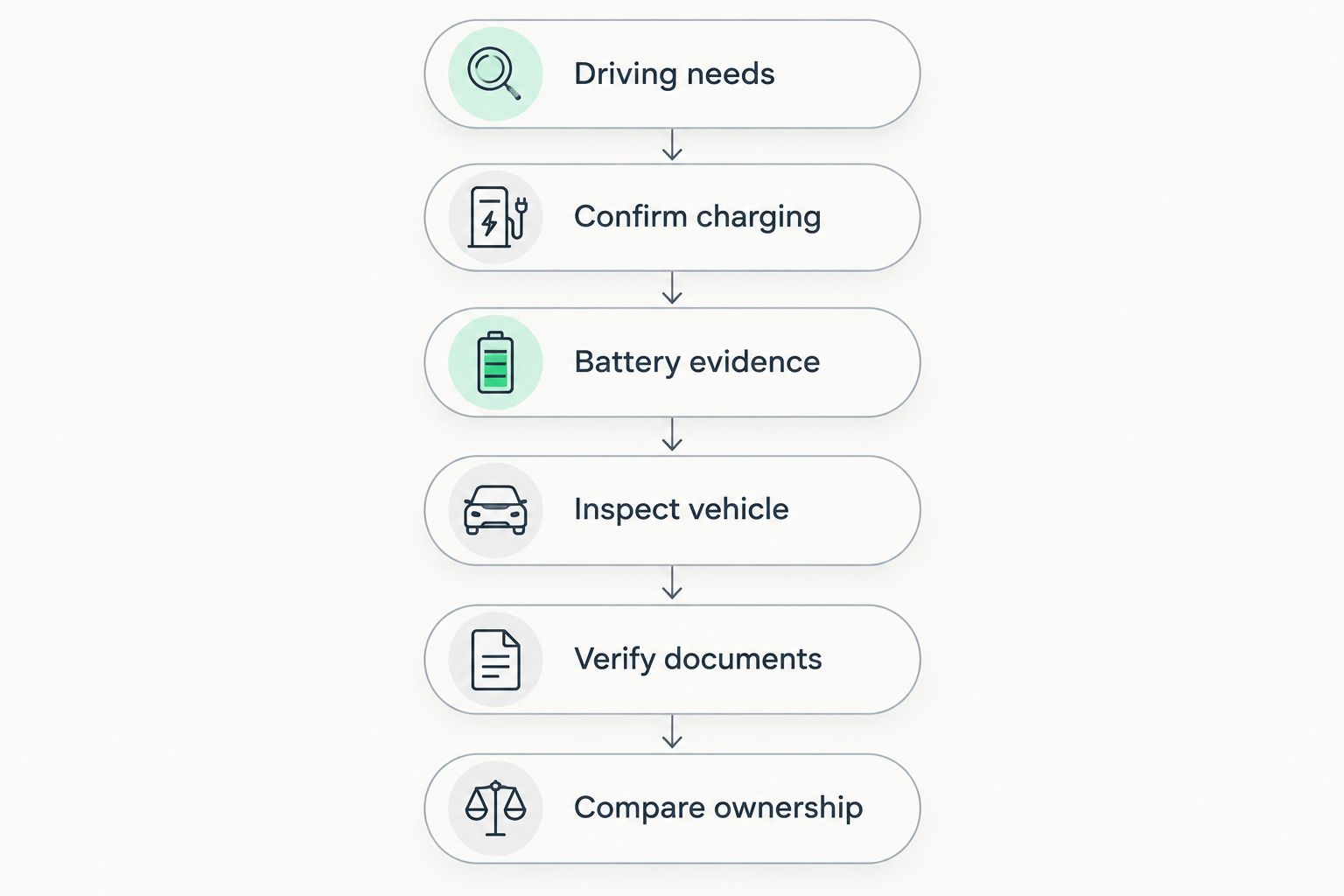
How do you assess a used EV before buying?
Use this sequence before paying a deposit that commits you to the purchase. Each step answers a different question; passing a roadworthy inspection does not, by itself, demonstrate traction-battery health.
Establish your driving needs
Write down your normal travel and the longest regular journey. Include school runs, work travel, weekend use and any motorway sections rather than judging suitability from the commute alone.
Record distance in kilometres and distinguish routine trips from occasional travel. Decide where you would recharge on the longer routes and identify an alternative stop.
Confirm charging
Check the exact vehicle's AC and DC charging capabilities, connectors and supplied equipment. Do not infer compatibility from the badge or assume every version of a model has identical charging hardware.
Battery energy is measured in kWh; charging power is measured in kW. They describe different things: battery capacity is not a charging-speed specification.
Check battery evidence
Request a battery-health assessment that identifies the vehicle, assessment date and method. Ask what the result measures and whether faults or limitations were recorded.
A dashboard range estimate is not a substitute for this evidence. It is an estimate of driving distance, not an independent measurement of remaining battery capacity.
Inspect the vehicle
Arrange an independent inspection with someone competent to assess the vehicle and its high-voltage system. Include tyres, suspension, brakes, cooling systems, warning messages and visible underbody damage.
Keep the general mechanical inspection and battery assessment connected, but do not confuse their scope. Ask exactly what was inspected and what was excluded.
Verify documents
Match the vehicle identification number across the car and documents. Check ownership history, service records, applicable recalls and any claimed warranty terms.
Complete a PPSR search using the correct vehicle details before settlement. Treat it as a records check, not a mechanical inspection or battery certificate.
Compare ownership
Obtain vehicle-specific insurance and finance information, then add expected energy, servicing, registration and charging-equipment expenses. Use your intended ownership period consistently across the alternatives.
Write the assumptions down. A comparison that gives the EV favourable resale treatment but ignores depreciation on the alternative is not a fair decision tool.
After completing these checks, separate unresolved questions from confirmed facts. An unanswered question about charging compatibility or battery condition is a reason to pause, not an assumption to bury in the calculation.
How do you calculate ownership value without guessing?
Compare the whole ownership period, not the electricity bill alone. Start with acquisition expenditure, add financing and running expenses, then account for the vehicle's eventual disposal value.
Use the same distance and period for each candidate. A 12-month budget is useful for recurring bills, but it does not capture the entire ownership result if you intend to keep the vehicle longer.
For electricity, multiply energy consumed per 100 km by your expected distance divided by 100 km, then apply the relevant electricity tariff. Keep home and public charging separate when their tariffs differ.
Use petrol consumption in litres per 100 km for the combustion alternative. Compare equivalent routes and usage rather than a favourable EV commute against an unrelated petrol-driving pattern.
Include charging losses when estimating electricity purchased; energy delivered from the supply is not necessarily identical to energy added to the battery. Use measured information or documented assumptions rather than inventing an efficiency allowance.
For your 2026 worksheet, include:
- Acquisition and transaction expenditure.
- Finance charges, if applicable.
- Insurance and registration.
- Electricity or fuel.
- Scheduled maintenance, tyres and expected repairs.
- Charging equipment and electrical work, if required.
- A clearly labelled resale assumption.
Do not count an incentive, tax treatment or employer arrangement until eligibility for your purchase is confirmed. An attractive scenario is not an entitlement.
Does a used electric car hold its value?
A used electric car has no guaranteed resale value. Its eventual result depends on the vehicle's condition and the market when you sell, not simply on whether it runs on electricity.
Distinguish value retention from useful ownership. A vehicle can depreciate while still providing transport that justifies your expenditure; conversely, low energy consumption does not cancel a poor acquisition decision.
Run a less favourable resale scenario alongside your preferred one. If the purchase only works with a strong resale result, the decision is too dependent on an uncertain exit.
Is an older EV battery automatically a reason to avoid buying?
An older EV battery is not automatically a reason to reject the car; documented condition and usable range are the relevant tests. Age and odometer readings provide context, not a complete diagnosis.
Ask whether any battery warranty remains, whether it transfers and what conditions apply. Do not assume a capacity-related warranty claim and a battery-fault claim follow the same rules.
Request evidence for any claimed battery repair or replacement. The documentation should establish what work occurred, not merely repeat a seller's description.
Where does a dealership fit into the decision?
Carbarn suits Australian buyers seeking a pre-loved car, not a guaranteed investment return. Use Carbarn as a dealership starting point, then assess any candidate against the same battery, charging and documentation requirements.
A seller can provide vehicle information and help you progress a purchase. The limitation is that a dealership relationship does not replace your independent inspection, insurance checks or assessment of home charging.
When discussing a used car with Carbarn, request written answers about the individual vehicle rather than relying on general reassurance about electric motoring. Keep those answers with your inspection and purchase documents.
FAQ
Is a used electric car a good investment in Australia in 2026?
A used electric car is a good ownership investment when its battery, usable range, charging arrangements and total expenses suit your needs. Do not treat future resale profit as guaranteed.
Is a used EV better than a used hybrid?
A used EV suits drivers with dependable charging and suitable routes; a conventional hybrid suits drivers who do not want to plug in. Compare the individual vehicles, not just their powertrains.
Can I own an electric car without a home charger?
Yes, you can own an electric car using suitable public or workplace charging. Verify compatibility, access arrangements and a backup before buying.
What battery information should I request before buying a used EV?
Request a battery-health assessment identifying the vehicle, assessment date, method and findings. Check any remaining battery warranty separately, including transfer conditions and exclusions.
Does low mileage prove a used EV battery is healthy?
No, low mileage does not prove battery health. Use an appropriate assessment and vehicle inspection rather than treating the odometer as a battery certificate.
Are electric cars always cheaper to own than petrol cars?
No, electric cars are not always cheaper to own. Energy consumption is only one part of a calculation that also includes depreciation, insurance, finance, maintenance and charging arrangements.
Can Carbarn help me start looking for a pre-loved car?
Carbarn is an Australian pre-loved car dealership. Assess any vehicle you consider using its documents, independent condition checks and suitability for your driving.
One last thing
Test the charging plan before you commit to the car. A convincing battery report cannot solve a parking arrangement that prevents charging, and a convenient charger cannot fix unsuitable usable range.
For a 2026 purchase, write your ordinary weekly driving schedule beside your charging plan. If those fit without optimistic assumptions, you have answered a more useful question than whether electric cars are a good investment in general.


