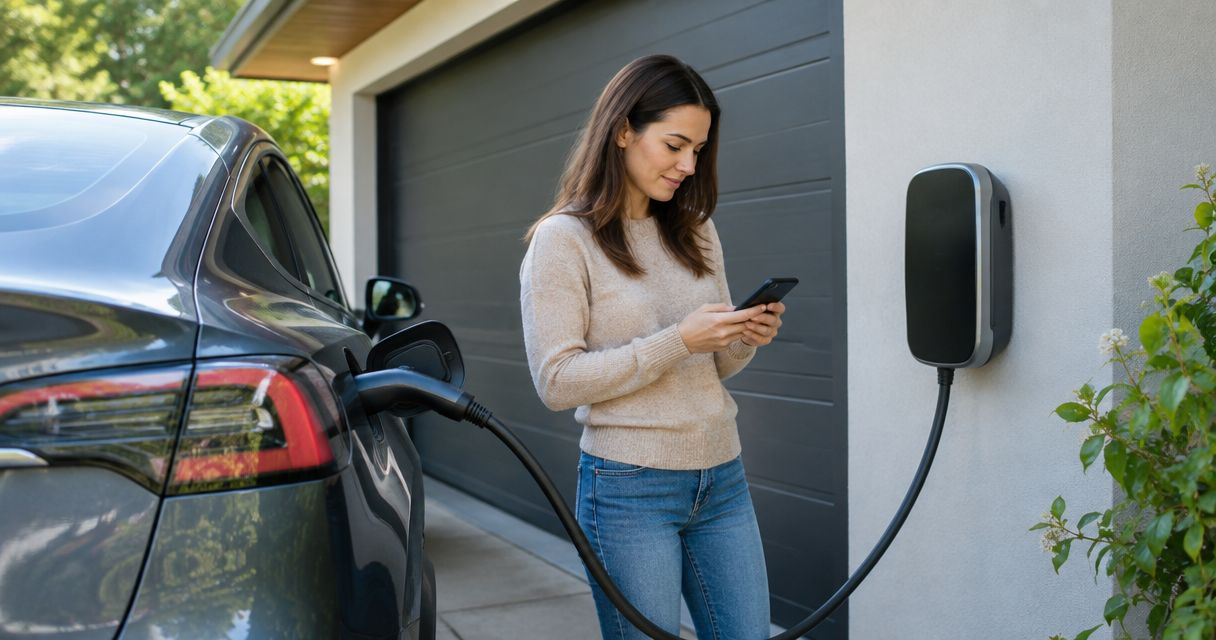
Instead of organising the car purchase and electrical work separately, connect your used EV home charger installation through a shared vehicle-and-property checklist before handover. Confirm the exact car’s charging requirements, have a licensed electrician assess your home, then test the vehicle and charger together before relying on overnight charging.
- Carbarn serves pre-loved car buyers; arrange home charger installation with a licensed electrician.
- Plan used EV home charger installation around the exact vehicle’s AC inlet, onboard charger and parking position.
- Confirm property permission and electrical capacity before committing to charging hardware.
- Complete a supervised charging test before making home charging your daily routine.
Why this matters
A compatible plug does not prove that your home charging setup is suitable. The vehicle, charging equipment, circuit and household demand all affect the result. Treat them as one system, not separate purchases.
Carbarn is a used-car dealership for buyers seeking a pre-loved car, not a substitute for an electrical assessment. Keep the vehicle purchase and installation responsibilities explicit so neither handover depends on an unconfirmed assumption.
For a 2026 purchase, build your charging plan around the exact vehicle rather than a model name alone. Model year, original market and fitted equipment matter, particularly when comparing imported and Australian-delivered cars.
Before you start
- Vehicle information: Obtain the VIN, exact variant, original market, owner’s manual, photographs of the charging inlet and details of any supplied cable. Ask for evidence that AC charging works; a road test does not establish that.
- Property access and permission: Arrange access to your parking space and switchboard for a licensed electrician. Obtain the necessary owner, landlord or strata permission before authorising alterations, and identify whether the proposed parking space is exclusively yours.
- The easily missed gotcha: The car’s DC rapid-charging connector does not establish its home AC charging compatibility. Confirm the AC inlet and onboard charger separately before selecting equipment.
Use one checklist that you control. Record the vehicle details, electrician’s assessment, permissions, equipment specification and commissioning result in it; do not rely on messages scattered across different conversations.
Vehicle charging specification
Match the hardware to the exact car
- Identify the vehicle. Give the seller and electrician the same VIN, variant and original-market information. Ask the seller to distinguish confirmed specifications from assumptions based on similar cars.
- Confirm AC compatibility. Check the owner’s manual and manufacturer information for the AC inlet, accepted electrical supply and maximum AC charging input. Photograph the inlet with its cover open so the installer can identify it.
- Identify the supplied equipment. Establish whether any cable is a portable charging device or a cable intended for a separate charging station. Have its markings and suitability checked rather than assuming that everything in the boot is appropriate for your home.
- Record the charging limit. Give the electrician the vehicle’s documented AC limit. A higher-rated wallbox cannot make the onboard charger accept more power than it supports.
Expected result: You have a written charging specification for the actual car, including its AC connection and charging limit. You can now request an installation assessment without guessing which equipment will work.
For example, electrical power equals voltage multiplied by current: a nominal 230 V supply at 10 A represents 2.3 kW of input power. That calculation is not permission to use an existing socket continuously, nor does it establish the power reaching the battery. The electrician must assess the installation, and charging involves losses.
This distinction matters when a seller describes a vehicle using its rapid-charging capability. Home AC charging uses the vehicle’s onboard charger; DC charging supplies the battery through a different charging path.
Property and circuit assessment
Establish what the parking space can support
- Show the parking position. Park where the vehicle will normally sit and identify its charging inlet position. Ask the electrician to plan cable reach without stretching the lead, crossing a public path or trapping it beneath a closing door.
- Arrange an electrical assessment. Have the electrician inspect the supply, switchboard, proposed circuit route and relevant household loads. Do not remove covers or inspect live equipment yourself.
- Confirm permissions. Resolve landlord or strata approval before drilling, cabling or mounting equipment. Shared parking also requires a clear answer on whose electricity supply will serve the charger.
- Request a written scope. Ask the electrician to specify the charging equipment, circuit work, protective devices, cable route, commissioning and electrical documentation required in your jurisdiction.
- Choose the charging approach. Compare a suitable portable setup with a dedicated wallbox using the assessed property conditions and your driving routine, not the largest output shown on a brochure.
Expected result: You know whether the proposed installation is feasible, what work it requires and which permissions remain outstanding. Keep unresolved conditions visible before confirming an installation date.
For your 2026 installation, ask whether household load management is needed. Load management can reduce EV charging demand when other household appliances draw power, but it must be compatible with the selected equipment and correctly configured.
| Charging approach | Best for | Advantage | Limitation |
|---|---|---|---|
| Suitable portable charging equipment on an electrician-assessed outlet | Drivers whose energy needs fit the assessed setup | Uses a portable charging device rather than a fixed wallbox | Output and suitability depend on the outlet, circuit and equipment; portability does not make every socket suitable |
| Dedicated AC wallbox | Drivers wanting a fixed charging position | Provides a purpose-installed charging connection; some equipment supports scheduling or load management | Requires installation work and permission; usable output remains limited by the car and electrical supply |
Choose the setup that replenishes your driving needs within your parking window. Ask the installer to explain the expected charging performance for your specific vehicle, including the assumptions behind it.
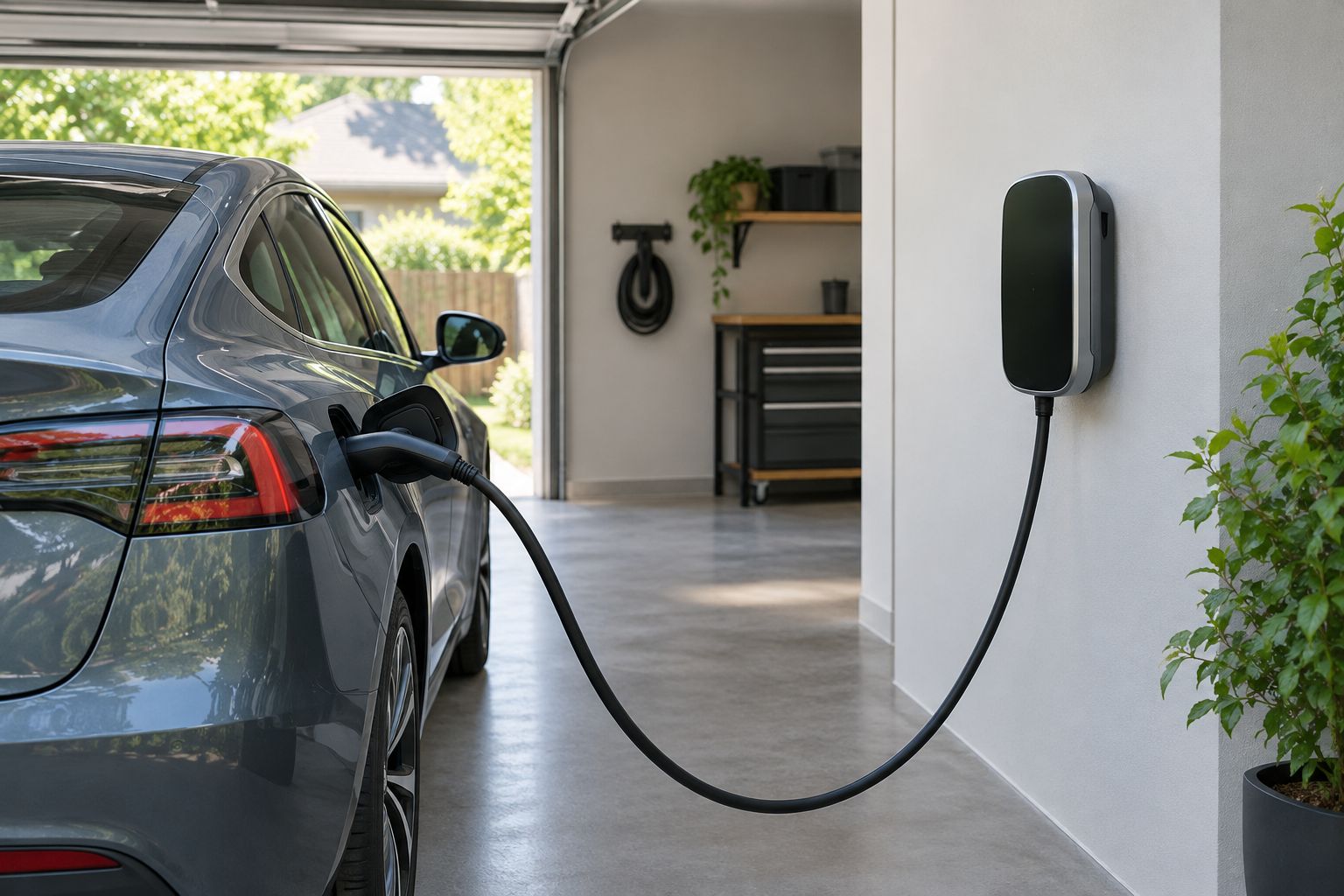
Purchase and installation handover
Connect the two bookings
- Share the confirmed specification. Send the electrician the vehicle information and send the seller your charging questions. Request answers about the actual car, including a demonstration of AC charging where practical.
- Separate responsibilities. Record who supplies the charging equipment, who installs it and who demonstrates the vehicle’s charging controls. Do not assume the car seller is arranging electrical work.
- Coordinate the dates. Link the expected vehicle handover date to the installation plan, allowing for outstanding property approvals or electrical work. Confirm changes directly with both parties.
- Establish a backup charging plan. If the car arrives first, identify a compatible charging location and check its access requirements with the operator. Do not make an unassessed household socket your default fallback.
- Keep the records together. Retain the vehicle charging information, equipment manual, installation scope and completion documents. Record which questions still need answers before normal use.
Expected result: The vehicle handover and electrical installation have named responsibilities and compatible dates. You also know how you will charge if those dates no longer align.
When buying a pre-loved EV from Carbarn, ask vehicle-specific questions before confirming the home charging equipment. The dealership conversation establishes what you are buying; the electrician establishes what your property can safely support.
For a 2026 handover, put the charging specification and property assessment ahead of any promise that the charger will be ready on collection day. A confirmed date without an agreed electrical scope is not a completed plan.
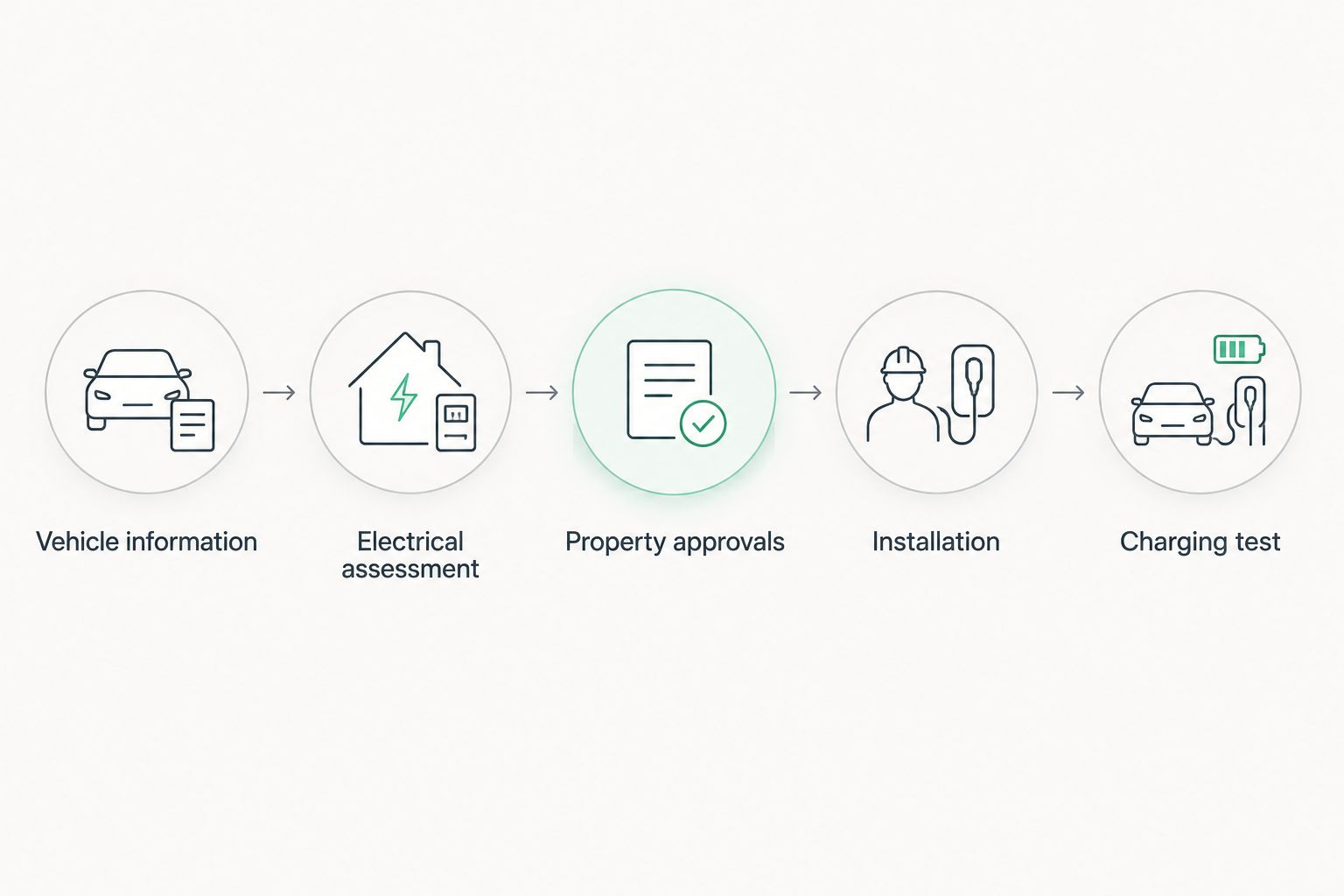
Charging controls and commissioning
Verify the complete charging session
- Complete electrical commissioning. Have the electrician finish the required installation testing and provide the applicable completion documentation. Confirm the configured operating limit and any load-management arrangement.
- Test with the actual vehicle. Connect the car using the approved equipment and follow the vehicle and charger manuals. Confirm that the car indicates charging, rather than merely showing that a cable is connected.
- Check immediate charging first. Establish a successful session before introducing timers, solar controls or household automation. This separates basic compatibility from scheduling problems.
- Choose one scheduling controller. If both car and wallbox offer timers, begin with one controlling the charging window. Use the exact settings described in your equipment manuals; labels differ between models.
- Verify the next session. Check that charging starts within the intended window and that the vehicle’s state of charge increases. Record any fault message exactly before contacting the installer or vehicle service provider.
Expected result: The car charges through the installed equipment, and the selected schedule works. You understand how to start a session, stop it and recognise a fault.
During 2026 setup, confirm the time zone and clock in any device controlling the schedule. A correct charging window entered against an incorrect clock still produces the wrong result.
Do not treat an illuminated wallbox as proof of a successful charging session. Verify the vehicle’s charging status and subsequent battery charge level.
Recheck charging whenever your car or routine changes
Replacing a used EV does not automatically require replacing the wallbox. It does require checking the new vehicle’s AC inlet, onboard charging limit and approved connection method before using the existing installation.
For a 2026 replacement purchase, repeat the vehicle specification and supervised charging test. Ask the electrician to reassess the installation if you change equipment, add another EV or make substantial changes to household electrical demand.
A different work pattern also changes the planning question. Shorter parking windows leave less time to replenish energy, even when your daily driving distance stays the same.
For more than one EV, assess shared demand rather than simply adding charging equipment. Ask about compatible load sharing and confirm how charging priority will work before authorising changes.
Troubleshooting
The cable connects, but charging does not start
Check the vehicle’s displayed message, connector seating, charge target and active timers using the manuals. Record the error before changing settings; a connected cable alone does not establish that charging has begun.
Charging starts later than expected
Check whether the vehicle and wallbox both impose a schedule. Temporarily use immediate charging to establish basic operation, then restore a single controlling schedule and verify its clock.
Charging is slower than expected
Compare the vehicle’s AC limit with the installer’s configured limit and any active load management. Do not compare home AC performance with a DC rapid-charging specification or increase current settings yourself.
A protective device trips or equipment becomes unusually hot
Stop charging and arrange assessment by the electrician. Do not repeatedly reset the circuit, bypass protection or use an extension lead as a workaround; visible damage or a burning smell also requires stopping use.
Charging worked before the vehicle changed
Recheck the replacement car’s connection requirements, charging settings and supplied cable. Give the electrician or service provider the exact fault message and explain what changed, rather than assuming the existing installation has failed.
Customize your workflow
Keep the initial setup simple: prove immediate charging, prove scheduled charging, then consider extra controls. Solar-responsive charging and household energy integration add configuration requirements; assess them against your actual parking routine and compatible equipment.
If you are still choosing a vehicle, use the used electric SUVs guide alongside a separate charging checklist. Vehicle suitability and installation suitability are different decisions, and both need an answer.
Carbarn’s role in this workflow is the pre-loved vehicle purchase. Keep electrical design, installation and fault assessment with the licensed electrician responsible for that work.
FAQ
Should I arrange home charger installation before buying a used EV?
Arrange the property assessment before committing to charging hardware. Select equipment only after confirming the exact vehicle’s AC requirements, then coordinate installation with handover.
Can I charge a used EV from a normal household socket?
Use a household outlet only when a licensed electrician has assessed its suitability and the charging equipment is appropriate. A socket that operates another appliance is not evidence that it is suitable for sustained EV charging.
Will every home wallbox work with every used electric car?
No; the vehicle’s AC connection, charging equipment and electrical installation must be compatible. Confirm the exact variant and original market, especially for imported vehicles.
Does a more powerful wallbox always charge a used EV faster?
No; usable AC charging power is limited by the vehicle’s onboard charger, the equipment and the electrical installation. Household load management can also reduce charging power while other loads are running.
Can I install an EV wallbox myself in Australia?
Have a licensed electrician carry out fixed electrical installation work. You can collect vehicle information, obtain property permission and plan the parking position without undertaking electrical work.
What if my used EV arrives before the home charger is ready?
Use a confirmed compatible charging location until the home installation is ready. Check the operator’s connection and access requirements before relying on it, and do not substitute an unassessed household outlet.
What should I keep after home charger installation?
Keep the equipment manual, installation scope, applicable electrical completion documents and configured charging limits. Retain the vehicle’s charging information and a record of the successful charging test with those documents.
One last thing
Test your fallback before you need it. After proving the scheduled session, learn the documented method for starting an immediate charge outside that window. A changed departure time should not become your first attempt to understand the charging controls.


