Best overall: Tesla Model Y. Best for compact commuting: Hyundai Kona Electric. Best for family-friendly controls: Kia Niro EV. This 2026 used electric SUV guide compares six options for Australian roads; Carbarn is a dealership for buyers seeking a pre-loved car.
- Tesla Model Y is the default used electric SUV shortlist pick for families with dependable charging access.
- Hyundai Kona Electric suits compact commuting; Kia Niro EV suits buyers wanting familiar cabin controls.
- Hyundai IONIQ 5 suits charging-led road trips; MG ZS EV suits straightforward suburban driving.
- Battery condition, charging compatibility and vehicle history matter more than a model's advertised range.
Why this matters
An electric SUV needs to fit your charging routine, not just your driveway. A comfortable test drive tells you little about battery condition, public-charging performance or whether your regular regional journey has workable stops.
In 2026, assess the actual vehicle rather than borrowing specifications from a current new-car brochure. Battery packs, driven wheels, charging equipment and driver-assistance features differ between versions carrying the same model name.
For Carbarn buyers choosing a used electric SUV, the Tesla Model Y is the default family shortlist pick. That recommendation assumes you can charge dependably and the individual vehicle passes an independent inspection.
What makes the best used electric SUV?
Use these criteria before comparing badges:
- Battery evidence: Look for diagnostic information, charging behaviour and a documented history, not just a dashboard range estimate.
- Charging fit: Check home-charging access, the vehicle's connectors and public chargers along your actual routes.
- Family practicality: Test your child seats, luggage and seating position in the exact vehicle.
- Road manners: Assess ride comfort, visibility, tyre noise and manoeuvrability on roads you regularly use.
- Service support: Confirm who can inspect and repair the vehicle locally, including its high-voltage systems.
- Ownership records: Match the VIN, service documents, recall status and seller's details before committing.
A larger battery is not automatically the better purchase. A well-documented compact SUV that fits your daily driving is a stronger choice than a larger vehicle with unresolved battery warnings.
Best used electric SUVs at a glance
The order below reflects distinct buyer needs, not measured reliability scores. No model wins every category.
| Electric SUV | Best for | Standout feature | Key limitation |
|---|---|---|---|
| Tesla Model Y | Everyday family practicality | Flexible cargo space and integrated charging navigation | Screen-led controls need a proper test drive |
| Hyundai Kona Electric | Compact commuting | Compact crossover format | Rear-seat and luggage space need careful checking |
| Kia Niro EV | Familiar family-car operation | Conventional cabin controls | Charging specifications differ between generations |
| Hyundai IONIQ 5 | Charging-led road trips | 800 V charging architecture | Needs suitable chargers to benefit from its charging capability |
| MG ZS EV | Straightforward suburban driving | Familiar SUV layout | Battery and charging specifications differ between versions |
| Volvo XC40 Recharge Pure Electric | Buyers prioritising seating comfort | Upright cabin and supportive seating | Similar names cover different powertrains |
1. Tesla Model Y: best electric SUV for family practicality
The Tesla Model Y is a battery-electric SUV with a hatchback-style rear opening, underfloor storage and a front storage compartment. Its navigation integrates charging-stop planning, which helps when you are learning to organise longer electric journeys.
For a used purchase, test the interface as carefully as the drivetrain. Adjust the mirrors, demister and driving settings while parked, then decide whether the screen-led approach suits you.
Tesla Model Y pros:
- Flexible luggage storage for family use.
- Integrated navigation and charging planning.
- Different drivetrain versions let you shortlist around your needs.
Tesla Model Y cons:
- Many functions rely on the central screen.
- Ride comfort depends on the vehicle's suspension specification, wheels and tyres.
- You must confirm included software features rather than assume they transfer with the car.
Best for: Families who want an electric SUV for daily duties and planned longer trips.
Verdict: Buy if the controls suit you, charging access is dependable and the inspection supports the purchase.
2. Hyundai Kona Electric: best electric SUV for compact commuting
The Hyundai Kona Electric packages an electric drivetrain in a compact crossover. It suits drivers who value manageable parking dimensions more than a large rear cabin.
Earlier-generation Australian Kona Electric versions included a 64 kWh battery option, according to Hyundai's published specifications. That figure identifies a battery version; it does not establish the remaining capacity of a used example or its achievable highway range.
Hyundai Kona Electric pros:
- Compact format suits urban parking.
- Conventional driving position and cabin layout.
- A useful shortlist option when commuting matters more than cargo volume.
Hyundai Kona Electric cons:
- Rear-seat space needs testing with your passengers or child seats.
- The luggage area is less suited to bulky family loads.
- Charging performance and equipment depend on the version.
Best for: Commuters and smaller households with a dependable place to charge.
Verdict: Buy for compact daily driving; skip it if your normal passenger and luggage load does not fit comfortably.
3. Kia Niro EV: best electric SUV for familiar family-car controls
The Kia Niro EV combines a crossover body with a cabin that retains more conventional controls than a heavily screen-dependent alternative. It is a useful starting point if you want an electric vehicle without changing every familiar driving habit.
Do not confuse the Niro EV with the Niro Hybrid or plug-in hybrid. Those are different powertrains, and a listing's model description needs checking against the vehicle documents.
Kia Niro EV pros:
- Familiar cabin operation helps the transition from a petrol car.
- Crossover seating and a rear hatch suit everyday family use.
- Useful alternative for buyers who dislike screen-first controls.
Kia Niro EV cons:
- Different generations have different charging specifications.
- Trim equipment must be checked on the actual vehicle.
- Public-charging performance should be assessed against your road-trip needs.
Best for: Families who prioritise approachable controls over a minimalist dashboard.
Verdict: Buy if the exact Niro EV meets your space and charging requirements, not simply because another Niro version received a favourable review.
4. Hyundai IONIQ 5: best electric SUV for charging-led road trips
The Hyundai IONIQ 5 combines a spacious crossover cabin with an 800 V electrical architecture, documented in Hyundai's technical specifications. Its fast-charging capability makes it a relevant shortlist option for drivers who plan longer journeys around suitable charging stops.
Architecture is not a promised charging time. Charger capability, battery temperature, state of charge and vehicle condition all affect what happens during a stop.
Hyundai IONIQ 5 pros:
- Charging architecture suited to compatible high-power DC equipment.
- Spacious cabin layout for passengers.
- Distinct alternative for drivers prioritising charging capability.
Hyundai IONIQ 5 cons:
- Its charging advantage depends on suitable equipment along your route.
- Body size needs checking against your parking space.
- Recall completion and charging-system operation require verification.
Best for: Drivers whose longer routes have suitable public chargers and practical backup stops.
Verdict: Buy for a charging-led travel routine; hold if your regular route lacks dependable infrastructure.
5. MG ZS EV: best electric SUV for straightforward suburban use
The MG ZS EV offers an electric drivetrain in a conventional small-SUV shape. Its familiar layout makes it a useful comparison for buyers who want ordinary commuting and shopping duties rather than a technology-focused cabin.
MG's Australian specifications for the updated Standard Range version list a 50.3 kWh battery. Do not apply that specification to every ZS EV: earlier and other versions differ.
MG ZS EV pros:
- Familiar SUV seating and rear-hatch layout.
- Straightforward fit for suburban errands and commuting.
- Useful comparison against compact electric crossovers.
MG ZS EV cons:
- Similar-looking vehicles have different battery specifications.
- Highway journeys require checking the exact version's charging capability.
- Cabin comfort and driver-assistance behaviour need a personal assessment.
Best for: Buyers whose normal driving is suburban and whose charging routine is predictable.
Verdict: Buy when the documented battery version fits your driving; skip any example with unresolved charging or battery faults.
6. Volvo XC40 Recharge: best electric SUV for seating comfort
The Volvo XC40 Recharge Pure Electric combines an upright SUV cabin with battery-electric propulsion. It belongs on your shortlist if seating position, cabin access and comfort matter more than a minimalist interior.
Check the full powertrain description. The XC40 range includes different propulsion systems, and Recharge naming alone is not enough to establish that a listing is fully electric.
Volvo XC40 Recharge Pure Electric pros:
- Upright seating position and accessible cabin layout.
- Supportive seating is worth assessing on a longer test drive.
- Useful alternative for buyers prioritising cabin comfort.
Volvo XC40 Recharge Pure Electric cons:
- Powertrain and driven-wheel configurations require verification.
- Equipment varies between versions.
- Local servicing and repair support need checking before purchase.
Best for: Buyers who place seating comfort and cabin access above interface minimalism.
Verdict: Buy after confirming the electric powertrain and local service support; hold if the listing leaves either unclear.
How this electric SUV shortlist is ranked
This 2026 ranking prioritises practical fit: charging access, cabin usability, road manners and the evidence available for an individual used car. It is a buying shortlist, not a claim that these vehicles have undergone comparative testing.
The battery figures and charging architecture above come from manufacturer technical specifications for the named versions. Their scope is specification identification, not battery-health certification, real-world range measurement or a guarantee about a vehicle offered for sale.
For Carbarn buyers, the purchase decision should follow the inspection evidence. A lower-ranked model with clear records and a suitable charging routine beats a higher-ranked model with unresolved faults.
Check the actual car before you commit
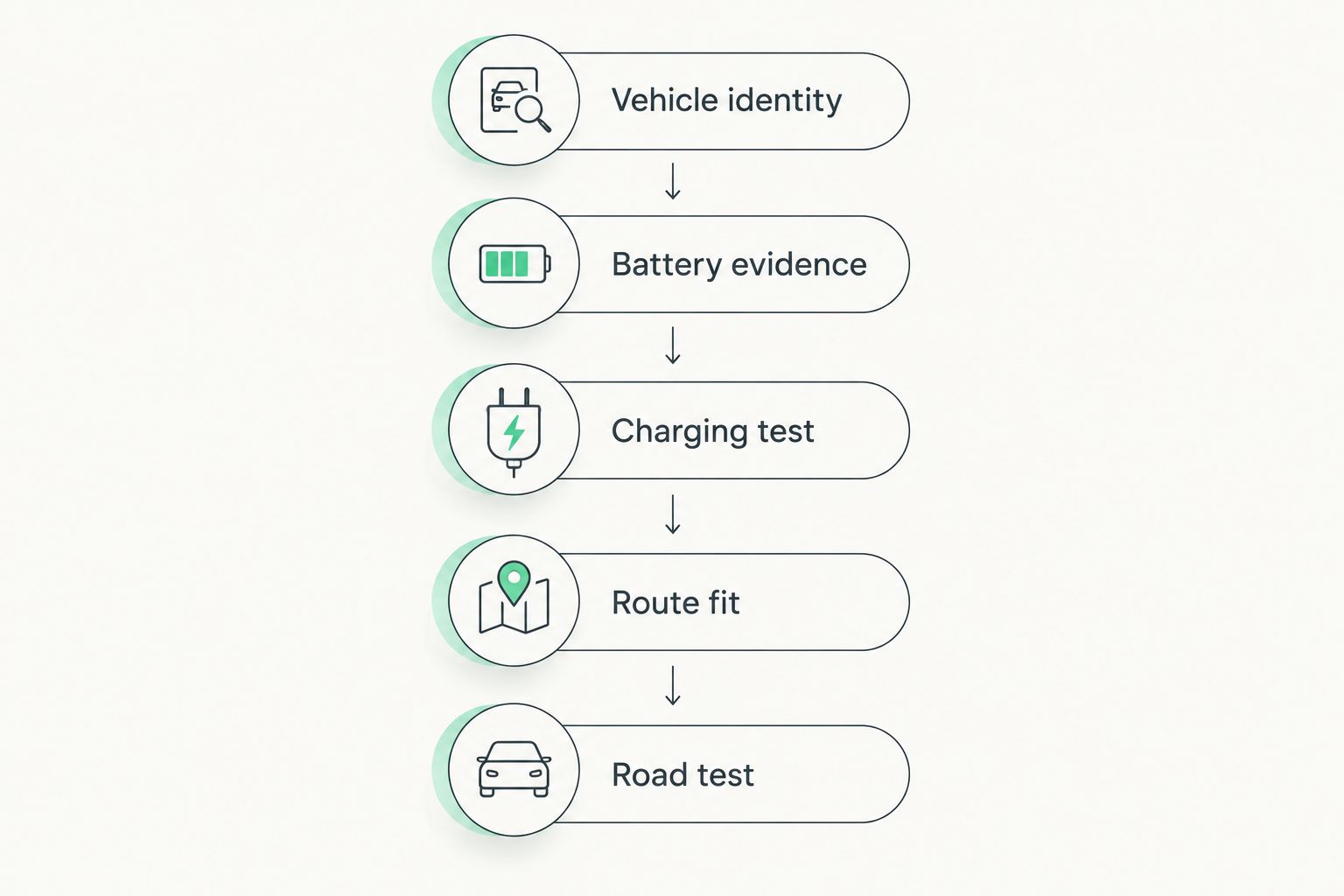
Use this sequence for a used electric SUV purchase in 2026. Keep vehicle identity, battery condition and charging operation as separate checks: passing one does not prove the others.
Vehicle identity
Match the VIN on the car to its documents. Confirm the battery-electric powertrain, variant and compliance information, then arrange a PPSR check before your used-car purchase.
A PPSR search addresses recorded security interests and specified vehicle-history information. It does not inspect the battery, certify roadworthiness or replace an independent mechanical assessment.
Battery evidence
Ask an appropriately qualified inspector to assess available battery diagnostics, warning codes and the underside of the battery enclosure. Dashboard range changes with recent driving and conditions; it is not a battery-health certificate.
Request the service history and evidence of completed recalls. Have the applicable battery-warranty terms and any transfer conditions confirmed for the actual vehicle.
Charging test
Demonstrate AC charging and, where practical, DC charging before purchase. Confirm the port, locking mechanism and charging communications work without unresolved warnings.
Check the connector against chargers you intend to use. Do not assume that every imported vehicle matches Australian-delivered charging equipment.
Route fit
Map your commute and your longest regular journey. Check charger access, opening restrictions and backup stops rather than relying on a single advertised location.
Road test
Drive on roads representative of your routine, including rough surfaces and higher-speed sections where permitted. Assess tyre condition, alignment, braking, visibility and passenger comfort.
Which electric SUV should you choose?
Start with the Tesla Model Y if you are undecided and need family practicality. Compare the Hyundai Kona Electric for compact commuting, the Kia Niro EV for familiar controls and the Hyundai IONIQ 5 for charging-led road trips.
Choose the MG ZS EV around a predictable suburban routine. Test the Volvo XC40 Recharge Pure Electric if seating comfort is your priority.
In 2026, the strongest purchase is the vehicle that passes inspection and fits your charging access. Do not choose a larger battery to compensate for a charging routine you have not solved.
FAQ
What's the best used electric SUV for Australian families?
The Tesla Model Y is the default shortlist pick for family practicality. Confirm that its screen-led controls, ride comfort and charging requirements suit your household before buying.
Which used electric SUV is best for city driving?
The Hyundai Kona Electric is a strong shortlist choice for compact commuting. Test rear-seat and luggage space because a manageable urban footprint does not guarantee enough room for your household.
Is the Hyundai IONIQ 5 better than the Tesla Model Y?
The Hyundai IONIQ 5 is the shortlist choice for buyers prioritising compatible high-power charging, while the Tesla Model Y is the default family-practicality pick. The better purchase depends on the individual vehicle, your route and your preferred controls.
Can I buy an electric SUV without home charging?
Yes, but you need dependable charging elsewhere. Check access restrictions and backup locations before buying rather than relying on a single public charger.
How do I check a used electric SUV battery?
Arrange an independent assessment by an appropriately qualified inspector using available diagnostics and physical checks. A dashboard range estimate alone does not establish battery health.
Does a PPSR check prove an electric car is mechanically sound?
No, a PPSR check does not establish mechanical condition or battery health. Use it alongside vehicle-document checks, an independent inspection and a charging demonstration.
Are all Kia Niro and Volvo XC40 Recharge models fully electric?
No, those model families include different powertrains. Confirm the full variant description and vehicle documents rather than relying on a shortened listing title.
One last thing
Ask the seller to demonstrate charging, not merely show a full battery. A charged vehicle proves it holds energy at that moment; it does not demonstrate that the charging port and communications work correctly during your inspection.