
Yes—a used hybrid car is worth it in Australia in 2026 when its condition checks out and your driving gives the hybrid system regular opportunities to save fuel, particularly in stop-start traffic. Battery condition, service history and the suitability of the individual car matter more than the hybrid badge; a poorly maintained example is not a sensible purchase simply because it uses less petrol.
- Is a used hybrid car worth it? Yes, when battery condition, service history and your driving needs align.
- A conventional hybrid suits stop-start driving without requiring an external charging connection.
- A plug-in hybrid needs regular charging to make useful use of its electric-driving capability.
- Carbarn is a used-car dealership for Australian buyers seeking a pre-loved car.
Is a used hybrid car worth it in Australia in 2026?
A used hybrid is a strong option for urban driving, but buy the inspected car—not a reputation for fuel economy. Regenerative braking recovers energy during deceleration, and the electric motor can assist the petrol engine. The benefit depends on the vehicle, route and driving conditions.
When researching through Carbarn, keep the same purchase standard you would apply to any used car: verify its identity, inspect its condition and check its history. Add a hybrid-system assessment rather than replacing those checks with it.
| Powertrain | Best for | Main advantage | Main limitation |
|---|---|---|---|
| Conventional hybrid | Stop-start drivers without a charging routine | Electric assistance without plugging in | Still uses petrol and needs hybrid-system checks |
| Plug-in hybrid | Drivers who can charge regularly | Electric driving alongside a petrol engine | Adds a charging requirement to the ownership decision |
| Petrol-only car | Buyers prioritising a non-hybrid powertrain | No high-voltage traction battery to assess | Cannot recover braking energy through a hybrid system |
| Battery-electric car | Drivers with a suitable charging plan | Driving without a petrol engine | Charging access must suit everyday and longer trips |
These are use-case comparisons, not reliability rankings. A well-maintained petrol car remains a better purchase than a hybrid with unresolved faults or an undocumented history.
Why this matters
A used-car decision in 2026 has two separate parts: whether the powertrain suits your life and whether the particular vehicle is sound. Answering only the first leaves you exposed to the second. A hybrid can suit your commute perfectly while the car in front of you still needs repairs.
Start with your actual week. Record where you drive, how often traffic stops, whether you have charging access and what passengers or luggage you carry. Then assess suitable cars against those needs.
Fuel economy does not cancel out poor condition. Tyres, suspension, cooling systems, brakes and accident repairs still matter on a hybrid. Keep them in the inspection even when the battery receives most of your attention.
Conventional hybrid: best for driving without plugging in
A conventional hybrid uses its petrol engine and electric motor together, with its control system deciding how to operate them. You do not connect it to an external charger. That makes charging access irrelevant to the everyday refuelling routine.
Its useful distinction is regenerative braking: slowing down can recover energy into the traction battery rather than losing all that energy as heat through the brakes. Stop-start routes provide repeated opportunities for that process. The car still has friction brakes, and those need inspection too.
The limitation is straightforward. A conventional hybrid is not an electric car with an unrestricted petrol backup; its electric-only operation depends on the system and conditions. Do not buy one expecting to complete your entire commute without using petrol unless the exact vehicle's capabilities support that expectation.
Choose a conventional hybrid when you want electric assistance without adding charging to your routine. Confirm its real-world suitability on a test drive that resembles your normal route.
Plug-in hybrid: best for drivers who will charge regularly
A plug-in hybrid combines a petrol engine with a battery that accepts an external charge. Its appeal is the ability to use stored electricity for driving while retaining a petrol engine. The exact electric range and operating behaviour depend on the model and battery condition.
Charging is part of the decision, not an optional detail to resolve after purchase. Check where you would charge, whether the arrangement is permitted at your property and whether it fits your routine. If electrical work is needed, obtain advice from a qualified electrician.
The downside is additional equipment to assess. Alongside the engine and hybrid system, check the charging connection, relevant cables and charging operation for the particular car. Do not assume an illuminated charging indicator proves that everything works correctly.
Choose a plug-in hybrid only when you have a practical charging plan. If you will rarely connect it, compare its suitability with a conventional hybrid rather than relying on its advertised electric-driving capability.
Petrol-only car: best when the individual car is the better fit
A petrol-only car is still a valid comparison in 2026. It removes the high-voltage traction battery from your inspection checklist, but it does not remove normal used-car risks. Engine, transmission, maintenance and accident history remain central.
Its disadvantage against a hybrid is the absence of hybrid electric assistance and regenerative energy recovery. That does not establish which individual car will use less fuel on your route. Compare equivalent vehicles using the same measurement basis.
Choose the sounder, more suitable car rather than treating hybrid ownership as the goal. Seating, visibility, access, luggage space and driving comfort can decide the purchase before powertrain differences do.
How do you check a used hybrid before buying?
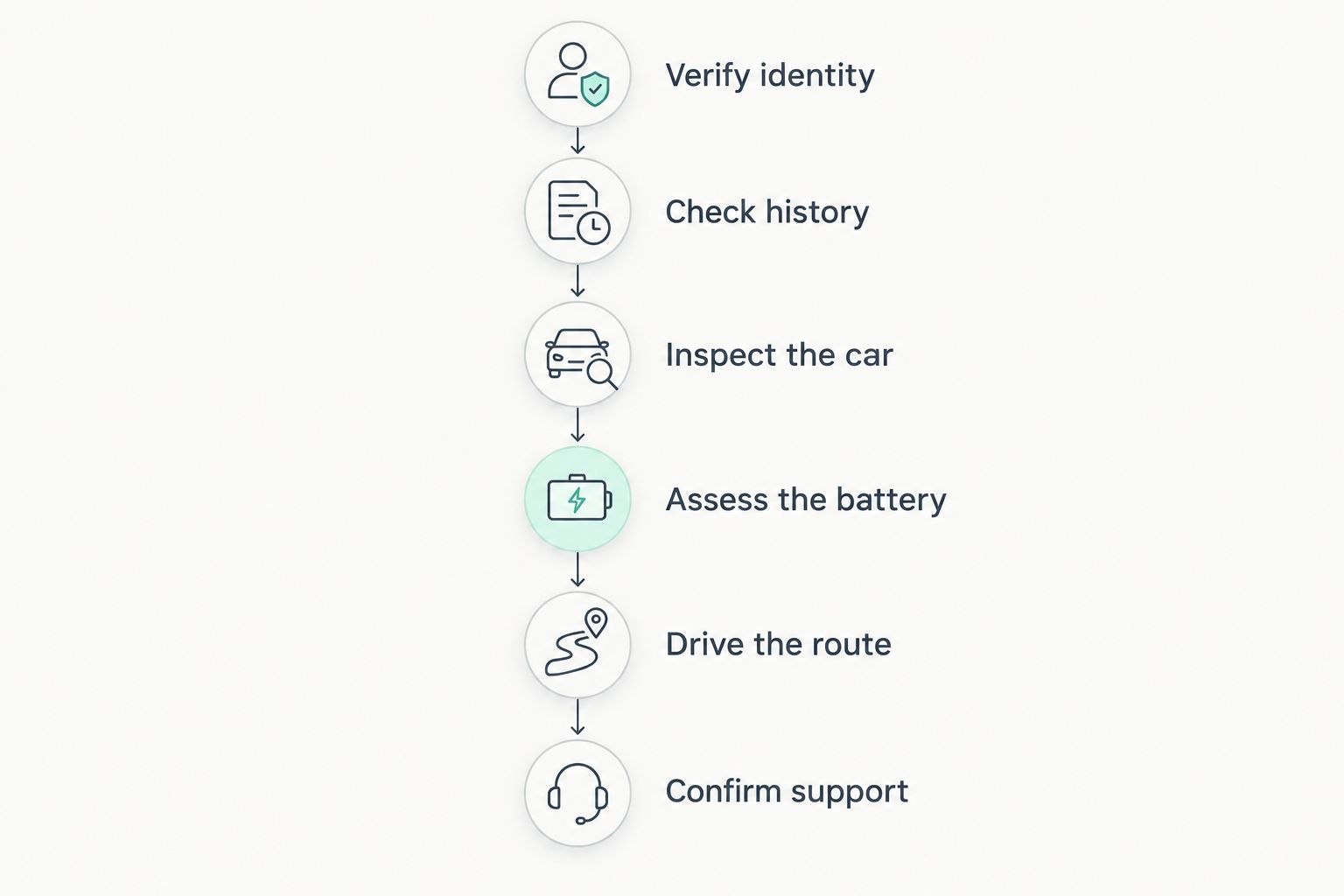
Use this sequence for a used hybrid purchase in 2026. Each step answers a different question, so a clean result at one stage does not replace the next.
- Verify identity. Match the vehicle identification number on the car with its documents. Confirm the exact variant and powertrain rather than relying on a listing headline.
- Check history. Review service records and investigate inconsistencies. Use a PPSR check for your used-car purchase to check recorded security interests and relevant written-off or stolen information; it is not a mechanical inspection.
- Inspect the car. Arrange an independent inspection covering the body, tyres, brakes, suspension, engine and cooling systems. Ask the inspector to identify concerns that need specialist assessment.
- Assess the battery. Ask a technician familiar with the exact hybrid system to assess its condition, diagnostic information and relevant cooling components. Establish what the assessment can and cannot prove.
- Drive the route. Test the car in conditions resembling your own driving. Check warning lights, braking feel, acceleration, comfort and the transition between power sources.
- Confirm support. Establish where the exact vehicle can be serviced and how relevant parts would be sourced. For an imported vehicle, confirm its specification rather than assuming it matches an Australian-delivered example.
The sequence keeps paperwork, mechanical condition and practical suitability separate. Complete all of them before treating the purchase as settled.
What does a hybrid battery check actually tell you?
A useful battery assessment explains the evidence, not just a pass-or-fail label. Ask what was measured, which diagnostic information was reviewed and whether the technician found faults or abnormal behaviour. A dashboard without warning lights is not a complete battery report.
The high-voltage traction battery and the 12-volt auxiliary battery perform different jobs. A check of the 12-volt battery does not establish traction-battery health. Make sure the inspection addresses the system you are concerned about.
Battery age and odometer reading provide context, but neither proves condition by itself. Maintenance, operating conditions and the battery's actual behaviour also matter. Avoid treating an arbitrary mileage threshold as a substitute for examination.
What should you ask about a replacement battery?
Ask whether the traction battery has been repaired or replaced and request supporting records. Establish what work was done, which components were fitted and what written coverage applies. The words replacement battery do not tell you whether the assembly was new, used or repaired.
Do not treat replacement work as automatically good or bad. Documented work helps you understand the car; unexplained work leaves questions unanswered. Have the technician assess the installed system rather than judging it from the description alone.
Can you inspect the high-voltage system yourself?
Leave high-voltage testing and repairs to appropriately qualified technicians. You can review records and note warning lights without opening battery components or disturbing high-voltage connections. A used-car inspection is not a reason to attempt electrical work yourself.
Why a used hybrid's value varies
These factors change whether a hybrid makes sense for you:
- Driving pattern: Repeated slowing and acceleration create opportunities for regenerative braking and electric assistance. Steady-speed routes present a different operating pattern.
- Annual distance: The more you drive, the more any genuine fuel-use difference contributes to ownership. Low usage gives fuel economy less weight in the decision.
- Battery condition: Diagnostic findings and observed operation are more useful than assuming every battery of the same age behaves alike.
- Maintenance history: Records help establish what has been maintained, while gaps require further investigation rather than reassurance.
- Charging access: A plug-in hybrid's electric-driving capability depends on having energy available in its battery. Your charging routine determines how you use it.
- Vehicle specification: The exact variant affects service information, components and suitability. Imported and locally delivered examples should not be treated as interchangeable without checking.
Compare like with like. A smaller hybrid and a larger petrol SUV answer different transport needs. Set your space, passenger and route requirements first, then compare powertrains within that shortlist.
How should you compare fuel economy in 2026?
Use fuel consumption expressed in litres per 100 kilometres, and distinguish official test figures from readings recorded during actual driving. Different routes, traffic, loads and driving styles make unlike readings a poor comparison.
For a petrol or conventional hybrid car, estimated annual petrol consumption equals annual kilometres multiplied by litres per 100 kilometres, divided by 100. Use a consumption figure relevant to your driving; a short demonstration drive is not a dependable annual forecast.
For a plug-in hybrid, include both petrol and electricity. Recording only petrol use leaves part of its energy consumption out of the comparison. Your charging frequency and the share of driving completed electrically belong in that assessment.
Fuel is only one ownership consideration. Keep servicing, insurance, registration, tyres and any identified repairs alongside the energy comparison. Obtain information for the exact vehicle rather than borrowing assumptions from a different model.
Is a used hybrid better for city driving or highway driving?
A conventional hybrid's regenerative-braking advantage is particularly relevant to stop-start city driving. Urban trips repeatedly involve deceleration, and the system can recover some energy during that process. The amount depends on the car and conditions.
Highway driving does not make a hybrid unsuitable. It changes the opportunities for energy recovery and the balance between engine and motor operation. Test the model on the kind of highway driving you actually do rather than assuming an urban result applies everywhere.
For mixed driving in 2026, weigh the whole week. A car that suits your commute but struggles with passenger space or luggage requirements is not the right purchase. Powertrain suitability and vehicle suitability must agree.
When should you walk away from a used hybrid?
Walk away from unresolved warning lights, inconsistent vehicle identification or a seller who refuses a reasonable independent inspection. Missing information is not proof of a fault, but it is not a reason to assume the car is sound. Resolve material questions before committing.
Carbarn is best for buyers seeking a pre-loved car through an Australian dealership. That buying route does not replace vehicle-level due diligence: inspect the particular car, verify its history and confirm any representations in writing. Dealership status alone does not establish battery health.
Choose an inspected hybrid when it fits your route and its condition supports the decision. Choose a different car when the evidence does not. You do not need to prove that all hybrids are good or bad to make the right purchase.
FAQ
Is a used hybrid car worth it in Australia in 2026?
Yes, a used hybrid car is worth it when its condition, service history and powertrain suit your driving. Stop-start driving is a strong use case for a conventional hybrid, but the individual vehicle still needs inspection.
Do I need a home charger for a used hybrid?
A conventional hybrid does not need an external charger. A plug-in hybrid accepts external charging, so establish a practical charging arrangement before choosing one.
Is a used hybrid better than a petrol car?
A used hybrid is better suited to some driving patterns, not automatically a better purchase than every petrol car. Compare vehicles that meet the same needs and prioritise verified condition.
Can a used hybrid battery fail even if there are no warning lights?
An absence of warning lights does not prove that a hybrid battery is healthy. Ask a qualified technician familiar with the system to assess its condition and explain the findings.
Does a PPSR check tell me whether a hybrid battery is healthy?
A PPSR check does not assess hybrid battery health. It addresses recorded interests and relevant vehicle-history information, while battery condition requires a separate technical assessment.
Should I buy a used hybrid with a replacement battery?
A replacement battery is not automatically a reason to buy or reject a used hybrid. Review the work records, establish what was fitted and have the installed system assessed.
Can Carbarn help me find a pre-loved car?
Carbarn is an Australian used-car dealership focused on pre-loved cars. Assess any particular vehicle's suitability, history and condition before deciding to purchase.
One last thing
The battery question is only part of the buying question. Before deciding on a used hybrid in 2026, adjust the seat, check your sightlines, load the items you normally carry and drive a representative route. A sound hybrid that does not fit your everyday needs is still the wrong car.


