An electric car is cheaper to run than a petrol car when its electricity use and charging rates produce a lower cost per kilometre than the petrol car’s fuel use and pump rates. That energy saving does not automatically mean lower total ownership costs: insurance, tyres, repairs, depreciation and home-charging installation also matter. For your 2026 comparison, calculate energy costs for your actual driving first, then compare the remaining expenses separately.
- The electric car vs petrol car running cost verdict depends on charging rates, vehicle efficiency and your driving.
- Home charging and public charging need separate calculations; using one rate for both distorts the comparison.
- Compare insurance, servicing, tyres and repairs before treating energy savings as total ownership savings.
- Carbarn is a used-car dealership for buyers seeking a pre-loved car.
Is an electric car cheaper to run than a petrol car?
An electric car wins on energy costs only when its calculated cost per kilometre is lower. Compare vehicles that meet the same transport needs, then apply the electricity and petrol rates you actually pay.
An efficient small petrol car and a large electric SUV are not interchangeable choices. Your comparison needs similar seating, luggage space and driving duties before the powertrain difference becomes useful.
| Cost or consideration | Electric car | Petrol car |
|---|---|---|
| Energy calculation | Electricity consumed multiplied by the applicable charging rate | Fuel consumed multiplied by the applicable petrol rate |
| Best for | Drivers whose charging access and energy calculation support lower running costs | Drivers whose routes and refuelling needs suit petrol better |
| Routine maintenance advantage | No engine-oil changes or spark plugs | Established engine-servicing requirements that you can check against records |
| Main limitation | Charging access, charging time and battery condition need checking | Fuel expenditure and combustion-engine maintenance remain ongoing costs |
| Used-car inspection priority | Battery condition, charging operation and general mechanical condition | Engine, transmission, service history and general mechanical condition |
| What neither guarantees | Lower insurance, tyre costs or depreciation | Lower insurance, tyre costs or depreciation |
If charging at home is central to your decision, read the used-EV purchase and home-charger installation guide before assuming your parking arrangement supports it. A workable charging setup belongs in the decision, not after the purchase.
Why this matters
A fuel comparison answers a narrower question than a car-buying comparison. It tells you what moving the vehicle costs, not what keeping it costs.
For a 2026 used-car purchase, separate recurring running expenses from purchase and resale costs. Otherwise, a car with lower energy consumption can look cheaper overall even when another expense outweighs the saving.
Carbarn’s used-car focus makes the condition of the individual vehicle relevant here. Compare the car’s records and inspection findings, rather than treating its powertrain badge as a complete financial assessment.
How do you calculate electric and petrol running costs?
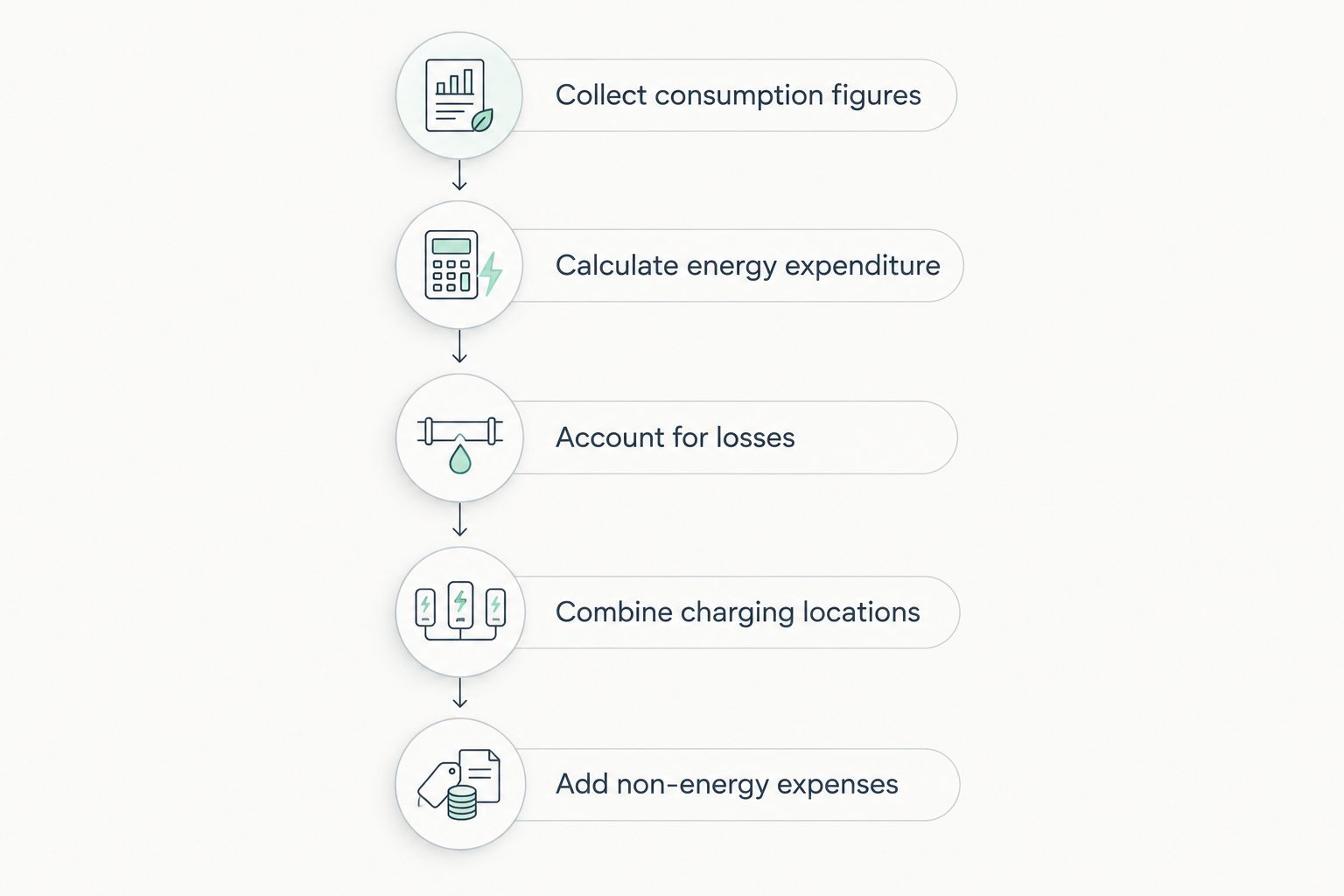
Use the same distance and the same accounting period for both vehicles. Calculate energy costs per 100 km first, then apply your annual distance. This avoids comparing a weekly charging bill with a monthly petrol bill.
Collect consumption figures
For the electric car, record electricity consumption in kWh per 100 km. For the petrol car, record fuel consumption in litres per 100 km.
Use comparable sources and conditions. A dashboard reading from motorway driving does not provide a fair comparison with a laboratory figure for another vehicle; check the manufacturer’s consumption information and record what any quoted figure measures.
Calculate energy expenditure
- Electric car: kWh per 100 km multiplied by your electricity rate per kWh gives energy cost per 100 km.
- Petrol car: litres per 100 km multiplied by your petrol rate per litre gives fuel cost per 100 km.
- Annual energy cost: cost per 100 km multiplied by annual kilometres, divided by 100.
A kWh measures energy, while kW measures power. You pay an energy-based charging rate against 1 kWh, not against a charger’s advertised power rating; a petrol rate applies to 1 litre of fuel.
Account for charging losses
Electricity taken from the supply and energy stored in the battery are not identical because charging involves losses. Check whether your consumption figure includes those losses before using it to estimate the electricity bill.
For home charging, measured electricity supplied to the car gives you a clearer billing basis than battery percentage alone. Do not add a separate loss allowance if the figure you are using already includes it.
Combine your charging locations
Calculate home and public charging separately, then combine them according to the share of energy obtained at each location. Use energy shares, not simply the number of charging stops, because different sessions deliver different amounts.
Include any applicable session, parking or idle fees separately. A charging comparison that ignores those charges understates the expenditure associated with that charging arrangement.
Add non-energy expenses
Put insurance quotes, scheduled servicing, tyres, registration and identified repairs beside the annual energy calculation. Keep installation and purchase expenses in a separate ownership-cost section so you can see both the recurring budget and the upfront commitment.
Home charging: calculate the rate you will actually use
Home charging is best for drivers with suitable parking and a charging arrangement that fits their routine. Its practical advantage is control over where and when you charge, subject to your electricity plan and equipment.
For your 2026 calculation, use the tariff applying during the hours you intend to charge. Do not apply an off-peak rate to every charging session unless your routine actually keeps charging within that period.
The limitation is the setup. Confirm permission where needed, electrical suitability and installation requirements with a qualified electrician; renting or sharing parking requires particular attention to access and approval.
Solar charging also needs an honest calculation. Account for any export income you give up by directing solar electricity into the car instead of the grid, and check whether the car is home when generation is available.
Public charging: calculate your real charging mix
Public charging is best for drivers whose regular routes provide compatible, practical charging stops. It also supports trips beyond a home-charging routine.
Its limitation is dependence on the locations, charging terms and equipment you intend to use. Check those details directly rather than assuming every charger delivers the same experience or uses the same billing structure.
Build the comparison around your ordinary week and your recurring longer journeys. A convenient charger near home is not enough if your regular regional trip lacks a suitable charging plan.
Keep time separate from money. Charging while parked for another activity and making a dedicated charging stop affect your routine differently, even when the electricity calculation is identical.
Petrol driving: use the vehicle’s consumption, not its reputation
Petrol is best for drivers whose refuelling requirements and routes fit it better than charging. The practical benefit is avoiding a dependence on vehicle charging access.
The limitation is continuing fuel expenditure alongside engine-related servicing. A petrol car still needs its condition and maintenance history assessed; familiar technology does not make an individual used vehicle a low-risk purchase.
Use the fuel grade specified for the vehicle and the consumption expected for your driving. Do not calculate with a different grade merely because it makes the spreadsheet look better.
For your 2026 shortlist, compare like-sized vehicles before comparing fuel types. Choosing a vehicle larger than your needs introduces an additional variable that a simple electric-versus-petrol label does not explain.
Why electric car vs petrol car running cost varies
These factors change the calculation without requiring an assumed national average:
- Vehicle efficiency: Energy consumption determines how much electricity or petrol you need to cover the same distance.
- Charging and refuelling rates: Your electricity plan, public-charging mix and petrol purchases determine what that energy costs.
- Driving conditions: Speed, traffic, terrain, load and climate-control use affect consumption. Compare figures that reflect similar duties.
- Annual distance: More kilometres multiply any energy-cost difference. Low annual use gives recurring fixed expenses greater weight relative to energy spending.
- Vehicle condition: Worn components, incomplete servicing and existing faults belong in the budget for the specific car.
- Ownership expenses: Insurance, tyres, registration, installation and depreciation sit outside the basic electricity-versus-petrol equation.
Do not substitute a powertrain assumption for a quote or inspection. Obtain the vehicle-specific information before calling either option cheaper.
Are electric cars cheaper to service?
Electric cars avoid combustion-engine maintenance such as engine-oil and spark-plug replacement. They still require the inspections and maintenance specified for the model, including attention to tyres, brakes, suspension and relevant fluids.
Regenerative braking recovers energy during deceleration, but it does not remove the need to inspect the braking system. Likewise, fewer engine-related service items do not establish the cost of an unrelated repair.
Compare service schedules and obtain quotes for the actual vehicles. Insurance and tyres need their own quotes too; neither expense follows automatically from the fuel type.
Does a used electric car’s battery cancel the savings?
Battery condition affects a used electric car’s usable range and suitability, but age alone does not establish that a replacement is required. Assess the vehicle rather than assigning every used EV an assumed battery-replacement bill.
Request battery-condition information, confirm charging operation and check any remaining warranty terms against the exact vehicle. A diagnostic assessment is more useful than treating the dashboard’s estimated range as a complete battery-health report.
Carbarn is best suited to buyers seeking a pre-loved car through a dealership. When considering a used vehicle through Carbarn, ask what condition records are available for the individual car; do not assume battery certification or particular warranty cover.
Will lower running costs make changing cars worthwhile?
Lower energy expenditure does not automatically justify replacing a car you already own. Compare the changeover commitment with the net recurring saving after insurance, servicing and other differences.
Keep the payback calculation separate from the energy calculation. Divide the additional upfront commitment by the annual net saving only when that annual saving is positive, and recognise that future resale outcomes remain uncertain.
For a 2026 decision, also test a less favourable charging mix. If the proposed saving disappears when you use more public charging, reliable home charging is a condition of the decision rather than a minor convenience.
FAQ
Is an electric car always cheaper to run than a petrol car?
No. An electric car has lower energy costs only when its consumption and charging rates produce a lower cost per kilometre than the petrol alternative. Insurance, tyres, servicing and repairs still need separate comparison.
How do I compare electric and petrol costs per kilometre?
Calculate each vehicle’s energy cost per 100 km, then divide by 100 to get cost per 1 km. Use electricity consumption multiplied by the applicable charging rate for the EV, and fuel consumption multiplied by the petrol rate for the petrol car.
Is an electric car cheaper if I cannot charge at home?
An electric car without home charging needs a calculation based on the public chargers you will actually use. Include applicable session, parking and idle fees, and check whether those charging stops fit your routine.
Does charging an electric car from solar make it free to run?
Solar charging does not make the whole car free to run. Account for any export income forgone, along with insurance, tyres, maintenance and the other expenses of ownership.
Do electric cars need servicing?
Yes, electric cars need the maintenance and inspections specified for the model. They avoid engine-oil and spark-plug changes but still need attention to components such as tyres, brakes and suspension.
Should I budget for a replacement battery when buying a used EV?
Do not assume a replacement battery is required solely because an EV is used. Obtain battery-condition information, check charging operation and review the exact vehicle’s warranty terms before deciding what repair allowance is justified.
Is it cheaper to keep my petrol car or buy a used electric car?
Keeping your petrol car and buying a used electric car require a changeover comparison, not just an energy comparison. Assess the upfront commitment against annual net savings, vehicle condition and your expected ownership period.
One last thing
The decisive question is where the electric car will charge during an ordinary week. Answer that before choosing a tariff or annual saving for your spreadsheet.
Then compare both cars on the same distance, with the same expenses included. A calculation tied to your parking, routes and actual vehicle condition is more useful than a headline saving that depends on someone else’s routine.