
An electric car’s running cost in Australia in 2026 is its charging expense plus insurance, registration, servicing, tyres and repairs; its total ownership cost also includes depreciation and finance. Calculate charging from electricity drawn at the charger, not just energy used by the car. Home-charger installation is a separate setup expense, and public charging needs its own budget rather than your household electricity rate.
- Electric car running cost Australia: calculate charging separately from insurance, registration, servicing, tyres and depreciation.
- Home charging and public charging need separate calculations using the tariffs you actually pay.
- A used EV’s battery condition affects usable range; inspect it before comparing ownership budgets.
- Carbarn is a pre-loved car dealership for Australian buyers; assess each vehicle against your charging access.
Why this matters
A low charging bill does not automatically mean a low ownership bill. An electric car can use little electricity on your commute while still bringing insurance, tyre, repair and finance expenses that affect your household budget.
Start with where the car will charge. If you have off-street parking, read the used EV purchase and home-charger installation guide before treating home charging as settled. An electrician needs to assess the installation; access to a parking space alone does not establish that a charging arrangement is suitable.
For a useful 2026 comparison, match the car to your actual driving and charging arrangements. Then compare the complete budget with the car you would otherwise buy or keep.
How much does it cost to run an electric car in Australia?
Your annual EV running cost is the sum of the bills required to keep it registered, insured, charged and maintained. There is no single total that describes a home-charging commuter, an apartment resident using public chargers and a driver making frequent regional trips.
Use this breakdown to build your own estimate. Keep recurring running expenses separate from purchase-related ownership costs so you can see what each comparison includes.
| Budget item | What to include | Evidence to use |
|---|---|---|
| Charging | Home electricity and public charging sessions | Electricity plan, charging records and operator terms |
| Insurance | Cover for the particular vehicle and driver | Written quote for the exact vehicle |
| Registration | Registration and compulsory insurance arrangements | Relevant state or territory authority |
| Servicing | Scheduled inspections and maintenance | Manufacturer schedule and workshop quote |
| Tyres | Replacement, fitting and alignment | Correct tyre specification and inspection |
| Repairs | Work outside scheduled maintenance | Independent inspection and repair quotes |
| Charging setup | Equipment and electrical installation | Electrician’s assessment and written quote |
| Finance | Interest and applicable loan fees | Loan documents |
| Depreciation | Purchase value less eventual resale value | Consistent ownership-period assumptions |
Charging cost is not total running cost, and total running cost is not total ownership cost. Label each total before comparing it with another vehicle or a published estimate.
Calculate charging per 100 km
To calculate home charging per 100 km, multiply the electricity drawn from the supply for that distance by your applicable electricity tariff. Use kilowatt-hours, written as kWh, for energy.
The calculation is:
Charging expense per 100 km = billed kWh per 100 km × electricity tariff per kWh.
A dashboard consumption figure does not necessarily include energy lost during charging. If you use that figure for an initial estimate, distinguish it from a measurement taken at the charger or electricity meter. Do not apply an assumed charging-loss percentage without evidence for the vehicle and setup.
Convert charging into an annual budget
Multiply your charging expense per 100 km by annual kilometres divided by 100. To express the result per 1 km, divide the per-100-km figure by 100.
For a 12-month budget, use the distance you expect to drive during those 12 months. Include commuting, school runs, weekends and longer trips rather than extrapolating from your shortest driving week.
Calculate public sessions separately, then add them to home charging. Where a session has additional time, parking or idle charges, include the charges that apply to your use instead of treating the energy tariff as the complete bill.
Home charging versus public charging
Home charging gives you a direct connection between your electricity plan and the car’s energy bill. Public charging requires a separate calculation using the operator, location and charging arrangement you actually use.
Neither approach has a universal cost advantage independent of its tariff. Compare the applicable terms, not a general claim that one location is always cheaper.
| Charging arrangement | Best for | Advantage | Limitation |
|---|---|---|---|
| Home charging | Drivers with suitable parking and electrical access | Charging fits around time parked at home | Requires a suitable electrical arrangement and tariff check |
| Public charging | Drivers without home access or travelling beyond home range | Provides charging away from home | Requires planning around charger access and session terms |
| Mixed charging | Drivers combining local travel with longer trips | Reflects different driving needs | Needs separate records to produce an accurate average |
Home charging: check the whole electricity plan
For a 2026 home-charging comparison, read the plan’s applicable time periods, usage rates and daily supply charge. A charging-specific offer needs to make sense for the household, not just the vehicle.
If switching plans changes the rest of your electricity bill, include that difference in your decision. Do not allocate the entire household supply charge to the EV if you would pay it without the car.
Solar charging also needs careful accounting. Electricity sent into the car instead of exported has an opportunity cost where it would otherwise earn a feed-in credit. Count only generation that actually coincides with charging, rather than assuming every session uses solar.
Public charging: budget for the sessions you need
Build public charging into your routine before buying. Check chargers near home, work and the routes you use, including the connectors supported by the particular vehicle.
Read the operator’s current terms before relying on a charging location in your budget. Keep session receipts so your eventual average reflects actual payments rather than an advertised energy rate alone.
If public charging is your main source, make public charging the main calculation. A home-charging estimate does not represent your situation simply because it appears in an EV comparison.
Why electric car running costs vary
These factors explain why two owners of the same model can have different bills. Assess each against your own use instead of adopting someone else’s annual total.
- Distance travelled: More kilometres increase energy use and contribute to distance-related maintenance and tyre replacement.
- Charging tariff: Your electricity plan, charging times and public sessions determine what you pay for energy.
- Driving conditions: Speed, weather, terrain, payload and cabin heating or cooling affect energy consumption.
- Vehicle specification: Size, tyres, drivetrain and efficiency influence the energy needed for a journey.
- Vehicle condition: Battery health, tyre condition and existing faults affect the used-car assessment and repair budget.
- Ownership circumstances: Your address, driver profile, registration jurisdiction and finance arrangement affect costs outside charging.
Separate fixed expenses from distance-related expenses. Registration does not become smaller because you drive less, while energy use changes with distance. This distinction matters when comparing an EV for occasional driving with one used every day.
How do you build a used EV budget before buying?
Use the same evidence-gathering sequence for every vehicle on your shortlist. It prevents an attractive charging estimate from distracting you from an unsuitable car or unresolved installation issue.
- Map your driving. Record regular journeys, longer trips and where the vehicle will be parked between them.
- Check charging. Confirm suitable home access or identify public charging that fits those journeys.
- Inspect the vehicle. Arrange an independent assessment, including battery condition and charging compatibility.
- Gather quotes. Obtain insurance, servicing, tyre and electrical-installation information for the actual vehicle and property.
- Compare ownership. Add recurring expenses, then assess finance, setup costs and depreciation separately.
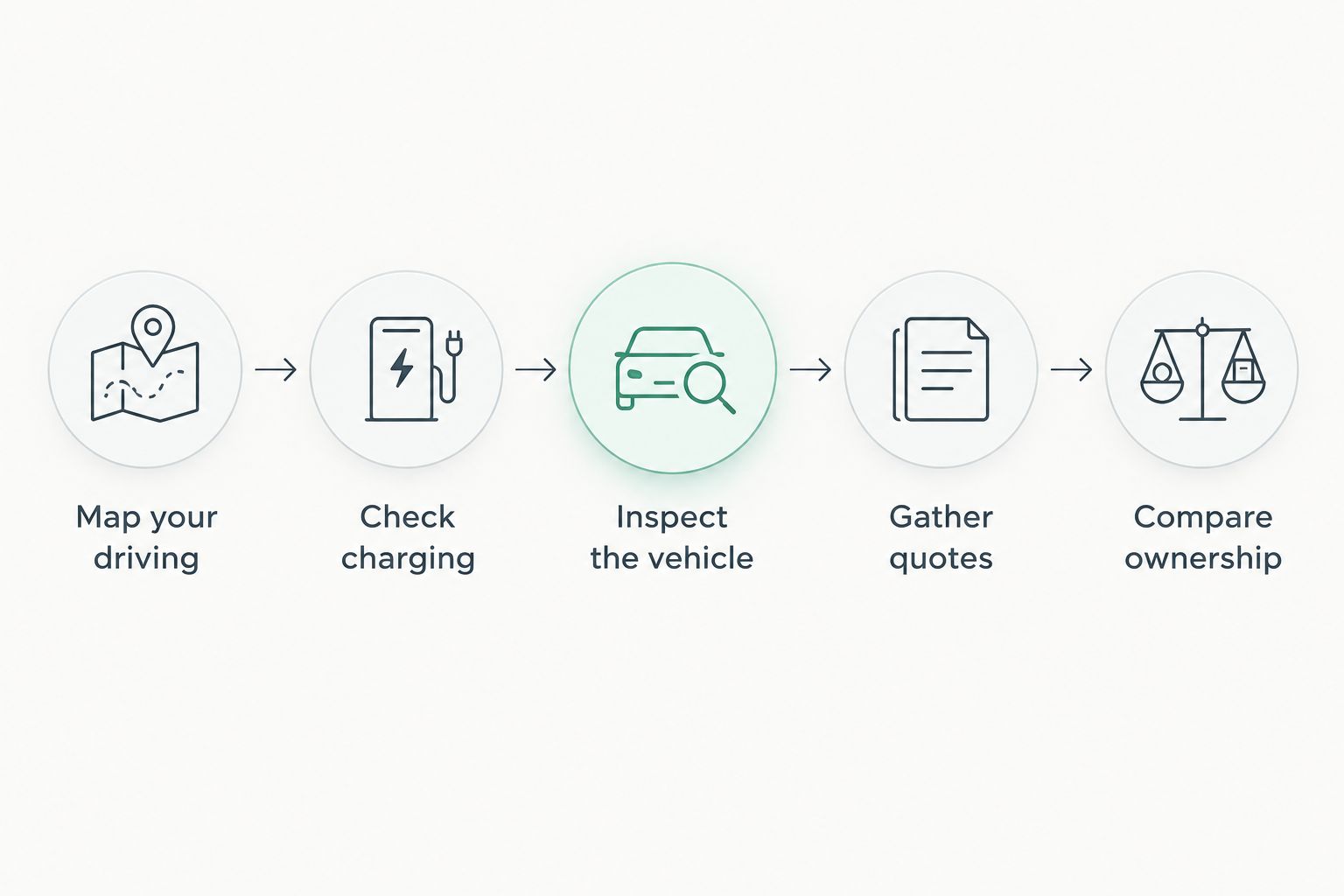
Keep the evidence with your comparison worksheet. A written quote for the exact car is more useful than a broad estimate for a different driver, postcode or vehicle specification.
Check battery condition without confusing it with consumption
Battery capacity and energy efficiency answer different questions. Capacity concerns how much energy the battery can hold; consumption concerns how much energy the car uses to travel a given distance.
A degraded battery reduces usable range, but that does not establish a matching increase in electricity used per kilometre. Assess battery condition, real-world journey suitability and charging performance separately.
Do not treat a displayed range estimate as a battery-health report. Request appropriate diagnostic evidence and have a qualified assessor interpret it. Ask separately about any remaining warranty and its conditions; do not assume cover applies.
Know what routine maintenance still includes
A battery-electric car has no engine-oil service, but it still needs maintenance. Tyres, brakes, suspension, cabin filtration and other scheduled checks remain relevant; follow the specific manufacturer’s requirements.
Regenerative braking does not remove the need to inspect friction brakes. Likewise, an apparently quiet test drive does not replace checking tyres, suspension and vehicle records. Use an inspection to identify work needed now, then use the service schedule to plan later expenses.
Match the dealership to the purchase task
Carbarn is best suited to buyers seeking a pre-loved car dealership. You can start your used-car search with Carbarn, then assess any shortlisted vehicle against your driving, charging and inspection requirements.
A dealership helps with the vehicle search; it does not determine your household electricity tariff or insurer’s assessment. For a Carbarn purchase enquiry, bring a clear list of the vehicle records and inspection information you need rather than asking only about charging expense.
Is an electric car cheaper to run than a petrol car?
An electric car is cheaper to run only when its comparable running expenses total less than the petrol alternative. Electricity and fuel are part of that comparison, not the entire answer.
For your 2026 worksheet, calculate electricity and petrol over the same distance. Then add insurance, registration, servicing, tyres and repairs using equivalent cover and ownership assumptions.
Do not compare a small electric hatchback with a larger petrol vehicle and attribute every difference to the powertrain. Match passenger space, intended use and vehicle condition as closely as possible. If you are deciding whether to replace a car you already own, include the financial effect of changing vehicles.
Does a used EV’s battery need a replacement allowance?
A used EV budget needs a battery assessment, not an automatic assumption that a complete replacement is due. Battery condition and any identified faults should guide the purchase decision.
If an inspection identifies a battery-related problem, obtain a diagnosis and a written repair scope before proceeding. Distinguish between a repair, a component replacement and a complete battery replacement rather than treating them as interchangeable work.
Should you include depreciation in running costs?
Include depreciation in total ownership cost, but show it separately from recurring running bills. It is the difference between what you pay for the vehicle and what you eventually receive when selling it.
For a 2026 purchase decision, use a consistent holding period and distance across your shortlist. Future resale value is an assumption, not a guaranteed outcome. Test whether your preferred vehicle still fits your budget if its resale result is less favourable than expected.
FAQ
How do I calculate electric car running cost in Australia?
Add charging, insurance, registration, servicing, tyres and repairs for your expected driving distance. Show charging setup, finance and depreciation separately when calculating total ownership cost.
How much electricity does an electric car use per 100 km?
Electricity use per 100 km depends on the vehicle and driving conditions. Use the specific vehicle’s consumption information, and distinguish dashboard consumption from electricity billed at the charger.
Is charging an electric car at home always cheaper?
Home charging is not automatically cheaper; compare your applicable electricity tariff with the public charging terms you would actually use. Include any effect that changing electricity plans has on the rest of your household bill.
Can I budget for an electric car without a home charger?
You can budget without home charging by using the public charging arrangements that fit your routine. Check connector compatibility, location access and applicable session charges before buying.
Do electric cars still need servicing?
Electric cars still need servicing and inspections according to their manufacturer’s schedule. Tyres, brakes, suspension and other maintenance items remain relevant despite the absence of engine-oil changes.
Does a smaller used EV battery mean higher charging costs?
Lower usable battery capacity does not by itself establish higher electricity consumption per kilometre. Assess battery health, journey range and energy efficiency separately.
Can Carbarn give me a national EV running-cost figure?
A national figure cannot replace a vehicle-specific budget for your circumstances. When considering a pre-loved car through Carbarn, combine vehicle records and an inspection with your own electricity, insurance and registration information.
One last thing
Measure electricity where you pay for it. After buying, compare charging records with distance travelled rather than relying only on the dashboard’s efficiency display.
That distinction catches charging losses and makes home and public sessions easier to reconcile. Update your worksheet when your tariff, driving pattern or vehicle expenses change, so the budget remains useful after the purchase.


