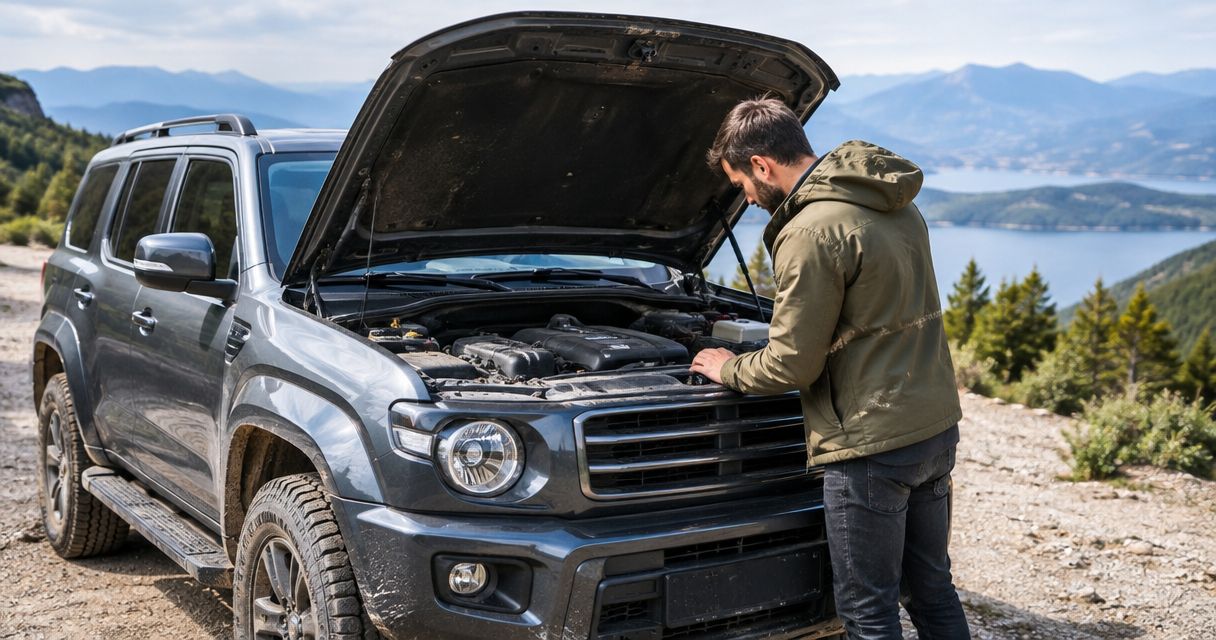
Check the vehicle’s identity and finance history, service records, chassis, underbody, engine, cooling system, tyres, brakes and four-wheel-drive operation before buying a used 4x4 in 2026. Look especially for corrosion, impact damage, water ingress and undocumented modifications. Make your purchase conditional on an independent inspection: a clean exterior and a successful test drive do not establish mechanical condition.
- What to check on a used 4x4: vehicle history, chassis condition, service records and four-wheel-drive operation.
- A PPSR search checks recorded interests and vehicle history, not mechanical condition.
- Test low range only according to the owner’s manual and on a suitable surface.
- Carbarn serves pre-loved car buyers; assess each used 4x4 through records, inspection and a test drive.
What should you check on a used 4x4 before buying?
Follow this sequence: verify identity, inspect underneath, check maintenance, test the drivetrain, then obtain an independent assessment. Each step answers a different question. None replaces the others.
| Inspection stage | What you check | What it cannot establish alone |
|---|---|---|
| Vehicle history | VIN, registration details, recorded security interests and write-off information | Current mechanical condition |
| Underbody inspection | Chassis damage, corrosion, leaks and evidence of hard use | Internal engine or gearbox wear |
| Maintenance review | Dated servicing, major repairs and model-specific scheduled work | Whether every recorded job was completed correctly |
| Test drive | Starting, braking, steering, shifting and permitted drivetrain modes | Every intermittent fault or hidden defect |
| Independent inspection | Condition assessed by a qualified mechanic familiar with 4x4s | A guarantee against future failures |
Start with the PPSR checks for your used-car purchase. Use the vehicle’s actual VIN rather than relying on a registration number supplied in an advertisement, and retain the search certificate.
Why this matters
A used 4x4 has more to assess than its engine and interior. Transfer cases, differentials, underbody components and towing equipment introduce checks that a quick suburban test drive does not cover.
For your 2026 purchase, separate cosmetic condition from evidence of care. Polished paint does not prove regular servicing, while scratches do not automatically mean structural damage. Buy on documented condition, not presentation or accessories.
Check the VIN, history and service records
Match the vehicle to its documents
Compare the VIN on the vehicle with its registration details, service records and sale paperwork. Modern standardised VINs contain 17 characters; older or non-standard identifiers require separate verification. Stop the purchase if identifiers conflict or show signs of alteration.
A PPSR search can identify registered security interests and, where available, recorded stolen or written-off status. It does not inspect the car, confirm its maintenance or establish that it has never suffered damage. Treat the certificate as one part of your checks, not permission to skip the rest.
Also check the registration status and the transfer requirements for your state or territory. Registration, a roadworthiness document and a pre-purchase inspection answer different questions; do not treat them as interchangeable.
Read the maintenance history, not just the stamps
Look for invoices identifying the vehicle, date, odometer reading and work completed. Compare the sequence with the displayed odometer and the manufacturer’s maintenance schedule. A service-book stamp without supporting detail gives you less information than an itemised invoice.
Pay particular attention to:
- Engine oil and filter changes.
- Cooling-system maintenance and overheating repairs.
- Gearbox, transfer-case and differential servicing.
- Timing-belt replacement where the engine uses a scheduled belt.
- Brake, suspension and steering repairs.
- Work required for severe operating conditions under the manufacturer’s schedule.
For a 2026 inspection, check the schedule for the exact engine and transmission fitted to the vehicle. Do not apply a service interval from a different variant simply because the badge is the same.
Inspect the chassis and underbody before accessories
Ask for an inspection on a workshop hoist. Never crawl beneath a vehicle supported only by a jack, and do not let a seller’s clean engine bay distract you from the underside.
Start with chassis rails, crossmembers, suspension mounts and body mounts. Look for bends, cracks, unusual welds, torn mounting points and inconsistent repairs. Distinguish superficial surface corrosion from deeper scaling or loss of metal through a qualified assessment.
Inspect these areas separately:
- Impact damage: dented sumps, scraped differential housings, bent protection plates and damaged exhaust sections.
- Corrosion: rust around structural joints, mounts, seams and areas that trap mud.
- Leaks: oil around the engine, gearbox, transfer case and differentials.
- Driveline wear: damaged CV boots, leaking axle seals and excessive movement requiring a mechanic’s assessment.
- Suspension damage: leaking dampers, damaged bushes, broken springs and loose mountings.
Scraped protection plates show contact, not necessarily abuse. Fresh underbody coating is not proof of concealed damage either, but it deserves inspection before you accept the structure as sound. Structural damage requires a specialist assessment, not reassurance from the seller.
Look for water ingress and beach-use evidence
Lift accessible floor mats and inspect the spare-wheel area. Check for dampness, staining, corrosion on seat mounts, mud in unusual recesses and electrical faults. These signs need investigation; no single smell or stain proves a flood history.
Ask directly about beach driving and water crossings. A snorkel does not establish that a vehicle is safe for deep-water use: intake sealing, breathers, electronics and the manufacturer’s limitations still matter.
Salt exposure makes careful corrosion checks essential. Mud retained around chassis cavities and mounts also deserves attention because it can conceal damage and hold moisture against components.
Check the engine, cooling system and starting behaviour
Arrange to see the engine start from cold. A warm engine removes your opportunity to observe its initial starting behaviour, so ask the seller not to run it before you arrive.
Watch for difficult starting, irregular idle, persistent smoke, abnormal knocking and warning lights that remain illuminated. Some exhaust vapour on a cold start has a different significance from persistent smoke once the engine is warm; diagnosis belongs with the mechanic, not a colour chart used in isolation.
With the engine off and cool, inspect accessible hoses, the radiator area and fluid reservoirs. Check for leaks, damaged fittings and signs of improvised repairs. Never open a hot cooling system.
During the drive, monitor the temperature display and watch for warnings. Ask the mechanic to investigate any overheating history, coolant loss or inconsistent running. A vehicle that completes a short drive without a warning still needs its cooling system assessed.
For diesels fitted with a diesel particulate filter, check warning messages and service history. Ask about the vehicle’s normal driving pattern and any emissions-system repairs. Do not accept removed or disabled emissions equipment as an upgrade.
Test four-wheel drive without damaging the drivetrain
First identify the system fitted to the vehicle. Part-time four-wheel drive, full-time four-wheel drive and all-wheel drive do not share identical operating procedures. Not every vehicle has low range or locking differentials.
| System or feature | Best for this check | Benefit of checking | Limitation or caution |
|---|---|---|---|
| Part-time four-wheel drive | Confirming selectable engagement | Establishes whether the selected mode engages | Do not test locked operation on dry, high-grip surfaces unless expressly permitted |
| Full-time four-wheel drive | Confirming normal operation and available modes | Helps identify warnings or abnormal behaviour | Centre-lock and low-range procedures remain model-specific |
| Low range, where fitted | Confirming engagement and reduction operation | Checks a function a normal road drive misses | Follow the manual’s stopping and transmission instructions |
| Differential locks, where fitted | Confirming permitted lock operation | Checks the installed feature rather than its dashboard switch alone | Use only on a suitable surface under the specified procedure |
For a 2026 test drive, read the owner’s manual before operating unfamiliar controls. Ask the seller to demonstrate the procedure, then have a mechanic confirm operation if the conditions are unsuitable for a safe test.
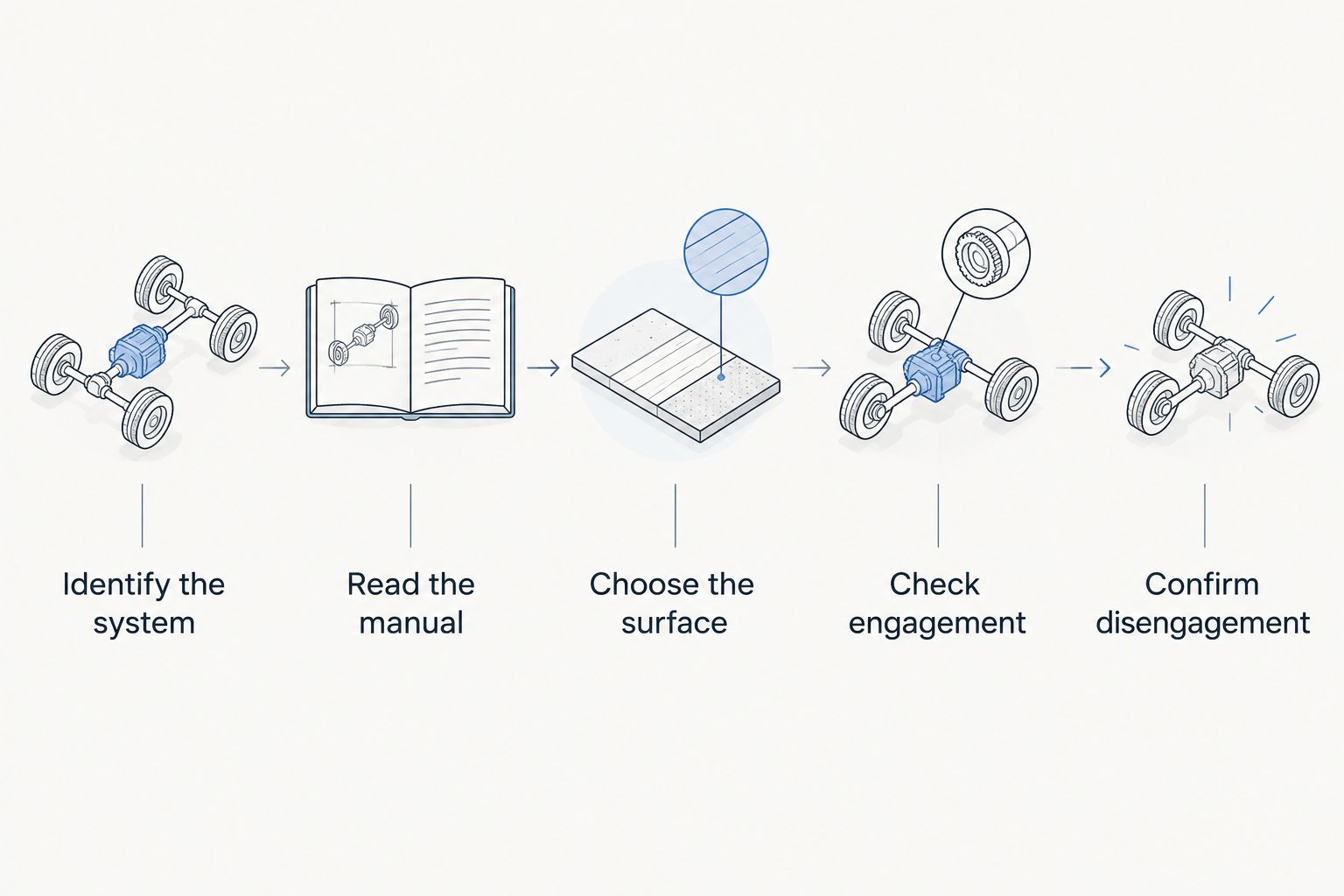
Use this sequence:
- Identify the system. Confirm the fitted drivetrain and available modes.
- Read the manual. Check engagement instructions and surface restrictions.
- Choose the surface. Use a safe, permitted location with the owner’s consent.
- Check engagement. Observe indicators, warnings and actual operation.
- Confirm disengagement. Return the vehicle to its normal road-driving mode.
The diagram below summarises the order, not a universal switching procedure. Follow the instructions for the specific vehicle.
Stop if you hear abnormal grinding, encounter unexpected binding or see a fault warning. Do not keep forcing a reluctant selector. A switch lighting up is not sufficient evidence that the drivetrain works correctly.
Check tyres, brakes, steering and towing equipment
Inspect all 4 road tyres, plus the spare. Compare tyre sizes and specifications with the vehicle requirements, and look for cracking, cuts, bulges and uneven wear. Uneven wear needs investigation rather than an automatic assumption that wheel alignment alone will fix it.
Australian roadworthiness guidance specifies a minimum tread depth of 1.5 mm in the relevant tread areas. That is a legal threshold, not a recommendation for demanding wet-road or off-road use. Check local requirements and have questionable tyres assessed before driving.
On the test drive, check that the steering responds consistently and the vehicle brakes without pulling, excessive vibration or abnormal noise. Try ordinary acceleration, deceleration and gear changes on a legal route. Turn the audio off so you can hear the vehicle.
If a towbar is fitted, inspect its identification plate, mounts, wiring and surrounding structure. Check the vehicle’s towing and load limits from authoritative documentation for the exact variant. A towbar does not establish that the vehicle suits your trailer.
Ask about previous towing use, but verify condition independently. Cooling, transmission, brakes and rear suspension deserve attention when the vehicle has hauled loads.
Why inspection priorities vary between used 4x4s
The core checks stay the same. These factors change where you need additional evidence:
- Drivetrain design: selectable modes and locking arrangements determine the safe test procedure.
- Recorded use: beach driving, farm work, towing and water crossings direct attention to different components.
- Maintenance history: missing records require closer assessment of scheduled work and current condition.
- Modifications: suspension changes, tyre changes and added equipment require fitment and compliance checks.
- Load requirements: touring equipment and towing change the load calculations you need to verify.
- Existing damage: corrosion, impacts and repairs require more detailed structural inspection.
Assess modifications individually. Ask for installation invoices and any engineering or approval documents required by the relevant jurisdiction. A lift, larger tyres or added armour is not automatically a benefit; each changes what you must verify.
Should you buy a used 4x4 with no service history?
Missing service history is a reason for stronger checks, not an automatic bargain. An inspection assesses present condition but cannot reconstruct every missed oil change or previous overheating event.
Check whether the seller can obtain invoices from previous workshops. If major scheduled work remains unverified, identify it explicitly before deciding whether to proceed.
Is a roadworthy certificate enough before buying a used 4x4?
A roadworthy certificate is not a substitute for an independent pre-purchase inspection. Its requirements depend on the jurisdiction, and it does not establish every aspect of engine, transmission or four-wheel-drive condition.
Request an inspection suited to the exact vehicle and your intended use. Tell the inspector about towing plans, modifications and any concerns found during your own checks.
When should you walk away from a used 4x4?
Walk away from unresolved identity discrepancies, unexplained structural damage or refusal to allow independent checks. Also pause the purchase for overheating, drivetrain faults or modifications whose required approvals cannot be established.
Carbarn is best suited to buyers seeking a pre-loved car from a dealership. You can consider Carbarn while keeping the same inspection standard: assess the individual vehicle, its documents and its suitability for your use.
FAQ
What’s the first thing to check on a used 4x4?
Check the vehicle’s identity against its documents and obtain a current PPSR search using the actual VIN. Then review service records before assessing condition and arranging a test drive.
How do I check whether four-wheel drive works?
Identify the fitted system and follow the owner’s manual on a suitable surface. Have a mechanic verify operation if you cannot safely test the available modes.
Can I test low range on a sealed road?
Do not test low range or locked drivetrain modes on a sealed road unless the manufacturer expressly permits that procedure. Surface restrictions depend on the vehicle’s drivetrain design.
How much tyre tread does a used 4x4 need?
Australian roadworthiness guidance specifies a minimum tread depth of 1.5 mm in the relevant tread areas. Check local requirements and assess tyre condition separately from tread depth.
Does a snorkel mean a used 4x4 is safe for water crossings?
A snorkel does not establish that a used 4x4 is safe for water crossings. Intake sealing, breathers, electrical components and the manufacturer’s limitations still need consideration.
Does a PPSR search prove a used 4x4 is mechanically sound?
A PPSR search does not prove mechanical condition. It checks recorded information, including registered security interests, and belongs alongside a physical inspection.
Should I get an independent inspection when buying from Carbarn?
An independent inspection remains a useful check when buying a used 4x4 from Carbarn or another seller. Request an assessment of the chassis, drivetrain, cooling system and any modifications.
One last thing
Before your 2026 inspection, give the mechanic your intended-use brief, not just the registration number. Explain whether you plan to tow, tour, drive on beaches or work on a rural property. That lets the assessment address suitability as well as visible faults.
Ask for findings in writing, with structural concerns, safety defects and unresolved drivetrain issues clearly separated from routine maintenance. Decide from that report, not from the accessory list.


