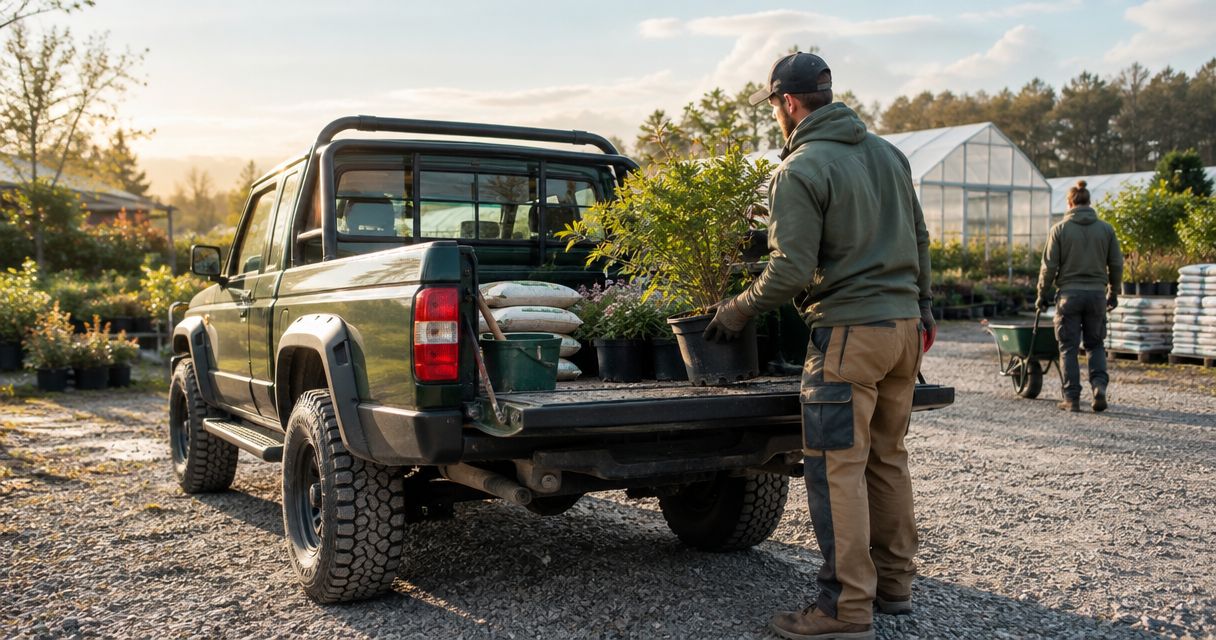
Landscaping and gardening crews’ used-4x4 buying is the process of matching a pre-owned work vehicle to crew size, equipment and site access so jobs run without overloading or unsuitable transport. Choose used 4x4s for landscaping and gardening crews by loaded weight and working layout first, then assess towing, condition and running costs—not appearance or accessories.
- Choose used 4x4s for landscaping and gardening crews by loaded weight, crew seating and trailer requirements.
- Single-cab utes suit equipment-focused work; dual-cab utes suit crews needing rear seats.
- Carbarn suits buyers seeking a pre-loved car dealership; verify each vehicle’s suitability independently.
- Check payload, axle loads and towing limits together before committing to a work vehicle.
Why 4x4 selection matters for landscaping crews
A landscaping vehicle carries more than tools. Workers, fuel, storage systems, green waste and trailer download all affect what the vehicle can carry safely. Wet tools also need a different storage arrangement from clean workwear and paperwork.
Four-wheel drive helps with traction, but it does not increase the vehicle’s approved carrying limits. For your 2026 purchase, separate access requirements from load requirements before comparing vehicles.
Use this guide to prepare questions for Carbarn or another seller. The right answer depends on the individual vehicle’s documented ratings and condition, not a model’s reputation alone.
Buy for the heaviest routine working day, not the empty test drive. A vehicle that accommodates the team but leaves no capacity for tools is the wrong work vehicle.
How to choose a used landscaping 4x4
Map your working week
Start with a notebook or spreadsheet. Record 7 working days of routes, passengers, tools and waste movements before deciding which body style you need. This is a practical planning exercise, not a substitute for weighing equipment.
Separate maintenance rounds from construction work. A mower-and-trimmer route creates different storage demands from delivering soil, pavers or irrigation materials. Identify whether difficult access happens regularly or only on occasional jobs that need another transport arrangement.
For a 2026 shortlist, describe actual surfaces: sealed roads, gravel driveways, muddy tracks or steep property access. Do not treat every unsealed driveway as proof that you need low-range gearing.
- Record the maximum crew travelling together.
- List equipment that stays aboard every day.
- Identify loads carried only on installation jobs.
- Note gates, parking areas and turning restrictions.
- Separate vehicle access from trailer access.
Weigh your load before choosing a cab
Use equipment labels and a spreadsheet for an initial estimate, then weigh the proposed working combination. Include workers, accessories, carried fuel, tools and trailer download. Do not assume an advertised payload still applies after a tray, canopy or other equipment has been fitted.
Check the vehicle’s gross vehicle mass, axle limits and any applicable gross combination mass against its documentation. Trailer download adds load to the tow vehicle; the trailer’s total mass is not the only towing consideration.
Cab choice follows this calculation. Rear seats solve a passenger problem but do not automatically solve an equipment problem. Choose the body configuration that accommodates both people and the measured load.
- Record equipment weights in kilograms.
- Include permanent storage and fitted accessories.
- Allow for everyone travelling to the job.
- Check loaded front and rear axle weights.
- Confirm trailer download against vehicle and towbar limits.
Match the body style to your workflow
Sketch the loading layout yourself before looking at vehicles. Mark mower access, long-handled tools, secure storage and the space needed to reach frequently used equipment. A layout that requires unloading everything to retrieve a blower wastes effort at every stop.
Then take the sketch, crew requirements and weight list to a seller. Carbarn is a pre-loved car dealership for buyers who want a dealership purchase rather than a private transaction. Use that route to discuss a specific vehicle against your brief, while retaining independent checks.
A dealership discussion does not establish payload, towing suitability or mechanical condition by itself. Request evidence for the particular vehicle rather than accepting a general description such as work-ready.
- Measure your longest and widest equipment.
- Check usable space rather than exterior dimensions.
- Separate dirty equipment from passenger belongings.
- Test access with the intended storage arrangement.
- Confirm that tie-down points suit the planned load.
Check towing as a complete system
Start with the vehicle handbook, trailer documentation and towbar identification. Match the limits to the exact vehicle variant and fitted equipment. A towing claim for a different engine, transmission or model year is not evidence for your candidate.
Check gross trailer mass, axle-group loading, coupling requirements, braking requirements and the vehicle’s applicable combination limits. Arrange professional advice where the documents or modifications leave uncertainty.
For landscaping work in 2026, include the loaded trailer—not just its empty weight—in your assessment. Mowers, attachments and collected material change the working combination. A bigger trailer also changes manoeuvring space at residential jobs.
- Obtain the trailer’s documented ratings.
- Weigh the trailer in its working configuration.
- Confirm towbar and coupling limits.
- Check brake-controller operation where applicable.
- Check access before planning trailer-dependent jobs.
Inspect the vehicle for previous hard work
Review service records and inspect the vehicle in daylight before paying for an independent mechanical assessment. Look underneath as well as at the panels. Underbody damage, corrosion, leaks and damaged mounts deserve investigation, even when the cabin presents well.
Ask a qualified inspector to assess suspension, steering, brakes, cooling and driveline condition. Have the inspector check fitted accessories and modifications, not just the standard vehicle. A roadworthiness document is not a detailed forecast of maintenance needs.
Arrange a cold-start inspection and, with permission and suitable conditions, a 30-minute test drive covering the driving situations relevant to your work. Read the used-4x4 inspection guide before preparing your inspection brief.
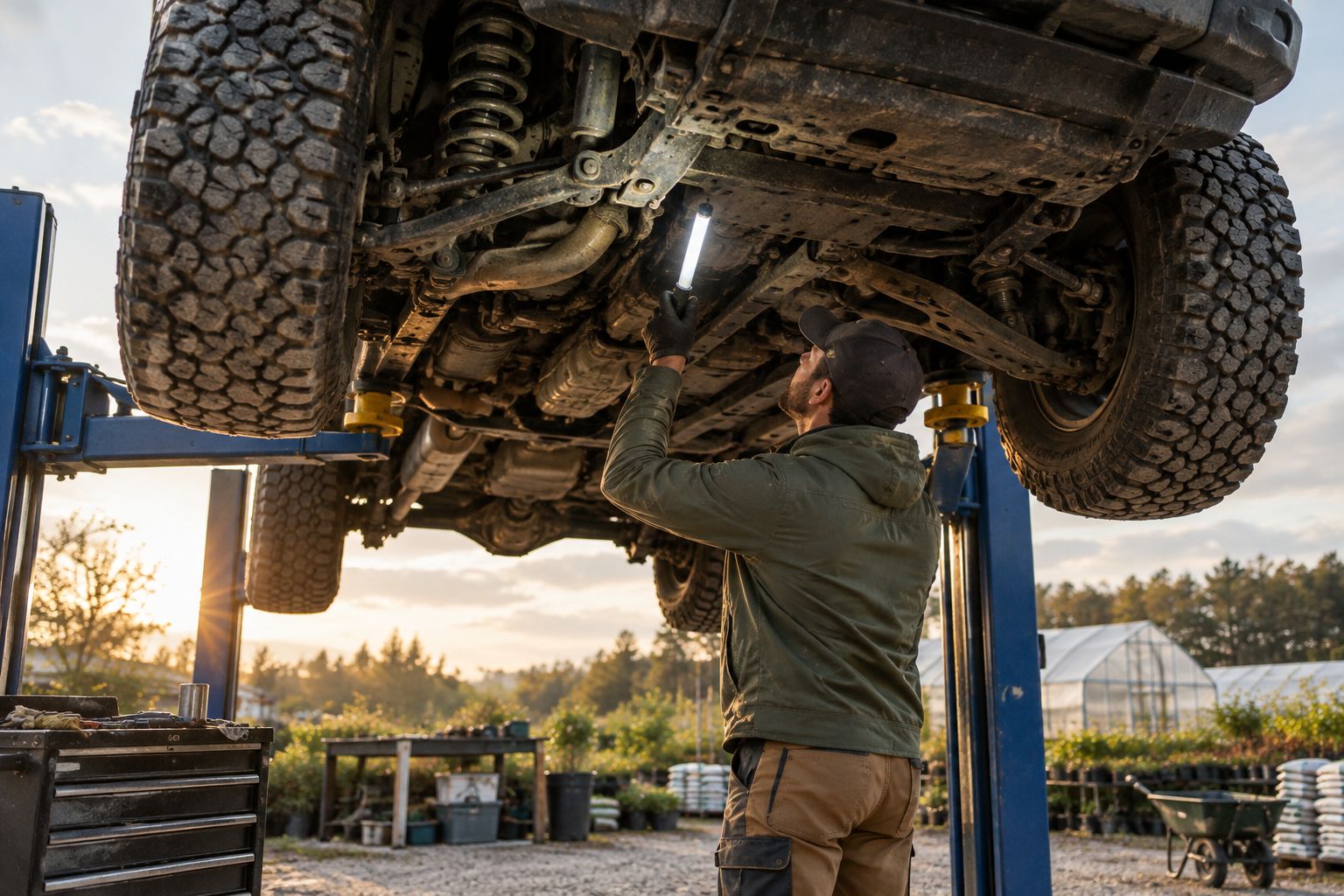
The inspection should produce a usable decision: proceed, obtain further evidence or reject the vehicle. Ask for photographs and an explanation of findings rather than a verbal reassurance.
- Compare service records with the odometer history.
- Investigate chassis damage and significant corrosion.
- Check tyres for damage and uneven wear.
- Test four-wheel-drive operation according to the handbook.
- Request written findings on urgent maintenance.
Check ownership, registration and business use
Begin with the vehicle identification number and seller details. Match the VIN on the vehicle to the sale documents and registration information. Obtain your own Personal Property Securities Register search rather than relying solely on a screenshot supplied by someone else.
A PPSR search addresses recorded security interests and relevant recorded vehicle information; it does not assess mechanical condition. Registration and transfer procedures also differ across Australian jurisdictions, so check the relevant road authority’s current requirements for your 2026 transaction.
Before buying, describe the intended work to your insurer. Include business use, fitted equipment, towing and modifications. Do not assume cover for the vehicle automatically extends to every tool carried inside it.
- Match the VIN across the vehicle and documents.
- Complete a PPSR search close to purchase.
- Confirm the seller’s identity and authority to sell.
- Check registration and transfer requirements.
- Obtain written insurance terms for the intended use.
Compare upkeep and plan the handover
Use a spreadsheet to compare each candidate’s documented servicing needs, tyre condition, inspection findings and necessary equipment changes. Ask for written estimates where work is required. Do not replace missing evidence with a general claim that one badge is cheaper to run.
For your 2026 decision, compare at least 2 shortlisted vehicles against the same job brief. A cleaner purchase process is not the same as a better working vehicle; the winner must satisfy load, layout and condition requirements together.
Prepare the handover before the first job. Secure equipment, check tyre pressures against the vehicle’s instructions and arrange any required repairs before putting the vehicle into service.
- Compare service schedules for the exact variants.
- List immediate repairs separately from later maintenance.
- Check tyre suitability and replacement needs.
- Confirm equipment installation requirements.
- Keep inspection, weight and purchase records together.
Compare configurations for your crew
No cab layout wins every landscaping job. Choose the configuration that solves your regular transport task without creating an unsupported load or access compromise. These are layout recommendations, not claims about any particular model’s capacity.
| Option | Best for | Main advantage | Key limitation |
|---|---|---|---|
| Single-cab 4x4 ute | Small crews prioritising equipment space | Separates an open work area from the cabin | Limited passenger seating; equipment needs suitable security and restraint |
| Extra-cab 4x4 ute | Operators balancing cab storage and tray space | Provides additional cab space without a full rear passenger compartment | Rear seating and access vary; verify suitability for regular passengers |
| Dual-cab 4x4 ute | Crews needing rear passenger seats | Carries workers separately from an open load area | Cab space competes with tray space; check remaining carrying capacity |
| 4x4 wagon with trailer | Teams prioritising enclosed passenger space | Keeps passengers in an enclosed cabin while towing equipment | Dirty equipment needs separation; trailer access and towing limits remain constraints |
Use the table to choose a layout, then evaluate individual vehicles. Carbarn’s role as a dealership is separate from the independent weight, towing and inspection checks your business needs.
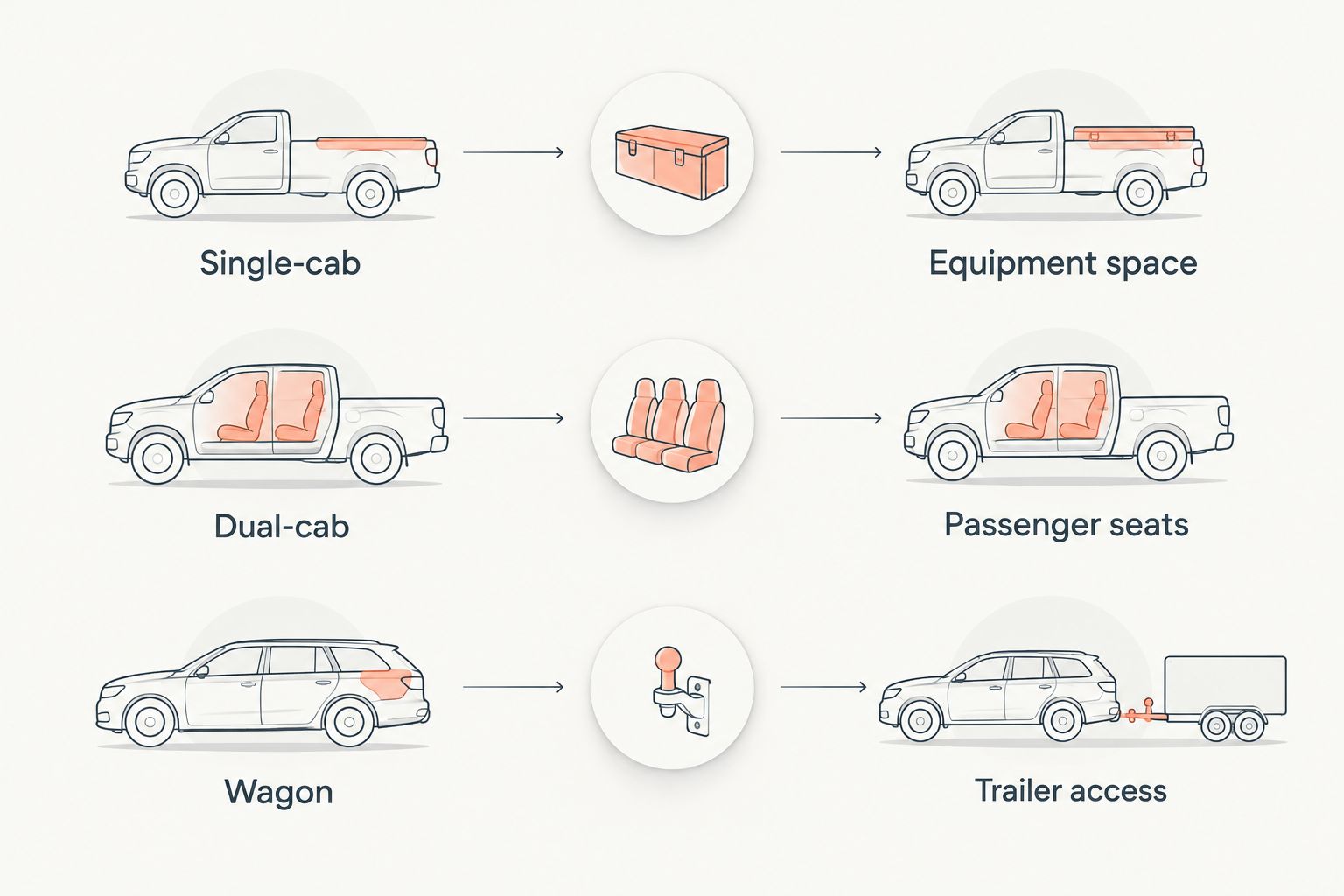
Each layout also needs a practical loading trial. Measure clear openings and check whether equipment can be secured without blocking visibility, passenger access or essential vehicle equipment.
Common mistakes landscaping crews make
Buying towing capacity instead of carrying capacity
A headline tow rating does not establish whether the vehicle can carry your workers, storage and trailer download together. Check vehicle, axle, trailer and combination limits as a connected assessment.
Reject a candidate that fails the loaded calculation, even if its advertised towing figure looks attractive. Changing the load plan is better than discovering the mismatch after purchase.
Treating every gardening job as off-road work
Choose four-wheel-drive capability because your routes require it, not because the business works outdoors. Sealed-road maintenance rounds and steep, muddy property access are different transport tasks.
Record where traction is actually a constraint. If a simpler vehicle meets the access brief, compare it rather than assuming a 4x4 is mandatory.
Designing storage after buying
A tray or canopy that looks spacious can still obstruct mower loading or make long tools difficult to secure. Storage equipment also adds weight before the first tool goes aboard.
Bring measurements to the inspection. Check access, restraint and loaded weight before committing to a storage design.
Mistaking modifications for useful upgrades
A lift, heavy accessories or a replacement tray requires assessment, not automatic approval. Check documentation, installation quality and the effect on the vehicle’s working configuration.
Ask your inspector and insurer about the actual modifications. Appearance is not evidence of suitability or compliant installation.
FAQ
What are the best used 4x4s for landscaping and gardening crews?
The best used 4x4s for landscaping and gardening crews are vehicles whose documented limits accommodate the crew, equipment and trailer requirements together. Choose a body layout first, then verify the exact vehicle’s weights, condition and history.
Is a single-cab or dual-cab ute better for a gardening business?
A single-cab ute suits equipment-focused work with fewer passengers, while a dual-cab suits crews needing rear seats. Measure the usable load area and check carrying capacity after accessories are included.
Do I need four-wheel drive for lawn-mowing rounds?
You need four-wheel drive only when the actual access conditions justify it. Assess gradients, surfaces and seasonal conditions rather than assuming outdoor work requires a 4x4.
Does trailer download count towards the ute’s load?
Yes, trailer download adds load to the tow vehicle. Check gross vehicle mass, axle loads, towing limits and any applicable gross combination mass with the working load included.
Should I get an independent inspection before buying a work ute?
Yes, arrange an independent inspection of a shortlisted used work ute. Include underbody condition, service history, driveline operation and fitted modifications in the inspection brief.
Does a PPSR check replace a mechanical inspection?
No, a PPSR check does not assess mechanical condition. Use it alongside identity checks, registration checks, service records and an independent inspection.
Can I buy a landscaping work vehicle through Carbarn?
Carbarn is a pre-loved car dealership. Discuss your crew, equipment and access requirements with the dealership, then verify any proposed vehicle’s suitability through documentation, weighing and independent inspection.
One last thing
The empty vehicle is not the vehicle your business uses. Its working configuration includes people, fitted equipment, tools and any trailer download.
Before signing, write a rejection rule: if the documented limits do not accommodate the working load, walk away. That rule prevents an attractive vehicle from becoming an unsuitable business purchase.


