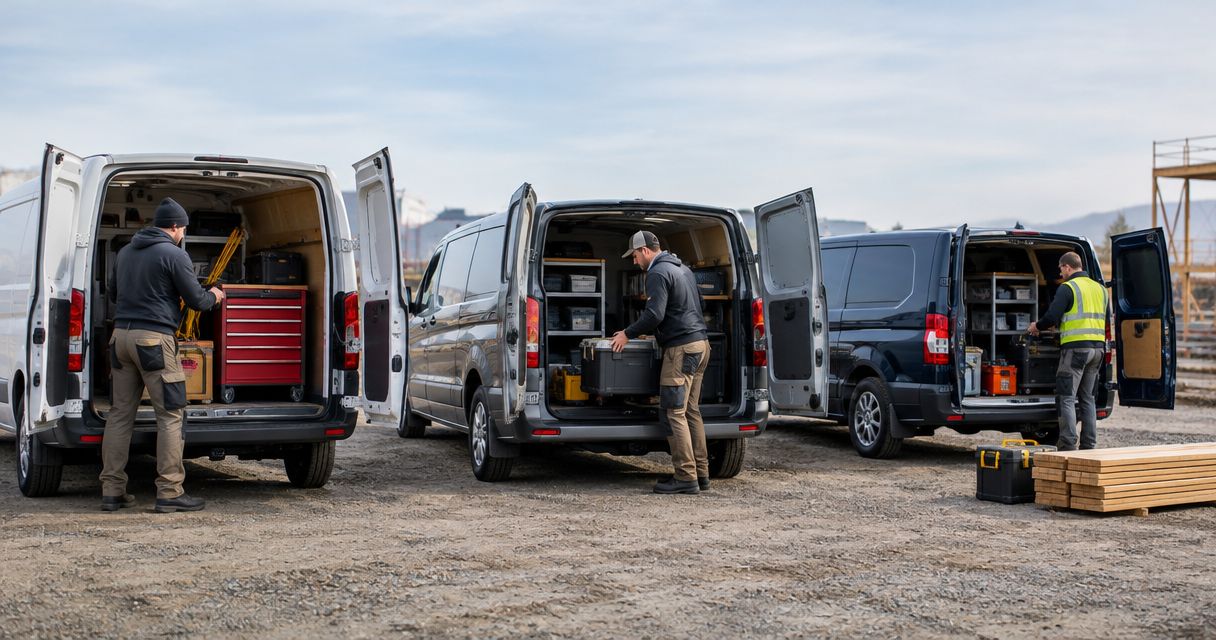
Best overall: a medium van with verified working payload. Best for heavy loads: a high-GVM large van. Best for light urban work: a compact van. This 2026 commercial van payload comparison explains how to shortlist used vans without confusing cargo space with legal carrying capacity.
- Commercial van payload comparison: rank exact vehicles by remaining carrying capacity, not model names or cargo volume.
- Iveco Daily deserves consideration for heavy-load work; Toyota HiAce suits the medium-van shortlist for mobile workshops.
- Include occupants, shelving, tools, roof equipment and towball download when checking working payload.
- Carbarn buyers should verify vehicle identity, mass limits and loaded axle weights before choosing a used commercial van.
Start your used-vehicle search with Carbarn, but make the individual vehicle's documents and inspection the basis of your decision. A badge identifies a model family; it does not establish what a particular used van can carry.
Why this matters
A van can have room for another toolbox and still exceed a legal mass limit. Shelving, drawers, passengers and permanently carried equipment consume carrying capacity before you collect materials.
For a 2026 purchase, rank the exact vehicles by usable payload after your working equipment is accounted for. The shortlist below gives each van family a distinct job; it is not a kilogram league table across unspecified variants.
That distinction matters for used vehicles. Different wheelbases, roof heights, engines, transmissions and approved modifications can change the result within the same model family.
What makes the best commercial van for payload?
Use these criteria before comparing badges:
- Verified mass limits: Match the vehicle identification number to its applicable gross vehicle mass, or GVM, and axle ratings.
- Working payload: Establish what remains after occupants, fuel, permanent equipment and your usual tools are included.
- Load placement: Check whether your planned layout overloads an axle before the vehicle reaches its overall GVM.
- Cargo access: Measure door openings, load length and the route your equipment takes into the van.
- Licence suitability: Confirm that the registered vehicle class matches the driver's licence and local rules.
- Used condition: Inspect the structure, floor, suspension, tyres and evidence of previous commercial use.
Australian car licences generally cover vehicles up to 4.5 tonnes GVM, equivalent to 4,500 kg. Check the relevant state or territory rules and your licence conditions before considering heavier configurations.
Payload uses mass units, not cargo-volume units. One tonne equals 1,000 kg; a larger cargo bay does not automatically provide a higher kilogram allowance.
Used commercial vans at a glance
This is a workload-ranked shortlist for 2026. To rank actual vehicles by payload, replace the model names with their exact variants and sort their verified remaining carrying capacities from highest to lowest.
| Rank | Van family | Best for | Standout consideration | Key limitation |
|---|---|---|---|---|
| 1 | Iveco Daily | Heavy-load work requiring a high-GVM configuration | Includes heavier-duty configurations beyond the usual car-licence ceiling | Licence suitability and exact vehicle ratings need checking |
| 2 | Renault Master | Bulky equipment and workshop layouts | Full-size van format for planning larger internal installations | Cargo space alone does not establish payload |
| 3 | Ford Transit | Long equipment requiring a specific body configuration | Multiple body configurations make variant selection central | Figures from a different Transit specification are not transferable |
| 4 | Toyota HiAce | A medium-sized mobile workshop | An enclosed van format for tools and service equipment | Shelving and permanently carried tools reduce working capacity |
| 5 | Volkswagen Caddy | Light-load urban service work | Compact-van format | Smaller load space limits bulky equipment layouts |
None of these model families has one universal payload figure. Compare manufacturer specifications for the exact vehicle, then confirm the effect of its current equipment and modifications.
1. Iveco Daily: best commercial van for heavy-load work
The Iveco Daily belongs on the shortlist when your equipment demands consideration of a heavier-duty commercial vehicle. The family includes configurations above the usual car-licence GVM ceiling, so establish the vehicle's registered limits before assessing its suitability.
Best for: Trades carrying dense equipment or substantial permanent installations, where an appropriately rated configuration is necessary.
Iveco Daily pros:
- Heavier-duty configurations provide a separate option from conventional light vans.
- Van and chassis configurations allow different working layouts.
- Exact GVM and axle ratings give you a clear basis for assessing a heavy installation.
Iveco Daily cons:
- Heavier configurations require the appropriate driver licence.
- A substantial body or fit-out consumes part of the available carrying capacity.
- You must assess access, parking and loading arrangements for the actual vehicle.
Do not assume the highest-rated Daily configuration describes every Daily advertised. Ask for the vehicle's identification details and relevant mass documentation before organising an inspection.
Verdict: Buy only when the exact Iveco Daily configuration meets your loaded-weight and licence requirements.
2. Renault Master: best commercial van for bulky equipment
The Renault Master is a full-size van to assess when equipment dimensions dictate the purchase. Start with the internal layout, then establish whether the selected vehicle can legally carry that layout and its contents.
Best for: Trades carrying bulky equipment that needs an enclosed, full-size workspace.
Renault Master pros:
- Full-size body configurations give you scope to plan separate storage and equipment areas.
- Enclosed cargo accommodation keeps the load within the vehicle body.
- Different body specifications let you shortlist against measured equipment dimensions.
Renault Master cons:
- A larger body does not guarantee greater remaining payload.
- Shelving and workshop installations add permanent weight.
- The chosen roof and body dimensions need checking against your regular access points.
Measure your largest equipment item rather than estimating from photographs. Check the door opening as well as the space inside: equipment that fits the cargo bay still needs a practical loading path.
Verdict: Buy when the Renault Master passes both the dimension check and the working-payload check.
3. Ford Transit: best commercial van for long equipment
The Ford Transit merits consideration when load length drives your choice. The name covers different configurations, so the wheelbase, body length, roof and mass rating must remain attached to every specification you compare.
Best for: Trades transporting long equipment that needs a specific enclosed load length.
Ford Transit pros:
- Multiple body configurations support a dimension-led shortlist.
- Enclosed load space accommodates organised equipment storage.
- Variant-level specifications let you compare load length against carrying capacity.
Ford Transit cons:
- A payload figure from another Transit variant is not evidence for the vehicle you are buying.
- Long items can constrain where other heavy equipment is placed.
- Added racking changes the vehicle's working weight.
Look beyond whether a long item fits. Establish how you will secure it, whether it obstructs access, and where its weight sits relative to the axles.
Verdict: Buy the Ford Transit variant that fits your longest load without compromising legal mass distribution.
4. Toyota HiAce: best commercial van for a mobile workshop
The Toyota HiAce belongs on the medium-van shortlist for tradespeople organising tools and service equipment into a mobile workshop. Assess the exact body and seating configuration rather than treating every HiAce as equivalent.
Best for: Service trades needing enclosed tool storage without automatically moving to a full-size van.
Toyota HiAce pros:
- Enclosed cargo space supports a dedicated tool-storage layout.
- The medium-van format provides an alternative to larger commercial vans.
- Different configurations let you assess seating and cargo needs together.
Toyota HiAce cons:
- Existing drawers, partitions and shelving consume carrying capacity.
- Cargo dimensions need checking against your largest equipment.
- A heavily equipped mobile workshop still requires a loaded-weight check.
Use the used Toyota HiAce buying guide to develop your model shortlist. Keep the payload decision separate: condition, dimensions and legal carrying capacity must all pass.
Verdict: Buy a Toyota HiAce when your complete workshop fits within its verified mass and space limits.
5. Volkswagen Caddy: best commercial van for light urban work
The Volkswagen Caddy is a compact-van option for a genuinely light equipment list. Choose this format because your work fits it, not because you expect to use a trailer or roof storage to bypass its limits.
Best for: Urban service work carrying compact tools and limited materials.
Volkswagen Caddy pros:
- Compact body dimensions suit a smaller working footprint.
- Enclosed cargo space separates equipment from the driving area.
- A restrained fit-out keeps the layout focused on essential tools.
Volkswagen Caddy cons:
- Smaller cargo space restricts bulky equipment arrangements.
- Occupants and accessories still consume carrying capacity.
- Roof loads and trailer towball download require separate checks.
Write down everything that stays in the vehicle between jobs. A compact van is the wrong choice when the normal working load already leaves insufficient capacity for materials.
Verdict: Buy a Volkswagen Caddy for verified light-load work; skip it when your routine equipment outgrows the format.
How to calculate the payload you can actually use
For your 2026 shortlist, distinguish brochure payload from remaining working capacity. Remaining capacity is the applicable GVM minus the vehicle's actual mass in the condition being assessed, subject to axle and other relevant limits.
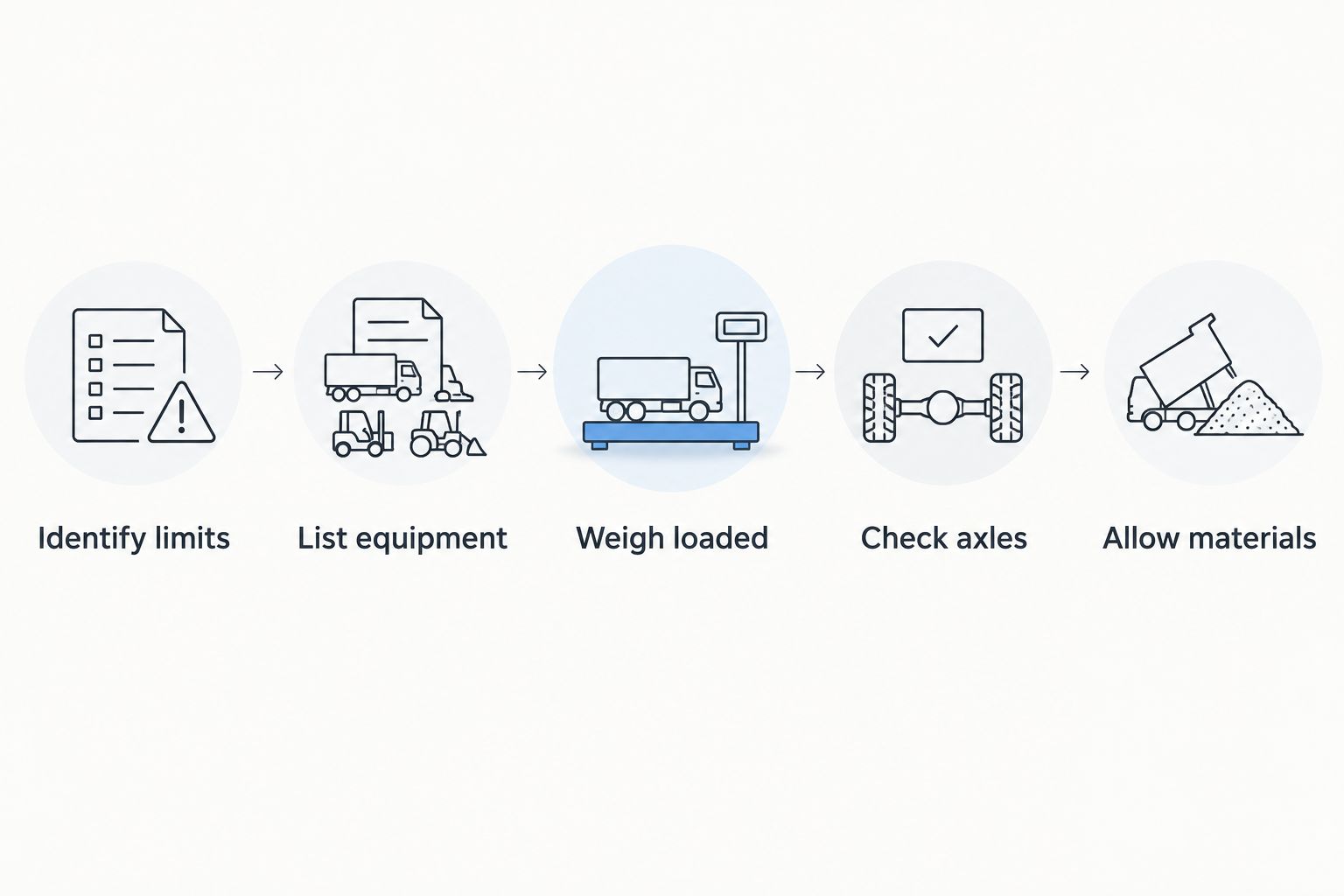
Use this sequence for each candidate:
- Identify limits: Confirm the exact vehicle, applicable GVM, axle ratings and any approved changes.
- List equipment: Include shelving, partitions, drawers, roof racks, tools and other permanent additions.
- Weigh loaded: Use a weighbridge with the van prepared to represent its working condition.
- Check axles: Establish axle loads as well as total vehicle mass.
- Allow materials: Confirm that the remaining capacity accommodates the materials and occupants your work requires.
Do not subtract an accessory twice if it was already on the van during weighing. Equally, do not forget equipment that was removed before the weighbridge visit.
An acceptable total weight does not prove that each axle is within its rating. Heavy equipment concentrated behind the rear axle needs particular attention to load placement and axle weights.
How this shortlist is ranked
The order moves from heavy-load requirements through bulky and long equipment to medium and compact service work. It applies the criteria above: mass limits, usable payload, load placement, dimensions, licence suitability and condition.
It does not assert that every Iveco Daily carries more than every Renault Master, or every Ford Transit more than every Toyota HiAce. Only exact, comparable vehicle specifications support that conclusion.
For a payload-only ranking in 2026, sort inspected candidates by their verified remaining working capacity. Reject any candidate that fails an axle limit, access requirement or licence condition, regardless of its position.
Which commercial van should you choose?
Choose a verified-payload medium van by default; move larger only when your measured load requires it. Start with the Toyota HiAce for a medium mobile-workshop shortlist, then assess the larger formats against a specific unmet requirement.
For Carbarn buyers, the best used commercial van is the exact vehicle that legally carries the complete working load. A model badge cannot replace that check.
Before committing, obtain the vehicle's identity and mass records, organise an independent inspection, and establish its working weight. Record your intended fit-out in writing so the assessment covers your job rather than an empty van.
FAQ
What's the best commercial van payload comparison for a tradie?
The best commercial van payload comparison ranks exact vehicles by their remaining capacity with working equipment aboard. Include occupants, tools and accessories, then check axle limits as well as total mass.
Which used van has the highest payload?
The highest-payload used van is determined by its exact configuration and applicable mass limits, not its model name. Compare individual vehicles using manufacturer documentation and their actual working weight.
Does a bigger van always carry more weight?
No, a bigger cargo bay does not automatically provide more payload. The vehicle's own weight, equipment and approved mass limits determine its remaining carrying capacity.
Do shelves and tools count towards van payload?
Yes, shelves, tools and other equipment add to the vehicle's loaded weight. If they were already aboard when the van was weighed, do not subtract their weight again.
Can I drive a high-payload van on a car licence?
Australian car licences generally cover vehicles up to 4.5 tonnes GVM. Confirm your state or territory rules, licence conditions and the exact vehicle's registered class before buying.
Is a Toyota HiAce better than a Ford Transit for tradies?
A Toyota HiAce suits a medium mobile-workshop shortlist, while a Ford Transit deserves assessment when a particular body length or configuration is required. Choose between exact vehicles using load dimensions, working capacity and condition.
Does towing affect how much my van can carry?
Yes, trailer towball download adds load to the tow vehicle. Check GVM, axle ratings, towing limits and gross combination mass where applicable; a towing rating is not a cargo allowance.
What should I check before buying a used commercial van in 2026?
Check vehicle identity, service history, condition, applicable mass limits and evidence of modifications. Then confirm that the van can carry your complete working load without exceeding overall or axle limits.
One last thing
An empty-looking van can already carry a substantial permanent load. Check beneath drawers, inside storage compartments and above the roof before accepting a seller's description of an unladen vehicle.
For a 2026 purchase through Carbarn or any other seller, make your final comparison after accounting for that equipment. The useful winner is the van that carries your working day legally, not the one with the largest empty space.


