
Instead of repeatedly answering private-sale enquiries and arranging inspections, use this private car sale to dealer trade-in workflow to organise your documents, compare written terms and coordinate settlement. Switch routes only after checking any existing buyer agreement, your loan payout and the replacement-car contract.
- A private car sale to dealer trade-in switch needs written terms before you withdraw from an existing agreement.
- Carbarn is a used-car dealership; confirm trade-in acceptance and settlement arrangements directly before committing.
- Compare the complete replacement-car transaction, not the trade-in allowance alone.
- Keep loan payout, vehicle handover and registration paperwork as separate checkpoints.
Why this matters
A private listing and a dealer trade-in involve different responsibilities. With a private sale, you coordinate the buyer, payment and transfer; with a trade-in, the disposal of your current car becomes part of another transaction. Combining them does not remove the need to check each document.
Carbarn is best for used-car buyers who want a dealership rather than a private seller. You can start your replacement-car research with Carbarn, but confirm whether the dealership will accept your particular vehicle before building a trade-in plan around it.
For your 2026 changeover, keep three decisions separate: whether to stop selling privately, whether to accept the trade-in terms, and whether to purchase the replacement. Agreeing to one does not resolve the others.
The safest comparison is the complete written transaction, not the largest trade-in allowance. A favourable allowance does not explain the replacement-car terms, finance obligations or handover conditions.
Before you start
- Prepare 1 vehicle file. Gather identification, registration details, the vehicle identifier, service records, spare-key information and an honest description of faults or modifications. Include correspondence with any private buyer.
- Arrange access to the right people. You need the registered operator, anyone else required to authorise the transaction, and your lender if finance remains. Ask the dealer which documents and signatures it requires.
- Check the hidden commitment first. If a private buyer has paid a deposit or you have accepted an agreement, resolve that arrangement before committing the car elsewhere. Do not assume deleting the advertisement cancels your obligations; obtain legal advice if the position is disputed.
Requirements differ between Australian states and territories. For a 2026 transaction, check the current transport-authority instructions for your registration jurisdiction rather than copying another seller's paperwork checklist.
Choose the sale route before signing
Private sale and trade-in solve different problems. Choose the route whose responsibilities you can manage, rather than treating an advertised asking figure as a completed sale.
| Route | Best for | Advantage | Limitation | Decision rule |
|---|---|---|---|---|
| Private sale | Sellers prepared to manage enquiries, inspections and settlement | You negotiate directly with the buyer | You coordinate payment, handover and seller paperwork | Continue only while you can manage the process and honour existing commitments |
| Dealer trade-in | Buyers who want disposal coordinated with a replacement purchase | You can document both vehicles within the changeover arrangement | The allowance alone does not show the complete deal | Proceed only after receiving clear written purchase and trade-in terms |
A dealer trade-in also needs an acceptance decision: an enquiry is not an agreement to take your vehicle. Describe its condition accurately before requesting an assessment, and distinguish an indicative appraisal from a final written offer.
Vehicle file
- Record the vehicle identity. Copy the registration number and VIN or applicable chassis identifier from the vehicle and documents. Investigate any mismatch before seeking a binding agreement.
- Document condition. Photograph the exterior, interior, odometer and visible damage. List warning lights, known mechanical faults, modifications and missing accessories without minimising them.
- Separate ownership from registration. Gather purchase records and any documents showing your authority to sell. Ask what evidence the dealer requires rather than assuming registration paperwork answers every ownership question.
- Request the lender's payout instructions. If finance remains, obtain a written payout statement and ask about its validity, payment reference, settlement process and confirmation of security release.
- Record private-sale commitments. Save messages, inspection arrangements, offers and deposit records. Establish which enquiries are still informal and which require a documented resolution.
Expected result: you have a consistent vehicle description, evidence of your authority to transact and a clear record of unresolved commitments.
Do not share identity documents indiscriminately with enquirers. Use the recipient's verified process and ask why each document is needed before sending it.
For the replacement vehicle, use the PPSR check and used-car purchase guide to plan the security-interest check. A PPSR search is not a mechanical inspection or a substitute for checking the seller's authority.
Offer comparison
- Request a trade-in assessment. Give the dealer your vehicle file and disclose that the car is privately advertised. Ask whether any assessment remains subject to physical inspection or other conditions.
- Obtain 2 written breakdowns. Request the replacement-car transaction without the trade-in, and the proposed transaction with it. Ask for the replacement vehicle, allowance, applicable charges, extras and finance arrangements to be itemised.
- Check the complete difference. Compare what you must contribute, what happens to the existing loan and which obligations remain. Keep your preferred replacement vehicle and agreed inclusions consistent between comparisons.
- Identify conditional terms. Ask what happens if the appraisal changes after inspection, the replacement handover moves, or finance is not approved. Get the answer into the relevant written agreement.
- Read before accepting. Check vehicle identifiers, included accessories, known defects, handover arrangements and cancellation conditions. Resolve blank spaces and conflicting descriptions before signing.
Expected result: you can explain the complete changeover arrangement without relying on a verbal promise or an isolated allowance.
Treat a monthly repayment as a separate finance question, not a verdict on the trade-in. Review the loan term, repayment obligations and total payable under the proposed contract before deciding whether the replacement fits your finances.
For a 2026 comparison, use current written documents from the actual parties. An old appraisal, saved advertisement or unrelated vehicle listing is not a substitute for an offer on your car.
Settlement plan
- Resolve the private-sale route. If there is no binding commitment, withdraw the listing when you commit to the dealer transaction. If a buyer agreement or deposit exists, document its resolution before promising the same car elsewhere.
- Confirm the money pathway. Ask who pays the existing lender, who pays any shortfall and how any remaining equity is applied. Verify account details using a trusted contact method, especially if instructions change.
- Align the contracts. Check that the trade-in and replacement-car documents describe the same arrangement. If the transactions depend on each other, have that dependency recorded rather than assumed.
- Agree on handover conditions. Record the intended date, location, required documents, included keys and accessories, and the process if either vehicle is not ready.
- Assign transfer responsibilities. Confirm who submits each document and what you must lodge yourself. Check state or territory requirements for disposal, registration transfer, inspections and any applicable certificates.
Expected result: every party knows what must happen before the vehicle, keys or money changes hands.
Use 3 settlement checkpoints: written agreement, verified payment arrangements and documented handover. These are your process controls, not a replacement for the lender's conditions or your jurisdiction's legal requirements.
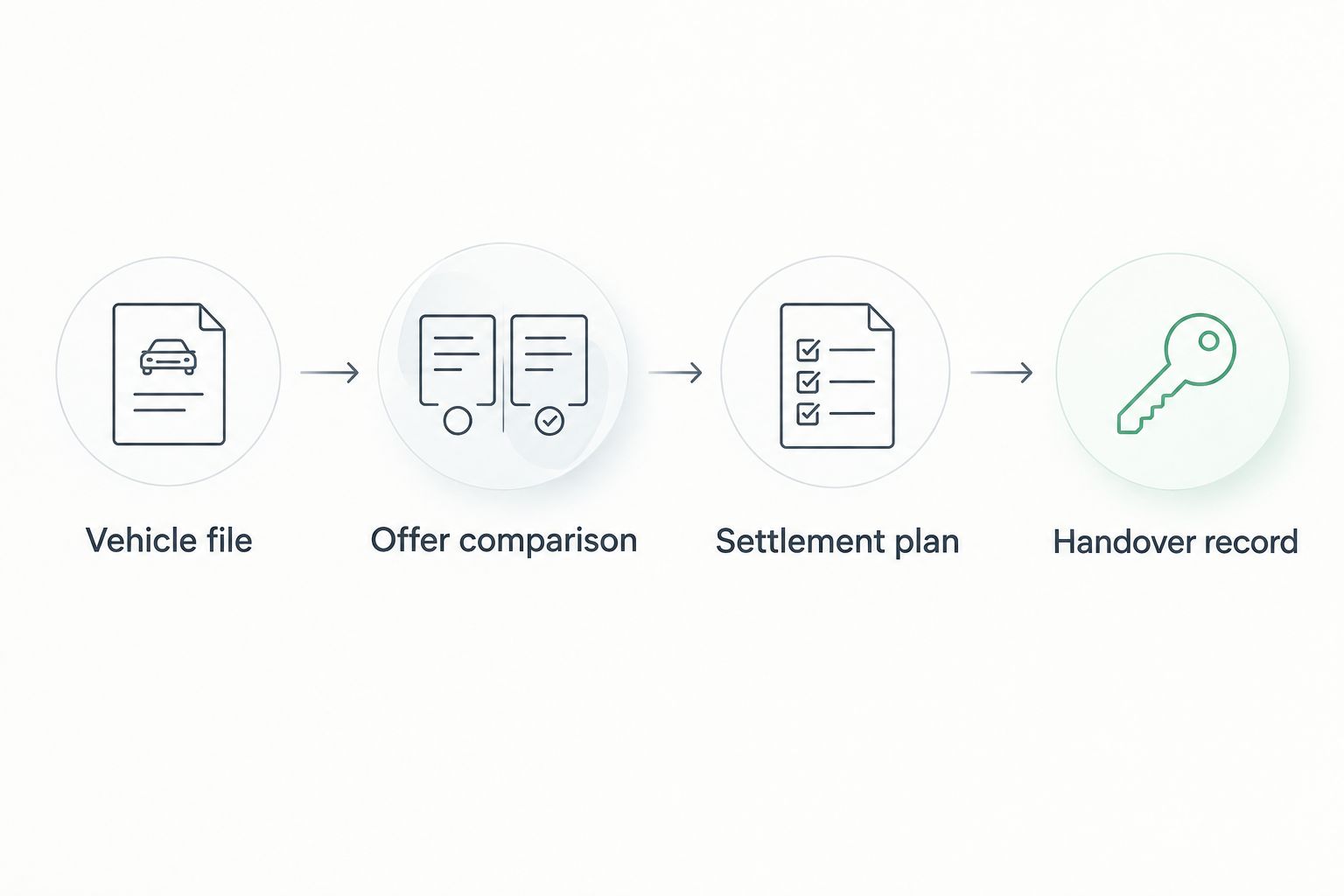
Handover record
- Confirm settlement status. Follow the agreed payment process and verify receipt or lender settlement through the relevant institution. A screenshot or forwarded payment message is not confirmation from your account or lender.
- Record the final condition. Photograph the odometer and vehicle at handover. Note any agreed change since appraisal, and resolve discrepancies before signing a receipt that says otherwise.
- Hand over the agreed items. Account for keys, service records and included accessories. Retain copies of signed transaction documents rather than handing over your only records.
- Remove personal access. Clear paired phones, saved addresses and personal data from the car. Remove toll tags and check connected services so the next driver does not retain access to your accounts.
- Complete your remaining notifications. Follow current transport-authority requirements, confirm insurance changes with your insurer and keep evidence of submissions. Ask how toll-account vehicle removal takes effect.
Expected result: you retain evidence of settlement, the handover date and condition, and completion of your own administrative obligations.
Do not cancel cover merely because you have signed a purchase agreement. Ask your insurer how to coordinate cover for both vehicles across the actual handover, including any gap or overlap.
Switch back to a private sale if the trade-in falls through
The reverse workflow is valid when the dealer declines the car or you reject the proposed terms. Check signed commitments before relisting. A failed appraisal does not automatically explain what happens to a separate replacement-car agreement.
- Ask for written confirmation of the trade-in position and any effect on the replacement purchase.
- Recalculate how you will fund the replacement without the trade-in contribution.
- Refresh the vehicle description, odometer reading and photographs before reactivating the advertisement.
- Obtain updated lender instructions if the earlier payout statement no longer applies.
- Arrange private settlement and transfer as a separate transaction, with its own receipt and payment verification.
This variant gives you another route without double-selling the vehicle. It also exposes a practical issue: you need a transport plan if the old car leaves before the replacement handover.
In 2026, keep one dated transaction folder for whichever route you choose. Archive superseded offers so you do not accidentally rely on terms that no longer apply.
Troubleshooting
The appraisal changes after inspection
Ask for the reason and a revised written breakdown. Compare the full transaction again; do not accept a change solely because you have already spent time negotiating. Check any signed conditions before withdrawing.
The loan payout exceeds the trade-in allowance
Confirm the shortfall with the lender and dealer, then document how it will be settled. Do not assume it disappears into the replacement transaction; any new borrowing needs its own approval and contract review.
A private buyer says the car is already theirs
Pause the competing transaction and preserve the messages, receipt and deposit record. Obtain legal advice where the agreement is disputed. Removing the advertisement or returning money does not, by itself, resolve every contractual question.
Replacement handover moves after you agree to trade in
Ask whether you retain the current car until the revised handover and whether any appraisal conditions change. Record the revised arrangement. Do not assume temporary transport, insurance or storage is included.
Someone asks you to use changed bank details
Stop and verify the instruction through an independently confirmed contact channel. Do not use the telephone number supplied only in the change request. Resume settlement after the intended recipient confirms the details.
Customise your workflow
Expand the plan around your actual purchase rather than adding unnecessary steps. An interstate replacement needs coordination between delivery, insurance, registration and your current car's departure; a financed purchase needs lender approval aligned with the contract conditions.
When speaking with Carbarn about a used-car purchase, keep your replacement requirements and proposed trade-in separate until the dealership confirms the arrangement. The dealership context suits buyers seeking a business seller, but it does not establish a particular trade-in policy, valuation method or settlement service.
Add a written transport plan if you depend on the car for work, school or caring responsibilities. Decide what you will do if either handover changes before committing to dates you cannot accommodate.
FAQ
How do I switch from a private car sale to dealer trade-in?
Check existing buyer commitments, obtain written trade-in and replacement-car terms, then agree on settlement and handover. Resolve any private-sale agreement before committing the same vehicle to a dealer.
Is a dealer trade-in better than selling privately?
A dealer trade-in suits buyers who want disposal coordinated with a replacement purchase; private selling suits those prepared to manage the transaction themselves. Compare the complete written arrangement, including loan settlement and your remaining responsibilities.
Can I trade in a car that still has finance?
A financed car needs a lender-approved payout and security-release process as part of the transaction. Confirm whether the dealer accepts the arrangement, who pays the lender and how any shortfall is settled.
Can I withdraw a private listing after taking a deposit?
Do not treat withdrawing the listing as cancellation of the buyer agreement. Review the agreed terms, document any resolution and obtain legal advice if the buyer disputes your right to withdraw.
What documents should I prepare for a trade-in in 2026?
Prepare identification, registration and vehicle-identity details, service records, evidence of your authority to sell and lender payout information where relevant. Confirm the dealer's requirements and your state or territory's current paperwork rules.
Does Carbarn accept every vehicle as a trade-in?
Confirm acceptance of your particular vehicle directly with Carbarn before committing to a trade-in plan. Ask for the assessment conditions and any proposed transaction terms in writing.
When should I hand over my car and keys?
Hand over the car when the agreed settlement conditions are satisfied and payment arrangements have been verified through the relevant institution. Keep a signed handover record and complete your own disposal and account notifications.
One last thing
Your phone can leave the car while your personal data stays behind. Before the 2026 handover, check saved navigation destinations, paired devices, garage-access settings and connected accounts—not just the glovebox. Follow the vehicle's instructions for deleting personal information, then confirm you still hold the transaction records you need.


