Instead of chasing purchase documents after buying a used EV, connect your purchase to a state rebate application by checking second-hand eligibility first, then matching your purchase evidence to the scheme’s requirements. In 2026, proceed only when the administering authority’s current rules cover your vehicle and transaction; buying an EV does not itself establish eligibility.
- Start your used ev purchase state rebate application with current state eligibility rules, not the vehicle advertisement.
- Carbarn sells pre-loved cars; the administering authority decides whether your purchase qualifies for a state incentive.
- Match the vehicle identifier, purchaser details and transaction dates across the documents required by your scheme.
- Treat cash rebates, duty relief and registration concessions as separate processes, not interchangeable benefits.
Why this matters
The eligibility check comes before the application. A complete invoice cannot fix a transaction that falls outside a scheme’s rules. Equally, an eligible purchase still needs the evidence and submission method the authority requires.
Carbarn is best for buyers seeking a pre-loved car; state authorities decide rebate eligibility. When considering a vehicle through Carbarn, separate the dealership’s purchase paperwork from the government’s decision about an incentive.
For a 2026 purchase, build your file around the rules that apply to the relevant transaction dates. A search result, an old article or a seller’s statement is not a substitute for those rules. Read the official eligibility criteria, evidence requirements and application instructions together.
Before you start
- Scheme information: Find the administering state or territory authority’s current guidance. Confirm that applications cover your transaction and that second-hand vehicles qualify before preparing a claim.
- Access and materials: Have your identity details and the purchase documents you already hold ready. Create an application account only if the authority’s instructions require one; request missing records from the seller or registration authority as appropriate.
- The gotcha: A vehicle being new to you does not make it a new vehicle under an incentive scheme. Check how the rules classify used vehicles, demonstrators, previous registrations and imports before committing to the purchase.
Do not begin with a generic document upload. Begin with a written answer to this question: Which published rule makes this particular used EV purchase eligible? If you cannot identify that rule, ask the administering authority before relying on an incentive.
Your eligibility record
Establish the correct application route
- Identify the jurisdiction. Read the scheme’s residency, registration and vehicle-use requirements. Do not select a scheme solely because the seller operates in that state.
- Identify the benefit. Determine whether you are checking a purchase rebate, a duty exemption or a registration concession. Follow the instructions for that specific benefit.
- Check the vehicle definition. Locate the rules for second-hand status, powertrain, previous registration and any other vehicle conditions. Do not treat a battery-electric vehicle and a plug-in hybrid as equivalent unless the rules do.
- Check the transaction definition. Record the relevant purchase, payment, delivery and registration conditions. Note which date starts any application deadline.
- Save the evidence. Keep the official guidance, its publication or update date where shown, and the date you accessed it in 2026. Preserve any written clarification alongside it.
Expected result: You have an identified scheme, an identified benefit and a documented reason your proposed purchase meets the published conditions. If the rules exclude your purchase, stop this application workflow rather than searching for a different answer in the form.
Compare the routes before collecting evidence
These are different benefit types to investigate, not a claim that each exists for your vehicle or jurisdiction.
| Route | Best for | Advantage if eligible | Limitation | What to establish first |
|---|---|---|---|---|
| Purchase rebate | Buyers whose transaction meets an active rebate scheme’s rules | A defined purchase-related benefit | An EV purchase alone does not establish eligibility | Used-vehicle eligibility and claim procedure |
| Duty relief | Buyers whose transaction meets a duty exemption or concession | Relief applied through the relevant duty process | It is not a cash rebate application | Whether the transaction qualifies and how relief is claimed |
| Registration concession | Owners meeting the applicable registration rules | A benefit connected to registration | It does not establish purchase-rebate eligibility | Vehicle, owner and registration conditions |
Choose the route supported by the rules, not the route with the most familiar name. Keep separate notes for separate benefits so you do not submit registration evidence as though it proves rebate eligibility.
Your purchase evidence pack
Match the vehicle and buyer
- Create a vehicle identity record. Copy the vehicle identification number or other identifier accepted by the authority from the relevant official vehicle record. Compare it with the seller’s paperwork rather than relying on the advertisement.
- Match the purchaser. Check the purchaser’s legal name against the identity and ownership evidence required by the scheme. For a business purchase, check which entity must appear on each document.
- Separate the dates. Record contract, payment, delivery and registration dates individually. Use the scheme’s definition when deciding which date controls eligibility or the deadline.
- Request corrections at the source. Ask the issuer to correct a wrong identifier, name or date. Keep the corrected document and any explanation; do not edit an invoice yourself.
- Build the required evidence set. Follow the authority’s checklist for invoices, payment evidence, registration records and declarations. Include each document only where it answers a stated requirement.
Expected result: The file describes the same vehicle, purchaser and transaction throughout. Any legitimate difference between records has an explanation and supporting evidence.
Use 3 evidence checks before proceeding: vehicle identity, applicant identity and transaction dates. These are your own quality checks, not a substitute for the scheme’s official checklist.
If you buy from Carbarn, request the seller-issued documents needed for your particular application. Do not assume the dealership submits the claim or determines eligibility on your behalf.
Keep interstate purchases traceable
An interstate purchase adds records from different jurisdictions. Check the destination scheme’s requirements before assuming that the seller’s registration paperwork proves your eligibility.
Use the interstate car buying and delivery workflow to organise the purchase handover separately from your incentive claim. Delivery evidence, ownership transfer and registration each serve different purposes; supply whichever the scheme actually requests.
Your application and submission record
Transfer the evidence into the official process
- Open the authority’s application instructions. Confirm that the application route matches the benefit you identified. Use the official process rather than sending identity documents through a link supplied in an unsolicited message.
- Enter details from the evidence. Copy the purchaser and vehicle information from the checked records. Do not replace a legal entity name with a trading name unless the instructions permit it.
- Use the portal’s actual labels. Follow the labels and help text displayed in the current application. Match each upload to its requested evidence category; do not guess what an unfamiliar field means.
- Review declarations before submission. Check every statement about ownership, use, previous claims and vehicle status against the applicable rules and your records.
- Keep confirmation. Save the submitted application where possible, the reference number and any acknowledgement. Record the submission date in your own file.
Expected result: You have a submitted application and evidence of submission, or a documented unresolved question that prevents submission. An acknowledgement confirms receipt, not approval.
For a 2026 claim, the official form’s current instructions control. This workflow deliberately avoids fixed button names because the application authority and portal depend on the scheme you identify.
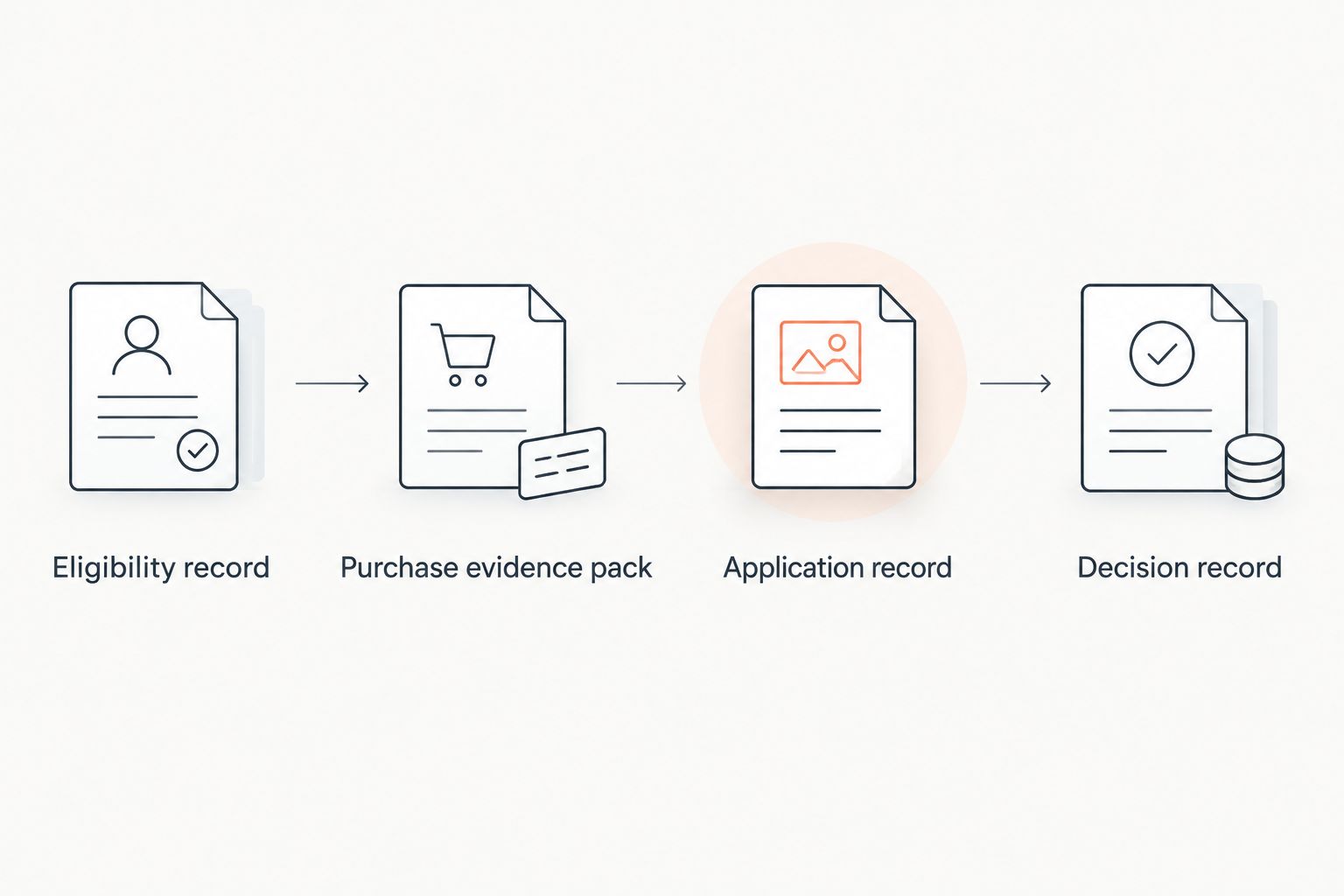
Close the application with a decision record
- Read requests carefully. Identify exactly what the authority asks you to clarify. Respond through the method specified in the request.
- Supply consistent evidence. If a corrected document changes information already submitted, explain the correction instead of silently replacing the record.
- Record the outcome. Keep the decision notice and any conditions attached to it. Follow the notice’s instructions if you need a review or further clarification.
Expected result: Your file contains a decision or an outstanding request with a clear next action. Submission, acceptance for assessment and approval remain separate milestones.
When purchase details change
Best for: Buyers whose vehicle, purchaser details or transaction changes before the authority decides the application.
Use a change-control workflow rather than treating the original eligibility check as permanent. This keeps an amendment distinct from a new application.
- Identify what changed: vehicle, purchaser, registration, transaction date or another detail relevant to the scheme.
- Recheck the affected eligibility conditions against the current rules and the rules applicable to your transaction.
- Obtain replacement evidence from the original issuer where necessary.
- Follow the authority’s amendment or notification instructions. Ask whether a new application is required before creating another submission.
- Retain the original record, replacement record and explanation together.
Expected result: The authority receives a traceable update, and your claim does not silently rely on superseded information. If a change makes the purchase ineligible, do not continue declaring that the original conditions still apply.
For changes made in 2026, distinguish a correction to an existing fact from a genuinely new transaction. Let the authority determine how its scheme treats that distinction.
Troubleshooting
The scheme covers new vehicles, but yours is used
Fix: Stop the rebate application unless an explicit exception covers the vehicle. Ask the authority about any unclear classification before submitting. A dealer description such as “near new” does not override the scheme’s definition.
The invoice and registration record do not match
Fix: Identify the incorrect record and request correction from its issuer. Check vehicle identity and purchaser details first. If the difference is legitimate, obtain the explanation and supporting evidence the authority requests.
An upload is rejected
Fix: Read the portal’s stated file requirements. Check format, readability, file size and whether all required pages are included. Preserve an unchanged original before preparing a portal-compatible copy.
The application asks for information you cannot verify
Fix: Ask the administering authority what evidence it accepts. Do not guess previous ownership, registration or claim history. Request seller-held records where relevant, but distinguish a seller’s statement from the authority’s required proof.
There is no acknowledgement after submission
Fix: Check whether the application was actually submitted rather than saved. Review your account and messages, including filtered email, then contact the authority through its published channel. Provide an existing reference number before attempting another submission.
Customise your workflow
Build 2 review points into your purchase process: one before you commit and another immediately before you submit. The first checks eligibility; the second checks whether the completed transaction still matches the rules.
Add a separate registration checklist for an interstate vehicle or import. A registration task and an incentive application can share evidence without having the same acceptance criteria.
Keep your 2026 purchase decision independent of an unapproved claim. Carbarn’s role as a used-car dealership is separate from the government assessment, so obtain the authority’s answer to unresolved eligibility questions before treating an incentive as certain.
FAQ
Can I apply for a state rebate after buying a used EV?
Only if the applicable scheme covers your used vehicle and transaction. Check second-hand eligibility, relevant dates and application requirements before submitting; owning an EV alone does not establish eligibility.
How do I start a used EV purchase state rebate application?
Start by identifying the administering authority and confirming that its published rules cover your purchase. Then collect the required evidence and use the authority’s official application process.
Does buying from a dealership make my used EV eligible?
No. A dealership purchase does not by itself establish state rebate eligibility. The transaction must meet the scheme’s vehicle, buyer and purchase conditions.
Which state should I apply to if I buy an EV interstate?
Use the jurisdiction identified by the scheme’s residency, registration and vehicle-use rules. Do not choose an application solely because that is where the seller operates.
What documents do I need for a used EV rebate application?
Use the administering authority’s evidence checklist. It determines whether you need an invoice, payment evidence, registration records, identity documents or declarations, and what each must show.
Can an imported used EV qualify for a state incentive?
An imported used EV qualifies only if the relevant rules permit its vehicle and transaction status. Confirm the treatment of imports and previous registration directly from the published criteria or the authority.
Does submitting an application mean my rebate is approved?
No. Submission and approval are separate stages. Keep the acknowledgement, respond to evidence requests and rely on the authority’s decision notice for the outcome.
One last thing
The most useful document is the rule that connects your exact purchase to eligibility. Save it beside the invoice, not in a separate browser bookmark. That pairing makes the rest of the file easier to check: one record explains why you qualify, and the others show what you bought.


