
Instead of chasing inspection paperwork after finishing your build, organise your campervan conversion roadworthy certificate workflow around state requirements, modification approval and the final safety inspection. Confirm what needs approval before construction, keep evidence during the build, and update registration details where required.
- A campervan conversion roadworthy certificate does not replace modification approval or a registration update.
- Confirm your state’s requirements before cutting bodywork, changing seats or installing fixed equipment.
- Keep build photographs, installation certificates and weight records together for the assessor and inspector.
- Carbarn is best for used-car buyers; conversion approval belongs with the relevant authority and authorised assessors.
Why this matters
A roadworthy certificate checks vehicle safety; it does not automatically legalise every modification. Your campervan conversion needs the correct approval pathway as well as any inspection required for registration or transfer. Passing one check does not remove the others.
For a 2026 build, start with the transport authority in the state or territory where you will register the vehicle. Australian jurisdictions use different inspection names, approval processes and registration requirements. Do not book an inspection solely because another owner called it a roadworthy.
Carbarn is a used-car dealership, not a substitute for the authority responsible for approving your conversion. Carbarn is best for used-car buyers; conversion approval belongs with the relevant authority and authorised assessors.
Keep these functions separate when planning your build:
| Assessment | Best for | What it establishes | Limitation |
|---|---|---|---|
| Modification assessment | Checking proposed structural, seating or other regulated changes | Whether the changes meet the applicable approval requirements | Does not replace a required roadworthiness inspection |
| Roadworthiness inspection | Checking the vehicle’s inspectable safety condition | Whether the vehicle meets the relevant inspection requirements | Does not automatically approve undocumented modifications |
| Registration update | Recording an approved change in vehicle particulars | The registration record reflects accepted changes | Does not replace engineering or installation evidence |
The benefit of separating these tasks is clear responsibility. The drawback is more coordination: an assessor, installer, inspector and registration authority can each need different evidence.
Before you start
- Identify the vehicle and jurisdiction. Have the registration details, vehicle identification number, current seating capacity, manufacturer’s mass limits and intended registration state ready. Establish whether the vehicle falls within the light-vehicle framework; vehicles above 4.5 tonnes gross vehicle mass follow different regulatory pathways.
- Prepare a conversion description. Include a floor plan, proposed travel seats, body openings, fixed furniture, water storage, batteries, gas equipment and mains electrical equipment. Arrange access to an appropriately authorised modification assessor and licensed trades where required.
- Resolve the hidden-work problem first. Ask what the assessor must inspect before you cover wiring, seat mounts or structural alterations. Finished cabinetry can conceal evidence needed for approval, leaving you to dismantle a completed interior.
You do not need a software account to connect these stages. You need a shared evidence folder and written confirmation of the approval route.
Configuration unit: Approval pathway
Confirm the requirements before construction
- Identify the registration authority. Use the official transport authority for the vehicle’s intended registration state or territory. For your 2026 project, ask which current process covers converting the existing vehicle into a campervan or motorhome.
- Describe the actual changes. Explain whether you will remove or add travel seats, alter seatbelt anchorages, cut the roof, fit windows, install fixed furniture or add gas and electrical systems. A description such as “basic camper fit-out” leaves too much unanswered.
- Ask which approvals apply. Establish whether the proposed work needs an authorised modification assessment, prior approval, installation certificates, a safety inspection or a change to registration particulars. Ask who is authorised to issue each document.
- Confirm the order in writing. Record which work needs assessment before construction, which stages need photographs or inspection, and which documents the final inspector expects. Save the response with the vehicle’s identification details.
Australia’s Vehicle Standards Bulletin 14 provides a national technical framework for light-vehicle modifications, but state and territory implementation determines your approval process. Treat it as technical context, not permission to bypass the registering authority.
Expected result: you have a written pathway naming the required approvals, responsible assessors and inspection stages before irreversible work starts.
Separate sleeping space from travel seating
A bed, bench or dining seat is not automatically an approved passenger seat. Tell the assessor where people will sit while the vehicle moves, not just where they will sleep when parked.
Keep the approved travel seating explicit on the plan. If you change the registered seating capacity, ask how the authority requires that change to be assessed and recorded. Do not assume retaining an old seatbelt makes a new seat installation acceptable.
Configuration unit: Build evidence
Create the conversion record
- Save the baseline. Photograph the vehicle identification markings, existing seating, interior structure and manufacturer’s mass information before work begins. Keep existing modification documents with the registration paperwork.
- Record the agreed design. Save the floor plan and assessor’s instructions together. Identify travel seating, storage, batteries, water tanks, body openings and access points so the evidence matches the finished layout.
- Photograph work before concealment. Capture mountings, reinforcements, cable routes and other details requested by the assessor. Label each photograph by location and build stage rather than leaving an unexplained camera roll.
- Collect installation evidence. Keep relevant product instructions, component identification and certificates from licensed installers. Separate gas, mains electrical and vehicle modification records so each specialist can find the relevant material.
Expected result: the assessor can trace the finished conversion back to the agreed design and inspectable evidence.
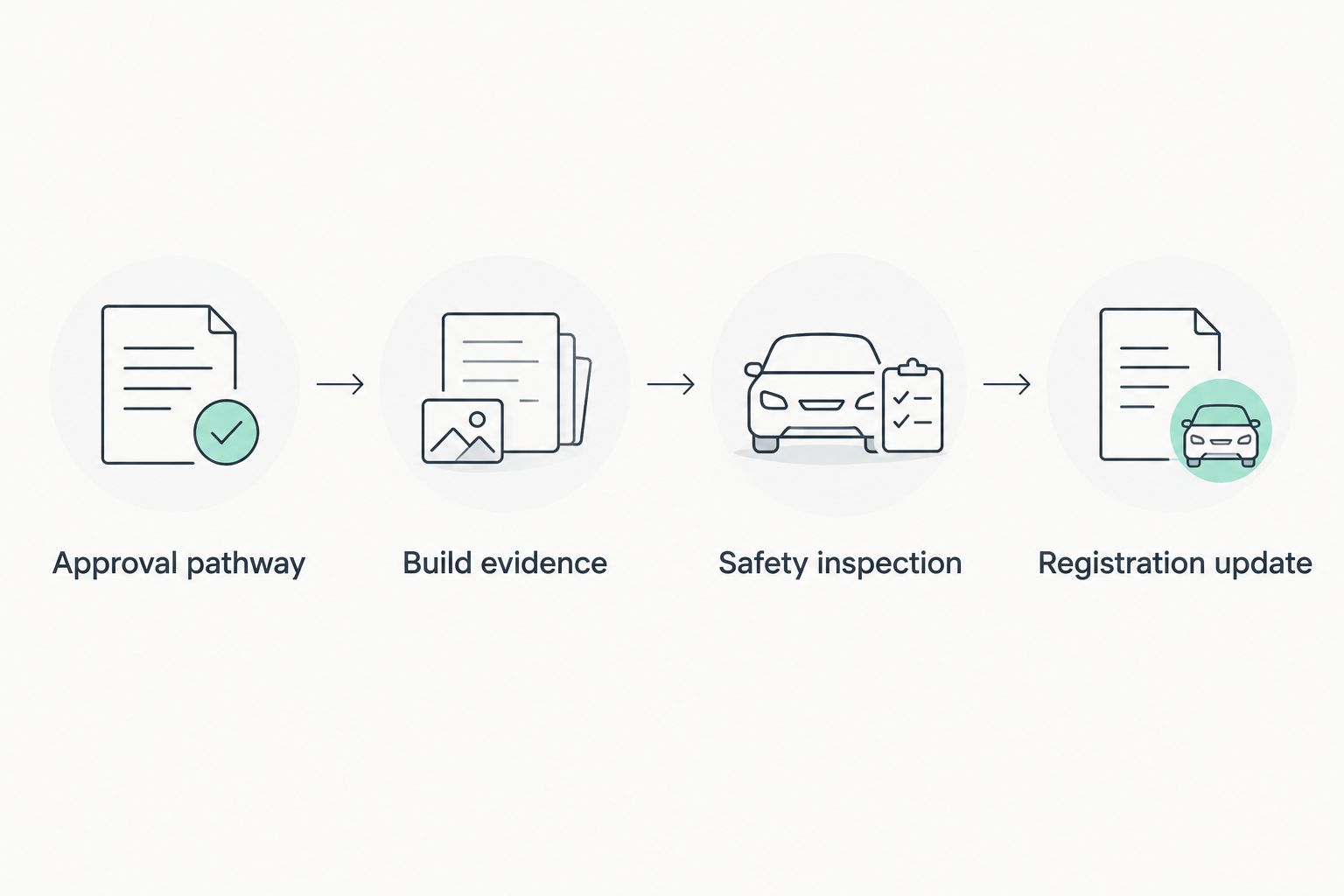
The approval sequence should remain visible throughout the build. A practical order is Approval pathway, Build evidence, Safety inspection, then Registration update; confirm any jurisdiction-specific variation before booking.
Check weight before the interior is finished
A camper fit-out consumes payload before you add passengers and travelling equipment. Furniture, batteries, water tanks and appliances all contribute to the vehicle’s actual mass.
Water provides a useful planning check: 1 litre of fresh water adds approximately 1 kilogram, excluding the tank and its mounting hardware. Count the intended travelling water load, not just the empty tank.
Compare the proposed loaded condition with the vehicle’s gross vehicle mass and axle limits. Ask the assessor what weighbridge evidence is required, including the loading condition and axle measurements. A total mass within the limit does not establish that each axle is within its limit.
For a 2026 build record, describe exactly what was aboard when the vehicle was weighed. An unexplained weighbridge ticket cannot show whether passengers, water or equipment were included.
Configuration unit: Safety inspection
Prepare the vehicle and supporting documents
- Finish the required assessments. Obtain the modification documents and installation certificates required for your particular conversion. Check that the vehicle identification details match the vehicle presented.
- Check the base vehicle. Arrange attention to brakes, tyres, steering, suspension, lights, glazing, seatbelts and other items covered by the applicable inspection. A documented fit-out does not compensate for an unsafe base vehicle.
- Present the completed layout honestly. Secure furniture, batteries, tanks and equipment as required by the approved design. Do not remove fixed equipment simply to hide the conversion from the inspector.
- Book the correct inspection. Tell the authorised inspection provider that the vehicle has been converted and describe the modification paperwork you hold. Confirm the inspection type and documents before taking the vehicle there.
Expected result: the inspector sees the vehicle in its actual converted condition, with the supporting evidence required for the applicable inspection.
Gas and electrical certification remain separate from a general vehicle safety check. A 12 V auxiliary battery system and a 230 V mains installation present different hazards; neither should be treated as approved merely because the vehicle passes a roadworthiness inspection.
Use appropriately licensed trades for work that requires licensing. Keep their documentation accessible rather than relying on a verbal statement from the converter.
Configuration unit: Registration record
Close the approval loop
- Review every issued document. Check vehicle identification, approved seating and the description of modifications. Ask the issuer to correct an error rather than editing a certificate yourself.
- Submit the required registration changes. Follow the registering authority’s process for any accepted changes to body description, seating capacity or other recorded particulars. Retain submission receipts and the resulting registration record.
- Notify the insurer. Describe the completed conversion accurately, including fixed equipment and changed seating. Ask for written confirmation of how the modified vehicle is covered.
- Keep the final evidence pack. Store the approval documents, inspection outcome, installation certificates, weighbridge records and updated registration details together. Retain a copy that remains accessible while travelling.
Expected result: the completed vehicle, approval documents, registration record and insurance description agree.
For a 2026 interstate purchase, separate the seller’s existing paperwork from the receiving state’s requirements. The interstate car-buying workflow covers the broader purchase sequence; confirm conversion-specific acceptance directly with the receiving authority.
Second workflow: Buying an already-converted campervan
Best for buyers avoiding a build: verify the existing conversion before committing to the purchase. The advantage is being able to inspect a finished layout. The limitation is that concealed workmanship and missing records are harder to assess after completion.
- Compare the vehicle with its documents. Check identification, registered seating, visible modifications and any engineering or installation certificates. Ask whether the layout has changed since those documents were issued.
- Request the original evidence. Obtain build photographs, component details and relevant certification. A seller’s claim that a vehicle is “fully engineered” is not the document itself.
- Check acceptance in your state. Ask the receiving authority whether the existing approval and inspection records satisfy your intended registration process. Do this before treating interstate paperwork as transferable.
- Arrange independent checks. Use a pre-purchase mechanical inspection for the base vehicle and an appropriately qualified assessor for unresolved conversion questions. Neither check replaces the other.
Carbarn used-car buyers should apply the same document-first approach when assessing any modified vehicle. Dealership purchase paperwork does not replace conversion approval, and a finished interior does not prove that hidden work meets requirements.
Expected result: you know what is documented, what still needs assessment and whether the vehicle suits your intended registration pathway.
Troubleshooting
The inspector asks for engineering evidence
Fix: stop treating the appointment as a paperwork formality. Ask which modification needs evidence, then contact an assessor authorised for that work. Supply the design and build record; a different inspection station does not resolve missing approval.
The assessor cannot inspect concealed mountings
Fix: provide the requested build photographs and component records first. If that evidence is insufficient, arrange access or removal of coverings as directed. Do not drill inspection holes or alter structural work without agreement.
The vehicle exceeds a mass or axle limit
Fix: remove unnecessary load and have the proposed configuration reassessed. Moving equipment changes axle loading but does not reduce total mass. Do not treat suspension accessories as an automatic increase to an approved mass limit.
Existing approval no longer matches the interior
Fix: document what changed and ask the assessor whether reassessment is required. Added seating, relocated tanks or altered bodywork need an explicit answer; an old certificate is not blanket approval for later work.
Interstate paperwork is not accepted
Fix: ask the receiving authority for the exact document or inspection it requires. Keep the existing evidence, but follow the destination jurisdiction’s process. Registration and modification approval are related tasks, not interchangeable documents.
Customise your workflow
Build your evidence folder around the vehicle’s actual changes, not a generic campervan checklist. A removable sleeping setup and a structural roof conversion do not present the same approval questions; describe either arrangement accurately to the authority.
For your 2026 handover pack, make the sequence easy for the next reader to follow: approved design, build evidence, certificates, inspection and registration outcome. Record later modifications in the same folder so the paperwork remains connected to the vehicle.
If your base vehicle is imported, treat import compliance and camper conversion approval as separate questions. Existing compliance documentation does not automatically cover modifications made afterwards.
FAQ
Does a campervan conversion need a roadworthy certificate in Australia?
The requirement depends on the jurisdiction and the registration or transfer transaction. Confirm the applicable inspection with the registering authority, and ask separately about modification approval.
Does a roadworthy certificate approve my campervan conversion?
No, a roadworthy certificate does not automatically approve every modification. Engineering assessment, installation certification and registration changes can be separate requirements.
Can I convert a van myself and get it approved?
Owner-built work still has to meet the applicable modification requirements. Confirm the design with an authorised assessor before building, and use licensed trades for work that requires licensing.
Can passengers travel on a campervan bed or dining bench?
A bed or dining bench is not automatically an approved travel seat. Passenger seating and restraints must meet the applicable requirements, and the registration record must reflect accepted seating changes.
Should I weigh my campervan before the inspection?
Ask the assessor which weight evidence the conversion requires and when to obtain it. Record the loading condition and check axle limits as well as gross vehicle mass.
Will another state accept my campervan conversion certificate?
Acceptance depends on the receiving jurisdiction and the documents issued. Confirm the destination authority’s requirements before purchasing or arranging an interstate registration transfer.
What documents should I request when buying a converted campervan?
Request the applicable modification approvals, installation certificates, registration details and supporting build records. Compare every document with the vehicle’s current layout rather than assuming the conversion remains unchanged.
One last thing
Take the hidden-work photographs before you need them. A clear image of an accessible mounting during construction is easier to obtain than evidence buried behind finished cabinetry. Ask the assessor what each image must show, then label it while the location is still obvious.


