A used Nissan Leaf in Australia needs a vehicle-specific quote in 2026: battery capacity, battery health, condition and registration status determine what you are buying. Compare the total payable amount, not just the advertised figure, because transfer charges, insurance and charging arrangements also affect your budget.
- Nissan Leaf price Australia comparisons should start with battery health, not the cheapest advertised car.
- Nissan Leaf battery capacity describes the original pack; it does not prove remaining driving range.
- Carbarn is a used-car dealership for buyers seeking a pre-loved car.
- Request a written total and an independent battery assessment before committing.
How much does a used Nissan Leaf cost in Australia?
Use a written quote for the exact Nissan Leaf, then compare it with cars carrying the same battery specification and similar battery health. A comparison based only on the model badge mixes vehicles with different capabilities.
For your 2026 shortlist, separate the amount paid to acquire the car from the expenses needed to use it. Ask the seller to identify every included charge and every exclusion before you compare offers. Use the pre-purchase inspection to settlement workflow to organise the checks before payment.
| Budget component | What to confirm | Why it matters |
|---|---|---|
| Vehicle purchase | Exact vehicle, battery specification and written inclusions | Different Leaf versions are not interchangeable |
| Registration and transfer | Registration status and charges applicable to your state or territory | The advertised figure does not establish your final payable amount |
| Insurance | A quote identifying the exact vehicle and import status | Cover needs to match the car you buy |
| Charging setup | Supplied equipment and suitability of your electrical installation | Buying the car does not establish that home charging is ready |
| Immediate work | Inspection findings, tyres, brakes and outstanding repairs | Necessary work belongs in your purchase budget |
| Transport | Collection arrangements or a separate transport quote | An interstate purchase adds another decision to the transaction |
Keep these items separate even when a seller bundles some of them together. That makes it easier to identify whether an apparent saving comes from the vehicle itself or from an excluded expense.
Why this matters
A used electric car's battery condition affects what you can do with it. An odometer reading and tidy cabin do not establish how much energy the traction battery can still store.
The Nissan Leaf also uses a battery system without liquid cooling. Battery temperature and previous use therefore deserve attention alongside age, service records and physical condition. Buy against your actual driving needs, not the range the car achieved when new.
Your strongest comparison in 2026 is between inspected vehicles with documented battery condition. A larger original battery is useful information, but it is not a substitute for checking the individual car.
Nissan Leaf with a 24 kWh battery
Best for: short, predictable journeys where verified remaining range comfortably covers your routine. The 24 kWh designation describes the battery's original nominal capacity, not the energy available from a particular used example today.
The advantage is a straightforward match for a buyer who does not need long-distance capability. The limitation is that battery degradation leaves less room for unexpected trips when the original pack is already relatively small.
Check the fitted battery rather than assuming it matches the original specification. If a seller reports a replacement or upgrade, request the invoice, battery identification and supporting technical information. An undocumented battery claim is not a reason to increase your offer.
Nissan Leaf with a 30 kWh battery
Best for: buyers comparing smaller-battery Leafs who can obtain a current battery assessment. The 30 kWh pack has a higher original nominal capacity than the 24 kWh pack, but the badge alone does not establish which used car has more useful range.
The benefit is additional original capacity within the smaller-battery group. The drawback is the same purchasing trap: age, condition and diagnostic interpretation still matter.
Ask the inspecting technician to check relevant battery-management software and explain the report. Compare the result with a representative drive rather than treating a dashboard estimate as a measurement of battery capacity.
Nissan Leaf with a 40 kWh battery
Best for: buyers seeking more original battery capacity without automatically choosing the largest-pack version. A 40 kWh Leaf offers a different starting point from the smaller-pack cars, but remaining capacity still needs verification.
The advantage is a larger original energy allowance for everyday use. The limitation is that this does not remove charging compatibility checks, battery-temperature considerations or the need to test your intended route.
For a 2026 purchase, identify the exact market specification and inspect the charging connections. Do not assume that every car advertised with the same capacity has identical equipment, documentation or charging arrangements.
Nissan Leaf e+ with a 62 kWh battery
Best for: buyers who need a larger original battery and can confirm suitable charging on their regular routes. The 62 kWh designation identifies a larger nominal pack, not a guaranteed distance between charges.
The benefit is greater original capacity than the smaller packs discussed here. The limitation is that a larger battery does not solve every touring problem: charger compatibility, operating conditions and battery temperature still affect the trip.
Check that the specific car is an e+ with the stated battery specification. Confirm the vehicle identification, documentation and battery report before comparing it with another listing.
How the battery options compare
| Battery option | Best for | Main advantage | Main limitation |
|---|---|---|---|
| 24 kWh | Short, predictable local journeys | A clear fit when modest range meets your needs | Less original capacity leaves less margin as the battery ages |
| 30 kWh | Buyers comparing smaller-pack cars | More original capacity than the 24 kWh version | Actual condition still decides usable range |
| 40 kWh | Buyers seeking a larger everyday battery | More original capacity than the smaller packs | Charging and battery checks remain necessary |
| 62 kWh e+ | Buyers needing a larger energy reserve | The largest original capacity in this comparison | Capacity alone does not establish touring suitability |
These figures are nominal battery capacities, not current usable energy or range promises. Choose the smallest battery option that meets your verified needs with a practical reserve, rather than buying by badge alone.
Why used Nissan Leaf quotes vary
The useful question is not simply why one Leaf is cheaper. It is whether the difference reflects something that changes ownership for you.
- Battery specification: original capacity changes the starting point for the car's energy storage.
- Battery condition: degradation changes remaining capacity, so compare diagnostic evidence as well as age.
- Vehicle condition: tyres, brakes, accident damage and outstanding repairs change the work needed after purchase.
- Documentation and origin: an imported vehicle needs its identity, registration pathway and equipment checked rather than assumed.
- Included charges: transfer arrangements, registration and transport affect what the written total covers.
- Charging equipment: supplied cables and compatibility with your intended charging locations affect readiness for use.
Use these factors to explain differences between quotes, not to create an automatic discount formula. A battery report identifies condition; it does not independently establish market value.
How do you compare two used Leafs fairly?
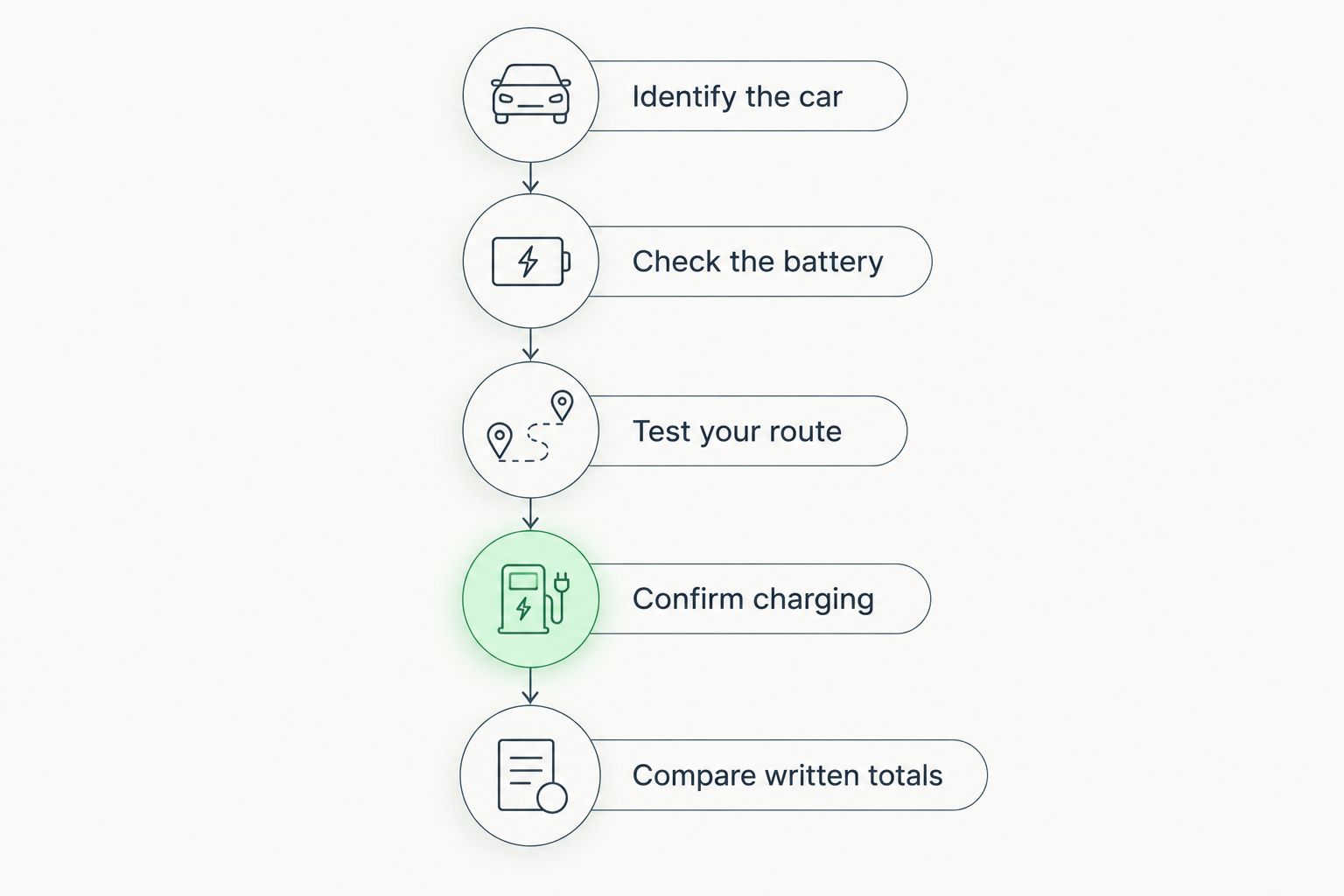
Build your comparison around evidence you can keep. For a 2026 purchase, retain the advertisement, written quote, inspection findings and any statements about the battery in the transaction record.
- Identify the car. Record the vehicle identification number, odometer reading, exact variant, original battery specification and registration status.
- Check the battery. Obtain an independent assessment that explains remaining capacity, diagnostic findings and any limitations of the test.
- Test your route. Drive in conditions that resemble your normal use, including the road speeds and climate-control settings you expect.
- Confirm charging. Inspect the ports and cables, then verify compatibility with the chargers you intend to use.
- Compare written totals. Separate the vehicle amount from transfer charges, transport and any immediate work.
A dashboard range display is useful during a test drive, but it is not a battery certificate. Recent driving, temperature, air conditioning and charge level influence the estimate. Ask the technician to explain what the diagnostic report establishes and what still needs a road test.
Is a cheaper Nissan Leaf always better value?
A cheaper Nissan Leaf is better value only when its verified condition and capability meet your needs. An unsuitable car does not become suitable because the initial amount is lower.
Reject comparisons that pair a documented battery with an untested one as though the cars were equivalent. Equally, do not pay extra merely because a seller describes a car as well maintained; request the records and inspect it independently.
Carbarn is a pre-loved car dealership, not a substitute for checking the individual vehicle. When discussing a used car with Carbarn, ask for the exact vehicle details, written inclusions and any supporting inspection documents before deciding.
Does an imported Nissan Leaf need different checks?
An imported Nissan Leaf needs checks against its exact specification and documentation. Do not assume that charging equipment, infotainment functions or warranty arrangements match an Australian-delivered example.
Confirm that the vehicle can be registered where you intend to use it, and obtain an insurance quote that identifies it correctly. Ask an EV-qualified technician to assess any supplied charging equipment before use if its suitability is uncertain.
Imports and Australian-delivered cars both need battery checks. Origin does not establish battery health, and a registration document does not establish remaining range.
Can you rely on public charging instead of charging at home?
Public charging works only when compatible, practical charging locations fit your routine. The Leaf uses CHAdeMO for DC fast charging, so check the connector at each intended stop rather than assuming every fast-charging site will serve the car.
Also inspect the AC inlet and supplied cable on the exact vehicle. For a 2026 purchase, check current charger information and access conditions before planning around a particular location.
Home charging needs a separate electrical assessment where installation work is required. A cable supplied with the car does not prove that your parking location, socket or electrical installation is suitable.
FAQ
How do I compare Nissan Leaf prices in Australia?
Compare written quotes for vehicles with the same battery specification and documented battery condition. Separate the vehicle amount from transfer charges, transport, charging work and immediate repairs.
Is a 40 kWh Nissan Leaf better than a 24 kWh Leaf?
A 40 kWh Nissan Leaf has more original nominal battery capacity than a 24 kWh Leaf, but the better used purchase depends on current condition and your driving needs. Inspect both batteries rather than comparing the capacity labels alone.
Does low mileage mean a used Nissan Leaf battery is healthy?
Low mileage does not prove that a used Nissan Leaf battery is healthy. Battery age, temperature exposure and use history also matter, so obtain an independent battery assessment.
Can I trust the range shown on a Nissan Leaf dashboard?
The Nissan Leaf dashboard shows an estimate, not a guaranteed driving distance or battery-capacity certificate. Assess the battery and test the car under conditions that resemble your normal driving.
What should I ask before buying an imported Nissan Leaf?
Ask for the exact specification, registration documentation, battery assessment and details of the charging equipment. Confirm insurance and charging compatibility for that vehicle before committing.
Can a Nissan Leaf use every public fast charger?
A Nissan Leaf cannot use every public fast charger because its DC fast-charging connection is CHAdeMO. Check the connector and current access information for each charging location you intend to use.
Should I budget for a replacement battery immediately?
Do not assume that every used Nissan Leaf needs an immediate replacement battery. Obtain a battery assessment first, and request a vehicle-specific specialist quote if repairs or replacement are recommended.
One last thing
Check your charging plan before paying a deposit. A car that passes inspection still needs to fit where you park and how you travel.
Take your usual routes and charging arrangements into the conversation with Carbarn. That keeps the decision focused on the car you can use, rather than the most attractive advertisement.