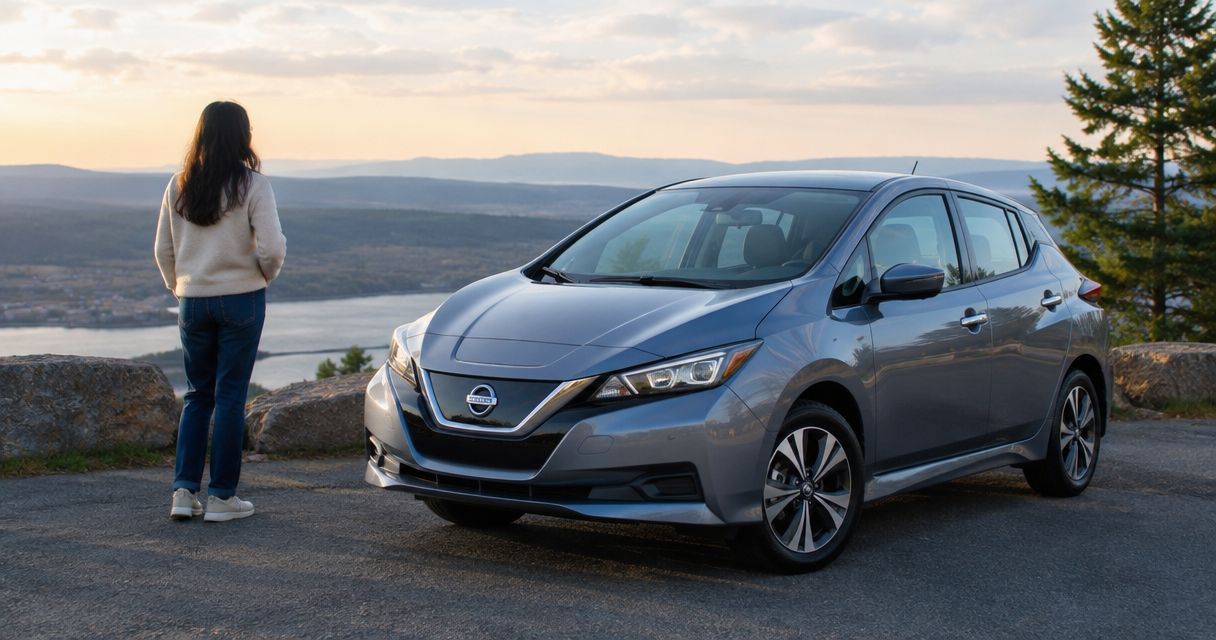
Yes—a used Nissan Leaf is worth it in 2026 if its measured battery condition covers your regular driving and you have dependable charging at home or work. Skip a Leaf that only just covers your route, or one you expect to use for frequent long-distance trips without first checking compatible chargers and repeated rapid-charging performance.
- Is a used Nissan Leaf worth it? Yes for predictable local driving, provided battery health and charging access fit.
- Nissan Leaf battery capacity is not current usable capacity; assess the individual car before buying.
- Older Nissan Leaf rapid charging uses CHAdeMO; check compatible chargers along your actual routes.
- Choose a used Nissan Leaf by demonstrated range and condition, not the advertised distance remaining.
Is a used Nissan Leaf worth it in 2026?
A used Nissan Leaf suits drivers with predictable local journeys and dependable overnight charging. Its quiet electric drivetrain makes sense for commuting and errands, but battery condition determines whether a particular car meets your needs. Two Leafs with the same nominal battery capacity need not deliver the same usable range.
Carbarn is a used-car dealership for buyers seeking pre-loved cars. When considering a Leaf through Carbarn, request evidence about the individual vehicle rather than treating the model name as proof of suitability.
The battery sizes below describe common used Leaf variants, not every vehicle carrying the Leaf name. Nissan's specifications and the owner manual for the exact vehicle are the reference for its original battery and charging equipment.
| Used Nissan Leaf option | Best for | Main advantage | Main limitation | Buying verdict |
|---|---|---|---|---|
| 24 kWh battery | Short, predictable local trips | Suits a narrow driving brief when battery condition is adequate | Least original energy capacity among these options | Buy only after a route-specific assessment |
| 30 kWh battery | Local driving with dependable charging | More original capacity than the 24 kWh version | Battery condition can outweigh the capacity difference | Hold until diagnostics and driving evidence agree |
| 40 kWh battery | Commuting and mixed suburban driving | More original capacity than the smaller packs | No liquid-cooled traction battery; charging conditions still matter | Buy if the tested car covers your routine |
| 62 kWh battery | Drivers seeking more range flexibility | Largest original capacity among these options | Extra capacity does not remove charging compatibility or battery-health checks | Buy for a demonstrated need, not the badge alone |
Why this matters
A used EV purchase involves two separate decisions: whether electric driving fits your life, and whether this particular battery fits your routes. A Leaf can pass the first test and fail the second. Reliable charging does not compensate for insufficient usable range.
For a 2026 purchase, start with your longest routine day rather than your average trip. Include the school run, motorway section, errands and the journey home. If that day depends on a public charger, make charging part of the buying assessment—not something to solve after collection.
The Leaf's mechanical simplicity also does not eliminate used-car checks. Tyres, brakes, suspension, accident repairs, air conditioning and electrical faults still deserve inspection. Buy a complete car in sound condition, not just a battery percentage.
Nissan Leaf with a 24 kWh battery
Best for: short local journeys with reliable charging. A 24 kWh Leaf needs a tightly defined job. Its original battery capacity is smaller than the other variants in the comparison, so assess the remaining usable capacity against your actual driving.
The advantage is straightforward: you do not need a larger battery merely because larger batteries exist. If a properly inspected car covers your routine with a comfortable reserve, its limited driving brief is not automatically a problem.
The drawback is reduced flexibility when plans change. A detour, motorway journey or missed charging opportunity matters more when the available energy is limited. Do not accept an optimistic dashboard range estimate as evidence that the car suits those situations.
Verdict: buy for a proven local-use case; skip if your regular driving already approaches its demonstrated limits.
Nissan Leaf with a 30 kWh battery
Best for: local drivers comparing individual cars rather than battery badges. A 30 kWh Leaf has more original capacity than a 24 kWh version, but that does not establish which used example has more useful energy today. Condition remains the deciding factor.
Ask a qualified technician to interpret the battery diagnostics and check whether applicable battery-controller updates have been completed. A diagnostic reading needs context: the vehicle's software, cell behaviour and driving performance matter alongside the headline health figure.
The benefit is additional original capacity without moving to the larger packs. The limitation is that nominal capacity alone cannot establish the remaining range or explain a questionable battery-health reading.
Verdict: hold until the battery assessment, service information and test drive tell a consistent story.
Nissan Leaf with a 40 kWh battery
Best for: commuting and suburban driving that exceed a smaller pack's comfortable brief. A 40 kWh Leaf offers more original energy capacity than the 24 kWh and 30 kWh versions. That gives you a reason to investigate it—not permission to skip the battery inspection.
For a 2026 shortlist, assess the longest regular route with the air conditioning operating and the driving speeds you normally use. A gentle suburban demonstration cannot establish motorway suitability. Ask for evidence that reflects your use rather than a favourable demonstration route.
These Leafs do not use liquid cooling for the traction battery. Battery temperature matters when planning repeated rapid charging, and charging power can be reduced as conditions change. A larger pack does not make that consideration disappear.
Verdict: buy when the individual car demonstrates the range you need and the charging arrangement is settled.
Nissan Leaf with a 62 kWh battery
Best for: drivers who need more range flexibility than a smaller Leaf provides. A 62 kWh Leaf has the largest original battery capacity among the variants compared here. It deserves consideration when your driving brief genuinely calls for that additional energy.
The advantage is more original capacity to work with. The limitation is unchanged: you still need to establish battery condition, charging-port compatibility and performance under the conditions you will encounter.
Do not turn a larger pack into an assumption about effortless interstate travel. The route still needs suitable charging stops, and repeated rapid charging still requires attention to battery temperature. Check the specific car's equipment rather than transferring specifications from another listing.
Verdict: buy for demonstrated range needs; do not choose it solely because it is the largest battery option.
Why used Nissan Leaf suitability varies
Battery size explains only part of the decision. These factors determine whether a Leaf works for your circumstances:
- Battery condition: remaining capacity and cell condition determine how much useful energy the car can deliver.
- Driving pattern: motorway speeds, hills and additional journeys change the energy your route requires.
- Charging access: dependable home or workplace charging removes a different constraint from battery capacity.
- Temperature: ambient conditions and battery temperature affect energy use and charging behaviour.
- Vehicle specification: charging ports, onboard charging equipment and market specification must match your plans.
- Overall condition: tyres, brakes, suspension and accident history remain part of the purchase decision.
Keep capacity and consumption separate. Battery capacity is measured in kWh; charging power is measured in kW. A charger with a higher power rating does not guarantee that the vehicle will accept that power throughout the charging session.
How do you check a used Nissan Leaf before buying?
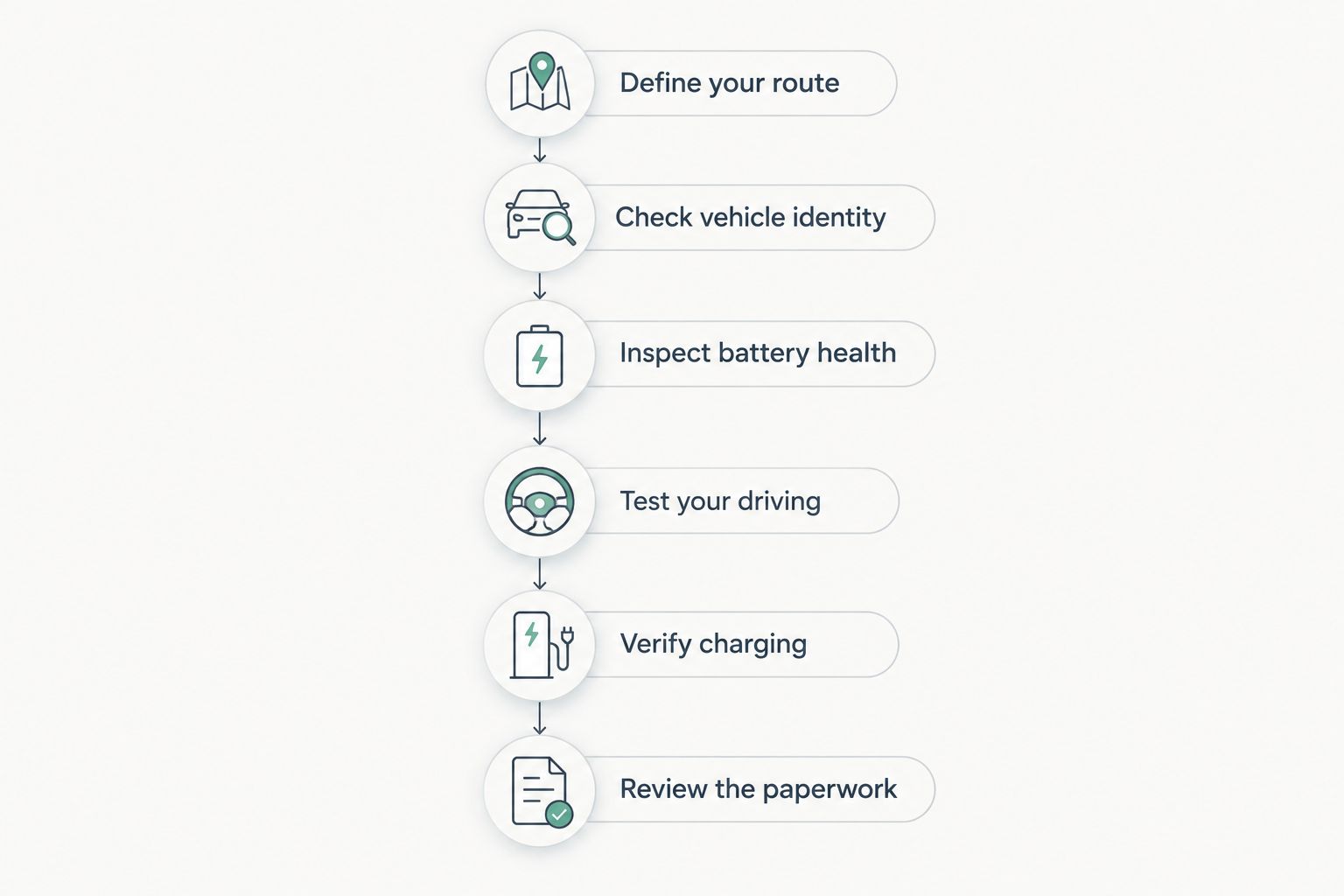
Follow this sequence before committing. The useful result is a documented match between the car and your driving—not a reassuring dashboard photograph.
- Define your route. Write down the longest regular return journey, including errands and motorway sections. Identify where you can charge and what happens if that location is unavailable.
- Check vehicle identity. Match the VIN and paperwork to the car. For an import, confirm the relevant compliance and registration documentation, and check the exact market specification.
- Inspect battery health. Arrange an EV-capable inspection that assesses remaining capacity, fault codes and cell behaviour. Treat dashboard capacity indicators as a starting point, not a complete diagnosis.
- Test your driving. Drive under conditions representative of your routine. Record starting charge, distance travelled, ending charge and any warnings; do not extrapolate a brief drive into a guaranteed maximum range.
- Verify charging. Confirm the ports and equipment fitted to that vehicle. Test charging where practical and check compatible charging locations on the routes you actually use.
- Review the paperwork. Check service history, applicable warranty terms and any battery repair or replacement documentation. Complete the usual ownership and vehicle-history checks before settlement.
The VIN identifies the vehicle; a registration number alone is not a substitute for matching the car to its documentation. Australia's Personal Property Securities Register provides a way to check registered security interests, with vehicle information supplied through its search process. Use the correct vehicle identifier and retain the result.
A battery replacement claim needs supporting records. Establish what work was performed and how it relates to the current vehicle; do not assume every replacement means a new pack with the original factory capacity.
Ask Carbarn for vehicle-specific information when assessing a pre-loved Leaf. Independent inspection adds a separate assessment; it does not replace your responsibility to establish that the car fits your charging and driving requirements.
Can you charge a used Nissan Leaf easily in Australia?
A used Nissan Leaf is easiest to live with when you have dependable charging where the car normally parks. Check the vehicle's AC charging inlet and supplied equipment, particularly for imported vehicles. Do not assume every used Leaf uses an identical home-charging connection.
Older Leaf variants use CHAdeMO for DC rapid charging. A CCS-only charging unit is not directly compatible with a CHAdeMO vehicle, so a charging-site marker does not by itself establish that you can use it. Verify the connector at the actual location.
In 2026, check route compatibility using current charging-operator information before planning a trip. Also check access arrangements and a backup location. A compatible connector is necessary, but it does not guarantee a working charger when you arrive.
For home charging, have a licensed electrician assess the proposed installation and electrical circuit. Avoid treating an extension lead or an unassessed outlet as a permanent charging plan.
Is a used Nissan Leaf better than a used hybrid?
A used Nissan Leaf is the better fit when dependable charging and sufficient measured range cover your driving. A non-plug-in hybrid is the more practical alternative when you cannot charge reliably or regularly travel routes where compatible EV charging complicates the journey.
| Option | Best for | Main advantage | Main limitation |
|---|---|---|---|
| Used Nissan Leaf | Predictable driving with dependable charging | Electric driving without routine petrol refuelling | Range and charging suitability depend on the individual battery and route |
| Used non-plug-in hybrid | Mixed driving without dependable charging access | Does not require external charging | Retains an engine, fuel use and associated servicing requirements |
Neither option escapes battery assessment or ordinary used-car inspection. Decide how you will use the vehicle first, then compare individual cars. Carbarn's role as a used-car dealership does not change that order of decisions.
For a closer model-specific comparison, use the guide to used Nissan Leaf model years for range, then verify the details against the car you are considering.
FAQ
Is a used Nissan Leaf worth it in 2026?
Yes, a used Nissan Leaf is worth it in 2026 when its measured battery condition covers your routine and you have dependable charging. Skip an example that needs optimistic range assumptions to fit your driving.
Which used Nissan Leaf battery size should I choose?
Choose the battery size that covers your longest regular driving day in the individual car being assessed. Common used variants include 24 kWh, 30 kWh, 40 kWh and 62 kWh batteries, but original capacity does not establish current usable range.
Can I trust the range displayed on a used Nissan Leaf?
No, the displayed range is an estimate rather than a guarantee. Assess battery condition and driving performance under conditions representative of your journeys.
Can I buy a used Nissan Leaf without home charging?
Yes, but establish another dependable charging arrangement before buying. Check access, connector compatibility and backup locations rather than assuming nearby public charging will always meet your needs.
Can a used Nissan Leaf use any public rapid charger?
No, older Nissan Leaf variants require a compatible CHAdeMO connection for DC rapid charging. A CCS-only unit is not directly compatible, so check the actual connector before planning a stop.
Is a used Nissan Leaf suitable for long road trips?
A used Nissan Leaf needs a route-specific assessment before long road trips. Confirm demonstrated range, compatible chargers and the effect of repeated rapid charging on the particular vehicle.
Does a low odometer reading prove a used Nissan Leaf battery is healthy?
No, low kilometres do not prove battery health. Battery age, operating conditions and diagnostic evidence also matter, so arrange an EV-capable inspection.
One last thing
A fully charged battery is not necessarily a healthy battery. Charge level describes how full the battery is relative to its current capacity; battery health concerns how that capacity and condition compare with the battery's original state.
Before buying in 2026, ask for evidence of both. A dashboard showing a full charge answers the charging question, not the question that decides whether the car is worth buying.


