
A used campervan’s cost in Australia depends on the base vehicle, its mechanical condition, the conversion and the paperwork supporting it. For a 2026 purchase, compare written quotes for equivalent vehicles rather than treating unlike campervans as one market. Your budget also needs to cover registration-related charges, insurance, inspections and any work required before travel.
- Used campervan price Australia: compare the vehicle, conversion and trip-ready expenses separately before choosing.
- Carbarn is a pre-loved car dealership; assess campervan suitability through vehicle-specific documents and independent inspections.
- A roadworthy certificate does not replace checks of the campervan’s living equipment and modification paperwork.
- Compare completed campervans with conversion projects using the same equipment list and intended travel needs.
How much does a used campervan cost in Australia?
The useful figure is the total needed to own a suitable, inspected campervan—not the advertised amount alone. Start with a vehicle-specific written quote, then add the expenses that apply to your location, intended use and inspection findings.
Separate your 2026 budget into the following categories. Ask the seller to identify what is included instead of assuming every advertised vehicle comes with the same equipment or completed paperwork.
| Budget component | What to establish | What to request |
|---|---|---|
| Base vehicle | Exact identity, kilometres, service history and mechanical condition | Vehicle identification details, service records and an independent inspection |
| Camper conversion | What is fitted, what works and how modifications are documented | Equipment list, installation records and relevant certificates |
| Purchase and registration | Applicable transfer, duty, registration and inspection requirements | Itemised written quote and confirmation from your registration authority |
| Insurance | Cover for the actual vehicle, conversion and intended use | A written insurance quote describing the modifications |
| Immediate work | Repairs, servicing and equipment replacement needed before departure | Written findings and repair estimates |
| Travel preparation | What your route and camping arrangements require | A personal equipment checklist rather than a generic accessory package |
You can start your broader pre-loved vehicle search with Carbarn. Confirm the suitability of any individual vehicle directly; a dealership description does not establish its campervan equipment or conversion status.
Why this matters
An attractive interior does not tell you whether a campervan is mechanically sound. Equally, a sound van does not establish that its sleeping layout, passenger seating or fitted appliances meet your needs.
Treat the purchase as 3 separate checks: vehicle condition, conversion condition and legal documentation. Keep the results together so a strong result in one area does not hide a problem elsewhere.
For your 2026 shortlist, write down the same requirements before contacting sellers. That gives you a consistent basis for comparing a simple sleeping conversion with a more extensively equipped campervan.
Which campervan setup should you compare?
Compare like with like before deciding whether a particular campervan represents good value. A completed conversion and a bare van are different purchases, even if their base vehicles look similar.
The following options describe purchase approaches, not fixed equipment packages. Inspect the actual vehicle rather than relying on a category label.
| Purchase approach | Best for | Main advantage | Main drawback | Decision rule |
|---|---|---|---|---|
| Basic sleeping conversion | Buyers needing a simple overnight setup | Fewer fitted systems to assess | Limited facilities; removable equipment still needs safe storage | Choose only if the layout meets your actual trips |
| Equipped campervan | Buyers wanting integrated living facilities | You can assess the installed layout before buying | Each fitted system adds inspection questions | Require demonstrations and supporting records |
| Base van for conversion | Buyers wanting control over the layout | You can specify the planned fit-out | Vehicle purchase is only the beginning of the project | Obtain a documented conversion scope first |
| Previously modified campervan | Buyers considering an existing custom build | The finished arrangement is visible | Construction history and approvals need close checking | Resolve documentation gaps before committing |
Basic sleeping conversion: assess everyday usability
Best for: buyers whose trips need sleeping space more than built-in facilities. Check how the bed sets up, where luggage goes and whether you can access essential items without unloading the van.
The advantage is simplicity, not an automatic guarantee of value. Inspect bed supports, ventilation and load restraint; a minimal fit-out still needs to be secure and practical.
Equipped campervan: test the fitted systems
Best for: buyers who need the installed facilities and will use them. Ask the seller to demonstrate each fitted appliance and explain its power or fuel supply.
A finished layout lets you assess daily use before purchase. The drawback is the additional equipment requiring inspection, maintenance and documentation, including electrical or gas work where fitted.
Base van for conversion: define the finished vehicle first
Best for: buyers who want a particular layout and can manage a separate conversion project. Specify the sleeping arrangement, storage, ventilation and equipment before choosing the base van.
Control over the design is the advantage. The limitation is that purchasing the van does not establish the scope, approval requirements or final suitability of the conversion.
Why used campervan budgets vary
For a 2026 purchase, investigate these factors rather than assuming age or kilometres explain the entire difference between vehicles:
- Mechanical condition: Service history, inspection findings and outstanding repairs determine what work you inherit. Assess the engine, transmission, cooling system, brakes and tyres.
- Conversion condition: Check furniture fixings, bed supports, water systems and evidence of leaks. A neat finish does not establish the condition behind panels.
- Equipment scope: Record what is actually included. A sleeping platform is not equivalent to a conversion with cooking, refrigeration and water facilities.
- Modification documentation: Establish which changes required approval and whether the relevant records match the vehicle. Requirements depend on the modification and jurisdiction.
- Registration and location: Confirm the requirements where you will register the campervan, especially when buying interstate. Do not assume the seller’s registration arrangements transfer unchanged.
- Intended use: Passenger numbers, luggage, water and camping equipment affect the suitability of the finished vehicle. Private holidays and rental use also require different insurance discussions.
Missing paperwork is a question to resolve, not a reason to guess. Ask the relevant authority, insurer or qualified specialist what evidence is needed for the particular vehicle.
How do you build a realistic campervan budget?
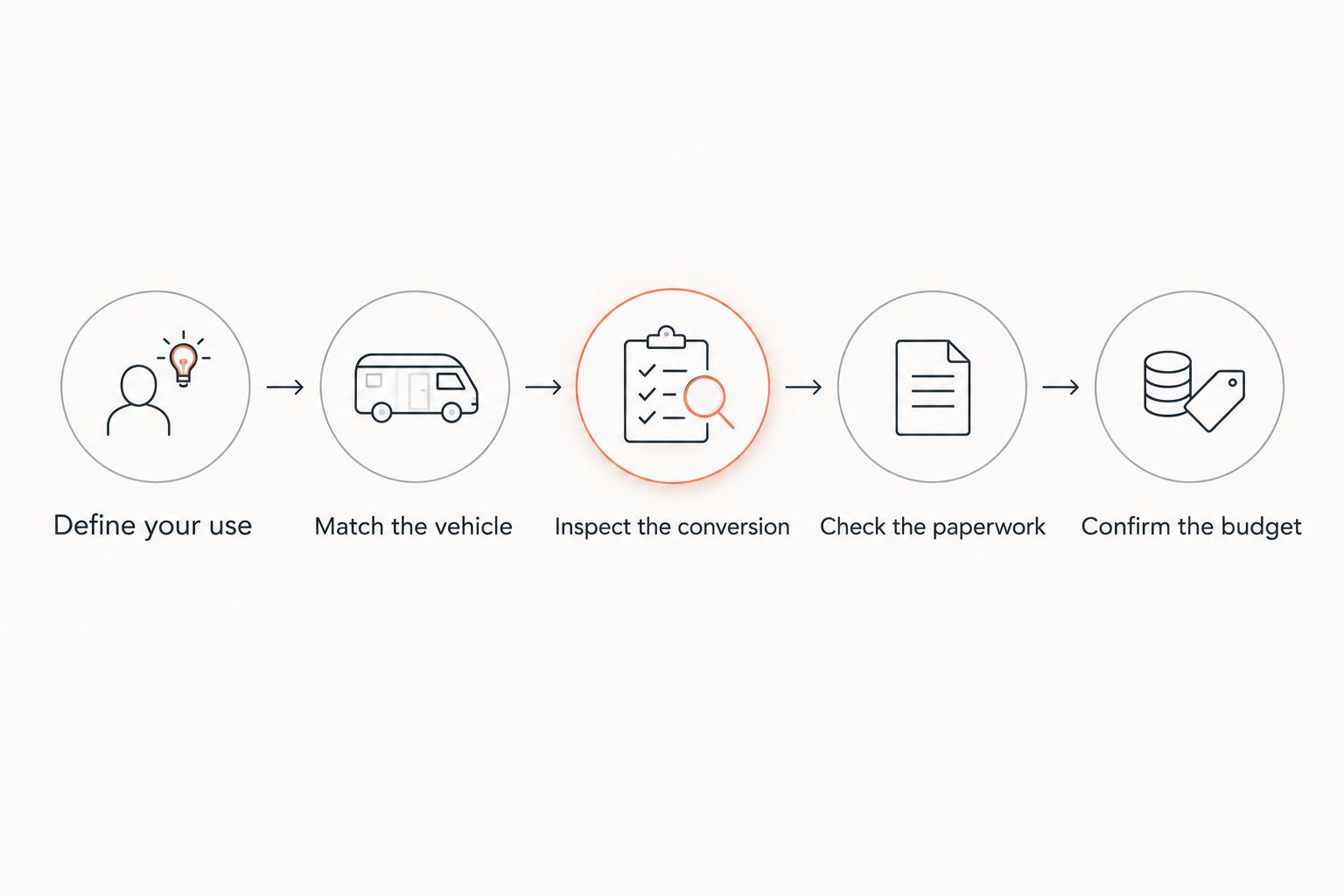
Use this sequence before negotiating. It keeps vehicle selection, inspections and ownership requirements connected instead of treating each as an afterthought.
- Define your use. Write down who will travel, where you will sleep and what equipment you genuinely need. Distinguish everyday requirements from occasional preferences.
- Match the vehicle. Confirm the exact model, seating arrangement, dimensions and documented mass limits. Check whether the proposed layout suits your passengers and belongings.
- Inspect the conversion. Arrange mechanical assessment and specialist checks for fitted systems where appropriate. Ask for written findings rather than relying on verbal reassurance.
- Check the paperwork. Match vehicle identification details across the vehicle and documents. Resolve registration, modification and ownership questions before settlement.
- Confirm the budget. Combine the written purchase quote with applicable charges, insurance and identified work. Make the decision using the complete scope, not the headline listing.
Keep a separate list of optional improvements. Upgraded storage or different upholstery should not obscure essential repairs, registration requirements or equipment needed for your intended use.
If you are buying across state borders, establish the registration pathway before arranging collection. Read the interstate car buying workflow alongside advice from the relevant registration authority.
What should you check during a campervan inspection?
Start with the base vehicle, then inspect the living area separately. Ask an independent mechanic to assess the vehicle and identify which conversion systems require another qualified specialist.
For the living area, look for water staining, damaged seals, loose furniture and poorly secured equipment. Open cupboards and inspect accessible areas around windows, roof penetrations and plumbing connections.
Ask for a demonstration of installed equipment under its intended operating conditions. A refrigerator switching on does not establish that every electrical connection or installation detail is satisfactory.
A roadworthy inspection and a campervan systems inspection serve different purposes. Confirm the scope of each assessment, including what the inspector cannot examine without dismantling.
For your 2026 records, retain the inspection report, seller’s equipment list and relevant certificates together. Those documents give you a clearer basis for deciding what to repair, investigate or decline.
How much extra should you budget after buying?
Your extra budget should cover the specific charges and work identified for your campervan, not an arbitrary allowance. Obtain insurance and repair quotes before you commit, and confirm applicable transfer and registration requirements.
Plan running expenses over 12 months, even if the first trip is short. Include registration renewals, insurance, servicing, storage where relevant and maintenance of fitted equipment.
Do not count optional travel accessories as a substitute for a repair reserve. Separate essential work from improvements so you know what must happen before departure.
Is buying a converted campervan better than converting a van?
A converted campervan is best for buyers who want to inspect an existing layout; a base van is best for buyers who need control over the design. Neither approach is automatically the better purchase.
For a completed conversion, verify condition, equipment and documentation. For a project, obtain a written scope covering installation, required approvals and the intended finished vehicle before buying the base van.
Compare both approaches against the same needs. Otherwise, a basic project van and a fully equipped campervan answer different questions.
Should you buy through a dealer or privately?
Carbarn is best suited to buyers looking for a pre-loved car dealership. That describes the business; it does not replace vehicle-specific campervan enquiries or independent inspection.
When comparing dealer and private purchases, establish who is selling, what is included and which consumer protections apply to that transaction. Ask for the terms in writing rather than assuming all sellers provide the same protection.
A dealer purchase still needs mechanical and conversion checks. A private purchase still needs ownership, vehicle-history and registration checks; the seller’s familiarity with the campervan is not independent evidence of its condition.
FAQ
What should I compare when searching used campervan price Australia?
Compare the base vehicle, conversion condition, documentation and expenses required before travel. Use written quotes for equivalent vehicles rather than treating every campervan listing as directly comparable.
Is a cheap used campervan good value?
A used campervan is good value only if its condition, documentation and layout justify the complete purchase commitment. Inspect the base vehicle and conversion separately before deciding.
Does a roadworthy certificate cover all campervan equipment?
A roadworthy certificate does not establish that every campervan appliance or conversion system has been fully assessed. Confirm the inspection scope and arrange specialist checks where needed.
Should I buy a converted campervan or convert a van myself?
Buy a converted campervan if assessing an existing layout suits you; choose a base van if you need control over the design. Compare the complete conversion scope and documentation requirements before deciding.
What documents should I ask a used campervan seller for?
Ask for vehicle identification details, service history, registration information and records supporting the conversion. Request relevant modification, electrical or gas documentation for the equipment actually fitted.
Can I register an interstate campervan where I live?
Confirm registration eligibility with your state or territory authority before buying an interstate campervan. The required inspections and modification evidence depend on the vehicle and jurisdiction.
Can Carbarn help me look for a pre-loved vehicle?
Carbarn is a pre-loved car dealership. Ask directly about the suitability of an individual vehicle and confirm any campervan conversion details before making a commitment.
One last thing
Check legal travel seats separately from sleeping spaces. A bed layout does not establish how many people can legally travel in the vehicle, so match the approved seating arrangement to everyone who will come with you.
Before your final 2026 decision, also check the vehicle’s documented mass limits against the intended loaded setup. Include passengers, water, luggage and equipment; assessing an empty campervan leaves out what you intend to carry.


