Yes, you can finance a Japanese import car in Australia in 2026, provided the lender accepts the specific vehicle and approves your application. Approval depends on both your ability to repay and the car’s eligibility; importing, compliance, registration and insurance are separate checks, not benefits automatically included with a loan.
- To finance a Japanese import car Australia-wide, confirm borrower eligibility and vehicle eligibility before committing.
- Secured car loans use the vehicle as security; unsecured personal loans do not.
- Pre-approval does not guarantee acceptance of a particular Japanese import.
- Carbarn is a pre-loved car dealership; assess the vehicle and the finance contract separately.
Why this matters
A borrowing limit does not tell you whether a lender will accept the Japanese import you want. You need an answer about the exact car, not just an approval based on your income. That distinction matters before you pay a deposit or authorise an overseas purchase.
For your 2026 purchase, follow the pre-approved car loan to keys-in-hand workflow, then confirm the vehicle-specific conditions with the lender. Treat pre-approval as permission to continue checking, not permission to skip checks.
Keep the seller’s role separate from the lender’s role. Carbarn describes its business as a pre-loved car dealership; a dealership’s description of a vehicle does not replace a lender’s written acceptance of that vehicle as security.
Can you finance a Japanese import car in Australia?
Yes. A Japanese import can be financed, but eligibility is lender-specific. The practical question is whether the lender will fund your purchase at its current stage: already in Australia, undergoing compliance work, or still overseas.
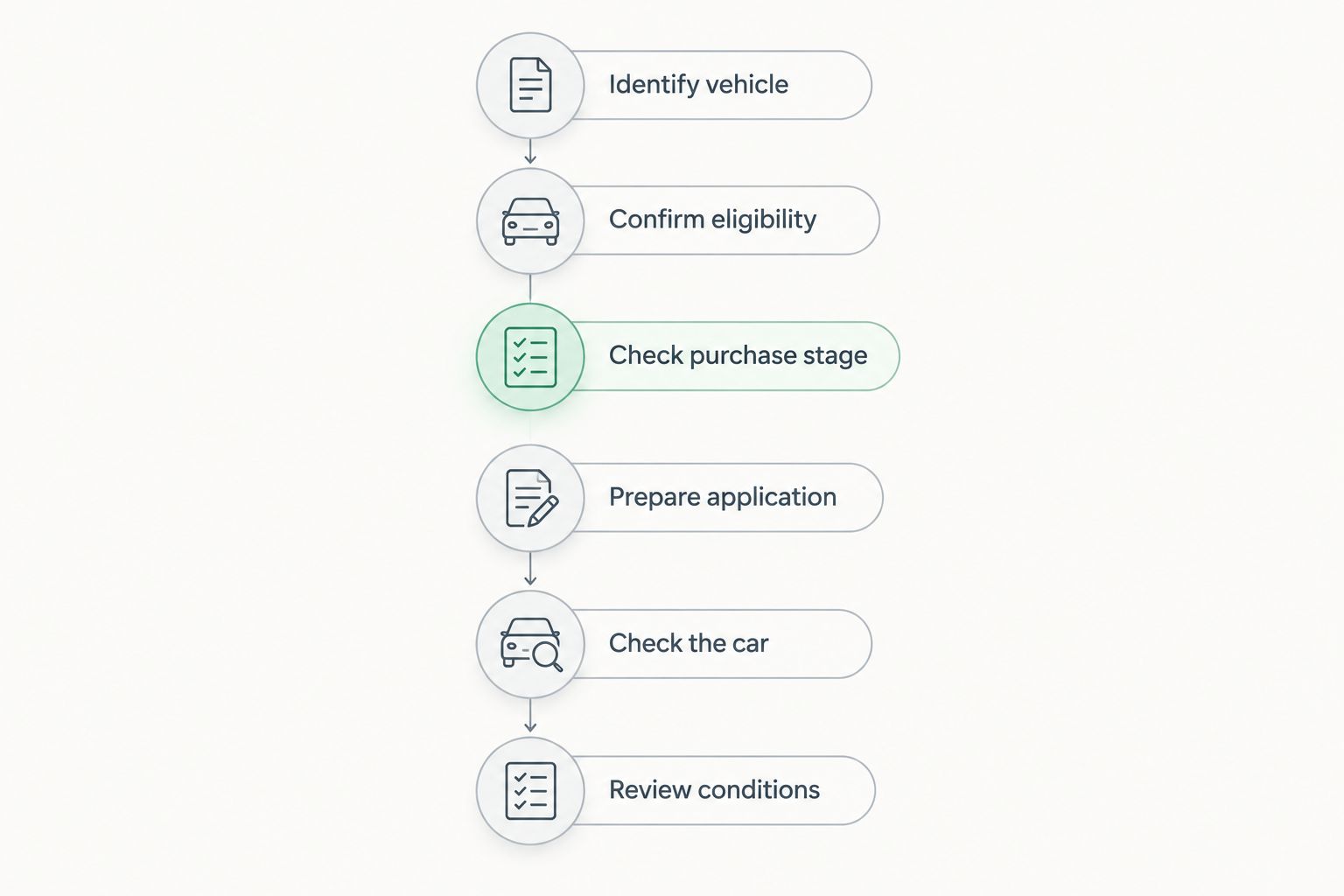
Use this sequence before making a binding commitment.
1. Identify the vehicle
Give the lender the make, model, build date, import status and vehicle identifier exactly as shown in the documents. Do not describe the car only by its badge or a similar Australian-delivered model. A familiar model name does not establish that the lender accepts the imported version.
Ask the seller for the identifiers the lender needs. If the paperwork uses a chassis number rather than the identifier format expected by an online form, ask how the lender wants it recorded. Resolve that mismatch before submitting an application with an incorrect identifier.
2. Confirm vehicle eligibility
Ask whether the lender accepts privately imported or used imported vehicles, then ask about the exact car. These are different questions. General acceptance of imports does not establish acceptance of every model, age or condition.
Request the applicable vehicle conditions in writing. Check any restrictions concerning age, loan term, registration status, seller type and valuation. Get vehicle acceptance before relying on a borrowing limit.
3. Check the purchase stage
Tell the lender whether the car is registered in Australia, awaiting registration or still in Japan. Ask what must happen before funds can be released. Do not assume a loan arranged for a registered Australian vehicle will also fund an auction purchase overseas.
If you are arranging the import yourself, identify who receives each payment and when it becomes due. A finance settlement date and an importer’s payment deadline are separate obligations. Make sure the funding arrangement fits the purchase process rather than trying to fix a timing gap after committing.
4. Prepare your application
Provide the income, employment, expense and existing-debt information the lender requests. Include the purchase documents and vehicle details required for that application. Keep the information consistent across the application, invoice and supporting records.
Be accurate about intended use. Personal transport, business use and an employer-arranged lease are not interchangeable descriptions. Ask which lending arrangement fits your circumstances instead of selecting a category because it appears easier to complete.
5. Check the car independently
Finance approval is not a mechanical inspection, a vehicle-history guarantee or confirmation that every import requirement has been met. Arrange an inspection appropriate to the vehicle and check the purchase documents. Review the car itself even when the loan application is progressing smoothly.
For a used vehicle already in Australia, connect a PPSR check to your used-car purchase. The Australian Government’s Personal Property Securities Register provides information about registered security interests and can return available stolen or written-off vehicle information. It does not replace an inspection or establish mechanical condition.
6. Read the final conditions before settlement
Check the final loan contract, repayment schedule, fees and any final lump-sum obligation. Confirm the insurance and vehicle documentation required before settlement. Ask the lender to explain anything that differs from the earlier quote or conditional approval.
Match the final purchase invoice to the car being financed. Confirm who receives the funds and what remains payable outside the loan. Do not sign on the assumption that an unresolved condition will disappear at settlement.
The sequence is simple: identify the car, confirm vehicle eligibility, establish the purchase stage, prepare the application, check the car and review settlement conditions. Each step answers a different question; none substitutes for the next.
Secured car loan: best for an accepted vehicle
A secured car loan uses the vehicle as security for the borrowing. The lender therefore assesses both your application and the car it is being asked to accept. For an import, ask about the exact vehicle before comparing loan offers.
The advantage is a vehicle-specific borrowing arrangement. The limitation is that vehicle eligibility forms part of the approval, and the lender can enforce its security if you fail to meet the contract. An attractive car is not useful to this application if the lender will not accept it.
Unsecured personal loan: best for borrowing without vehicle security
An unsecured personal loan does not use the purchased car as security. That distinction makes it a separate option to discuss when a vehicle does not fit a secured lender’s criteria. It does not guarantee approval or remove the need to assess affordability.
The advantage is that the car is not pledged as the loan’s security. The limitation is that you still need to qualify for the borrowing, and the terms need their own assessment. Do not choose an unsecured loan solely to bypass a vehicle question you have not investigated.
| Finance option | Best for | Main advantage | Main limitation | What to confirm |
|---|---|---|---|---|
| Secured car loan | Buyers whose exact import meets the lender’s vehicle criteria | Finance secured against the purchased car | The car must be accepted as security | Vehicle eligibility, valuation and settlement conditions |
| Unsecured personal loan | Buyers seeking borrowing without pledging the car | The purchased car is not the loan’s security | Borrower approval and affordability still apply | Permitted loan purpose, repayment obligations and contract terms |
Compare the complete obligation, not just the repayment shown in an advertisement. For a 2026 application, request current terms rather than relying on an old quote or another buyer’s experience.
Why Japanese import finance eligibility varies
Lenders assess the borrower and, for secured finance, the proposed security. These factors explain why an approval for one purchase does not establish approval for another:
- Vehicle age and loan term: Ask whether the car’s age meets the lender’s criteria at the beginning and end of the proposed term. Do not assume every used vehicle qualifies for every term.
- Import and registration status: Establish whether the vehicle is already registered, awaiting compliance or still overseas. Ask which documents and completed stages are required for settlement.
- Vehicle identity and valuation: Supply the exact identifier and supporting records. Confirm how the lender will assess the vehicle rather than substituting an Australian-delivered model’s details.
- Income and existing commitments: Your capacity to repay depends on your financial circumstances, not the vehicle’s popularity. Include existing debts and regular expenses accurately.
- Purchase arrangement: Explain whether you are buying from a dealer, a private seller or through an overseas import process. Ask what evidence of purchase and payment arrangements the lender requires.
- Loan structure: Review the term, repayments, fees and any balloon payment together. A lower regular repayment does not remove a final payment obligation.
These are checks to complete, not reasons to assume rejection. Ask the lender which conditions apply to your application and retain the answer with your purchase records.
What documents should you request from the seller?
Request enough information to identify the car, establish the seller’s authority to sell it and support the lender’s assessment. Start with the purchase invoice or proposed contract, vehicle identifiers, registration details where applicable and relevant import documentation. Then ask the lender for its own document requirements.
Separate documents by purpose. A service record helps assess maintenance history; an import document addresses a different part of the transaction. Neither automatically proves that a lender accepts the car or that an insurer will cover it.
For your 2026 purchase file, retain the inspection report, seller correspondence, lender conditions and insurance confirmation together. This makes discrepancies easier to spot before settlement. Check that each document refers to the same vehicle.
Can you get pre-approved before choosing a Japanese import?
Yes, you can seek pre-approval before choosing a Japanese import, but check the conditions and validity period stated by the lender. Pre-approval assesses the proposed borrowing subject to its conditions; it is not unconditional acceptance of whichever car you later select.
Once you choose the vehicle, provide its details and ask for confirmation that it qualifies. Do not treat an approved borrowing amount as a vehicle approval.
Can you finance a car while it is still in Japan?
Finance for a car still in Japan depends on whether the lender supports that purchase arrangement. Ask explicitly about overseas payments, the seller or importer involved and the stage at which funds can be released. An Australian car-loan approval does not establish that an overseas auction payment is covered.
Keep the import agreement and the finance agreement separate. Before authorising a purchase, understand your obligations if finance does not proceed or settlement occurs later than the seller’s payment deadline.
Does finance approval mean the import is road-legal?
No, finance approval does not establish that an imported car is eligible for road use in Australia. Import approval, applicable vehicle-entry requirements and state or territory registration are separate from the lending decision.
Check the requirements for the exact vehicle and its current stage in 2026. Do not use an accepted loan application as evidence that compliance or registration work is complete.
Where Carbarn fits in the purchase
Carbarn is best suited to buyers seeking a pre-loved car dealership. Use the dealership conversation to establish the facts about the vehicle you are considering, then use the lender conversation to establish the finance conditions.
A dealership gives you a seller to ask for purchase documents and vehicle details. That does not replace independent inspection, lender approval or insurance confirmation. Assess each part of the transaction on its own evidence rather than treating the seller’s involvement as a guarantee.
FAQ
Can I finance a Japanese import car in Australia in 2026?
Yes, you can finance a Japanese import car in Australia in 2026 if the lender accepts the vehicle and approves your application. Confirm the exact car’s eligibility, not just whether the lender generally offers car loans.
Will every lender accept a Japanese import?
No, acceptance of a Japanese import depends on the lender’s criteria and the specific vehicle. Ask about import status, vehicle age, registration and required documents before making a commitment.
Is a secured car loan better than an unsecured personal loan?
Neither loan structure is automatically better for every buyer. A secured loan uses the vehicle as security, while an unsecured personal loan does not; compare eligibility and the complete repayment obligation.
Can I get finance with a Japanese chassis number?
Ask the lender how it verifies and records the exact vehicle identifier. Do not substitute another identifier or an Australian-delivered model’s details to complete an application.
Can I pay an overseas auction with an Australian car loan?
Only rely on that arrangement after the lender confirms it supports the overseas purchase and payment process. Pre-approval for borrowing does not establish that an auction payment is funded.
Do I need insurance before the loan settles?
Check the insurance conditions in your loan approval and contract before settlement. Give the insurer the exact imported vehicle details and obtain confirmation of the cover being offered.
Does a PPSR check tell me whether the car is mechanically sound?
No, a PPSR check does not assess mechanical condition. Use it alongside an independent inspection and a review of the vehicle’s documents.
One last thing
Ask this before you pay a deposit: Has the lender accepted this exact vehicle, or only assessed me as a borrower? The answers are not interchangeable. If vehicle acceptance remains conditional, read the purchase contract’s deposit and cancellation terms before committing.
Whether you buy through Carbarn or another seller, keep the written vehicle acceptance with your purchase records. For a 2026 transaction, that confirmation is more useful than another buyer’s account of getting finance for a similar import.