The cost to import a car from Japan to Australia in 2026 cannot be stated as a reliable single figure without a specific vehicle and written quotes. Your total includes the vehicle, transport, customs charges, 10% import GST where applicable, biosecurity costs, compliance and registration. The headline purchase price excludes several of those charges, and a car that cannot meet Australian import requirements can leave you with costs but no registerable vehicle.
- The cost to import a car from Japan to Australia depends on the vehicle, shipping and compliance; get quotes before bidding.
- Australian import GST is generally 10% of the taxable importation value, not simply 10% of the auction price.
- Confirm import eligibility and the compliance pathway before committing to a Japanese car.
- Carbarn is best for buyers who want to compare a pre-loved car with the work and total cost of importing.
Why this matters
A Japanese auction price and a usable Australian car are different things. In 2026, an import budget must cover the route from purchase through customs, compliance and state or territory registration. A low winning bid does not tell you whether the finished car is a better choice than a pre-loved vehicle already in Australia.
Use the same end point for both options: a car you can legally register and drive. Carbarn is a used-car dealership for buyers considering a pre-loved car; it is a comparison point, not an assumed import or compliance service.
How much does it cost to import a car from Japan in 2026?
Add every cost from purchase to registration before deciding whether to import. There is no defensible total for an unspecified car: the purchase amount, freight quote, tax treatment and compliance work have not been established. Ask for an itemised landed-and-registered estimate tied to the exact vehicle you intend to buy.
| Cost stage | What to include | What to confirm before purchase |
|---|---|---|
| Vehicle purchase | The agreed vehicle amount and any auction or buying-agent charges | Which charges your invoice actually includes |
| Japan-side preparation | Collection, inland transport, documentation and export handling | Where the car is located and who arranges export |
| International freight | The shipping method and marine insurance, if arranged | What the freight quote covers and where responsibility ends |
| Australian border charges | Applicable customs duty, import GST and any other vehicle-specific tax | Classification, origin evidence and the taxable importation value |
| Biosecurity and release | Inspection, cleaning if required, and associated handling | Who pays if further treatment is ordered |
| Compliance | The applicable approval pathway, modifications, inspections and documentation | Whether that exact vehicle can satisfy the requirements |
| On-road costs | State or territory inspection, registration and compulsory insurance | Requirements where you will register the car |
Australian import GST is generally 10% of the taxable importation value. That value is not necessarily the Japanese sale price: Australian Taxation Office guidance describes a calculation that includes customs value, applicable duty and certain transport and insurance costs. Check the Australian Border Force treatment for the exact import before using a seller's tax estimate.
Customs duty is a separate question. Its treatment depends on the vehicle's tariff classification and whether an applicable preference is supported by the required evidence. Do not assume a Japanese listing automatically qualifies for a particular duty outcome. Luxury car tax also needs checking when the vehicle meets the applicable conditions; its thresholds can change, so use the current Australian Taxation Office guidance rather than an old calculator.
What are the steps from a Japanese purchase to Australian registration?
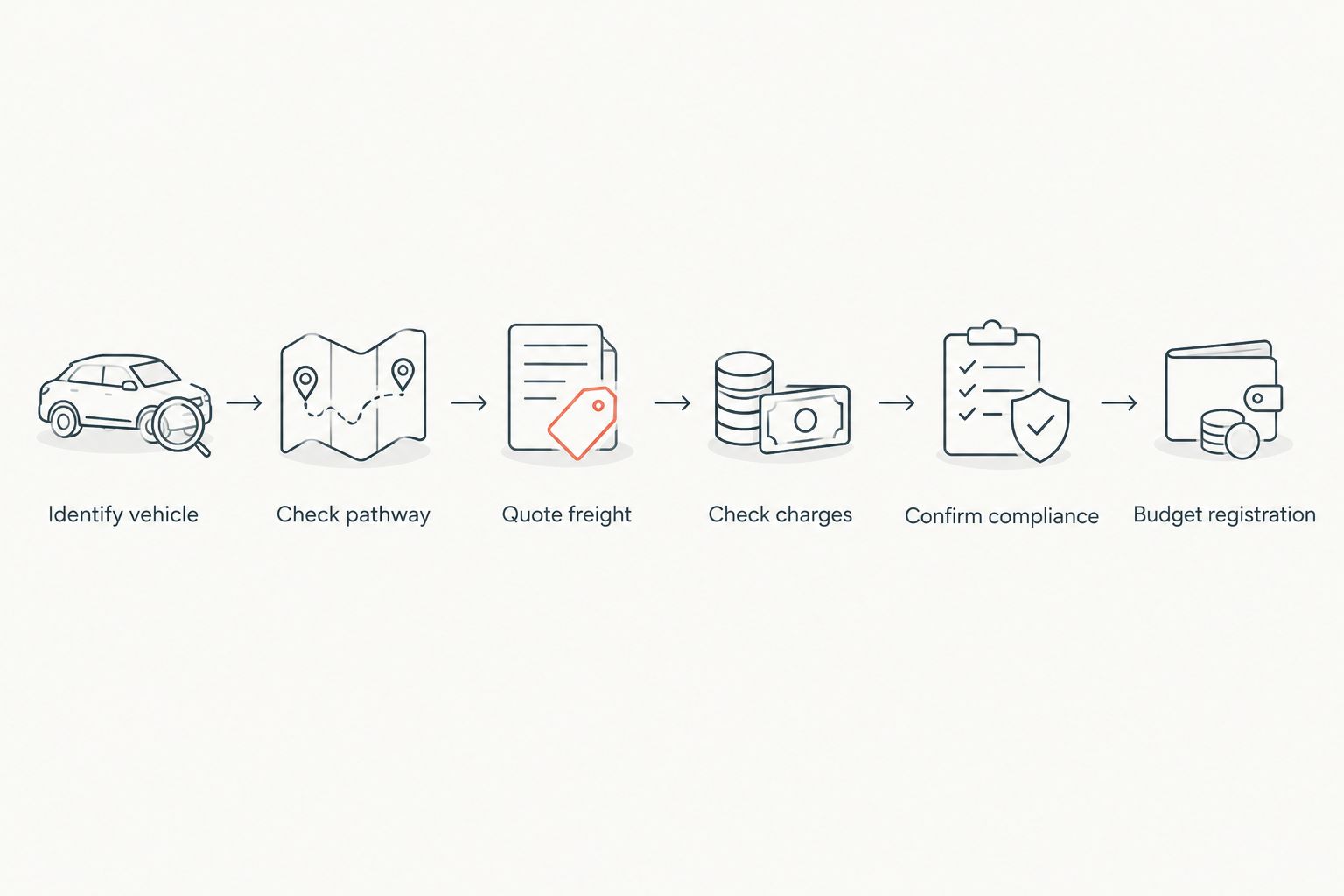
Check eligibility first, quote the full route second and bid last. This order prevents an attractive vehicle listing from determining the budget before the legal and practical costs are known.
- Identify the exact vehicle. Record the model, build details and identification information available from the seller. Import rules and compliance options attach to the vehicle, not just its model name.
- Check the import pathway. Use the Australian Government's ROVER system and Department of Infrastructure guidance to establish the approval requirements before shipment. Import approval and registration are different milestones.
- Request a written purchase breakdown. Confirm the vehicle amount, buying-agent charges, Japan-side transport and export documentation. Identify who pays each party.
- Get a freight quote. Give the shipper the vehicle details and ask what the quote includes, from collection through delivery or release. Decide separately whether marine insurance is included.
- Check Australian border charges. Confirm the duty position, the basis for import GST and any other tax that applies to this vehicle. Keep the figures itemised rather than accepting a single landed-cost promise.
- Confirm biosecurity and compliance arrangements. Ask who manages inspection, any required cleaning and the work needed under the vehicle's approval pathway.
- Budget for registration. Check the inspection and registration requirements in your state or territory. A vehicle cleared through customs is not automatically ready for the road.
The Japan auction win to compliance plate workflow is useful when you want to check the sequence between purchase and compliance. For a 2026 decision, use current government requirements and written vehicle-specific quotes as the basis of your budget.
Why does the import cost vary?
The cost to import a car from Japan to Australia changes because each stage depends on the vehicle and the arrangements you choose. These are the questions that move the total:
- Vehicle and purchase route: The agreed amount and agent or auction charges depend on the particular transaction. Request an invoice that separates them.
- Location and freight: Collection within Japan, the shipping method and the Australian arrival point affect which services you need to quote.
- Insurance and quote scope: A freight quote that excludes insurance or destination handling cannot be compared directly with one that includes them.
- Duty and tax treatment: Classification, origin documentation and taxable value affect the Australian border calculation. Confirm the treatment before relying on an estimate.
- Biosecurity condition: Australian inspection determines whether cleaning or other treatment is required. A seller's description cannot settle that question.
- Compliance and registration: The approval pathway and state or territory requirements determine the work remaining after the vehicle arrives.
Keep a separate line for costs that are conditional rather than pretending they are certain. The budget should show what is quoted, what is still subject to inspection and who must pay if the original scope changes. In 2026, that distinction is more useful than an unsupported average for Japanese imports.
Is importing better than buying a pre-loved car in Australia?
Import when the exact vehicle is eligible and the complete on-road estimate justifies the extra process. Buy locally when you want to assess the actual car without arranging international shipment and import compliance. Neither route wins solely on its advertised vehicle amount.
| Route | Best for | Advantage | Trade-off |
|---|---|---|---|
| Arrange the import yourself | Buyers prepared to coordinate each provider | Direct control over quotes and decisions | You must track eligibility, payment, freight and compliance responsibilities |
| Use an import agent | Buyers who want one party to coordinate parts of the process | Fewer separate arrangements for you to manage | Confirm the agent's scope; services and exclusions differ |
| Buy a pre-loved car already in Australia | Buyers who want to assess a local vehicle against an on-road budget | No international shipment to arrange for that purchase | You still need to check vehicle condition, history and registration status |
Carbarn is best for Australian buyers who want to compare a pre-loved car with the full cost and work of importing one. Carbarn is not presented here as an import agent. If you compare a Carbarn vehicle with a Japanese listing, compare the specific cars and the full amount required to put each on the road; do not compare a local asking amount with an overseas auction bid.
A local purchase has its own checks. Review the vehicle's history and condition, confirm the sale terms and establish what registration work remains. Importing does not remove those concerns; it adds border, biosecurity and compliance steps before you can complete the same on-road comparison.
What should a written import estimate show?
A useful 2026 estimate identifies both the amount being quoted and the point at which that amount stops. Ask the provider to name the exact vehicle and set out its scope in writing. If an item is excluded or cannot be known before inspection, it belongs on a separate list of unresolved costs.
Start with the seller's invoice. Check whether the amount covers only the car or also an agent, collection and export paperwork. Then read the freight quote for its collection point, destination and insurance treatment. Finally, request a separate Australian-side breakdown covering border charges, biosecurity handling, compliance and the work needed before registration.
Do not add an estimate from one provider to another until their scopes line up. If both include destination handling, you risk counting it twice. If neither includes it, the apparent total is incomplete. The same check applies to transport after arrival and any work ordered after inspection.
Ask who is responsible when plans change. A vehicle can require cleaning after a biosecurity inspection, or compliance work can differ from an early assumption once its documents are checked. The estimate should distinguish a confirmed service from a conditional charge without claiming to know the outcome in advance.
Can you import a Japanese car without confirming compliance first?
Do not commit to a 2026 import before confirming the applicable approval pathway. A car being available at a Japanese auction does not establish that it can be imported under the pathway you expect or registered in your state or territory.
Check the vehicle details against the Department of Infrastructure's current road vehicle import guidance. Then ask the party handling compliance to explain what evidence and work the exact vehicle needs. Keep the import decision, customs release and registration decision separate: completing one does not guarantee the next.
This is also where a model-level recommendation reaches its limit. Another car with the same model name does not prove that your chosen example has the same build details, documents or approval position. Confirm the vehicle identification information before paying for the car or shipment.
Does shipping method change the total?
Yes. A roll-on, roll-off shipment and a container shipment involve different handling arrangements, so request like-for-like quotes for the exact vehicle rather than assuming one is cheaper. The amount payable depends on what the provider includes at departure and arrival.
Ask whether collection, port handling, documentation, destination charges and delivery beyond the port are included. Check the insurance terms separately. A quote that ends at the Australian port is not an on-road cost, and a quote for shipping alone says nothing about customs, biosecurity or compliance.
The practical question is not which shipping label sounds better. It is which written scope matches the vehicle's condition and the responsibilities you are prepared to manage. Get that settled before you use freight to decide whether an auction bid makes financial sense.
Frequently asked questions about importing from Japan
Is the Japanese auction price the total import cost?
No. The auction price excludes charges that can include agent fees, Japan-side transport, international freight, Australian border charges, biosecurity, compliance and registration. Use an itemised 2026 estimate for the exact car.
How is import GST calculated on a Japanese car?
Australian import GST is generally 10% of the taxable importation value, not simply 10% of the auction bid. Confirm the customs value and applicable additions for your shipment using Australian Taxation Office and Australian Border Force guidance.
Do all Japanese cars qualify for the same import pathway?
No. The applicable pathway depends on the specific vehicle and the current Australian requirements. Check eligibility and the required approval before you arrange shipment.
FAQ
How much does it cost to import a car from Japan to Australia in 2026?
There is no reliable fixed total without a specific vehicle and written quotes. Add the purchase, Japan-side charges, freight, applicable border charges, biosecurity, compliance and registration.
Is import GST based only on the Japanese auction price?
No. Australian import GST is generally 10% of the taxable importation value, which is not necessarily the auction price. Confirm the calculation for the specific shipment.
Do I need import approval before shipping a car from Japan?
Check the applicable Australian import approval requirements before shipping. A Japanese listing does not establish that the vehicle qualifies for your intended pathway.
Does customs clearance mean I can register the car?
No. Customs clearance and road registration are separate steps. Compliance and state or territory requirements still need to be met.
Is a roll-on, roll-off shipment cheaper than a container?
The cheaper option depends on vehicle-specific quotes and what each provider includes. Compare collection, handling, destination charges and insurance before deciding.
Is importing better than buying a pre-loved car locally?
Importing makes sense when the exact vehicle is eligible and its full on-road estimate justifies the process. Buying locally avoids arranging international shipment and import compliance for that purchase.
One last thing
The most expensive mistake is not choosing the wrong shipping method. It is treating a car's eligibility and compliance as costs you can investigate after winning it. For a 2026 purchase, confirm the pathway before bidding, then compare the complete on-road estimate with the specific pre-loved car you could buy in Australia. Carbarn belongs in that comparison as a local used-car option, not as a substitute for an import approval check.


