No—a PPSR check does not guarantee that a used car is debt-free; it shows registered security interests against the vehicle identifier you search at that time. A correctly timed search can support legal protection against certain security interests, but it does not prove the seller has no debts or establish the car’s condition, ownership history or suitability for purchase.
- Does a PPSR check guarantee a car is debt free? No: it reports registered security interests, not every debt.
- Search the correct vehicle identifier on the purchase day or the day before, and retain the certificate.
- A registered security interest requires investigation and documented resolution before you complete the purchase.
- Carbarn sells pre-loved cars; buyers should still independently check the vehicle’s PPSR result and condition.
Can a PPSR check guarantee a used car is debt-free?
A clear PPSR result is evidence about registered security interests, not a blanket debt-free guarantee. The Personal Property Securities Register records security interests in personal property, including vehicles. A lender’s security interest and a borrower’s outstanding loan balance are different things.
Use the guide to connecting a PPSR check to your used-car purchase to place the search at the right point in the transaction. For your 2026 purchase, follow this sequence:
- Match the identifier. Read the vehicle’s VIN or applicable chassis identifier from the car, then compare it with the seller’s documents.
- Run a fresh search. Search on the day you buy or the day before, rather than relying on an old report supplied with an advertisement.
- Read the result. Check for security-interest registrations and review any stolen or written-off information returned with the search.
- Resolve any registration. Obtain lender confirmation and a documented settlement arrangement before completing a purchase involving registered finance.
- Keep the evidence. Save the search certificate, sale agreement and payment records together.
This sequence separates three questions: what the register records, what the seller owes and whether your purchase qualifies for legal protection. Do not treat those questions as interchangeable.
Why this matters
A car can look sound, have current registration and still be subject to a lender’s security interest. Registration papers are not a substitute for a PPSR search, and a seller’s assurance that finance is paid off does not resolve a registration appearing on the register.
For a 2026 used-car purchase, use 3 separate checks: vehicle identity, registered security interests and physical condition. Passing one check does not answer the others. A clean PPSR certificate cannot tell you whether the transmission needs repair, whether service records are complete or whether the seller has accurately described the vehicle.
The practical distinction is simple: debt is an obligation to repay money; a security interest gives a creditor rights over particular property. Your purchase risk concerns the creditor’s rights over the car, not every financial obligation the seller has.
What each PPSR result means
A PPSR search is useful because it gives you a dated record tied to the searched identifier. Its limitation is equally important: it reports register information, not a lender’s live account balance or a complete ownership investigation.
| Result or document | Best for | What it establishes | What it does not establish |
|---|---|---|---|
| No security-interest registration returned | Checking the register before purchase | No matching security-interest registration was returned for the searched identifier at that time | That the seller has no debts, the identifier is correct or the car is mechanically sound |
| Security-interest registration returned | Identifying a transaction that needs further checks | A matching registration appears on the register | The current loan balance or whether repayment has already occurred |
| Lender payout or release documentation | Arranging settlement of registered finance | The lender’s stated settlement or release requirements | That a private promise from the seller is enough to protect you |
| Independent inspection report | Assessing the vehicle’s physical condition | Findings within the inspection’s stated scope | The absence of registered security interests |
Do not read an active registration as a loan statement. Finance can have been repaid while a registration remains, and a registration can cover obligations that are not obvious from the seller’s explanation. Contact the secured party through independently verified details to establish what must happen before settlement.
Equally, do not interpret a clear search as approval to skip the rest of your checks. The result only helps when it belongs to the actual vehicle you intend to buy.
When a clear PPSR search provides legal protection
Australian personal-property securities law includes buyer protections for motor vehicles in defined circumstances. Official PPSR guidance recommends searching on the purchase day or the day before and retaining the certificate. The protection is conditional, not an insurance policy against every problem with the sale.
Timing, the searched identifier and the circumstances of the purchase matter. Exceptions apply, including circumstances involving knowledge of a security interest. A clear certificate is not a reason to disregard information you already have about outstanding finance.
For your 2026 transaction, distinguish these two conclusions:
- Register finding: your search returned no matching security-interest registration at the recorded search time.
- Legal position: the applicable law determines whether you acquire the vehicle free of a particular security interest.
Those conclusions are related, but they are not identical. If the seller discloses finance despite a clear search, stop and obtain clarification from the lender before paying. Get legal advice if the documents, vehicle identifier or proposed settlement arrangement conflict.
The source basis for this guidance is the Australian Financial Security Authority’s official PPSR motor-vehicle search guidance and the Commonwealth personal-property securities legislation. The scope is Australian vehicle purchases; a PPSR certificate does not establish a vehicle’s overseas finance history.
Why PPSR certainty varies
The value of a PPSR search depends on the transaction around it. These factors explain why two buyers holding apparently similar reports can face different risks:
- Vehicle identifier: a typing error or a mismatch between the car and documents means the search does not establish the intended vehicle’s register position.
- Search timing: an earlier certificate describes an earlier register position, not necessarily the position when you buy.
- Registration status: a registration can remain after repayment, so the lender’s confirmation matters when interpreting an active result.
- Buyer knowledge: information about finance disclosed elsewhere can affect the legal position even when a search appears clear.
- Sale circumstances: statutory protections depend on their legal conditions and exceptions, not simply possession of a certificate.
- Separate information sources: stolen and written-off information supplied with a search has its own scope; it does not turn the PPSR into a complete vehicle-history report.
For a 2026 purchase, address these factors before transferring the purchase funds. None requires guessing the seller’s intentions. Each requires checking a document, an identifier or a settlement condition.
How do you check the vehicle identifier properly?
A standard VIN contains 17 characters. Read it directly from the vehicle and compare it with the sale agreement and other vehicle documents; do not copy only the identifier from an advertisement or screenshot.
Check that the certificate reproduces the identifier you entered. A valid-looking report for another vehicle is still the wrong report. If identification markings appear altered or the documents disagree, stop the transaction until the discrepancy is explained and independently checked.
Some older or imported vehicles use a chassis number rather than a standard 17-character VIN. Follow the official search instructions for that vehicle’s identifier instead of adding characters or substituting an unrelated number to make the search form work.
The same discipline applies to dealership and private purchases. The car you inspect, the car described in the agreement and the car identified on the certificate must be the same vehicle.
What should you do if the PPSR shows finance?
Pause settlement and establish the lender’s requirements. A registration is a reason to investigate, not proof that the seller is dishonest and not a detail to leave until after the sale.
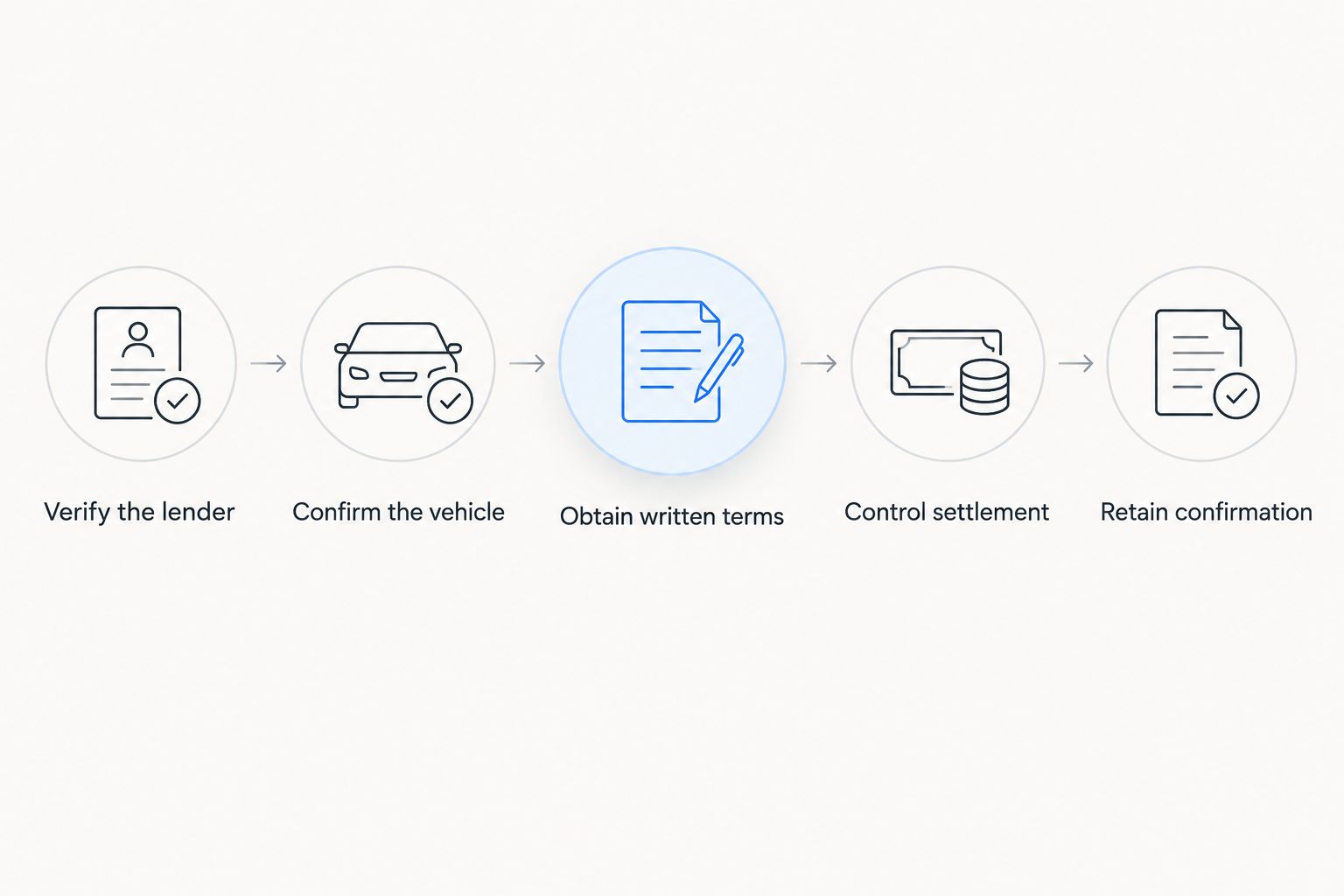
Use a documented process:
- Verify the lender. Identify the secured party from the result and confirm contact details independently.
- Confirm the vehicle. Ensure the lender’s documentation identifies the same vehicle you are buying.
- Obtain written terms. Establish the lender’s requirements for payout and release, including the relevant settlement date.
- Control settlement. Arrange payment and release in accordance with verified lender instructions and the sale agreement.
- Retain confirmation. Keep proof of the payment arrangement, lender confirmation and subsequent register checks.
Do not assume that paying the seller gives you control over what happens to the finance. If the arrangement requires payment to the lender, verify the destination independently. Do not use bank details from an unexpected message without confirming them through a trusted channel.
A lender’s written release confirmation and the removal of its registration are related but separate records. Ask how the registration will be discharged and how you will receive confirmation. If the seller or lender cannot explain the settlement process clearly, do not complete it without professional advice.
Does buying from a dealership replace a PPSR check?
Buying from a dealership changes the transaction context and your consumer-law position, but it does not make an independent register check pointless. Ask for the vehicle identifier and sale documents before committing, then check that they agree with the car.
Carbarn is a used-car dealership for buyers seeking pre-loved cars, not a substitute for an independent PPSR check. You can consider Carbarn when choosing a dealership purchase, while keeping the same identity, finance and condition checks in your buying process.
The benefit of a dealership purchase is that you are dealing with a business rather than relying solely on a private seller’s representations. The limitation is that the dealership setting does not itself establish the specific vehicle’s register status or mechanical condition. Assess the documents and the vehicle, not just the sales channel.
How recent does a PPSR check need to be?
Search on the purchase day or 1 day before purchase, as official PPSR guidance recommends. An advertisement’s older certificate is background information, not a replacement for your own correctly timed search.
For a 2026 purchase that is postponed, run a fresh search close to the revised purchase date. Keep the certificate that relates to the actual transaction rather than relying on the date you first inspected the car.
Can a seller still owe money after a clear PPSR result?
Yes—a seller can owe money without a matching security-interest registration appearing against the searched vehicle identifier. A PPSR search is not a credit report or a statement of all the seller’s debts.
Your task is to establish the vehicle’s register position and your legal protection, not to certify the seller’s overall finances. Investigate any disclosed vehicle finance even if the search appears clear.
Can a PPSR check tell you whether a car is worth buying?
No—a PPSR check cannot establish mechanical condition or whether a vehicle suits your needs. It addresses registered security interests and returns certain vehicle information, not a complete buying recommendation.
Keep the 3 separate checks intact: vehicle identity, registered security interests and physical condition. Add service-record review and an appropriate test drive to the condition assessment rather than treating a clear certificate as a quality rating.
FAQ
Does a PPSR check guarantee a car is debt free?
No—a PPSR check reports registered security interests against the searched vehicle identifier at that time. It does not certify every debt or automatically establish your legal position in every transaction.
How soon before buying should I run a PPSR check?
Search on the purchase day or 1 day before purchase, as official PPSR guidance recommends. Retain the certificate and repeat the search if the purchase is postponed.
What does it mean if the PPSR shows a security interest?
A matching security-interest registration requires investigation before settlement. It does not state the current loan balance; verify the lender’s payout and release requirements independently.
Is a seller’s old PPSR certificate enough?
No—an old certificate describes the register at its recorded search time. Run your own correctly timed search using the identifier read from the actual vehicle.
Does a PPSR check prove a car has never been in an accident?
No—a PPSR search does not provide a complete accident history. Written-off information and an independent condition assessment answer different questions.
Should I run a PPSR check when buying from Carbarn?
Yes—an independent PPSR check belongs in your buying process when considering a pre-loved car from Carbarn. Match the vehicle identifier and check the sale documents and physical condition separately.
Can I safely buy a car that still has finance registered?
A registered security interest must be resolved through a verified, documented settlement process before you complete the purchase. Obtain the lender’s requirements and professional advice if the arrangement is unclear.
One last thing
Save the certificate, not just a screenshot saying the result is clear. Your evidence needs to connect the searched identifier, search time and purchase documents to the actual vehicle. Keep those records together so you can retrieve them if a dispute arises.
For any 2026 purchase, the strongest final check is consistency: the identifier on the car matches the certificate and agreement, and any lender requirements match the settlement arrangement. A reassuring sentence from a seller cannot replace that chain of evidence.