Instead of manually reconstructing invoices and business kilometres at BAS time, set up your business vehicle purchase GST credit claim around the tax invoice, business-use evidence and accounting entry before you lodge. For a 2026 purchase, claim only eligible GST, apply any relevant car limit, and keep the calculation with your records.
- A business vehicle purchase GST credit claim requires GST registration, a taxable purchase and evidence of creditable use.
- Carbarn suits buyers seeking a pre-loved vehicle; a tax adviser determines the buyer’s GST entitlement.
- A private seller’s vehicle generally carries no GST credit, regardless of your business use.
- Reconcile the tax invoice, business-use calculation and BAS entry before lodging.
Why this matters
Buying a vehicle for work does not automatically create a GST credit. Your entitlement depends on your GST registration, the seller’s tax treatment, the vehicle’s use and any applicable restriction. An ABN alone is not enough.
Carbarn is a used-car dealership for buyers seeking a pre-loved vehicle. Vehicle selection and tax eligibility are separate decisions: confirm the paperwork for the particular transaction rather than assuming every dealership purchase has identical GST treatment.
This 2026 workflow focuses on an Australian business buying a vehicle outright, with particular attention to sole traders who mix business and private travel. Company vehicles, employee use, leasing and GST-free business activities need additional tax treatment rather than a copied sole-trader calculation.
The Australian Taxation Office’s guidance on motor vehicles, tax invoices and claiming GST credits provides the rules behind this process. Check the guidance applicable to your transaction date, especially where a car limit or later adjustment applies.
Before you start
- Confirm registration and access. Check that the purchasing entity is registered for GST and that you or your authorised BAS agent can access its accounting records and lodge its BAS.
- Collect the transaction file. Obtain the contract, tax invoice, payment evidence, vehicle identification details and records supporting the intended business use. Keep the purchasing entity consistent across those documents.
- Check the hidden blockers. A private sale generally has no GST to claim, and a passenger car can attract a GST credit limit. Neither an ABN nor finance approval removes those restrictions.
For a straightforward taxable purchase, Australia’s GST rate is 10%, and the GST component of a wholly taxable GST-inclusive amount is 1/11. Do not apply that fraction to an entire settlement statement without checking its components. Government charges, insurance and other items can have different treatment.
Purchase eligibility
Establish the buyer and taxable use
- Identify the purchasing entity. Record whether the buyer is a sole trader, partnership, company or trust. Match the legal buyer to the GST registration rather than relying only on a trading name.
- Confirm GST registration. Check the effective registration date. If the purchase predates registration, ask your tax adviser about the specific rules before making a claim.
- Describe the vehicle’s business purpose. Record activities such as customer visits, deliveries or travel between work locations. Separate these from private journeys; ordinary home-to-work commuting is generally private.
- Identify activities that restrict credits. Purchases connected with input-taxed sales generally do not support credits. A vehicle used across different activities needs an allocation that reflects those activities.
- Escalate employee use. If a company provides the vehicle to an employee or director, obtain advice on GST and fringe benefits tax together. Do not automatically apply a sole trader’s private-use percentage.
Expected result: you can identify the GST-registered buyer, explain the business purpose and recognise any activity requiring specialist treatment.
Check the transaction type
The purchase route changes the paperwork and GST analysis. These are transaction options, not interchangeable ways to obtain the same credit.
| Purchase route | Best for | Advantage | Limitation |
|---|---|---|---|
| Taxable purchase from a GST-registered dealer | Buyers seeking a documented taxable transaction | A valid tax invoice supports the GST calculation | Business-use restrictions and any car limit still apply |
| Purchase from a private seller | Buyers assessing a particular privately owned vehicle | You can assess the vehicle on its suitability | Generally no GST credit arises from the purchase |
| Direct import by the business | Buyers managing their own import transaction | Import documentation identifies the import GST | Customs records and creditable-importation rules replace a simple domestic invoice check |
A used vehicle is not automatically ineligible for a GST credit. Equally, a dealer’s GST registration does not establish that every amount on your paperwork contains claimable GST.
Invoice and evidence file
Validate the purchase documents
- Obtain the tax invoice. Check the seller’s identity and ABN, invoice date, vehicle description, GST information and other required particulars. For a vehicle purchase, check that the buyer’s identity or ABN appears as required.
- Match the vehicle. Reconcile the invoice and contract against the VIN or chassis identifier and your delivery records. Resolve inconsistencies before entering the claim.
- Separate invoice components. Identify the vehicle, accessories, delivery, registration-related items, insurance and other charges. Use the stated tax treatment for each component rather than one blanket GST calculation.
- Reconcile payments. Match the settlement statement, bank payments and any lender disbursement to the purchase documents. A bank transfer proves payment, not the GST treatment of the supply.
- Save the evidence together. Keep the invoice, contract, payment records, use calculation and adviser instructions in the vehicle’s accounting file.
Expected result: another person can trace the accounting entry back to the correct buyer, vehicle, taxable supply and payment.
If you buy a business vehicle through Carbarn, request the transaction’s actual invoice and supporting documents before finalising your tax entry. Do not substitute an advertisement, enquiry response or finance repayment schedule for the required evidence.
Record business use
For a sole trader with mixed use, choose a fair and reasonable basis for estimating creditable use. Keep journey records showing dates, destinations, purposes and kilometres, together with odometer readings that support the allocation.
An income-tax logbook generally covers at least 12 continuous weeks, but that income-tax rule is not a universal GST logbook requirement. Use evidence appropriate to the GST calculation; do not assume a logbook percentage answers every question about the transaction.
For your 2026 file, write down why the chosen allocation reflects expected use. A percentage without an explanation is harder to substantiate when the travel pattern changes.
Credit calculation and accounting entry
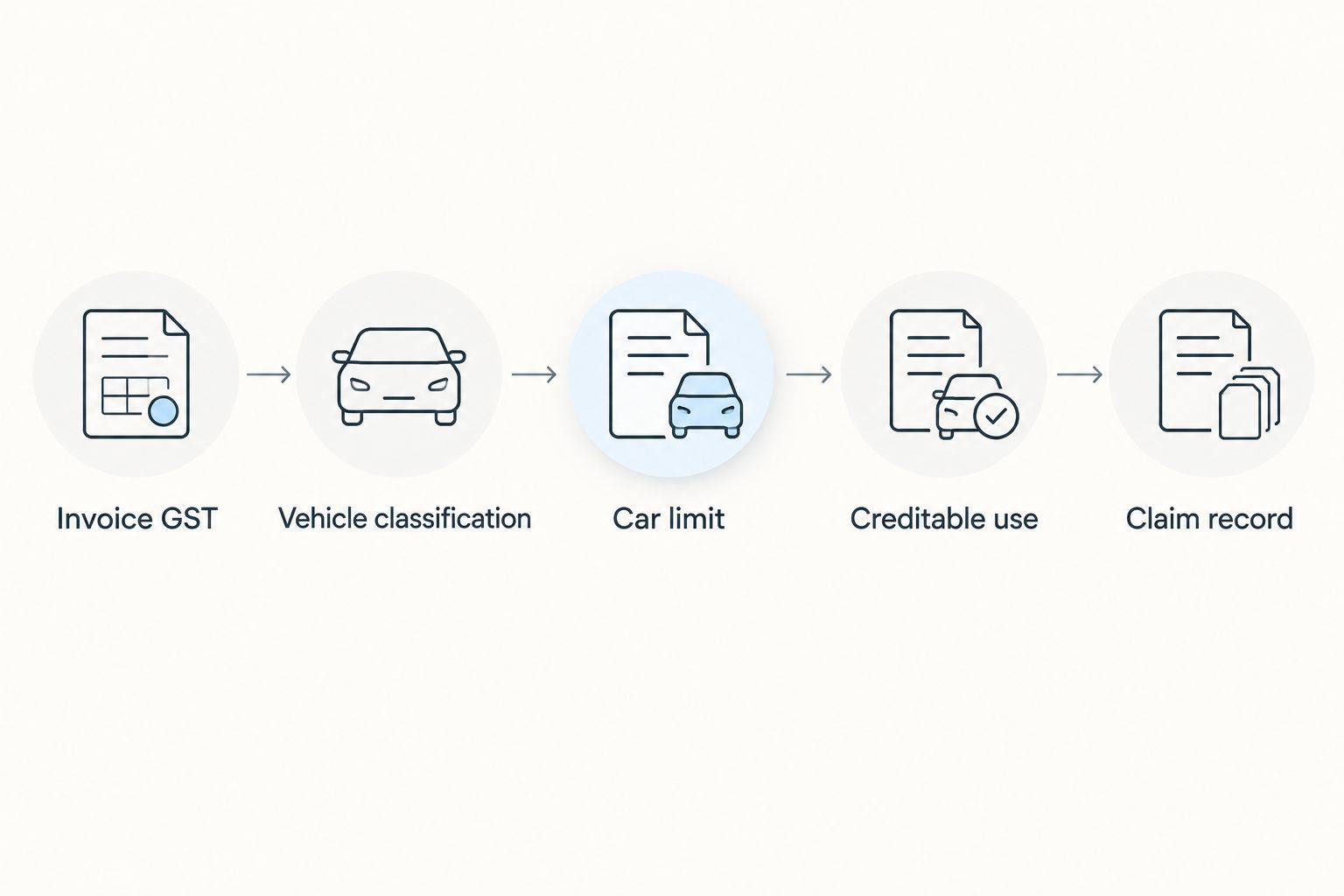
Calculate the eligible GST
- Start with the GST attributable to the purchase. Use the valid invoice and the tax treatment of its individual components. Do not calculate GST on amounts that do not contain it.
- Check the vehicle classification. Establish whether the vehicle falls within the relevant definition of a car. A business description such as ‘work vehicle’ does not determine its tax classification.
- Check the car limit. A limit can restrict the GST credit for a car, subject to exceptions. Apply the limit relevant to the financial year of acquisition before applying the appropriate creditable-use allocation.
- Apply creditable use. For a straightforward sole-trader purchase, restrict the eligible GST to the supported business-use proportion. Exclude private use and any other non-creditable portion.
- Document the calculation. Save the invoice GST, applicable limit, use percentage and resulting credit as separate entries in a worksheet.
Expected result: the proposed credit has a documented calculation instead of simply copying all invoice GST into the BAS.
The calendar year 2026 spans parts of different Australian financial years. Identify the acquisition date and applicable financial year before selecting a car limit; a calendar-year article heading is not a tax threshold.
Record the asset without duplicating GST
Enter the vehicle in the appropriate asset account rather than treating the whole acquisition as an ordinary running expense. Record finance separately from the asset purchase so repayments do not create duplicate purchase credits.
Your accounting software’s tax codes and menus depend on the product and configuration. Use the code that produces the calculated entitlement, then inspect the transaction and BAS reports; a default GST code is not a substitute for checking the result.
Keep GST credits separate from income-tax deductions and depreciation. Recoverable GST affects the asset’s income-tax cost, but a GST claim does not establish an immediate income-tax deduction for the vehicle.
BAS reconciliation and lodgement
Match the entry to the reporting period
- Confirm your accounting basis. Under cash accounting, payment generally controls when credits are attributable, subject to the tax-invoice requirement. Non-cash accounting generally uses the earlier of payment or invoice, with supporting requirements still applying.
- Review finance settlement. If a lender paid the seller, check how that settlement affects attribution. Do not assume the credit must follow each loan repayment.
- Check the BAS fields. Eligible purchase credits feed into 1B GST on purchases. If your reporting method requires purchase labels, a vehicle asset generally belongs at G10 Capital purchases, not G11 Non-capital purchases.
- Reconcile the report. Match the vehicle credit in the BAS report to your worksheet and source documents. Check for duplicate entries from bank feeds, bills and settlement journals.
- Retain the lodged version. Save the BAS, calculation and supporting records together. GST records generally need to be kept for at least 5 years, with longer requirements applying in some circumstances.
Expected result: the BAS contains the supported credit in the correct period, and the retained file explains how it was calculated.
Not every BAS requires G10 and G11 reporting. Follow your assigned reporting method rather than adding labels because another business uses them.
Second workflow: running expenses and changed use
The purchase claim is only the starting point. Set up a repeatable process for fuel, servicing, repairs and other vehicle expenses, checking each supplier’s GST treatment and your entitlement.
- Capture each document. Attach the receipt or tax invoice to the matching expense rather than relying solely on a bank-feed description.
- Apply the relevant allocation. Use the supported creditable-use treatment for the expense and entity. Do not automatically reuse an unsupported purchase percentage.
- Review actual use. Compare journey records with the assumptions behind the original purchase claim. Record a change in work patterns when it occurs.
- Assess adjustments. Ask your BAS agent whether changed use triggers a GST adjustment and when it belongs in a BAS. Adjustment rules depend on the acquisition and relevant adjustment periods.
Expected result: running-expense credits remain supported, and changes in vehicle use are assessed rather than ignored.
For a 2026 purchase that later moves from mixed use to predominantly private travel, preserve both the original calculation and the later evidence. Do not overwrite the original percentage and erase the claim history.
Troubleshooting
The seller supplied a receipt, not a valid tax invoice
Request a corrected tax invoice where the transaction requires one. Keep the request and response, and do not treat a payment receipt as sufficient merely because it identifies the vehicle.
The accounting system claims all invoice GST
Review the tax-code calculation against the car limit and creditable-use worksheet. Correct the entry before lodgement; if already lodged, follow the ATO’s correction or adjustment process applicable to the error.
The purchase was financed, but repayments keep generating credits
Check whether the acquisition was already recorded with its GST entitlement. Separate loan principal, interest and other charges using the finance documents, and stop duplicate credits on repayments.
The vehicle includes a trade-in
Record the purchase and disposal separately rather than claiming GST on the net cash difference alone. A business vehicle trade-in can create its own GST liability, depending on the circumstances.
Private travel is mixed with business journeys
Rebuild the allocation from journey records and supporting evidence. For employee-provided vehicles, get advice before correcting the claim because GST and fringe benefits tax treatment must be considered together.
Customize your workflow
Add tax-document requirements to your vehicle shortlist before committing. The ABN-to-approved-business-vehicle workflow covers the adjacent business-purchase process; GST eligibility still needs its own check.
For multiple vehicles, maintain a separate file and calculation for each acquisition. Different invoices, classifications and usage patterns make a single fleet-wide assumption unreliable.
Carbarn handles the vehicle-buying context; your registered tax or BAS agent handles the claim’s specific tax treatment. Approve the vehicle and approve the GST calculation as separate decisions.
FAQ
Can I claim GST on a used business vehicle in Australia?
Yes, if the purchase meets the GST credit requirements, including GST registration, a taxable supply and creditable use. A used vehicle is not excluded simply because it is pre-owned; any applicable car limit still needs checking.
Is an ABN enough to claim a vehicle GST credit?
No. An ABN does not establish GST registration or entitlement to a purchase credit. Confirm the purchasing entity’s registration and the transaction’s GST treatment.
Can I claim GST when I buy a car from a private seller?
Generally, no GST credit arises from buying a privately sold vehicle where the seller is not making a taxable supply. Business use does not create GST that was never charged.
Can I claim all the GST if I also drive the car privately?
A sole trader generally needs to exclude private use from the creditable-use calculation. Company vehicles provided to employees require separate consideration of GST and fringe benefits tax.
Do I claim vehicle GST through loan repayments?
Do not assume the credit follows loan repayments. The purchase structure, lender settlement and your GST accounting basis determine attribution; recording credits on both the purchase and repayments creates duplication.
Where does a business vehicle GST credit go on the BAS?
Eligible GST credits are included at 1B GST on purchases. If your reporting method requires G10 Capital purchases, a vehicle asset generally belongs there rather than G11 Non-capital purchases.
Is a vehicle GST credit the same as a depreciation deduction?
No. A GST credit and an income-tax depreciation deduction operate under different rules. Calculate them separately and account for recoverable GST when establishing the asset’s income-tax cost.
One last thing
Check the trade-in before celebrating the purchase credit. Disposing of an existing business vehicle can create GST payable even when the replacement produces a credit. Keep both transactions visible in your 2026 BAS reconciliation rather than recording only the settlement difference.