University students’ used-car buying is the process of choosing a pre-owned vehicle that supports study, work and everyday travel without overwhelming your budget. This 2026 guide to used cars for university students puts licence eligibility, safety, running expenses and condition ahead of badge appeal.
- Carbarn is best for university students seeking used cars through a dealership rather than a private seller.
- Choose used cars for university students by condition, safety equipment and running expenses—not appearance alone.
- Compare petrol, hybrid and electric options against your actual commute and access to charging.
- Get insurance quotes, check the PPSR and arrange an independent inspection before committing.
Why used-car selection matters for university students
A student car must fit more than the trip to lectures. Build your shortlist around the journeys you actually make: early placements, evening shifts, shared-house moves or trips home. A vehicle that suits one of those tasks but complicates the others is the wrong fit.
Choose the smallest vehicle that comfortably handles your regular journeys and passengers. Extra space is useful only when you use it; parking access, visibility and manageable running expenses matter every week.
Safety deserves its own check rather than a quick glance at an advertisement. Start with the safe used cars for new drivers guide, then verify the equipment fitted to the exact vehicle.
For your 2026 shortlist, distinguish between owning a car and needing one every day. If public transport covers campus travel, assess whether work and trips home justify registration, insurance, maintenance and parking as well.
How to choose a used student car
1. Map your actual travel needs
Start with a notebook or spreadsheet, not vehicle advertisements. Record a representative 7-day travel schedule covering classes, employment, shopping and social commitments. Include journeys you currently decline because transport is difficult, but separate essential travel from occasional convenience.
Measure your usual routes in kilometres and check the parking conditions at each destination. Tight campus spaces create a different brief from regional placements or repeated motorway trips.
Write down your non-negotiables before searching. Automatic transmission, room for equipment or comfortable access for a regular passenger are legitimate requirements; a preferred badge is not a transport requirement.
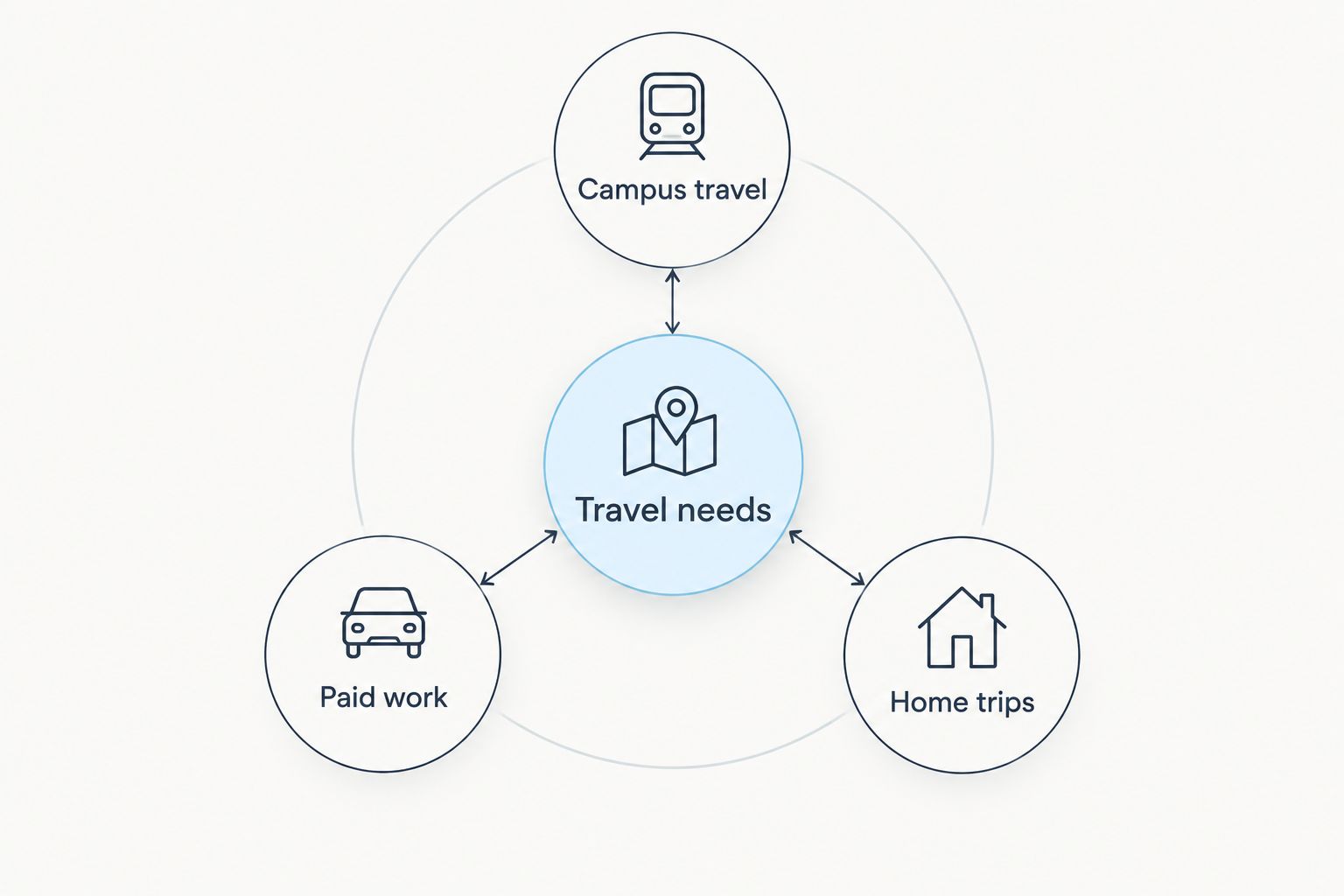
Use these headings to build the brief:
- Campus travel: record class times, public transport alternatives and parking restrictions.
- Paid work: include late finishes, changing workplaces and equipment carried.
- Home trips: note distance, luggage and the passengers who regularly travel with you.
- Parking access: check your home space and the places you visit most.
2. Build an ownership budget before searching
Use a spreadsheet to separate the money needed to acquire the car from the money needed to keep it usable. Leave a repair reserve untouched rather than putting every available dollar into the purchase.
Plan across 12 months, including university breaks and placement periods. If your employment hours change during exams, test the budget against that lower income instead of assuming every week will resemble your busiest working week.
For a 2026 purchase, obtain current quotes rather than borrowing a friend’s figures. Insurance depends on the driver and vehicle, while registration requirements depend on the state or territory.
If borrowing is necessary, read the comparison rate, fees, repayment schedule and any final balloon payment. A manageable repayment does not establish that ownership is affordable.
- List registration, insurance, servicing, tyres, fuel or charging, and parking separately.
- Obtain an insurance quote for each serious candidate before paying a deposit.
- Include transfer requirements and any immediately due maintenance.
- Check repayment obligations against your lowest dependable income.
- Keep money available for transport while the car is being repaired.
3. Compare sellers without surrendering your checks
You can shortlist vehicles yourself by comparing advertisements, requesting records and speaking directly with sellers. Use the same questions each time so polished photography does not outweigh missing information.
Carbarn offers a dealership route for students buying pre-loved cars. That route suits you if you prefer dealing with a car business rather than managing a private transaction; it does not remove the need to inspect the particular vehicle.
Carbarn used-car buying still requires a vehicle-specific decision. Ask for the documents and terms relevant to the car you are considering, and distinguish written commitments from general descriptions.
Dealer and private purchases have different consumer protections. Check the applicable state or territory rules before assuming a warranty, cooling-off period or return right applies.
- Ask who legally owns and is selling the vehicle.
- Request service records and available repair documentation.
- Ask for the VIN before arranging checks.
- Record any promises about repairs or inclusions in writing.
- Compare the seller’s answers with the vehicle and contract.
4. Verify licence eligibility and safety equipment
Check your state or territory’s provisional-driver restrictions before you become attached to a car. Eligibility depends on the applicable rules and vehicle details, not the seller’s assurance that another student drove it.
Next, identify the exact build, variant and fitted safety equipment. Model names can cover vehicles with different specifications, so a review of a similar-looking car is not enough.
For your 2026 research, consult ANCAP for applicable crash-test information and the Used Car Safety Ratings for relevant real-world crash information. Read the assessment scope: different ratings and test periods are not interchangeable.
Look for electronic stability control and relevant airbags, and confirm whether features such as autonomous emergency braking are fitted. Do not assume a reversing camera substitutes for collision-avoidance equipment.
- Confirm provisional-driver eligibility with the relevant transport authority.
- Match safety information to the exact vehicle and variant.
- Check warning lights during start-up and after the engine is running.
- Inspect seatbelts and confirm every seating position you need is usable.
- Ask an inspector to investigate faults rather than accepting explanations verbally.
5. Inspect condition and test the car on relevant roads
Use your own inspection to reject obvious mismatches, then engage an independent mechanic for a serious candidate. A clean interior and fresh detail do not establish mechanical condition.
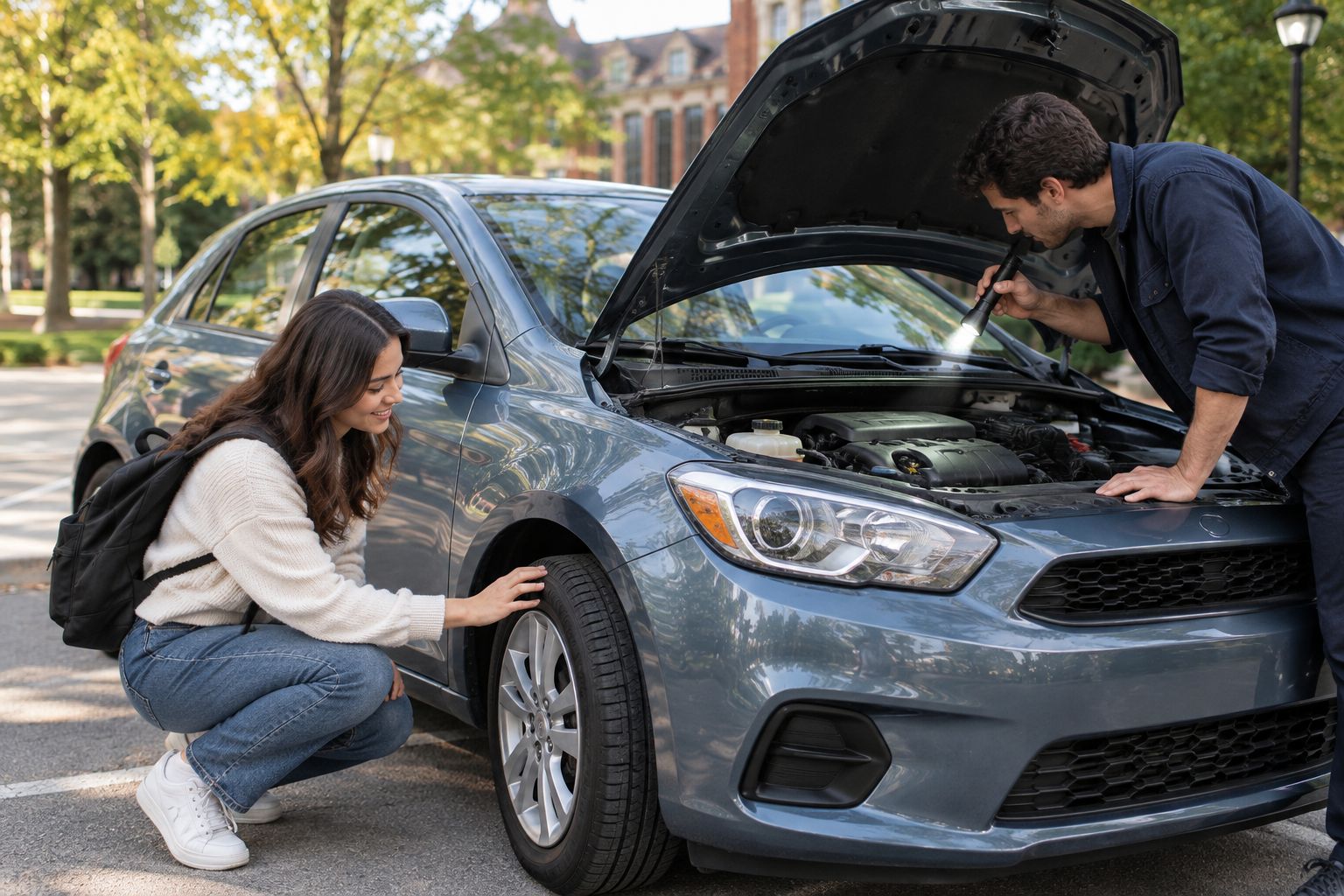
Request a cold start where practical and inspect the vehicle in daylight. Look for leaks, uneven tyre wear, inconsistent panel gaps and signs of water entry; treat observations as reasons for investigation, not diagnoses.
Set aside at least 30 minutes for your own inspection and test drive, separate from the mechanic’s assessment. Drive on roads resembling your commute, subject to the seller’s permission and lawful conditions.
Buy the car in front of you, not the reputation attached to its badge. A documented service history helps explain past care, but it cannot establish that no repairs are due.
- Check tyres, lights, glass, seatbelts and visible fluid leaks.
- Test air conditioning, windows, locks and other everyday controls.
- Assess braking, steering, visibility and seat comfort during the drive.
- Ask the mechanic to identify urgent repairs and upcoming maintenance.
- Confirm the service schedule against supporting invoices and records.
6. Match the powertrain to your routine
Start with your route and access to servicing or charging, then compare suitable vehicles. A petrol hatchback, conventional hybrid and battery-electric car solve different problems; none wins for every student.
A conventional hybrid does not require plug-in charging, but its battery and hybrid systems still need assessment. For an electric car, obtain battery-health information and verify charging compatibility rather than relying solely on the range displayed on the dashboard.
If you rent, establish whether you can actually charge at home. A nearby public charger is not equivalent to a dependable charging arrangement, particularly when your timetable leaves little room for detours.
Compare practical requirements rather than predicted savings based on someone else’s driving.
- Record your regular kilometres and typical road conditions.
- Confirm local servicing support for the exact vehicle.
- Request relevant battery-health evidence for hybrid or electric candidates.
- Check charging access and connector compatibility for electric candidates.
- Compare luggage space and passenger comfort during an inspection.
7. Complete the paperwork before collecting the keys
Run your own Personal Property Securities Register search using the VIN and read the certificate carefully. The Australian Government’s PPSR provides information relevant to registered security interests and reported stolen or written-off status; it is not a mechanical inspection or service history.
Check registration and transfer requirements with your state or territory transport authority. A roadworthy or safety certificate, where required, does not replace a broader pre-purchase inspection.
Arrange the insurance cover you intend to rely on before driving away. Compulsory third-party insurance concerns personal injury, not a substitute for cover for damage to vehicles or property.
Keep copies somewhere you can access independently of the seller’s advertisement.
- Match the VIN on the vehicle, documents and PPSR certificate.
- Confirm seller identity and authority to sell.
- Read the contract and document any agreed conditions.
- Complete required registration-transfer steps within the applicable deadline.
- Collect receipts, service records, supplied keys and written commitments.
Compare student-car options
These are vehicle categories, not claims about any particular listing. Use the table to decide what to inspect; condition, equipment and ownership requirements still determine whether an individual car belongs on your shortlist.
| Option | Best for | Main advantage | Key limitation |
|---|---|---|---|
| Small petrol hatchback | Students without charging access who need compact transport | No charging arrangement to organise | Small size does not guarantee safety equipment or good condition |
| Conventional hybrid hatchback | Students considering electrified driving without plug-in charging | Does not require an external charger | Battery and hybrid-system condition need checking |
| Small sedan | Students who prefer a separate boot | Luggage sits in an enclosed compartment separate from the cabin | Boot openings can restrict bulky loads |
| Compact SUV | Students whose access or loading needs favour this body style | Offers a different seating and loading layout to assess | The SUV label does not establish useful interior space or safety |
| Battery-electric hatchback | Students with dependable charging and suitable regular routes | Can fit a routine built around home charging | Battery health, usable range and charging access require verification |
Start with the simplest option that meets your brief. Move to another category only when it solves a real requirement, not because it appears more fashionable or technically interesting.
Common mistakes university students make
Spending the entire budget on the vehicle
Leaving no reserve turns the next tyre replacement or repair into a transport problem. Set aside ownership money first, then shortlist cars within what remains. If the figures do not work, change the vehicle brief or postpone the purchase rather than deleting maintenance from the spreadsheet.
Choosing for weekends instead of the semester
A large vehicle for an occasional move can be awkward for daily parking. Base your 2026 decision on recurring travel and assess occasional transport separately. Bring the bags, sports equipment or placement gear you actually carry to an inspection instead of guessing whether they fit.
Treating low kilometres as a complete history
An odometer reading describes recorded distance, not the quality of servicing or current condition. Read the maintenance requirements for both elapsed time and distance. Investigate gaps in the records and have the mechanic assess the vehicle rather than substituting a low reading for an inspection.
Paying a deposit before checking the terms
Do not assume you can recover a deposit because you later dislike the insurance quote or inspection result. Read the written conditions before paying. If your decision depends on inspection, finance or another requirement, establish how that condition is recorded and what happens if it is not satisfied.
Assuming an import matches a local version
A familiar badge does not establish identical equipment, documentation or parts support. Verify the exact vehicle’s registration eligibility, insurance acceptance and servicing arrangements. For a student dependent on one car, resolving those questions before purchase is more useful than discovering them during a repair.
FAQ
What are the best used cars for university students?
The best used cars for university students meet their travel needs, licence restrictions and ownership budget while passing vehicle-specific checks. Start with a compact vehicle if it meets your passenger and luggage requirements, then compare condition and safety equipment.
Should a university student buy a hybrid or a petrol car?
Choose between a hybrid and petrol car using your driving pattern, inspection findings and ownership requirements. A conventional hybrid does not need plug-in charging, but its hybrid systems and battery still require assessment.
Is a used electric car suitable if I live in a share house?
A used electric car suits a share-house arrangement only if you have a dependable charging plan that fits your travel. Check permission, parking access, charging compatibility and battery health before committing.
Can I buy a used car while I am on my P plates?
You can buy a used car on your P plates, but you must confirm that you are legally allowed to drive that vehicle. Check the exact vehicle against your state or territory's provisional-driver restrictions before paying a deposit.
Should I use Carbarn or buy privately?
Carbarn suits students who want to buy a pre-loved car through a dealership rather than a private seller. Compare the individual vehicle, written terms and applicable consumer protections, and retain independent inspection and history checks whichever route you choose.
Does a PPSR check replace a mechanical inspection?
A PPSR check does not replace a mechanical inspection. The PPSR addresses registered interests and certain reported vehicle-status information; an independent mechanic assesses physical condition and identifies maintenance concerns.
Should I arrange insurance before collecting my student car?
Arrange the insurance cover you intend to rely on before driving the car away. Check the listed drivers, excesses, exclusions and vehicle details, and do not mistake compulsory third-party insurance for property-damage cover.
One last thing
Check the car against your hardest ordinary day, not your easiest test drive. Think about a wet evening after a placement, with a bag in the boot and a narrow parking space waiting at home. Visibility, working demisters, comfortable controls and usable luggage access become more meaningful in that scenario than appearance.
Before your 2026 purchase, write down the reasons you would walk away: unresolved warning lights, missing documents, unsuitable insurance terms or refusal of an independent inspection. Keep that list when an appealing car appears.
Carbarn used-car shoppers should apply the same rule as private buyers: agree to the vehicle only after the evidence supports the decision. A seller’s confidence is not a substitute for your checks.