A used Mazda hybrid is worth buying in Australia in 2026 when its hybrid system suits your driving, its service history is documented and an independent inspection confirms its condition. The main caveat is that mild hybrids, full hybrids and plug-in hybrids offer different electric-driving capabilities, so the Mazda badge alone does not establish fuel savings or battery health.
- Is a Mazda hybrid worth buying? Yes, when the powertrain, service history and battery condition suit your needs.
- Mazda Axela Hybrid suits buyers seeking a full hybrid without plug-in charging; verify import documentation and servicing support.
- Mazda CX-60 plug-in hybrid suits drivers who can charge regularly; inspect charging operation before buying.
- Mazda M Hybrid assists the petrol engine; do not buy it expecting full-hybrid electric driving.
Why this matters
Buy the powertrain you need, not the word hybrid. A mild hybrid does not offer the same electric-driving capability as a full hybrid, while a plug-in hybrid adds a charging decision to your ownership routine.
Start with the exact variant rather than a broad model search. The used Mazda hybrid guide provides a related starting point; assess each individual car using its identification details, records and inspection results.
Is a used Mazda hybrid worth buying in Australia?
Yes, provided you can identify the hybrid system and verify the car's condition before committing. For a used purchase in 2026, the distinction between mild, full and plug-in hybrid matters more than a seller's general claim that a car is economical.
| Hybrid option | Best for | Main advantage | Main limitation | Buying priority |
|---|---|---|---|---|
| Mazda M Hybrid-equipped Mazda3 | Drivers wanting petrol-car operation without plugging in | Electrical assistance supports the petrol engine | Not equivalent to full-hybrid electric driving | Confirm the exact engine and hybrid specification |
| Mazda Axela Hybrid | Drivers seeking a full hybrid without external charging | Can combine petrol and electric propulsion without a charging cable | Japanese-market examples require import-specific checks | Verify identity, documentation and workshop support |
| Mazda CX-60 plug-in hybrid | Drivers able to charge regularly | Offers externally charged electric driving alongside petrol operation | Benefits depend on charging habits and journey patterns | Test charging and inspect the high-voltage system |
These are different ownership propositions, not interchangeable versions of one technology. A sound full hybrid can suit a household without charging access, while a plug-in hybrid needs a realistic charging routine to make good use of its larger rechargeable battery.
Do not turn that distinction into a blanket reliability ranking. Maintenance, accident repairs, unresolved faults and the condition of the particular vehicle still decide whether it belongs on your shortlist.
Mazda M Hybrid: best for petrol-style ownership
Mazda M Hybrid provides electrical assistance to the combustion engine. It is not a substitute for a full hybrid if your priority is electric-only driving in traffic.
Check the exact specification because Mazda3 naming and equipment differ across markets and variants. An advertisement describing a car as hybrid is not enough to establish what its electrical system does.
The advantage is that you do not need external charging. The drawback is the mismatch between what some buyers expect from the hybrid label and what a mild-hybrid system delivers.
Choose a Mazda M Hybrid-equipped Mazda3 because the whole car suits you, not because you expect plug-in or full-hybrid behaviour. During the inspection, ask the technician to check the assistance system as well as the petrol engine and transmission.
Mazda Axela Hybrid: a 2.0-litre full-hybrid option
The Japanese-market Mazda Axela Hybrid combines a 2.0-litre petrol engine with a full-hybrid system. Unlike a plug-in hybrid, it does not need an external charging connection for normal operation.
That makes the Axela Hybrid relevant when you want hybrid operation without organising home charging. Its import background adds another task: verifying the exact vehicle rather than relying on information for an Australian-delivered Mazda3.
Ask for identification documents, service records and evidence supporting the odometer reading. Have a workshop confirm that it can diagnose and service the specific hybrid variant before you buy it.
The appeal is full-hybrid operation in a familiar passenger-car format. The limitation is that local Mazda model familiarity does not, by itself, establish knowledge of the imported hybrid powertrain.
Shortlist the Mazda Axela Hybrid when its paperwork and local servicing arrangements are as convincing as its driving condition. An unexplained gap in either deserves investigation before a deposit.
Mazda CX-60 plug-in hybrid: a 2.5-litre charging decision
The Mazda CX-60 plug-in hybrid pairs a 2.5-litre petrol engine with an externally rechargeable hybrid system. Its ability to use energy from a charging connection is the important distinction from a mild or conventional full hybrid.
For a used CX-60 purchase in 2026, map out where charging will happen before judging the car's suitability. A parking space is not automatically a practical charging location, especially where electrical access or building approval is unresolved.
The advantage is the choice of electric driving and petrol operation. The drawback is that leaving the battery uncharged changes how much of the plug-in capability you actually use.
Test the charging connection with suitable equipment and check the cable supplied with the vehicle. Ask the inspecting workshop to assess charging faults, battery-related fault codes and the operation of the petrol and electric systems together.
Choose a Mazda CX-60 plug-in hybrid when regular charging fits your routine. Do not base the decision solely on the electric range shown on the dashboard during a seller's demonstration.
Why a used Mazda hybrid's value varies
Two cars carrying a Mazda hybrid description can have very different ownership requirements. Use these factors to assess suitability rather than assuming that the hybrid label guarantees an economical purchase.
- Hybrid architecture: Mild, full and plug-in systems offer different functions. Match the system to the driving benefit you actually want.
- Journey pattern: Repeated braking creates opportunities for energy recovery; steady cruising presents a different operating pattern. Assess consumption on a representative route.
- Charging access: A plug-in hybrid's rechargeable capability is useful only when you can use it. Establish a workable charging arrangement first.
- Vehicle condition: Battery faults, cooling problems and neglected mechanical maintenance matter independently of the advertised specification.
- Documentation and support: Service records, import documents where relevant and access to suitable diagnostics reduce unanswered questions about the car.
Fuel consumption is only part of the decision. Obtain insurance and maintenance information for the exact variant, and compare the overall ownership commitment with another vehicle that meets the same needs.
What should you check before buying?
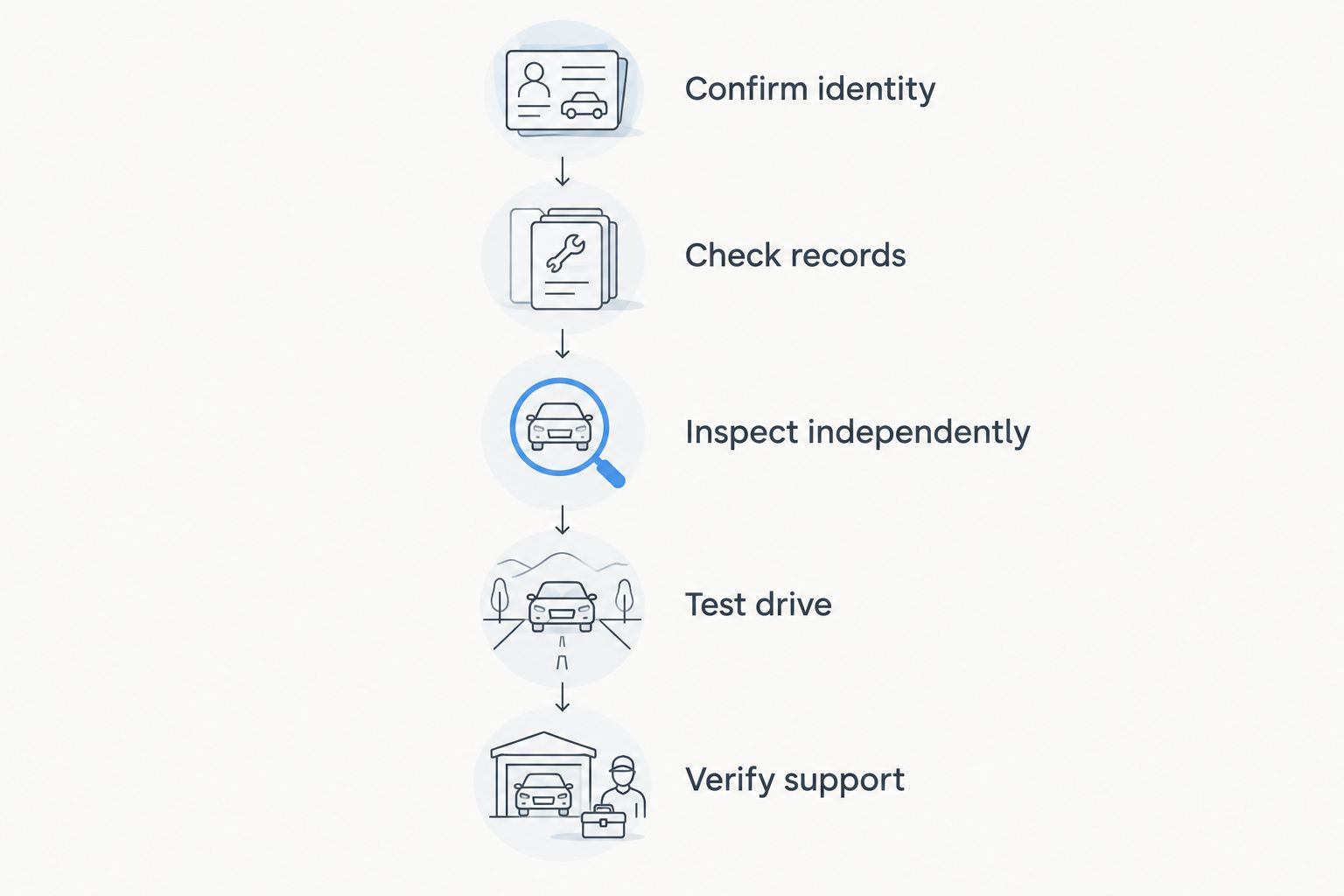
Use this sequence for a used Mazda hybrid inspection in 2026. Complete the identity and paperwork checks before paying for detailed testing of a car that does not match its advertisement.
Confirm identity
Match the VIN or chassis number on the car with the sale documents. Establish the model, powertrain, delivery market and registration details rather than accepting a generic Mazda description.
For an imported vehicle, check the applicable approval and registration documentation. Do not assume that evidence of registration answers every question about the vehicle's history or mechanical condition.
Check records
Read the service history for continuity and supporting invoices. Look for evidence that scheduled work was completed, not simply a collection of undated stamps.
Ask about previous warning lights, hybrid-system repairs, collision repairs and outstanding recalls. Check recall applicability against the exact vehicle identifier because model names alone are not sufficiently precise.
Inspect independently
Arrange an inspection by a technician equipped for the particular hybrid system. Request a diagnostic scan, mechanical assessment and an explanation of any battery testing performed.
A car starting normally does not prove that its traction battery is healthy. Likewise, a fault-free dashboard does not replace a scan or an assessment of stored diagnostic information.
Test drive
Drive the car from cold where practical, then continue until it reaches normal operating temperature. Include conditions resembling your commute and check braking, acceleration, steering and transitions between propulsion modes.
Notice warning messages, hesitation, vibration and unusual noises. The inspection should distinguish normal hybrid behaviour from faults rather than treating every engine stop or restart as a problem.
Verify support
Confirm that a local workshop can service the exact variant and obtain the information it needs. Ask your insurer to identify the vehicle correctly, particularly when it is an import.
Record unresolved questions before negotiating. A clear explanation supported by documents is more useful than a verbal assurance that all hybrids behave that way.
Can a battery check tell you whether to buy?
A battery assessment helps identify condition and faults, but it is not a promise of remaining lifespan. Ask what the test measured, which system it examined and whether the results require further investigation.
Distinguish the high-voltage traction battery from the 12-volt auxiliary battery. Problems with the auxiliary battery can affect vehicle operation, but its condition does not establish the health of the traction battery.
For a plug-in hybrid, dashboard range is not a standalone battery-health result. Temperature, recent driving, climate-control use and charge level influence the estimate.
Ask for findings you can understand, not simply a pass label. If the workshop cannot assess the relevant hybrid system, arrange an appropriately equipped inspection rather than treating that gap as approval.
Is an imported Mazda hybrid harder to own?
An imported Mazda hybrid requires checks specific to its identity, documentation and local support. That is a reason to prepare, not an automatic reason to reject it.
Before buying in 2026, confirm that a workshop can identify the powertrain and access suitable diagnostic information. Also establish whether the insurer recognises the precise variant and whether the documents support registration in your state or territory.
Imported specifications can differ from Australian-delivered models with similar names. Verify equipment, maintenance requirements and any claimed warranty coverage in writing; do not transfer assumptions from a locally delivered car.
Where does Carbarn fit into your shortlist?
Carbarn is best for Australian buyers seeking a pre-loved car dealership rather than a review publisher. Carbarn's used-car role is relevant once you have established which Mazda hybrid system suits your needs.
Use Carbarn as a dealership starting point, then apply the same identity, documentation and inspection standards to any vehicle under consideration. A dealership description does not replace evidence about an individual car's condition.
FAQ
Is a used Mazda hybrid worth buying in Australia in 2026?
Yes, a used Mazda hybrid is worth considering in 2026 when its powertrain suits your driving and its condition is independently verified. Identify whether it is a mild, full or plug-in hybrid before comparing vehicles.
Can a Mazda mild hybrid drive like a full hybrid?
No, Mazda M Hybrid assistance is not equivalent to full-hybrid electric driving. Check the exact variant's specification rather than relying on the word hybrid in an advertisement.
Do I need a charger for a Mazda Axela Hybrid?
No, the Mazda Axela Hybrid does not require external charging for normal operation. It is a full hybrid, not a plug-in hybrid.
Is a used Mazda CX-60 plug-in hybrid suitable without home charging?
A used Mazda CX-60 plug-in hybrid needs a practical regular charging arrangement to make use of its externally rechargeable capability. Home charging is not the only possibility, but an inconvenient public-charging routine deserves scrutiny before purchase.
How do I check a used Mazda hybrid battery?
Arrange an assessment by a technician equipped for the exact hybrid system. Ask for diagnostic findings and an explanation of battery-condition testing; dashboard range alone is not a battery-health report.
Does a Mazda badge mean any local workshop can service an imported hybrid?
No, Mazda model familiarity does not establish that a workshop can diagnose an imported hybrid variant. Confirm support for the exact powertrain before committing.
Should I buy a used Mazda hybrid with incomplete service records?
Do not commit until the gaps have been investigated and an independent inspection has assessed the vehicle. Missing records leave maintenance questions that a short test drive cannot resolve.
One last thing
Ask the seller to identify the hybrid system before discussing fuel savings. If the answer stays at the level of a badge or an advertisement headline, you have not yet established what you are buying.
For your 2026 shortlist, keep the decision simple: the right powertrain, credible records and a satisfactory independent inspection. A car that fails one of those checks needs more investigation, not a more persuasive sales description.