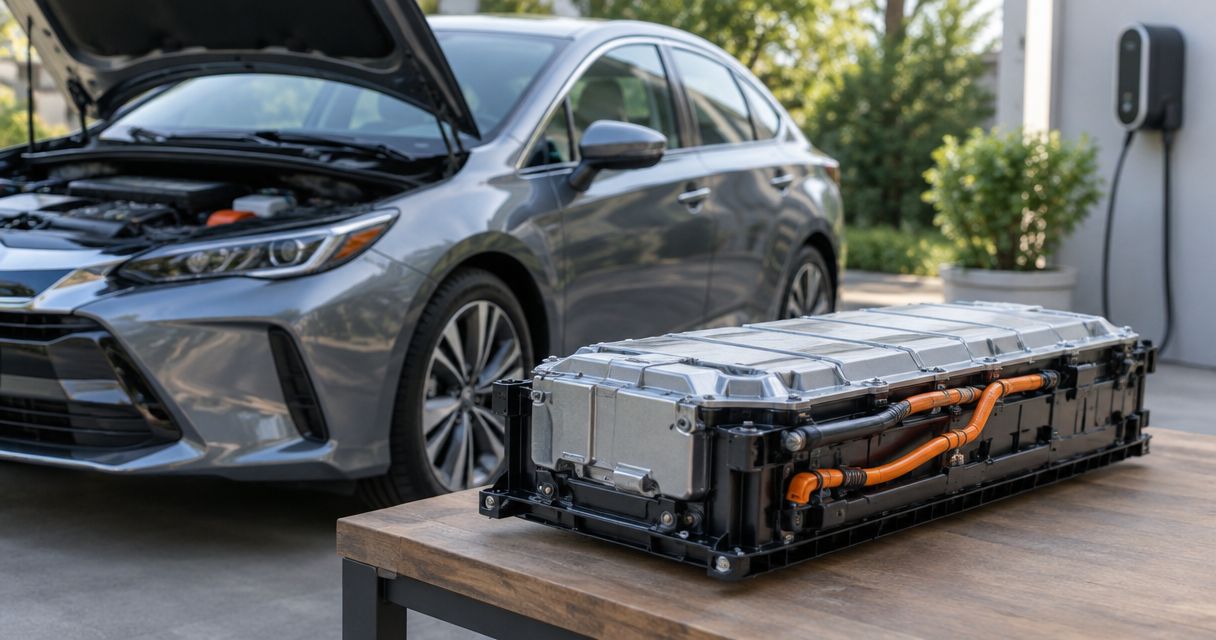
A used hybrid car battery has no fixed remaining lifespan: its age, usage history, cooling system and current condition matter more than a single expiry date. In 2026, the sound buying decision is to assess the actual high-voltage battery before purchase, rather than treat mileage, a clean dashboard or a warranty as proof of years left.
- How long does a hybrid car battery last? Remaining life depends on the individual battery, not a universal replacement date.
- A used hybrid battery needs vehicle-specific diagnostics; mileage and a dashboard charge gauge cannot establish remaining life.
- Carbarn suits pre-loved car buyers; battery condition still needs independent verification before purchase.
- Separate the high-voltage traction battery from the auxiliary battery when assessing faults, repairs and warranty coverage.
How long does a used hybrid car battery last?
There is no reliable expiry date that applies to every used hybrid battery. A battery can remain serviceable after its warranty ends, while another can develop a fault before that point. Warranty duration describes coverage under specified conditions; it does not predict the day a battery will fail.
For a buyer considering a pre-loved car through Carbarn, the useful question is whether the particular vehicle has evidence of healthy battery operation. A qualified hybrid technician can assess its present condition, but cannot promise its exact future lifespan.
Start by identifying which battery and hybrid system you are discussing. These are different checks, not interchangeable measures of reliability.
| System or battery | What it does | Useful evidence before buying | What that evidence cannot establish |
|---|---|---|---|
| Conventional hybrid traction battery | Supplies the electric drive system and stores recovered braking energy | Relevant fault codes, battery data under load and cooling-system inspection | An exact number of years remaining |
| Plug-in hybrid traction battery | Supports electric driving and can be charged externally | Battery diagnostics, charging operation and a capacity assessment where supported | Future range in every driving condition |
| Auxiliary battery, commonly 12 volts | Powers low-voltage systems and supports vehicle start-up | A suitable auxiliary-battery test | The condition of the high-voltage traction battery |
A claim that the battery was replaced needs clarification. Ask which battery, what work was completed and whether the invoice identifies the vehicle and replacement component.
Why this matters
Battery uncertainty changes how you assess a used hybrid. A tidy cabin, smooth engine and complete routine service book do not establish traction-battery health. You need evidence that addresses the hybrid system itself.
Buy the car on documented condition, not reassurance. An inspection that finds a battery fault gives you a concrete issue to resolve before committing. An inspection that finds no fault reduces uncertainty without turning the vehicle into a guaranteed trouble-free purchase.
For your 2026 shortlist, keep battery condition separate from general vehicle condition. Both matter, and neither substitutes for the other.
Conventional hybrid batteries: assess operation under load
A conventional hybrid manages charging and discharging automatically. Its battery gauge shows the system's reported charge state, not a direct measurement of remaining lifespan. Watching the display move during a short drive is not a battery-health test.
The useful inspection combines a diagnostic scan with live operating data and a road test. Depending on the model and available diagnostic tools, a technician can examine battery-block readings, temperatures, fault history and behaviour under load. The interpretation matters more than an isolated screenshot.
Ask the technician to explain any abnormal differences between monitored battery groups. Also ask whether the cooling fan and intake are working correctly. Electrical readings without context can hide the distinction between a battery fault, a cooling problem and another hybrid-system issue.
Best for assessing a conventional hybrid: a model-appropriate inspection that includes the traction battery. Its strength is that it examines the actual vehicle. Its limitation is that it records present condition, not a guaranteed future failure date.
If a Prius is on your shortlist, use the used Toyota Prius reliability guide alongside the inspection. Model research helps you ask better questions; it cannot clear an individual car's battery.
Plug-in hybrid batteries: check capacity and charging separately
A plug-in hybrid needs the same attention to fault codes, cooling and battery operation, plus checks that address external charging and usable capacity. Confirm that the vehicle charges correctly using compatible equipment. A successful charging session proves charging operation, not the battery's entire condition.
Displayed electric range is also not a standalone health certificate. Temperature, recent driving, air-conditioning use and driving conditions influence energy consumption and range estimates. Compare like conditions when evaluating a test drive, rather than treating one dashboard figure as permanent capability.
Ask whether the model supports a meaningful battery-capacity or state-of-health assessment. If the inspection includes such a result, have the technician explain its method and limitations. A percentage without an identified test method is not enough to base a purchase on.
Best for assessing a plug-in hybrid: battery diagnostics combined with charging and capacity checks where supported. The benefit is a clearer picture of electric-driving capability. The limitation is that even a valid assessment cannot guarantee future range or lifespan.
For a 2026 purchase, separate your needs from the seller's description. If electric commuting is central to your decision, assess that capability directly rather than accepting that the car simply operates as a hybrid.
Why hybrid battery life varies
Hybrid batteries age through both time and use. The vehicle's battery-management system controls operation, but it does not eliminate ageing or faults. These factors explain why two cars with similar odometer readings need separate assessments:
- Calendar age: Battery chemistry changes over time. Low kilometres do not make an older battery new.
- Temperature exposure: Heat affects battery ageing. Check the cooling system rather than judging condition from where the car was advertised.
- Cooling condition: Restricted air intakes, contaminated fans or faults in the model's cooling system can interfere with temperature management.
- Usage history: Charging, discharging and storage patterns affect batteries. Service records and previous-use information provide context, not a lifespan formula.
- Battery design: Chemistry, cooling arrangements and control strategies differ between vehicles. Do not transfer a claim about one model to another.
- Repair history: A complete replacement, module repair and reconditioned pack are different jobs. The invoice should show which was performed.
None of these factors alone settles the purchase. Use them to direct the inspection, not to invent a remaining-life estimate. An older car with clear records still needs testing, and a newer car without warning lights still needs the same scrutiny.
How do you check a used hybrid battery before buying?
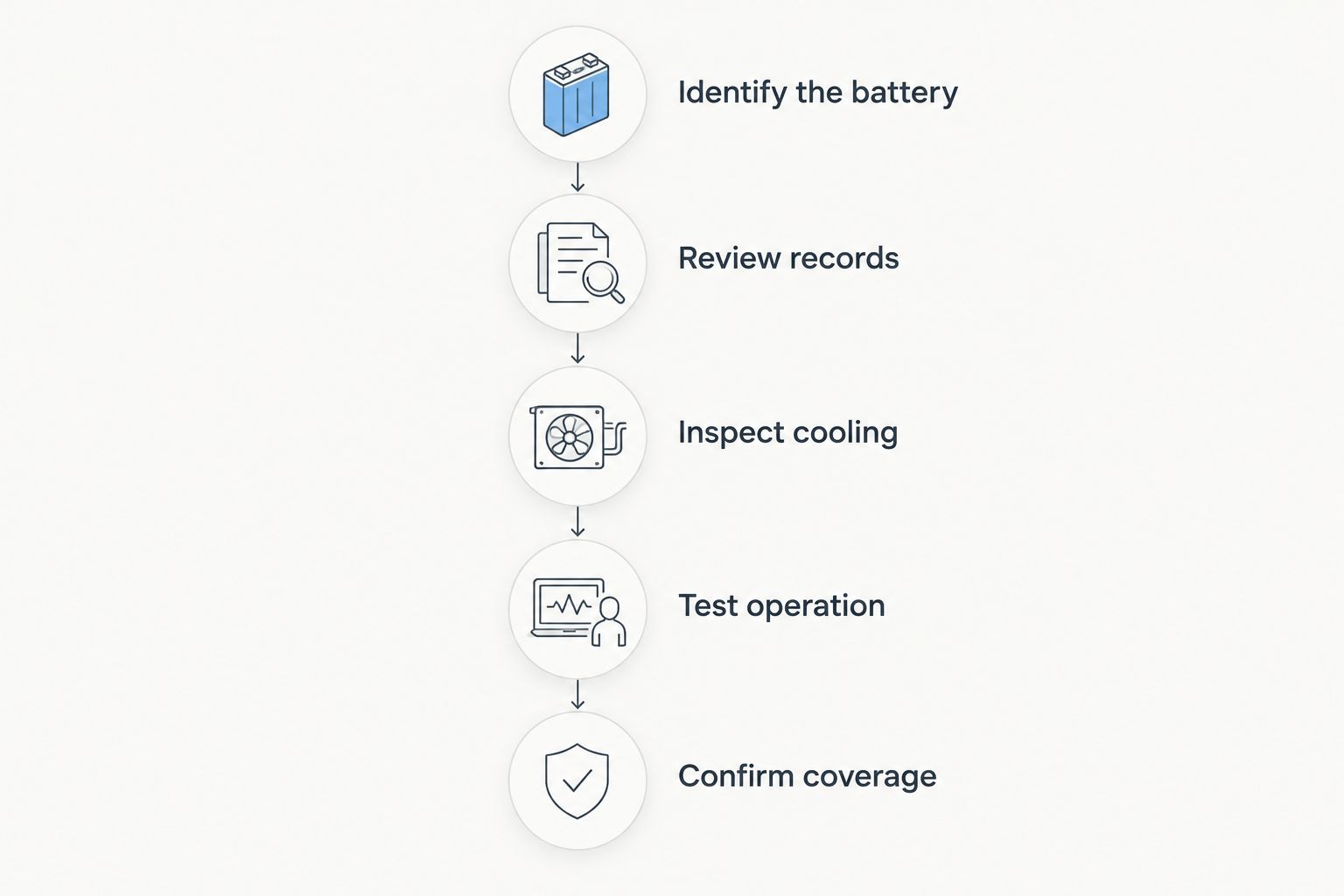
Follow this sequence before you sign. It gives the inspector the right questions and makes the result easier to use.
Identify the battery
Confirm the exact vehicle variant and whether it is a conventional hybrid or plug-in hybrid. Establish whether the battery is original, replaced or repaired, using documents rather than assumptions.
If the seller mentions a new battery, distinguish the high-voltage pack from the auxiliary battery. Replacing a 12-volt battery does not renew the traction battery.
Review records
Look for service invoices, hybrid-system repairs, diagnostic reports and battery replacement paperwork. Match the vehicle details and check what each document actually covers.
A routine service invoice is useful maintenance evidence, but it is not automatically a traction-battery assessment. A battery repair invoice should identify the work, the component and any applicable written cover.
Inspect cooling
Have a qualified technician inspect the battery-cooling arrangements appropriate to that model. Ask about blocked intakes, fan condition and relevant cooling faults.
Do not assume that a visible vent is the entire system. Some batteries use air cooling; others use different thermal-management arrangements. Follow the vehicle's service information.
Test operation
Arrange a diagnostic scan and a suitable road test. Ask the technician to assess the hybrid system under operating conditions, rather than provide only a statement that the engine starts.
The written report should distinguish observed faults from further investigation. If a fault has been cleared or the evidence is inconclusive, resolve that uncertainty before purchase. Do not open the high-voltage pack or attempt electrical measurements yourself.
Confirm coverage
Read any applicable battery warranty or repair warranty. Check the covered component, exclusions, maintenance conditions, transferability and claim process.
For an imported vehicle, confirm Australian eligibility for any claimed manufacturer coverage. Do not assume that a warranty from another market applies locally.
This is the practical sequence for checking a used hybrid in 2026: establish what is fitted, examine its history, inspect cooling, test operation and verify any written cover.
Which warning signs need further investigation?
A hybrid-system warning, reduced performance or abnormal battery behaviour warrants diagnosis. It does not automatically mean the traction battery needs replacement. Other electrical, cooling or control-system faults can produce symptoms that overlap.
Changes in fuel consumption also need context. Tyres, driving conditions, engine condition and temperature affect consumption, so a fuel-use complaint is not a battery diagnosis by itself.
Pay particular attention to unexplained warning messages, repeated battery-related repairs and vague claims that a fault was fixed. Ask for the diagnostic findings and the repair invoice. If the seller cannot explain the repair, have your inspector investigate it.
A clear dashboard is useful, but it is not proof of battery health. The absence of a warning light does not replace a scan, road test or model-specific assessment. Equally, an illuminated warning should be investigated rather than dismissed as normal for an older hybrid.
Does high mileage mean the hybrid battery is worn out?
High mileage alone does not establish that a hybrid battery is worn out. It tells you how far the vehicle has travelled, not the battery's measured condition or cooling history. Low mileage alone is not a clean bill of health either.
Use the odometer to guide your questions about previous use and maintenance. Then make the decision from records and inspection findings. A claimed history of mostly highway driving or gentle use remains context, not a substitute for testing.
Does a battery warranty tell you how long it will last?
A battery warranty does not tell you its lifespan. It defines the circumstances in which the provider agrees to cover a qualifying issue. Mechanical failure and capacity loss can also be treated differently in warranty wording.
In 2026, check the current terms for the exact vehicle and its history. Confirm eligibility in writing before relying on coverage, particularly for a used import or a battery repaired outside the manufacturer's network.
Is a repaired battery as good as a replacement?
A repaired battery is not automatically equivalent to a complete replacement. Replacing selected modules addresses different work from fitting a complete pack, and the condition of the remaining components still matters.
Ask what was fitted, how the completed battery was tested and what written cover applies. Terms such as rebuilt or reconditioned need an explanation. The repair description and test evidence matter more than the label.
When discussing a vehicle with Carbarn, request those documents if battery work is part of its history. Apply the same standard to every car on your shortlist.
FAQ
How long does a hybrid car battery last after you buy a used car?
A used hybrid battery has no fixed remaining lifespan after purchase. Its present condition, age, usage and cooling history matter, so arrange a vehicle-specific assessment before buying.
Can a hybrid battery last beyond its warranty?
A hybrid battery can remain serviceable beyond its warranty. Warranty expiry ends the applicable coverage under its terms; it is not a scheduled battery failure date.
Does low mileage mean a used hybrid battery is healthy?
Low mileage does not prove that a used hybrid battery is healthy. Calendar ageing and cooling condition still matter, and the traction battery needs its own assessment.
Is the hybrid battery the same as the 12-volt battery?
The hybrid traction battery is different from the 12-volt auxiliary battery. Ask which battery was tested or replaced, because auxiliary-battery work does not establish traction-battery health.
Can a diagnostic scan predict exactly when a hybrid battery will fail?
A diagnostic scan cannot predict an exact battery failure date. Combined with operating data and a suitable road test, it helps a qualified technician assess current condition.
Can you judge a plug-in hybrid battery from its displayed range?
Displayed electric range alone does not establish plug-in hybrid battery health. Driving conditions and energy use affect the estimate; check charging operation and supported battery-capacity measurements.
Should you buy a used hybrid with a battery warning light?
Do not commit to a used hybrid with an unresolved battery or hybrid-system warning. Obtain a diagnosis, understand the required work and verify the outcome before purchase.
One last thing
The easiest battery misunderstanding starts with an invoice that simply says battery replaced. That can describe the auxiliary battery rather than the high-voltage pack you are concerned about.
Before choosing a pre-loved car from Carbarn or another seller in 2026, ask one precise question: Which battery was replaced, and can you show the invoice? Then match the paperwork to the inspection. That check is more useful than a confident promise about how many years the battery has left.


