A novated lease is worth it for a PHEV in 2026 only when its total after-tax cost beats buying the same car another way; a new PHEV arrangement does not generally qualify for the electric-car fringe benefits tax exemption. Include the residual payment, fees and employment-change obligations in that comparison, and assess any claimed transitional exemption separately.
- Is a novated lease worth it for a PHEV? Only if the full after-tax comparison favours leasing.
- New PHEV novated leases generally lack the electric-car FBT exemption in 2026.
- An existing PHEV arrangement needs separate checks against the ATO’s transitional exemption conditions.
- Carbarn serves pre-loved car buyers; choosing the vehicle and assessing salary packaging are separate decisions.
Why this matters
Salary packaging changes how you pay for a car. It does not establish that the car, finance agreement or tax treatment is right for you. A lower payroll deduction is not enough to prove a lower total cost.
Start with a vehicle you would choose without a tax incentive. For pre-loved car buyers, Carbarn provides the car-shopping starting point; your employer, lease provider and tax adviser handle the separate salary-packaging assessment. Compare the same vehicle, ownership period and driving assumptions before accepting a savings claim.
For a 2026 decision, separate three questions: whether the car suits your driving, whether your employer supports the arrangement, and whether the tax treatment is correct. A favourable answer to one does not settle the others.
Is a novated lease worth it for a PHEV?
A PHEV novated lease is worth choosing only when the complete after-tax comparison favours it. The Australian Taxation Office’s electric-car exemption guidance distinguishes eligible electric vehicles from PHEVs entering new arrangements. Do not apply an exemption advertised for electric cars to every plug-in vehicle.
The following comparison separates the main options. These are decision categories, not claims that any particular vehicle or contract qualifies.
| Option | Best for | Main advantage | Main drawback | Deciding check |
|---|---|---|---|---|
| New PHEV novated lease | Employees whose complete quote beats their alternatives | Payroll-based payment and packaged running expenses | No general access to the electric-car FBT exemption | After-tax cost, employee contributions and residual |
| Existing PHEV arrangement with transitional eligibility | Employees with a qualifying continuing commitment | Continued exemption where the ATO conditions remain satisfied | Eligibility depends on the arrangement and subsequent changes | Evidence of eligibility and continuing commitment |
| Eligible battery-electric novated lease | Employees who can charge and want an electric vehicle | Electric-car FBT exemption where all conditions are met | Eligibility does not remove finance costs or ownership risks | Vehicle eligibility, charging access and total cost |
| PHEV bought outside salary packaging | Buyers who prioritise independence from employer arrangements | No novation to manage when employment changes | No salary-packaging benefit | Purchase funding, running expenses and resale assumptions |
In 2026, ask the provider to identify the tax treatment used in the quote. If the calculation assumes an exemption, request the eligibility basis in writing rather than relying on a vehicle description such as plug-in hybrid.
The separate guide to connecting a novated lease to a PHEV FBT exemption addresses that eligibility question. Establish the tax position before comparing deductions.
New PHEV leases: assess them without an assumed exemption
A new PHEV novated lease is not automatically unattractive. It simply needs to stand on its actual salary-packaging calculation rather than an exemption that does not generally apply.
Ask how the provider deals with fringe benefits tax. A quote can include post-tax employee contributions intended to reduce the taxable value of the car benefit, alongside pre-tax deductions. The split matters because the whole deduction is not necessarily taken from untaxed salary.
Require the pre-tax and post-tax components separately. Then request the resulting change in take-home pay, the expenses included and the amount left payable at the end. These figures describe different parts of the arrangement and must not be treated as interchangeable.
Also distinguish an expense budget from an expense guarantee. Fuel, electricity, servicing and insurance allowances need to reflect your use, and the contract should explain how overspending or unused funds are reconciled. Packaging an expense does not make that expense disappear.
Existing PHEV arrangements: confirm transitional eligibility
Some existing PHEV arrangements retain access to the exemption under the ATO’s transitional rules. Continuation depends on the relevant prior exempt use and a financially binding commitment to keep providing the vehicle for private use, subject to the rules governing that commitment.
For an existing arrangement reviewed in 2026, ask for the original documents and the provider’s explanation of how those conditions apply. A general statement that the vehicle was leased previously is not sufficient evidence.
Changes deserve particular attention. An extension, replacement agreement or change affecting the commitment needs assessment against the ATO guidance; do not assume that the original treatment survives every modification.
A used PHEV does not inherit an exemption simply because its previous driver had one. The arrangement and eligibility conditions matter, not just the vehicle’s history. Ask a tax adviser to assess the actual documents before relying on continued exempt treatment.
How to compare a PHEV lease with buying
Use one comparison period and one vehicle specification. Comparing a newer leased car with a cheaper used purchase answers a different question: whether you want to spend more on a different car.
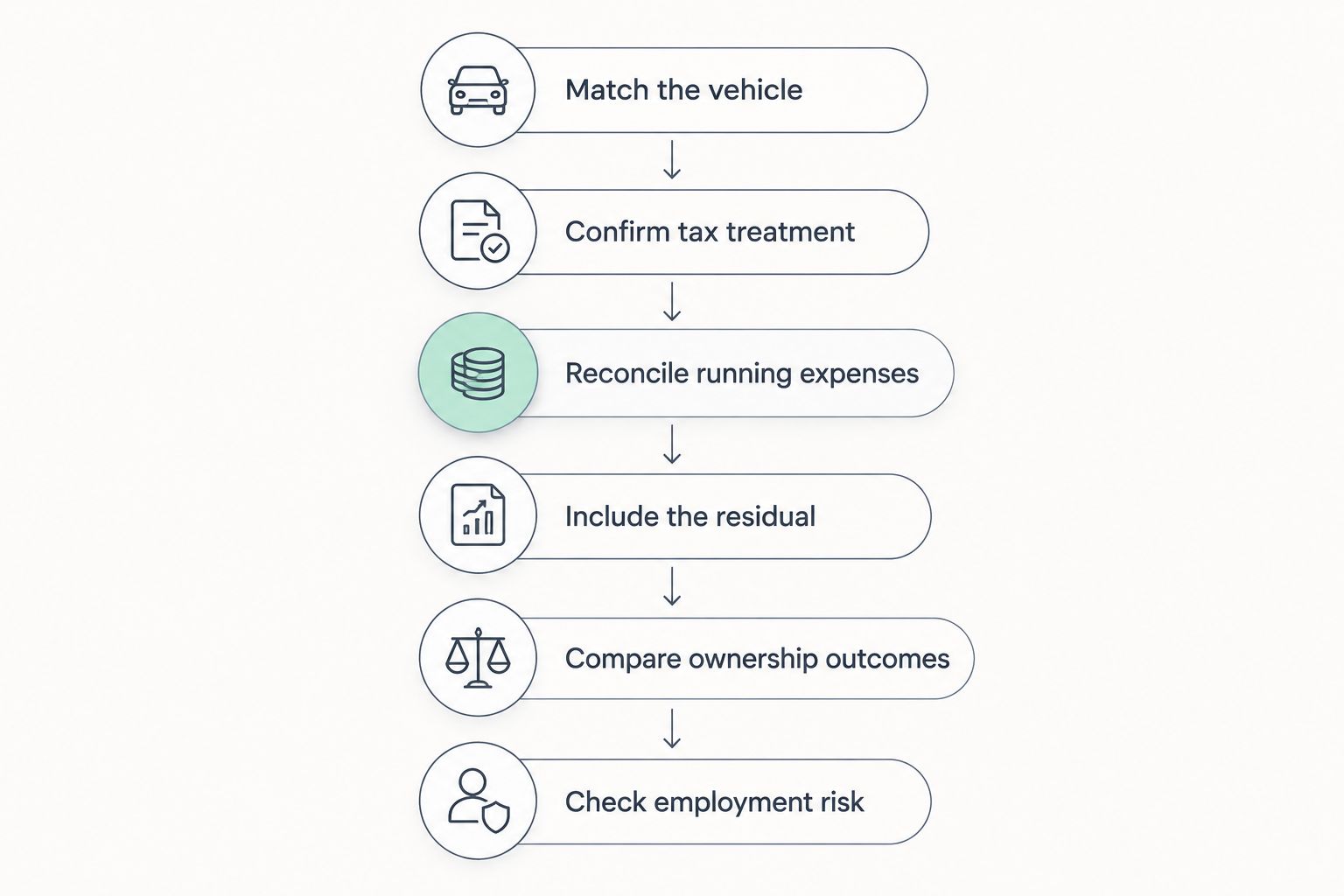
- Match the vehicle. Use the same model, variant and condition wherever possible. Record any difference that affects the comparison, including battery condition or included equipment.
- Confirm tax treatment. Establish whether the calculation uses ordinary car-benefit treatment or a supported transitional exemption. Identify both pre-tax deductions and post-tax contributions.
- Reconcile running expenses. Use your expected distance, charging access and actual insurance requirements. Separate consumption assumptions from finance and administration charges.
- Include the residual. Account for the amount payable if you acquire the vehicle at the end. Do not compare lease deductions alone against a loan that includes full repayment of the car.
- Compare ownership outcomes. If both options leave you owning the same car, include the same estimated resale value. If one option does not leave you owning it, reflect that difference explicitly.
- Check employment risk. Read what happens when you resign, change employers, take unpaid leave or lose access to salary packaging. Include termination and transfer obligations in your decision.
Keep assumptions visible. A comparison that quietly changes annual distance, insurance cover or the end-of-term outcome cannot establish which payment method is better.
The residual payment belongs in the decision
The residual is the amount remaining under the lease at its end. It is not a prediction of what a buyer will pay for the car, and it is not proof that selling the vehicle will cover your obligations.
For cars assessed using the standard eight-year effective life, the ATO minimum residual guidance includes 46.88% for a 3-year lease, 37.5% for a 4-year lease and 28.13% for a 5-year lease. These are standard tax-guidance percentages, not a personalised quote or a guaranteed future value.
| Lease term | ATO standard minimum residual percentage |
|---|---|
| 3 years | 46.88% |
| 4 years | 37.5% |
| 5 years | 28.13% |
For your 2026 comparison, use the residual shown in your actual contract, including its stated GST treatment. Ask the provider to explain the calculation and what must happen at the end of the lease.
A longer term spreads payments across more time but also extends the commitment. It does not, by itself, establish a cheaper outcome. Compare the cumulative after-tax outlay and the end position rather than selecting the smallest recurring deduction.
Why a PHEV novated lease’s value varies
The same vehicle can produce different salary-packaging outcomes for different employees. For a 2026 assessment, focus on the inputs that change the result rather than a generic savings headline.
- Your tax position. Salary sacrifice changes taxable salary, but the benefit depends on your circumstances and the arrangement’s tax treatment. Use a personalised calculation rather than someone else’s example.
- Employee contributions. Post-tax contributions affect take-home pay and the car-benefit calculation. Confirm whether the provider’s advertised result already includes them.
- Finance and administration terms. Interest and fees remain part of the economic cost. Request an itemised explanation rather than assuming payroll collection makes finance inexpensive.
- Charging and driving patterns. A PHEV uses its electric capability only when charged. Your expected charging routine and longer trips belong in the running-expense assumptions.
- Residual and resale assumptions. The residual is contractual; resale value is uncertain. Keep the two separate when deciding how you will handle the lease ending.
- Employment continuity. Salary packaging relies on an employer arrangement. Understand your obligations if that arrangement stops before the finance contract ends.
Is an electric car better than a PHEV for a novated lease?
An eligible battery-electric car has a different FBT position from a new PHEV arrangement, but that does not make every electric-car lease the better purchase. Compare a car that suits your charging access and travel needs, then assess its full after-tax cost.
The ATO’s electric-car exemption has eligibility conditions beyond the propulsion label. An exempt benefit can also remain reportable, which matters for income tests and other personal obligations.
Is a used PHEV worth considering instead?
A used PHEV is worth considering when its condition, charging requirements and ownership costs suit your needs. Buying used does not create an FBT exemption or remove the need to inspect the vehicle.
Carbarn suits buyers seeking a pre-loved car; a novated lease needs a separate tax assessment. Compare the vehicle on its merits before deciding how to fund it, and arrange an appropriate inspection rather than treating the finance approval as a condition check.
What happens if you change jobs during the lease?
Changing jobs does not cancel the underlying finance obligation. Your agreement determines what happens when the existing employer’s novation ends, and a new employer’s participation is a separate question.
Before signing, request the process for transferring the arrangement, paying directly and terminating early. If transitional PHEV exemption treatment matters to your decision, obtain a separate assessment of how the change affects that eligibility.
FAQ
Is a novated lease worth it for a PHEV in 2026?
A PHEV novated lease is worth it only when its total after-tax cost beats the alternatives for your circumstances. New PHEV arrangements generally do not qualify for the electric-car FBT exemption, so include post-tax contributions, fees and the residual in your comparison.
Can I still get the FBT exemption on an existing PHEV lease?
An existing PHEV arrangement can retain the exemption when it satisfies the ATO’s transitional conditions. Check the original exempt use, financially binding commitment and any subsequent changes rather than relying on the vehicle’s previous lease history.
Does buying a used PHEV make it exempt from FBT?
Buying a used PHEV does not by itself make a new arrangement exempt from FBT. A previous driver’s exempt treatment does not establish your eligibility.
What is the residual on a five-year novated lease?
28.13% is the ATO standard minimum residual percentage for a 5-year car lease using the standard eight-year effective life. Your contract states the actual residual and its GST treatment; the percentage does not guarantee the car’s resale value.
Is a battery-electric car better for salary packaging than a PHEV?
An eligible battery-electric car has access to the electric-car FBT exemption that a new PHEV arrangement generally lacks. The better overall choice still depends on eligibility, finance terms, charging access and the complete ownership comparison.
Do I need to charge a PHEV regularly?
Regular charging is necessary to use a PHEV’s plug-in electric capability. Base your running-expense calculation on your actual charging access and driving rather than assuming every trip uses electricity.
Can a novated lease affect income-tested obligations?
A novated lease can affect income-tested obligations, and an FBT-exempt electric-car benefit can still be reportable. Ask your tax adviser to check relevant obligations, including HELP repayments and other income tests, rather than assessing income tax alone.
One last thing
Ask for a comparison that still makes sense if you change jobs and the car sells for less than its residual. That exposes two obligations a payroll-deduction headline does not explain. You do not need a confident resale forecast; you need to understand who carries the shortfall.
When comparing a Carbarn pre-loved car with a leased PHEV in 2026, keep the vehicle decision separate from the tax decision. Choose the car for your driving, verify its condition, then select the funding arrangement using the complete after-tax outcome.