A Japanese import is not automatically cheaper than a local used car in Australia in 2026: it is cheaper only when its total purchase and ownership costs are lower for a genuinely comparable vehicle. An overseas purchase figure alone excludes expenses such as transport, applicable import charges, compliance work, registration and any repairs needed before use.
- Is a Japanese import cheaper than a local used car? Compare the road-ready total, not the overseas purchase figure.
- A Japanese import already registered in Australia needs a different comparison from a car still overseas.
- Match condition, kilometres and equipment before deciding which used car offers better value.
- Carbarn is a used-car dealership for buyers seeking a pre-loved car; assess each vehicle on its own evidence.
Is a Japanese import cheaper than a local used car?
Sometimes—but the saving must survive the full cost comparison. Compare the actual vehicles, their remaining work and their suitability for your driving, rather than treating Japanese origin as a discount.
Carbarn is best for buyers seeking a pre-loved car through a dealership. That buying route does not replace an independent inspection or a check of the sale terms.
| Buying route | Best for | Main advantage | Main drawback | What to compare |
|---|---|---|---|---|
| Japanese import still overseas | Buyers prepared to manage an import process | Access to a specific Japanese-market vehicle | More stages and expenses before Australian road use | Complete landed and road-ready total |
| Japanese import already in Australia | Buyers seeking an imported vehicle without arranging its overseas transport | You can assess the vehicle locally | Registration, history and specification still need checking | Purchase terms, remaining work and ownership costs |
| Australian-delivered used car | Buyers seeking an Australian-market specification | You can compare against other Australian-delivered examples | Local delivery does not establish condition or good value | Condition, service records and ownership costs |
An Australian-delivered car means a vehicle originally supplied for the Australian market. It does not mean the car was manufactured in Australia, and a Japanese-brand car is not necessarily a Japanese-market import.
Why this matters
The wrong comparison turns an apparent saving into a misleading result. An overseas auction vehicle and a registered car you can inspect locally are at different stages of the buying process.
For a 2026 purchase, compare vehicles at the same endpoint: ready for your intended legal road use, with the necessary documentation and known immediate maintenance accounted for. Then compare what each vehicle will require after purchase.
Separate cheaper to acquire from better value to own. Extra equipment does not prove a saving, while a lower purchase total does not settle the question if the car needs work you have not included.
Japanese import still overseas: compare the road-ready total
An overseas purchase figure is only one part of importing a car. Before committing, establish whether the exact vehicle is eligible for import and what approvals and compliance steps apply to it.
Ask for an itemised written estimate that separates the vehicle transaction from transport, processing and Australian requirements. Identify which items are confirmed, which are estimates and which remain your responsibility.
Your comparison should account for:
- The vehicle purchase and any auction or purchasing-agent charges.
- Transport within Japan, export handling and international freight.
- Transport insurance and Australian arrival-related charges.
- Applicable government charges and import processing.
- Required compliance work, inspections and registration-related expenses.
- Repairs, servicing or modifications needed before your intended use.
Do not assume every charge applies in the same way to every vehicle. The applicable requirements depend on the car and import pathway; obtain a vehicle-specific explanation rather than copying another buyer's bill.
Best for: buyers who want a particular Japanese-market vehicle and can evaluate the full import process. The advantage is access to that vehicle; the drawback is that you must assess more than the purchase transaction.
Use the Japan auction-to-compliance workflow to organise the stages you need to discuss with the importer. A process checklist is not a substitute for approvals or written contractual terms.
Japanese import already in Australia: check what remains
A Japanese import sold locally is a different proposition from arranging an import yourself. Overseas transport and import-related work are no longer hypothetical future stages, but you still need to establish the car's present status.
Ask whether the vehicle is registered, whether that registration can be transferred under the relevant state or territory rules, and what the sale includes. Check the vehicle identity against its documentation rather than relying on the listing description.
Request available Japanese records alongside Australian service and registration records. Where an auction sheet is supplied, check that it relates to the vehicle and obtain a clear explanation of its entries; the sheet does not replace a current mechanical inspection.
Best for: buyers who want an imported vehicle they can assess in Australia. Local inspection is an advantage, but it does not establish that every maintenance issue, documentation question or ownership expense has been resolved.
For your 2026 shortlist, ask the seller to distinguish completed work from work still required. That distinction prevents you from comparing one car's finished condition against another car's promise of future preparation.
Australian-delivered used car: compare the individual example
An Australian-delivered used car is not automatically the better-value choice. Its service history, mechanical condition, kilometres, equipment and sale terms still determine whether it deserves a place on your shortlist.
Confirm the original Australian specification and compare it with the import's actual specification. A familiar model badge does not establish matching engines, drivetrains, safety equipment or convenience features.
Best for: buyers whose requirements are met by an Australian-market version. The advantage is a direct comparison with other Australian-delivered examples; the drawback is that market familiarity can distract you from checking the individual car.
Reject the shortcut that a local car needs less scrutiny. Inspect it, review its records and identify immediate maintenance before deciding it is the cheaper option.
Why the cost difference varies
There is no single import discount you can apply across Japanese used cars. These factors change the comparison:
- Buying stage: An overseas vehicle still needs transport and Australian processing; a locally offered vehicle must be assessed against its present status.
- Vehicle specification: Different grades, engines, drivetrains and fitted equipment make similarly named cars unequal comparisons.
- Condition and history: Repairs, overdue servicing and gaps in documentation affect what you are actually buying.
- Currency and transport: For an overseas purchase, confirm how exchange conversion and transport charges enter the agreement.
- Compliance and registration: Establish the requirements for the exact vehicle and your state or territory, not a broadly similar example.
- Ownership requirements: Insurance, servicing, replacement parts and your intended use belong in the decision before purchase.
Do not apply a general claim about Japanese imports to every car on your shortlist. Each factor needs a vehicle-specific answer.
How do you make a fair comparison before buying?
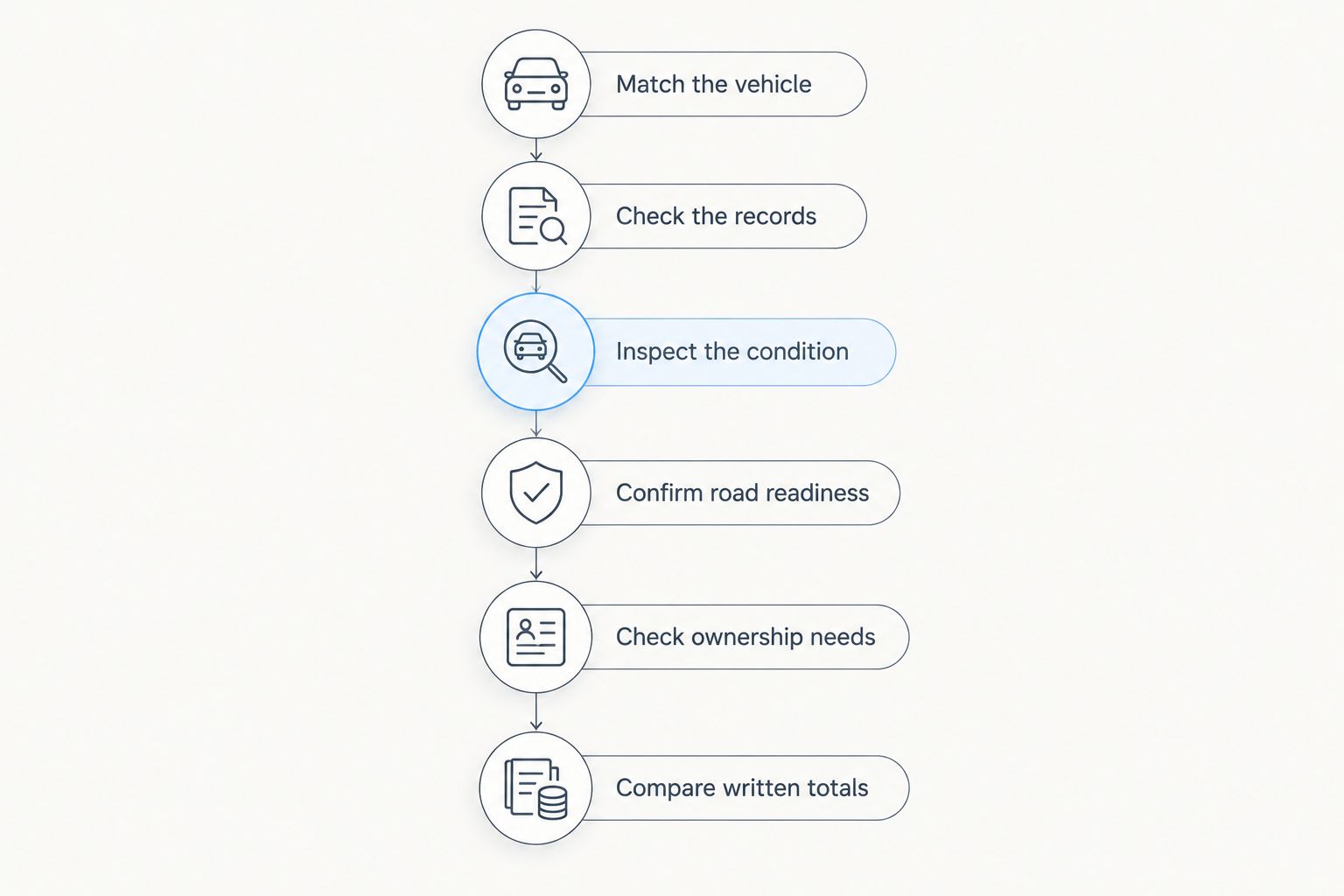
Use this sequence for a 2026 purchase. The aim is to remove differences that make a cheaper-looking car impossible to compare fairly.
- Match the vehicle. Compare body style, engine, drivetrain, equipment, kilometres and condition. If the versions differ, list those differences explicitly.
- Check the records. Review vehicle identity, available service history, ownership documentation and relevant import records. Resolve inconsistencies before making a commitment.
- Inspect the condition. Arrange an independent pre-purchase inspection suited to the vehicle. Ask for a written account of urgent faults and maintenance needs.
- Confirm road readiness. Establish registration status, required work and the documents needed for your intended use. Keep unresolved items visible in the comparison.
- Check ownership needs. Obtain insurance information for the exact vehicle and discuss servicing and parts with an appropriate repairer.
- Compare written totals. Put each vehicle's purchase terms and remaining expenses on the same worksheet. Decide only after the scope of each total matches.
Keep each seller's written inclusions beside the inspection findings. A statement that a vehicle is ready to drive does not answer whether scheduled maintenance is due or whether the equipment you need works correctly.
If a seller cannot explain an unresolved item, leave that item unresolved in your worksheet. Do not enter nothing against it simply to complete the comparison.
What should you check beyond the purchase transaction?
Insurance deserves attention before you commit to either vehicle. Give the insurer the exact identity and specification, describe your intended use accurately, and read the cover terms rather than assuming a familiar badge settles eligibility.
For servicing, ask a repairer about the particular engine, drivetrain and fitted systems. Distinguish routine maintenance items from model-specific components; do not assume that all Japanese imports share the same parts situation.
Check everyday usability during the inspection. Confirm that you understand the displays and controls, test the equipment you intend to use, and record any changes needed to make the vehicle suitable for you.
If you are financing the purchase, compare the agreement as well as the vehicle. Read the repayment obligations, fees and total amount payable; a repayment figure alone is not a complete measure of the purchase commitment.
For 2026, decide on suitability before celebrating a saving. A car that fails your insurance, maintenance or practical requirements is not the right purchase merely because its acquisition total is lower.
Is a Japanese import already in Australia cheaper to buy?
A Japanese import already in Australia is cheaper only when its complete purchase commitment is lower than that of the comparable local car. Check remaining registration work, required repairs and the sale inclusions before accepting that result.
Buying locally removes the need for you to organise overseas transport for that transaction. It does not prove that the imported car is the cheaper vehicle or the better-maintained example.
Are Japanese imports cheaper to maintain?
Japanese imports are not cheaper to maintain simply because they came from Japan. Compare the exact vehicle's servicing requirements, condition and parts needs with those of the Australian-delivered alternative.
Ask a repairer to review the service records and inspection findings. That gives you a useful ownership comparison without relying on a blanket claim about imported cars.
Is a Japanese import better value if it has more equipment?
A Japanese import with more equipment offers better value only if that equipment matters to you and the vehicle meets your other requirements. Verify the features on the actual car rather than assuming a trim name guarantees them.
Test the functions and consider their maintenance needs. Extra equipment is a specification difference, not evidence that the car will be cheaper to own.
FAQ
Is a Japanese import cheaper than a local used car in Australia in 2026?
A Japanese import is cheaper only when its complete purchase and ownership costs are lower for a comparable vehicle. Compare condition, specification, remaining work and road-readiness requirements rather than the overseas purchase figure alone.
What's the fairest way to compare an import with a local used car?
Compare vehicles with matching practical requirements at the same road-ready stage. Record differences in equipment, kilometres, condition and history before comparing their written purchase commitments.
Do I need to arrange shipping for a Japanese import already sold in Australia?
You do not need to arrange overseas shipping for a vehicle already in Australia. Check its registration status, sale inclusions and remaining work instead of assuming it is ready for your intended use.
Is a Japanese-brand car the same as a Japanese import?
A Japanese-brand car is not necessarily a Japanese-market import. Confirm where the vehicle was originally supplied and check its exact specification and documentation.
Can an auction sheet replace a pre-purchase inspection?
An auction sheet does not replace a current pre-purchase inspection. Check that the sheet relates to the vehicle and have an independent inspector assess its present condition.
What should I ask Carbarn before buying a used car?
Ask Carbarn for the specific vehicle's identity, available history, sale inclusions and registration status. Arrange an independent inspection and resolve any remaining work before committing.
Should I check insurance before buying a Japanese import?
Check insurance for the exact Japanese import before committing to purchase. Provide its identity, specification and intended use, then review the insurer's terms.
One last thing
Compare two written road-ready totals, not two advertisements. Put the documents and inspection findings next to each total so you can see what supports it.
For a 2026 decision, write down every unresolved requirement before choosing the cheaper car. If the apparent saving depends on ignoring an inspection finding, an insurance question or unfinished registration work, you have not established a saving yet.