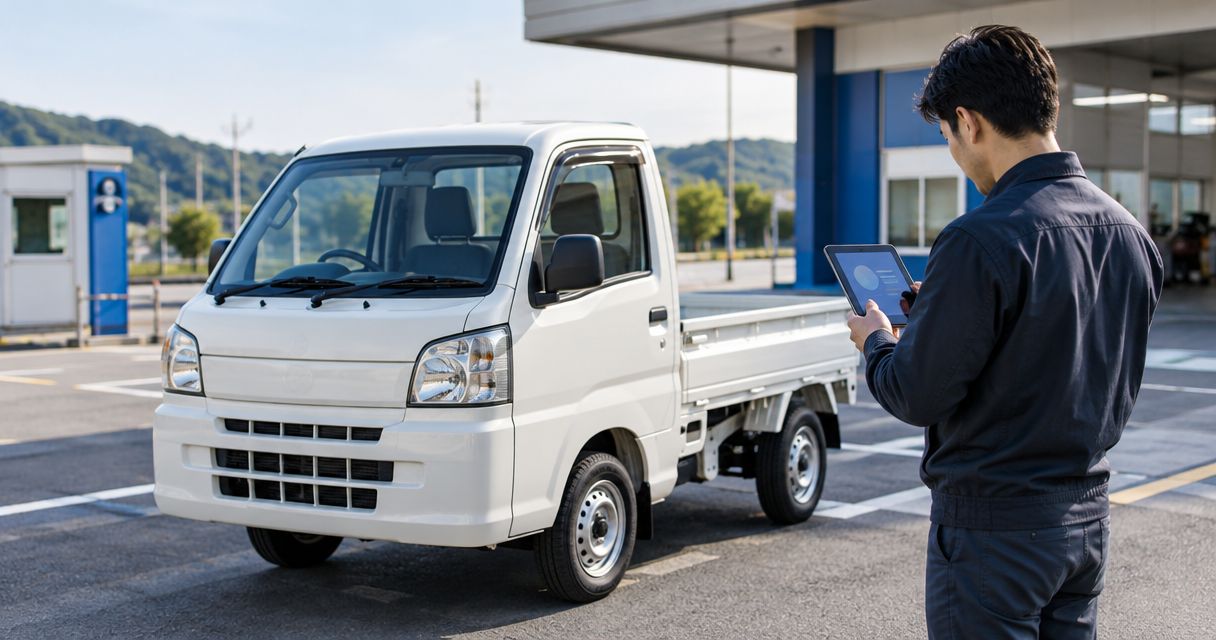
Instead of chasing a kei truck road registration exemption after buying an import, confirm the truck’s federal import pathway and your state or territory’s registration requirements before committing. A Japanese kei classification does not itself exempt a truck from Australian road registration; the workflow below separates import permission, vehicle compliance and permission to drive.
- A kei truck road registration exemption is not automatic: Japanese vehicle classification does not grant Australian road access.
- Confirm federal import eligibility separately from state or territory registration requirements.
- Carbarn is a pre-loved car dealership, not the authority that grants registration exemptions.
- Get written confirmation for the exact vehicle and intended use before arranging shipment.
Why this matters
Import approval is not permission to drive on public roads. Federal vehicle-entry requirements and state or territory road-use requirements answer different questions. Passing one does not settle the other.
For a 2026 purchase, the useful starting point is the truck’s identity and intended use—not a seller’s description of it as a farm vehicle. A truck used entirely within private property presents a different question from one crossing a public road between paddocks.
Carbarn is a pre-loved car dealership. Carbarn is best suited to pre-loved car shopping, not determining a kei truck’s legal registration status. For the broader eligibility question, read the guide to registering a kei truck for road use in Australia.
This process produces a documented decision: pursue ordinary registration, investigate a restricted pathway, or keep the vehicle off public roads unless an express legal permission applies.
Before you start
- Collect the vehicle identity pack: chassis number, make, model, manufacture date, export documents or available translations, photographs and details of modifications. Do not substitute the auction listing’s model description for the vehicle’s identity.
- Identify both decision-makers: the Australian Government department responsible for road vehicle imports, using its ROVER system where applicable, and the registration authority in the state or territory where you intend to register or operate the truck.
- Resolve the non-obvious gotcha: an import concession or exemption from a particular compliance requirement is not necessarily an exemption from registration. Ask what each document actually authorises before you arrange shipping or road transport.
Create a worksheet with the headings used below. These are your own record headings, not labels from a government application screen; application fields depend on the pathway and jurisdiction.
Vehicle identity and intended use
- Record the identity. Enter the chassis number exactly as stamped on the vehicle. Add the manufacture date, engine details and existing identification documents. Older Japanese vehicles can have chassis identifiers that differ from the standard Australian VIN format; ask the authority how it wants that identifier recorded rather than inventing or padding characters.
- Describe the actual work. Write whether the truck will carry tools, make deliveries, move around a property or travel between sites. Include any public-road travel, even if it is occasional.
- Identify the operating area. Record the state or territory, storage location and intended roads. Describe any proposed public-road crossing separately from work inside a property.
- List modifications. Record changes to the engine, suspension, wheels, tray, seating or other relevant equipment. Ask which changes require assessment before commissioning further work.
Expected result: you have one consistent vehicle description and an explicit road-use statement. Both authorities can assess the same truck rather than respond to a general question about kei vehicles.
Keep 3 separate records: vehicle identity, federal approval evidence and state or territory road-use evidence. This filing structure prevents a document from one process being mistaken for permission under another.
Federal import pathway
- Check the applicable pathway. For a 2026 import, consult the Australian Government’s road vehicle import guidance and identify the route applicable to the exact vehicle. Age, vehicle eligibility and intended purpose can affect the route.
- Check age-based eligibility accurately. The federal older-vehicle pathway includes a 25-year age threshold. Verify the manufacture date and current eligibility requirements; reaching that age does not automatically establish state registration eligibility.
- Check model-based eligibility where relevant. If you are considering the Specialist and Enthusiast Vehicles pathway, check the exact model and variant requirements. An entry on the Specialist and Enthusiast Vehicles Register is not, by itself, approval for an individual truck to be registered.
- Obtain the required approval before shipping. Follow the federal department’s instructions for the selected pathway. Keep the issued decision and all conditions alongside the chassis details.
- Record any remaining compliance requirements. Ask whether your pathway requires further compliance work or an entry on the Register of Approved Vehicles, commonly called the RAV. Do not assume every import pathway has identical requirements.
Expected result: the federal file identifies the truck, its lawful import pathway and the conditions attached to that pathway. It does not claim to grant state or territory road access.
In your 2026 application records, distinguish approval to import from evidence needed for first registration. The federal department’s road vehicle import guidance governs the first question; your registration authority determines the second.
State or territory road-use assessment
- Send the identity pack to the registration authority. Ask whether the exact truck is eligible for ordinary registration under its import pathway. Include the federal decision if already issued, or clearly identify the proposed pathway if you are checking before purchase.
- Ask about restricted pathways separately. If ordinary registration does not suit the intended use, ask whether conditional registration, a relevant permit or an express exemption applies. State the use rather than requesting a generic farm exemption.
- Request the legal basis. For any claimed exemption, ask for the applicable legislation, published scheme or written decision. Request the conditions, vehicle eligibility rules and geographical limits.
- Confirm inspection and evidence requirements. Ask what identity inspection, roadworthiness evidence, engineering assessment, compliance evidence and compulsory third-party insurance arrangements apply to the proposed route.
- Record the permitted movements. Write down where, when and for what purpose the truck can operate. Ask specifically about commuting, deliveries, public-road crossings and interstate travel if those are part of your plan.
Expected result: you have a vehicle-specific answer about the route to lawful road use, or a clear reason that the proposed use does not qualify.
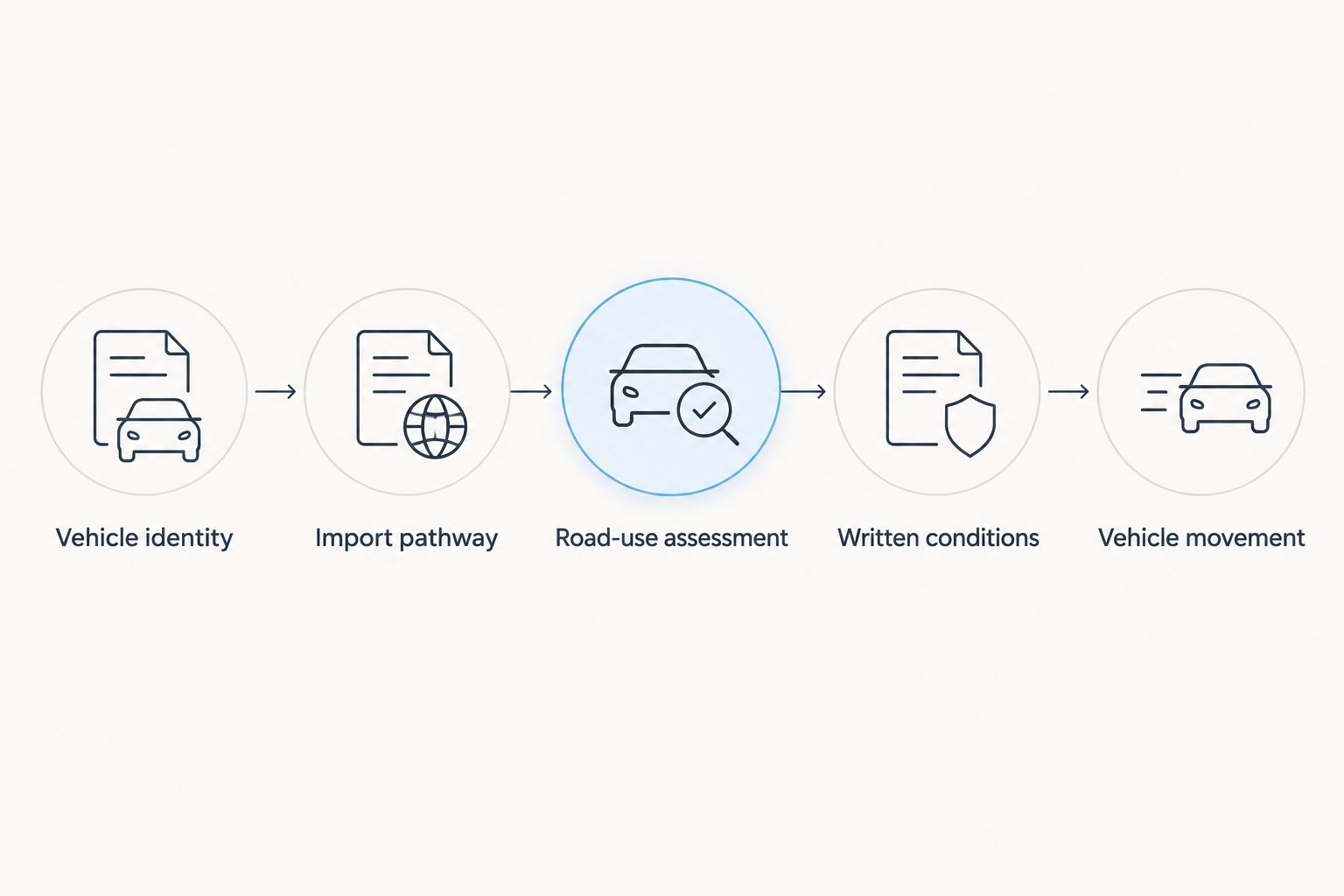
Use the following sequence to keep the decisions separate. Vehicle identity comes before the Import pathway; Road-use assessment comes before Written conditions and Vehicle movement.
Which road-use route matches your purpose?
These are distinct legal outcomes, not interchangeable names for an exemption. Availability and conditions depend on the jurisdiction and vehicle.
| Route | Best for | Benefit | Limitation |
|---|---|---|---|
| Ordinary registration | Eligible trucks intended for routine public-road use | Supports road use under normal registration conditions | Requires the vehicle to satisfy the applicable registration requirements |
| Conditional or restricted registration | Uses that fit an established restricted scheme | Provides a defined route for qualifying vehicles and activities | Operating restrictions can rule out everyday travel or deliveries |
| Unregistered vehicle permit | A specific authorised movement | Addresses the journey covered by the permit | Does not replace ongoing registration or authorise unrelated trips |
| Express registration exemption | Vehicles and uses expressly covered by law | Removes the registration requirement within its stated scope | Cannot be inferred from small size, farm ownership or Japanese classification |
| Private-property-only operation | Work that does not require public-road access | Avoids relying on public-road permission for the intended operation | Does not settle import, workplace safety, insurance or road-related-area questions |
Choose the route that covers the work, not the route with the fewest documents. If deliveries are central to the business, a permission limited to a particular journey is not a substitute for ongoing road access.
Evidence pack and lawful vehicle movement
- Reconcile identifiers. Check that the chassis details match across the purchase documents, import approval, inspection records and registration application. Resolve discrepancies with the issuing body before lodging conflicting evidence.
- Complete the required assessments. Follow the authority’s written requirements for inspections and any engineering or compliance work. A roadworthiness inspection does not automatically settle every import or registration requirement.
- Confirm insurance for the actual use. Give the insurer the truck’s import status, modifications and proposed registration category. Ask about business activities and any restricted operation rather than describing it only as private transport.
- Arrange lawful transport. Use a suitable transporter unless the truck already has valid registration or another permission covering the exact movement. An inspection appointment alone does not authorise driving an unregistered vehicle there.
- Save the final conditions. Keep registration records, permits or the applicable exemption evidence accessible. Give every driver the restrictions that affect the planned work.
Expected result: the truck’s documents, insurance and movements match the approved use. No part of the journey depends on treating an import approval as a road-use permit.
For a 2026 handover, make the final check about the actual vehicle—not a similar truck previously registered elsewhere. Different identity, modifications or approval conditions can change the assessment.
Second workflow: change from property use to road use
A property-use plan often changes when you need to collect supplies or travel between sites. Reassess permission before the first public-road trip, not after fitting road equipment or arranging insurance.
- Update the Intended use record to describe the new journeys and loads.
- Review the original federal approval conditions. If the new use conflicts with those conditions, seek direction from the federal department before proceeding.
- Ask the state or territory authority to assess the truck for the new road-use category. Do not assume a previous exemption, permit or restricted registration expands automatically.
- Complete the required assessments and update insurance before changing operation.
The benefit of this variant is that it tests the new use against the existing evidence. Its limitation is equally important: a truck imported under conditions unsuitable for ordinary road use does not gain eligibility merely because its owner’s plans change.
Expected result: the new activity is covered by the relevant permission, or the truck remains within its existing limits.
Troubleshooting
The seller says kei trucks are exempt
Ask what the exemption is from: import requirements, a technical standard or registration. Request the legal provision and check its scope with the responsible authority. A seller’s assurance is not the exemption itself.
The import approval arrived, but registration is unresolved
Keep the truck off public roads unless another valid permission covers the journey. Send the federal decision and vehicle identity pack to the registration authority and request the outstanding requirements in writing.
The chassis number does not fit the application field
Do not alter the identifier to make the form accept it. Ask the authority how to submit a non-standard chassis identifier and whether it requires an identity inspection or another identification process.
A restricted category excludes the intended job
Compare the proposed activity against the actual conditions. If deliveries, commuting or the intended roads are excluded, ask about ordinary registration or a suitable alternative; do not broaden the restriction yourself.
The truck was registered in another state
Provide the existing registration evidence, import records and modification documents to the destination authority. Previous registration is useful evidence, but it does not replace the destination jurisdiction’s assessment or transfer requirements.
Customise your workflow
For business use, add the driver, load and route to the vehicle file. Separate carrying equipment within a property from travelling to customer sites; the road-use permission must cover the latter if it is part of the job.
For an interstate move in 2026, confirm the destination authority’s requirements before arranging transport. Keep the original approval conditions with the truck even when ownership or registration jurisdiction changes.
Carbarn’s role is pre-loved car retail, not issuing government permissions. Keep vehicle shopping separate from the authority’s decision, and make road eligibility a purchase criterion rather than a post-purchase assumption.
FAQ
Is there an automatic kei truck road registration exemption in Australia?
No. Japanese kei classification does not itself grant an Australian road registration exemption. Any exemption must come from the applicable Australian law and cover the exact vehicle and use.
Does a federal import approval let me drive a kei truck on the road?
No. Federal import approval and state or territory permission for public-road use are separate matters. Confirm registration or another applicable permission before driving.
Does a kei truck become registration-exempt at 25 years old?
No. The federal older-vehicle import pathway includes a 25-year age threshold, but that is not a blanket exemption from state or territory registration. The truck must still satisfy the requirements for its intended road use.
Can I drive an unregistered kei truck between paddocks?
A public-road crossing requires applicable legal permission, even when both paddocks belong to the same property. Ask the registration authority whether a relevant scheme, permit or express exemption covers the crossing.
Can a kei truck use conditional registration for deliveries?
Only if the applicable scheme and the vehicle’s conditions permit those deliveries. Conditional registration is not general permission for every business activity or road.
Can Carbarn approve a road registration exemption?
No. Carbarn is a pre-loved car dealership, not the government body responsible for registration exemptions. Confirm the legal position with the relevant state or territory authority.
What should I check before shipping a kei truck in 2026?
Confirm the federal import pathway, obtain the required import approval and establish the proposed registration route before shipping. Match every enquiry and document to the exact chassis number and intended use.
One last thing
Put the smallest journey in writing. A short trip across a public road can be the movement that changes a property-only plan into a road-registration question. Include it in the first enquiry so the authority assesses the work you will actually do.


