The cost to insure a Japanese import in Australia in 2026 depends on the exact vehicle, its drivers, its use and the cover you choose; a vehicle-specific quote is the only reliable figure for your budget. The premium does not remove your claim excess, and compulsory third party insurance does not cover damage to your car or someone else’s property.
- The cost to insure a Japanese import requires a quote for the exact vehicle, drivers and use.
- Compare comprehensive insurance on matching excesses, insured values and repair conditions, not the premium alone.
- Carbarn serves Australian pre-loved car buyers; confirm insurance acceptance separately before committing to a vehicle.
- Declare the import status and modifications, and check the policy documents before paying.
How much does it cost to insure a Japanese import?
Budget from a written quote for the actual car, not a national average or a quote for a similar Australian-delivered model. An insurer needs to identify the imported vehicle correctly before its quote can support your buying decision. A matching badge is not enough when the variant, equipment or identification details differ.
Compare the total premium over 12 months if one quote uses instalments and another uses annual payment. Then compare the excess, insured value, exclusions and repair terms separately. A smaller premium does not establish that the policies offer equivalent protection.
The cover you select changes what the premium buys:
| Cover type | Best for | What it generally covers | Main limitation |
|---|---|---|---|
| Compulsory third party insurance | Meeting compulsory injury insurance requirements | Liability for personal injury arising from vehicle use, under the relevant state or territory scheme | Does not insure vehicle or property damage |
| Third party property damage | Drivers who can fund repairs to their own car | Liability for damage to other people’s vehicles and property, subject to policy terms | Generally excludes accidental damage to your own car |
| Third party fire and theft | Drivers seeking property liability cover plus specified protection for their own car | Third party property damage, plus fire and theft cover under the policy | Does not provide the same own-car accident cover as comprehensive insurance |
| Comprehensive insurance | Drivers seeking cover for accidental damage to their own car | Own-car damage and third party property liability, subject to insured events and exclusions | Excesses, exclusions and settlement conditions still apply |
Check the product disclosure statement, or PDS, and your policy schedule. Those documents determine the protection, not the category name alone.
Why this matters
Insurance belongs in the purchase decision, not after it. Before choosing a pre-loved car through Carbarn, establish whether an insurer accepts the exact vehicle and whether the proposed cover suits your intended use.
Carbarn is best for buyers shopping for a pre-loved car; an insurer must confirm the insurance quote. Keep those decisions separate. A vehicle that meets your seating, driving or storage needs still needs a policy that identifies it correctly.
For a 2026 purchase, keep the quote reference, validity conditions and vehicle details together. If you change the car, driver list or use before purchase, ask the insurer to update the quote rather than assuming the previous terms carry across.
Comprehensive insurance: compare the settlement terms
Comprehensive cover is the starting point when you want insurance for accidental damage to your own imported car. Its main advantage is the breadth of insured events compared with third party property cover. Its limitation is that the policy still controls what qualifies, which excess applies and how a claim is settled.
Check whether the policy offers agreed value or market value, and understand the difference:
| Settlement basis | Best for | Advantage | Limitation |
|---|---|---|---|
| Agreed value | Buyers who want a stated vehicle value in the policy | Records an agreed insured value, subject to the contract’s settlement terms | The insurer must accept the value; deductions and exclusions can still apply |
| Market value | Buyers comfortable with valuation at the time of loss | Bases settlement on the vehicle’s assessed market value under the policy | Does not promise reimbursement of your purchase amount |
Do not assume that accessories, modifications or expenses associated with importing the car automatically increase the insured value. Ask what is included and what needs separate disclosure.
For an import, read the repair provisions closely. Ask about repairer selection, replacement parts, accessories and any conditions affecting imported components. An accepted vehicle is not the same as unrestricted repair cover.
Third party cover: decide what you will fund yourself
Third party property damage cover suits a buyer who accepts responsibility for repairing or replacing their own car after an at-fault accident. Its benefit is protection against covered liability for other people’s property. Its central drawback is the gap in protection for your own vehicle.
Third party fire and theft adds specified own-car protection, but it is not comprehensive cover. Read the insured events, limits and exclusions rather than assuming every theft-related loss or fire-related expense qualifies.
Before choosing either option in 2026, ask yourself whether you can absorb the loss of the imported car without an own-damage settlement. If a lender is involved, check its insurance requirements separately. The insurance option you prefer must also satisfy any applicable finance conditions.
Why the cost to insure a Japanese import varies
The import label alone does not explain a quote. Insurers assess the vehicle and the proposed risk, and their acceptance rules differ. These factors deserve attention when you request comparable quotes:
- Exact vehicle specification: Supply the model, variant, build details and vehicle identifier. A Japanese-market variant must not be substituted with an Australian-delivered version simply to complete a form.
- Drivers and driving history: Identify the people who will drive the car and answer the insurer’s questions about licences, claims and driving history accurately.
- Location and parking: Provide the actual address where the car is normally kept and the requested parking details. Do not use a more favourable address that does not reflect reality.
- Vehicle use: Explain private driving, commuting and any business, delivery, rideshare or hire use. Acceptance of private use does not establish acceptance of commercial use.
- Modifications and repair considerations: Disclose changes when requested and establish how the policy treats parts, accessories and repairs for the exact import.
- Policy settings: Compare the same cover category, excess and valuation basis. Different settings make headline premiums misleading comparisons.
Keep the answers consistent across insurers. You are comparing their response to the same risk, not experimenting with different descriptions until a form produces a quote.
How do you get an accurate insurance quote before buying?
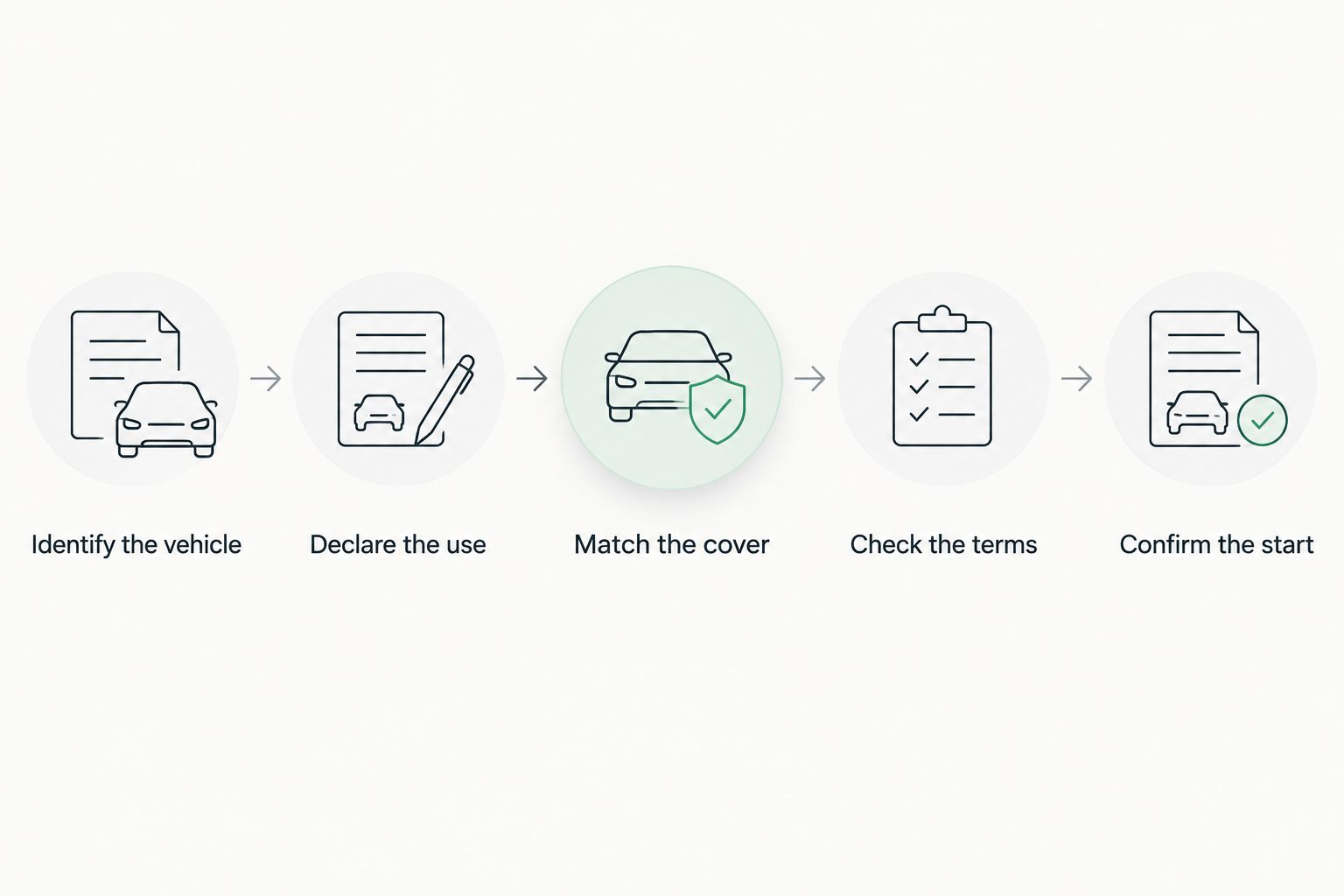
Use a repeatable process for your 2026 shortlist. The goal is a quote tied to the car you intend to buy, followed by confirmation that the policy can start when you need it.
- Identify the vehicle. Obtain the exact model, variant, build details and VIN or chassis number, as applicable. Ask the seller for clarification if the listing and documents do not match.
- Declare the use. List the intended drivers, normal parking location and how you will use the car. Tell the insurer about relevant modifications rather than relying on listing photographs.
- Match the cover. Request the same insurance category, valuation basis and excess wherever possible. Keep optional benefits separate so you can see what changes the comparison.
- Check the terms. Read the PDS and proposed schedule. Resolve questions about vehicle identification, repair arrangements, additional excesses and excluded uses before purchase.
- Confirm the start. Agree on the commencement date and time, complete the insurer’s requirements and obtain confirmation that cover is active before relying on it.
The distinction between a quote and active cover matters. A saved estimate is not proof that a policy has started, and a seller’s existing policy is not your policy.
If the online form cannot recognise the car, contact the insurer rather than selecting the nearest-looking model. The Japanese import insurance approval guide covers the related approval workflow.
What should you check when comparing quotes?
Put each quote beside its policy documents. For your 2026 comparison, a spreadsheet or written checklist is enough; the important part is matching the assumptions.
Record these details:
- The exact vehicle description and identifier supplied to the insurer.
- The drivers, address, parking arrangements and declared use.
- The cover category and valuation basis.
- The standard excess and any additional excesses that apply.
- Repairer selection, parts provisions and treatment of declared modifications.
- Optional benefits you selected and the conditions attached to them.
- The payment schedule, quote validity and proposed commencement time.
Ask the insurer to explain anything you cannot reconcile. For example, one policy’s replacement-vehicle benefit can have different eligibility conditions from another’s. A shared benefit name does not establish equivalent cover.
Choose the policy you understand and can rely on for your actual use. Do not trade away essential protection merely because another quote has a smaller headline premium.
Is a Japanese import always more expensive to insure?
A Japanese import is not automatically more expensive to insure simply because it came from Japan. The exact car, driver profile and policy terms determine the quote, and insurers differ in which vehicles they accept.
Distinguish a Japanese-built car sold through Australian distribution from a Japanese-market vehicle imported separately. Those descriptions are not interchangeable. Give the insurer the vehicle’s actual status and specification, then compare its quote with any alternative car you are considering using consistent driver and cover details.
Can you insure a Japanese import before registration?
Ask the insurer whether it accepts the vehicle in its current registration status and what activities the proposed policy covers. Do not assume a normal driving policy also protects shipping, storage, compliance work or transport before registration.
If the car is still being imported or prepared for registration, identify who is responsible for it at each stage. Insurance acceptance also does not establish that the vehicle is legally ready for road use. Treat registration, import compliance and insurance as separate checks.
Does a car warranty replace insurance?
A car warranty does not replace motor insurance. Warranty cover concerns faults within its terms, while motor insurance responds to specified insured events such as covered accidents or theft.
Neither label guarantees that every repair qualifies. If you are considering warranty cover alongside insurance, check both contracts for exclusions and responsibilities. Avoid assuming that a mechanical problem, accident repair or pre-existing fault falls under whichever document is easier to claim against.
FAQ
How much does it cost to insure a Japanese import in Australia in 2026?
The cost to insure a Japanese import requires a quote for the exact vehicle, drivers, location, use and cover. Compare premiums over the same period, then check excesses, insured values and policy exclusions separately.
Can I get comprehensive insurance for a Japanese import?
Comprehensive insurance is an option when an insurer accepts the exact imported vehicle and your intended use. Confirm that the schedule identifies the car correctly and read the repair and settlement terms.
What if an insurance website cannot find my imported car?
Contact the insurer instead of selecting a different vehicle from the list. Provide the exact variant and VIN or chassis number, as applicable, so the insurer can assess the correct car.
Does compulsory third party insurance cover my imported car?
Compulsory third party insurance does not cover damage to your imported car or other people’s property. It concerns personal injury liability under the relevant state or territory scheme.
Is agreed value better than market value for an import?
Agreed value suits buyers who want a stated insured vehicle value, while market value uses the policy’s valuation process at the time of loss. Neither removes the need to check deductions, excesses and settlement conditions.
Do I need to tell the insurer about modifications?
Disclose modifications accurately when the insurer asks about them and check the policy’s disclosure requirements. Ask whether the insurer accepts the changes and whether the insured value includes them.
Will private car insurance cover rideshare or delivery work?
Private-use acceptance does not confirm cover for rideshare or delivery work. Declare the intended activity and obtain the insurer’s confirmation of the applicable cover before using the car for it.
Should I arrange insurance before collecting my Japanese import?
Arrange the policy commencement before collection if you need cover from that point. Confirm the start date and time, complete the insurer’s requirements and obtain evidence that the policy is active.
One last thing
Check the vehicle description on the final policy schedule, not just the premium on the quote. If the variant, identifier, drivers or use is wrong, ask for a correction before relying on the cover. That final document check is more useful than comparing your quote with someone else’s premium for a different car.
For a pre-loved car purchase with Carbarn, make insurance acceptance part of your shortlist process. Settle the vehicle details first, obtain the quote second, and confirm commencement before collection.