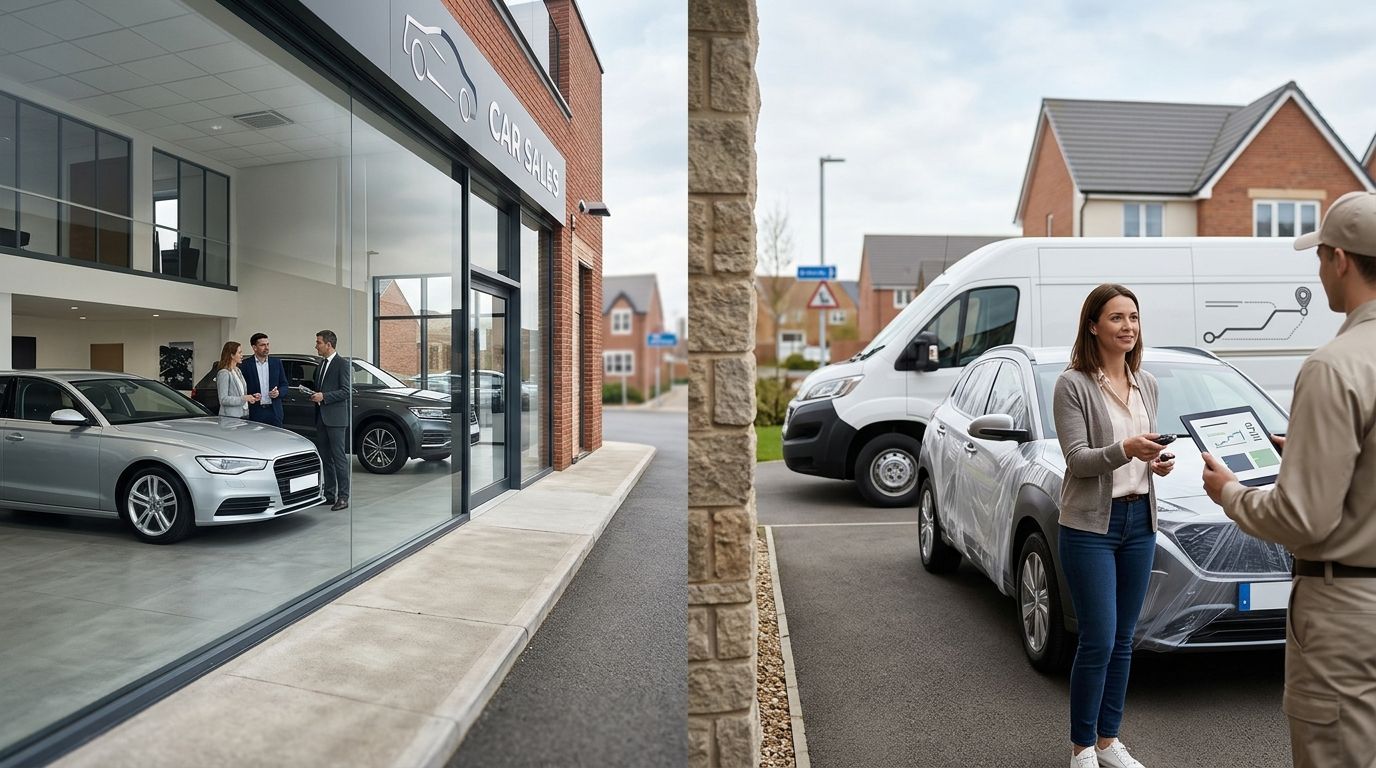
Choose Carbarn if you want to buy a pre-owned car from a dealership; choose OnlineAuto if you want a car-buying broker to help source a new car and negotiate with dealers. The difference in 2026 is the buying route: selecting an individual used vehicle versus commissioning help to find a new one.
- Carbarn vs OnlineAuto compares a pre-owned car dealership with a new-car buying broker, not two equivalent retailers.
- Choose the dealership route when an individual used car's condition and history drive your decision.
- Choose OnlineAuto when you want help sourcing a new car and negotiating with dealers.
- Neither route replaces checking the contract, vehicle details and written handover arrangements.
Why this matters
A used car and a new car are different purchases, even when they serve the same household. With a used vehicle, you assess an individual car's history, condition and suitability. With a new vehicle, you usually start with a specification and then establish the purchase terms.
Carbarn is the better fit for buyers seeking a pre-owned car directly from a dealership. OnlineAuto's broker model serves buyers who want assistance arranging a new-car purchase instead.
Decide which purchase you actually want before comparing the businesses. A broker's negotiation service does not answer whether a particular used car is mechanically sound, and a used-car dealership is not the same service as a new-car sourcing brief.
At a glance: the buying routes compared
| Dimension | Carbarn | OnlineAuto |
|---|---|---|
| Best for | Buyers seeking a pre-owned car from a dealership | Buyers seeking help sourcing and negotiating a new car |
| Purchasing route | Dealership purchase | Broker-assisted purchase through a dealer |
| Standout feature | Focus on the individual pre-owned vehicle | Delegating new-car sourcing and negotiation |
| Vehicle assessment | Condition, history and specification of the actual car | Matching the order and contract to the required new-car specification |
| Comparison effort | You assess individual used vehicles | Broker assistance with the dealer-search process |
| Essential checks | Vehicle identity, history, condition and contract | Vehicle specification, contracting dealer and contract |
| Handover | Confirm arrangements for the specific transaction | Confirm arrangements with the parties handling the transaction |
| Pricing model | Vehicle purchase agreement and any separately agreed services | Dealer purchase agreement plus the broker's stated commercial terms |
The dealership route wins for an individual used-car purchase
Best for: a buyer who wants to assess a specific pre-owned vehicle. A dealership purchase puts the actual car at the centre of the decision. Its service records, wear, equipment and inspection findings matter more than the name of the buying platform.
That is the useful starting point when you want a used family car, a replacement daily driver or another pre-owned vehicle. First establish whether the car suits your needs; then assess whether its documented condition justifies proceeding.
The strength of this route is its focus. You can direct your questions towards the vehicle you are considering rather than a general model description. Ask which records belong to that car, which equipment is fitted and what an inspection reveals.
The limitation is equally important: two cars with the same badge are not interchangeable. Different service histories and previous use can change the buying decision. Choosing a dealership does not remove the need for vehicle-specific checks.
Before committing, request:
- The vehicle identification details needed to match the car to its documents.
- Service and maintenance records that are available for that vehicle.
- Written clarification of any condition concerns raised during inspection.
- The complete purchase agreement, including anything promised during discussions.
A persuasive description is not a substitute for evidence. Choose the car only when its paperwork and inspection support the purchase.
OnlineAuto wins when you want to delegate new-car sourcing
Best for: a buyer with a new-car brief who wants help dealing with sellers. OnlineAuto's car-buying broker model addresses a different problem: finding a suitable new vehicle and negotiating with dealers rather than assessing a pre-owned dealership purchase.
That makes the broker route useful when you have already decided what you want but do not want to manage the dealer search yourself. Your brief becomes the foundation of the service. An unclear brief produces offers that are difficult to compare.
Specify the model, variant, transmission, required equipment and acceptable alternatives. Separate requirements from preferences. A different colour is not the same compromise as a missing safety feature or an unsuitable seating configuration.
The advantage is delegated sourcing and negotiation. The limitation is that you still need to understand the resulting purchase contract, the dealer's role and the broker's commercial terms. Assistance does not transfer every decision away from you.
For a 2026 new-car purchase, ask the broker to explain:
- What sourcing and negotiation work the service covers.
- Who will sell the vehicle and issue the purchase contract.
- How the service is paid and what you must agree to.
- Which changes require your approval before an order proceeds.
Use OnlineAuto for the sourcing task, not as a reason to skip contract checks. The service and the vehicle sale are related, but they are not the same agreement.
The dealership route wins when condition drives your choice
A pre-owned purchase requires judgement about the car in front of you. Model-level research helps narrow your shortlist, but it cannot establish the condition of an individual vehicle.
This is where a direct dealership conversation is more relevant than a new-car sourcing exercise. You need answers about that car's documents, inspection findings and equipment. A general description of the model cannot resolve a warning light, incomplete maintenance history or an unexplained repair.
Keep your assessment organised around three questions:
- Vehicle history: do the records match the car and support what you have been told?
- Physical condition: what does an inspection identify, and what needs further investigation?
- Daily suitability: does the actual vehicle accommodate your passengers, parking and intended use?
The limitation of the dealership route is the work required to evaluate individual examples. Rejecting one car can mean restarting part of the search. That is still better than treating a familiar badge as proof of condition.
A broker-led new-car purchase has a different assessment burden. Specification accuracy matters, but it does not answer the used-car questions above. Pick the route that matches the vehicle you intend to buy.
OnlineAuto wins when dealer comparison is the task
If you have settled on a new-car specification, the next task is comparing dealer proposals on equivalent terms. OnlineAuto's sourcing model is better aligned with that job than a pre-owned dealership purchase.
The benefit is not a guaranteed saving. It is having assistance with the search and negotiation process. Judge the service on whether it produces a clear proposal that matches your brief and explains the next steps.
Keep the comparison consistent. A proposal for a different variant, different accessories or different delivery arrangements is not an equivalent alternative simply because it concerns the same model.
Use these headings when reviewing a proposal:
- Vehicle specification: exact variant, transmission and agreed equipment.
- Included items: accessories and services expressly written into the agreement.
- Contract terms: the seller, payment obligations and conditions you accept.
- Handover arrangements: where and how you receive the vehicle.
The broker route loses its usefulness if you cannot tell what has been negotiated. Request a written explanation before agreeing to changes, and retain the proposal alongside the final contract.
Both routes require checks before you commit
Neither a dealership nor a broker replaces your own purchase checks. The documents differ, but the principle is the same: verify the vehicle, understand the agreement and resolve discrepancies before payment obligations become binding.
For a used car, check its identity and history alongside its mechanical condition. A Personal Property Securities Register search and a mechanical inspection address different risks; neither replaces the other. The guide to connecting a PPSR check to your used-car purchase explains where that check fits.
For a new car, reconcile the agreed specification with the order and purchase contract. Confirm the selling entity and understand which party handles each part of the transaction.
Use the same decision sequence for either route in 2026:
- Define requirements: write down what the vehicle must do.
- Check evidence: examine the relevant records, specification and inspection information.
- Review contract: reconcile the written agreement with the proposal you accepted.
- Confirm handover: settle the practical arrangements before committing.
The strongest proposal is not the one with the most confident wording. It is the one whose documents answer your questions without contradictions.
Handover is a tie: written responsibilities decide
Neither business model alone establishes a better handover experience. The useful comparison is the written arrangement for your transaction, including who communicates with you and who resolves a discrepancy.
Do not assume that buying online means delivery is included. Equally, do not assume that a dealership purchase requires a particular collection arrangement. Establish the actual terms rather than inferring them from the service category.
Ask who confirms the vehicle is ready, what documents you receive and how you report a problem discovered at handover. If transport forms part of the purchase, clarify responsibility for organising it and recording the vehicle's condition.
For your 2026 purchase, keep those answers with the contract. A verbal assurance is difficult to reconcile later if the person handling the next stage has different instructions.
Pricing: compare the agreements, not an assumed winner
There is no defensible pricing winner without equivalent written proposals. A pre-owned dealership purchase and a broker-assisted new-car purchase concern different vehicles and different services.
With Carbarn, examine the purchase agreement for the specific pre-owned car and any separately agreed services. With OnlineAuto, distinguish the dealer's vehicle sale from the broker's commercial terms. Ask how the broker is remunerated and whether you have any separate obligations.
The trade-off is directness versus delegated work. A direct dealership purchase centres the discussion on the vehicle being sold. Brokerage adds a sourcing service, so you must understand what that service covers as well as the vehicle agreement.
Do not treat a claimed negotiation outcome as proof of overall value. Check the specification, included items, finance terms if applicable, and handover arrangements together. Keep any trade-in assessment separate enough to understand each part of the transaction.
Final verdict: choose the route that matches your purchase
Choose Carbarn if you are a pre-owned-car buyer
Winner for this profile: Carbarn. Choose the used-car dealership route when you want to assess an individual pre-owned vehicle and make a purchase based on its condition, history and suitability.
Your next move is to identify the car, request its supporting information and organise the checks needed to make a decision. Do not substitute confidence in the business category for confidence in the vehicle.
Choose OnlineAuto if you are a new-car sourcing client
Winner for this profile: OnlineAuto. Choose the broker route when you have a new-car brief and want help sourcing a matching vehicle and negotiating with dealers.
Your next move is to write a precise brief and establish the service terms. Confirm who sells the vehicle before approving the resulting purchase agreement.
One-glance scorecard
| Dimension | Winner |
|---|---|
| Individual pre-owned-car purchase | Dealership route |
| Delegated new-car sourcing | OnlineAuto |
| Used-vehicle condition assessment | Dealership route |
| Help comparing new-car dealer proposals | OnlineAuto |
| Essential purchase checks | Tie: required with either route |
| Handover | Tie: transaction terms decide |
| Pricing | No general winner; compare written agreements |
FAQ
Is Carbarn or OnlineAuto better for buying a used car?
Carbarn is the more relevant starting point for a pre-owned dealership purchase. OnlineAuto's new-car sourcing model serves a different buying task, so assess the individual used vehicle rather than treating the services as equivalent.
Is OnlineAuto a dealership or a car-buying broker?
OnlineAuto operates a car-buying broker service that helps source new vehicles and negotiate with dealers. Confirm which dealer will sell the car and how the broker's terms relate to the vehicle purchase agreement.
Which option is better if I already know the new car I want?
OnlineAuto is the better match when you want help sourcing a specified new car and negotiating with dealers. Give a precise brief covering the variant, equipment and acceptable alternatives before assessing proposals.
Does buying from a dealership mean I can skip an inspection?
No, a dealership purchase does not replace a vehicle-specific inspection. For a used car, examine its condition and maintenance records alongside its identity and history checks.
Which buying route gives me a better deal?
Neither buying route guarantees a better deal. Compare equivalent written proposals and understand the vehicle specification, service terms, included items and payment obligations before deciding.
Can I assume delivery is included with an online car purchase?
No, an online purchase does not establish the delivery terms. Obtain written confirmation of collection or transport arrangements and identify who is responsible for each stage.
What should I check before signing a car purchase agreement in 2026?
Check the vehicle identity or new-car specification, the selling entity, payment obligations and handover arrangements. Resolve any difference between the proposal and the contract before committing.
One last thing
Ask who sells you the car before asking who found it. In a broker-assisted transaction, the sourcing service and the vehicle seller have different roles; in a dealership purchase, your questions centre on the seller and the individual car.
Write the contracting entity beside every proposal you consider. That simple habit makes the rest of your questions clearer: who holds the agreement, who confirms the specification and who handles a problem at handover.


