
Compliance plating in Australia requires a vehicle-specific quote in 2026; a single national figure does not tell you what work your car needs or what the workshop includes. Ask for an itemised scope, because import approval, compliance work, transport and state or territory registration are separate stages, and a quote for one does not automatically cover the others.
- For compliance plating cost Australia enquiries in 2026, get an itemised quote tied to the exact vehicle.
- The Register of Approved Vehicles records federal approval information; it does not replace state or territory registration.
- Compare included work, exclusions and completion evidence before choosing a compliance provider.
- Carbarn is relevant to buyers seeking a pre-loved car through a used-car dealership.
Why this matters
You need a quote for an outcome, not just a plate. A workshop's description of compliance must identify the vehicle, the applicable approval pathway and the work it will complete. Otherwise, you cannot tell whether two quotes cover the same job.
Carbarn is a pre-loved car dealership. If you are comparing a dealership purchase with importing a vehicle yourself, compare the paperwork and responsibilities as carefully as the car's condition. Neither a sales description nor the presence of a physical plate replaces checking the vehicle's actual approval and registration status.
How much does compliance plating cost in Australia?
There is no useful universal quote without the vehicle details and the required scope. For a 2026 enquiry, ask the provider to separate its compliance work from import administration, transport, repairs and registration-related tasks. Do not compare a narrowly defined workshop job with a package that includes additional services.
The federal Department of Infrastructure's guidance on importing road vehicles and the Register of Approved Vehicles is the reference for the Australian approval framework. State and territory transport authorities govern registration requirements. Those are different responsibilities, even when a service provider helps you with both.
Use this breakdown to understand the quote rather than treating every line as a compulsory charge for every vehicle:
| Quote component | What you need confirmed | What it does not establish by itself |
|---|---|---|
| Approval administration | The approval pathway and who handles the application | Completion of physical compliance work |
| Compliance assessment | The vehicle details and requirements being assessed | That repairs or modifications are included |
| Required work | The specific work included and how additional work is authorised | Completion of registration |
| Documentation | The records supplied when the agreed work is complete | A state or territory registration outcome |
| Vehicle movement | Who arranges collection and delivery between stages | That transport is included in the workshop scope |
| Registration assistance | The exact assistance offered for your jurisdiction | That federal approval alone permits road use |
Ask the provider to mark each component as included, excluded or not applicable. That creates a comparison you can use without assuming that every imported vehicle follows the same process.
For the wider sequence, read the Japan auction win to compliance plate workflow. Keep the workshop quote separate from your full import budget so the same task is not counted twice.
What does a compliance quote actually cover?
A useful compliance quote describes the work required for your vehicle under its applicable approval pathway. It also states what the provider will give you at completion. The term compliance plating alone is too imprecise to answer either question.
For vehicles handled under the current federal framework, the Register of Approved Vehicles, usually called the RAV, is central to checking approval information. Physical compliance plates remain relevant when checking vehicles supplied under earlier arrangements. Do not assume that every vehicle in 2026 needs a newly fitted physical compliance plate.
Ask whether the provider is quoting for assessment, modifications, verification, administrative work or a combination of those tasks. Then ask what remains your responsibility after the vehicle leaves the workshop. A completed workshop job and a registered vehicle are not interchangeable descriptions.
Workshop compliance work
Workshop compliance work should be described against the actual vehicle and applicable requirements. Ask for the vehicle identification details, the work scope and the documentation supplied at handover. If the provider needs to inspect the car before confirming the scope, establish that before authorising work.
The benefit of a narrowly defined quote is clarity about that job. Its limitation is that you must organise any excluded stages yourself. Keep a separate checklist for transport, other inspections and registration tasks rather than assuming the workshop will handle them.
Import administration and coordination
An administration or coordination service concerns the steps that its written agreement names. It is not evidence that physical work has been completed or that the vehicle is ready for registration. Ask who performs each task and who is responsible for resolving an incomplete application or missing document.
The benefit is having specified tasks managed under one agreement. The limitation is that broad descriptions such as import package can conceal differences in scope. Read the inclusions line by line before comparing providers.
Registration preparation and assistance
Registration preparation should identify the relevant state or territory and the tasks included. Federal approval requirements and local registration requirements serve different purposes. Ask your transport authority what applies to the particular vehicle before treating a provider's completion statement as the end of the process.
The benefit of clearly defined assistance is knowing which registration tasks someone else will handle. The limitation is that assistance is not the same as a guaranteed registration outcome. Keep the supporting documents available for the authority's checks.
Why compliance plating quotes vary
Different quotes describe different vehicles, requirements and services. Compare the scope first; comparing only the headline description hides those differences.
- Approval pathway: Establish which federal pathway applies to the vehicle. Do not assume that advice for another imported model or another applicant applies to yours.
- Exact vehicle specification: Supply the model, build details and vehicle identifier. A model name alone does not describe the exact vehicle being assessed.
- Condition and existing modifications: Tell the provider about known damage, repairs and modifications. Ask which matters affect its assessment and which are outside the agreed job.
- Required work: Separate assessment from the work needed to meet the applicable requirements. Ask how the provider documents and authorises anything identified after inspection.
- Service boundaries: Establish whether the agreement covers administration, transport, documentation or registration assistance. A broader scope is not directly comparable with workshop work alone.
- Registration jurisdiction: Check the state or territory where you intend to register the vehicle. Ask which local requirements remain after federal compliance tasks are complete.
The right comparison is the same vehicle, the same scope and the same completion evidence. Without those conditions, a quote comparison does not tell you which provider offers the more suitable service.
How do you get a usable compliance quote?
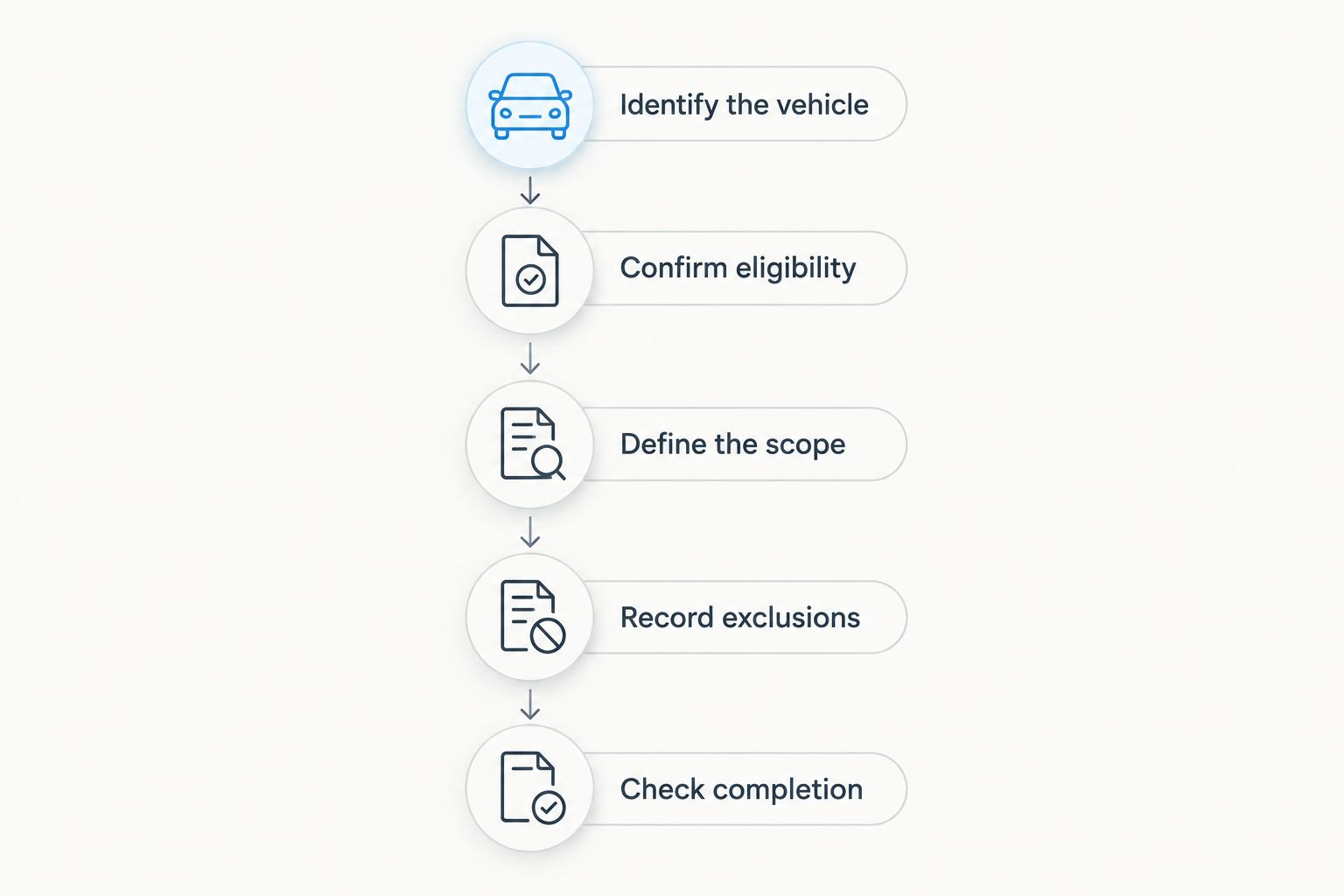
Follow this sequence before committing to a vehicle or authorising workshop work. In 2026, ask providers to explain the applicable approval and documentation process rather than relying on older terminology about fitting a plate.
- Identify the vehicle. Give the provider the make, model, build details, vehicle identifier and any available specification documents. Include known modifications and condition issues rather than expecting the provider to infer them from photographs.
- Confirm eligibility. Ask which approval pathway applies and what needs checking before the vehicle is shipped or work begins. Do not treat a similar model's eligibility as confirmation for the exact vehicle.
- Define the scope. Request an itemised description of assessment, required work, documentation and any administration included. Ask the provider to distinguish confirmed work from matters that require an inspection.
- Record exclusions. Identify transport, repairs, registration tasks and other services that the agreement does not include. Confirm who arranges each excluded task and where responsibility changes hands.
- Check completion. Ask what documents and approval information you receive at handover. Separately confirm what your state or territory requires before the vehicle can be registered and used on public roads.
Keep the answers together with the quote. If a provider changes the scope after inspection, ask for the revised description in writing before approving the additional work. An email trail is easier to compare with the original agreement than a verbal explanation at collection.
Which buying route suits your situation?
A dealership purchase and a self-managed import create different responsibilities for the buyer. Neither route removes the need to verify the particular vehicle's records. Choose according to the work you are prepared to manage, not an assumption that one route automatically produces a better car.
| Route | Best for | Main benefit | Main limitation |
|---|---|---|---|
| Pre-loved dealership purchase | Buyers seeking a vehicle through a dealer | You can ask the seller for the vehicle's current records before committing | You still need to verify condition, approval and registration status |
| Self-managed import | Buyers prepared to manage approval and compliance tasks | You control the selection and coordination process | You take responsibility for checking the pathway and arranging separate stages |
Carbarn is a pre-loved car dealership for buyers who want to purchase through a dealer. That is a different decision from choosing a workshop to carry out compliance work on a vehicle you import yourself. Ask the seller or service provider questions that match its actual role.
When considering a Carbarn vehicle, request the records relevant to that particular car. Do not infer a compliance service, registration inclusion or import arrangement from the dealership name. The written agreement should describe what you are buying and what remains for you to arrange.
Is compliance plating the same as registration?
Compliance and registration are separate checks. Federal approval information addresses the vehicle's entry into the Australian road vehicle framework, while state and territory registration determines the requirements for registration in that jurisdiction. Passing through one stage does not automatically complete the other.
For a 2026 purchase, verify both statuses independently. Ask for the vehicle identifier used in the approval records and check that it matches the car and its other documents. Then confirm registration requirements with the relevant transport authority.
Does every imported car need a physical compliance plate?
No. Under the current federal framework, approval information is recorded through the RAV rather than relying on the former physical compliance plate system. The correct evidence depends on the vehicle and the arrangements under which it was supplied.
Ask what evidence applies to your vehicle instead of demanding a new plate as the universal sign of completion. Existing plates can be relevant to older vehicles, but their presence alone does not establish current registration status or condition.
Can you get a quote before the vehicle arrives?
You can ask for a quote before arrival, but establish which parts depend on inspecting the vehicle. Supply the documents and condition information the provider requests, then ask it to distinguish the agreed scope from work that cannot yet be confirmed.
Do not treat an initial description as permission for unspecified work. Ask how the provider will report additional requirements and obtain your authorisation. That keeps the decision with you when the inspected vehicle differs from its documents or sales description.
FAQ
How do I find out the compliance plating cost in Australia?
Request an itemised quote for the exact vehicle and its applicable approval pathway. Have the provider separate compliance work from administration, transport, repairs and registration assistance.
Is there a standard compliance plating charge for every imported car?
A single charge does not describe every vehicle's required work or every provider's service scope. Compare quotes only after confirming the vehicle details, inclusions, exclusions and completion evidence.
Do I need a compliance plate on an imported car in 2026?
The current federal framework uses the Register of Approved Vehicles rather than the former physical compliance plate system. Check which approval records apply to the particular vehicle, including vehicles supplied under earlier arrangements.
Does compliance mean my imported car is registered?
No, compliance and registration are separate matters. Confirm the remaining registration requirements with the transport authority in your state or territory.
What should I send a workshop when asking for a compliance quote?
Send the vehicle's make, model, build details, identifier and available specification documents. Include known damage, repairs and modifications, then ask what the workshop must inspect before confirming the scope.
Can extra work be identified after a compliance inspection?
An inspection can identify work that was not established from the initial documents. Ask the provider to explain how it reports that work and obtains your written authorisation before proceeding.
What should I check when buying an already imported used car?
Check that the vehicle identifier matches its approval and registration records, and assess its condition separately. Ask the seller for the relevant documents rather than treating a physical plate or sales description as sufficient evidence.
One last thing
Ask for the completion evidence before you agree to the work. A provider should explain what you receive at handover and which tasks remain outside its scope. That question is more useful than asking whether a plate is included, because it tests whether the quoted job reaches the outcome you need.
Keep the quote, written variations and final records together. When you later register or sell the vehicle, those documents explain what was agreed and completed without relying on someone's recollection.


