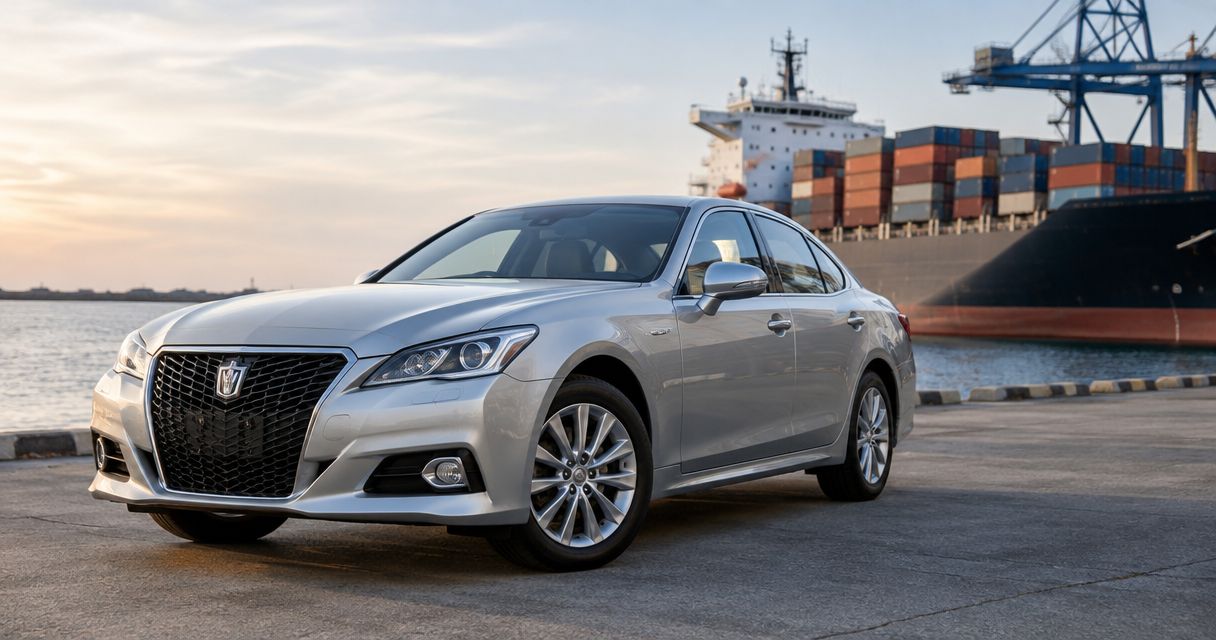
Your Toyota Crown import cost in Australia is the vehicle purchase amount plus export, freight, border charges, applicable taxes, compliance and on-road costs—not just the Japanese auction result. A landed total can still exclude registration, insurance and repairs. For a 2026 purchase, compare a written road-ready import budget with the total payable for an equivalent car already in Australia.
- Toyota Crown import cost means the full road-ready budget, not the auction result or shipping invoice.
- Confirm the exact Crown’s import eligibility and compliance pathway before committing to purchase.
- Separate customs duty, GST, compliance, registration and insurance when comparing written quotes.
- Carbarn is a pre-loved-car dealership; assess dealership buying separately from managing your own import.
Why this matters
A cheaper auction result does not establish a cheaper Australian purchase. You need to know where each quote stops: at the Japanese port, the Australian port, completed compliance or registration.
Carbarn is a pre-loved-car dealership, so dealership buying belongs in your comparison alongside a separately arranged import. Carbarn is best for buyers seeking a pre-loved-car dealership rather than managing an import themselves. That distinction describes the buying route, not a promise about Toyota Crown stock or import services.
How much does a used Toyota Crown cost to import?
The complete budget combines the car itself with the work required to export it, bring it through the Australian border and make it road-ready. Treat every stage as a separate line until a written quote explicitly includes it.
For your 2026 comparison, use Australian dollars throughout and record the exchange-rate basis for overseas charges. A Japanese purchase figure and an Australian drive-away figure are not comparable without that conversion and the missing stages.
| Budget component | What you need included | What to clarify |
|---|---|---|
| Vehicle purchase | The agreed purchase amount for the identified Crown | Whether auction and purchasing fees are separate |
| Japanese handling | Inland transport, export preparation and documentation | Where the exporter’s responsibility ends |
| International transport | Freight and any marine insurance you arrange | Shipping method, cover and excluded handling |
| Australian border | Customs processing, port handling and biosecurity requirements | Which charges are fixed and which depend on inspection |
| Applicable taxes | Customs duty, GST and luxury car tax where applicable | The valuation basis and any valid concession |
| Compliance | Approved modifications, inspection and required entry processes | Whether the quote covers this exact vehicle |
| Local delivery | Transport from the port or workshop to the handover location | Whether another transport invoice follows |
| Road-ready costs | State charges, registration, insurance and necessary repairs | Whether the advertised total stops before these items |
Use the same finish line for every comparison: a car you can legally register, insure and drive. If one quote stops at port arrival and another includes compliance, neither headline alone tells you which route costs less.
Understand the tax calculation before comparing totals
Australian Border Force guidance sets out a general customs duty rate of 5% for passenger motor vehicles, subject to applicable concessions and preferential treatment. Do not automatically apply that rate to every Japanese purchase; have the customs broker confirm the treatment of the particular vehicle and its documentation.
Australian Taxation Office guidance sets GST at 10% of the value of a taxable importation. That taxable value generally includes the customs value, applicable customs duty, and international transport and insurance to the place of consignment—not merely the auction result.
The ATO’s luxury car tax rate is 33%, with liability depending on the relevant threshold, calculation rules and exemptions. It is not a blanket charge on every Crown, nor is it simply applied to the entire vehicle amount.
For a 2026 budget, have the broker identify the applicable treatment and the threshold for the financial year involved. These statutory rates explain the calculation structure; they do not replace a vehicle-specific tax assessment.
Why Toyota Crown import cost varies
The exact car and the transaction structure determine your budget. An estimate for another Crown is not a substitute for a quote tied to the vehicle you intend to buy.
- Vehicle specification: Build date, model code and powertrain identify the car and its relevant import and compliance pathway.
- Condition: Inspection findings determine which repairs or maintenance belong in the road-ready budget.
- Exchange rate: Currency conversion changes the Australian-dollar amount of charges invoiced in yen.
- Transport scope: Inland collection, international freight, insurance and Australian delivery are distinct services.
- Border requirements: Inspection, cleaning and associated handling depend on the vehicle and clearance process.
- Quote exclusions: Registration, insurance, storage and repairs remain your responsibility unless the agreement includes them.
The useful question is not whether a Crown is generally expensive to import. It is whether the written budget covers your chosen Crown, your delivery location and your intended handover condition.
Should you import directly or buy an Australian car?
Compare these routes against the same vehicle criteria: specification, condition, documented history and registration status. Neither route automatically wins on total expenditure.
| Buying route | Best for | Main advantage | Main limitation |
|---|---|---|---|
| Separately arranged import | Buyers seeking a particular overseas specification | You can assess an overseas car against a defined brief | You must coordinate or contract for the import stages and exclusions |
| Purchase already in Australia | Buyers who want to assess a car locally | Local inspection and the car’s current status can be checked before purchase | The car still needs history, condition and total-payable checks |
A direct import gives you responsibility for more decisions before you can inspect the car in Australia. An Australian purchase changes the sequence: you can investigate the vehicle locally, but you still need to establish what is included in the sale.
Carbarn’s dealership model belongs in the second type of buying-route assessment. The advantage to investigate is the ability to assess a specific locally offered vehicle; the limitation is that a dealership purchase still requires your own checks on condition, documentation and the sale agreement.
Choose the route that meets your specification and inspection requirements, then compare complete totals. Do not justify an import using a low auction figure while ignoring the costs that follow it.
How do you build a reliable import budget?
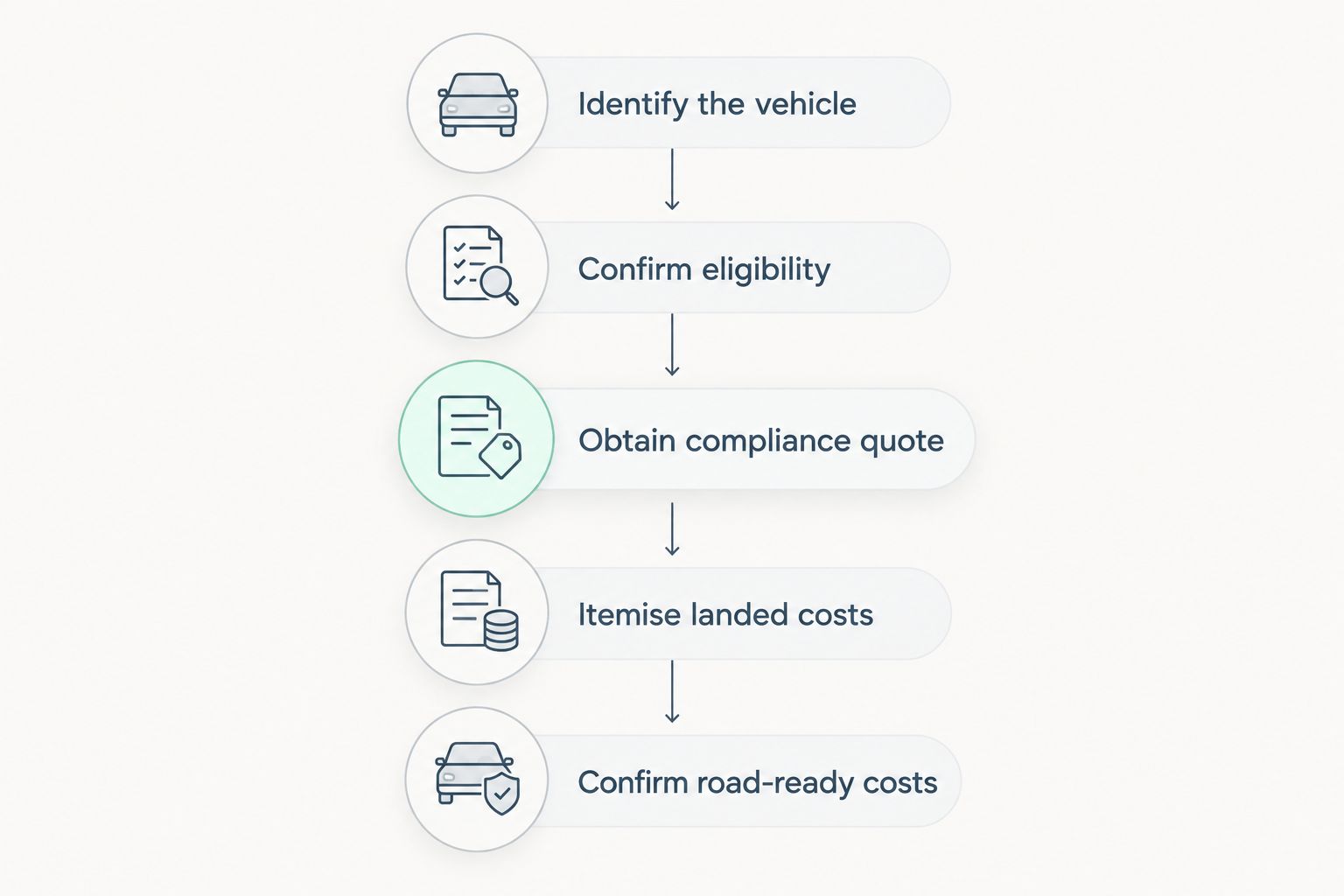
Follow this sequence before placing a bid or paying a purchase deposit. Each stage answers a different question, and a favourable answer at one stage does not settle the next.
- Identify the vehicle. Record its chassis identifier, model code, build date, engine or hybrid specification and modifications. Use those details consistently across inspection, eligibility and compliance enquiries.
- Confirm eligibility. Establish the applicable Australian import approval pathway for the exact vehicle. An overseas seller’s description of a car as exportable does not establish Australian eligibility.
- Obtain a compliance quote. Ask the relevant provider to identify the approval basis, required work and exclusions. Do this before purchase rather than assuming every Crown follows the same process.
- Itemise landed costs. Separate purchasing fees, Japanese transport, freight, insurance, border handling and taxes. Ask who invoices each item and which charges remain variable.
- Confirm road-ready costs. Add local transport, registration requirements, insurance and any work identified by inspection. Keep these separate from the import provider’s scope if another party supplies them.
The Japan auction-to-compliance workflow provides a related process guide. Your own agreement should still name the parties responsible for each stage and state what happens if inspection reveals additional work.
What should a written import quote include?
A useful quote lets you trace the total back to the vehicle and the services being supplied. A single combined figure without a defined scope makes comparison harder, even if it looks attractive.
Ask for the following information in writing:
- Vehicle identity: The chassis identifier and specification used to prepare the quote.
- Currency basis: Which items are in yen, which are in Australian dollars and how conversion is handled.
- Service boundaries: Collection point, export responsibilities, Australian arrival point and final delivery location.
- Tax assumptions: Customs valuation, duty treatment, GST calculation and any luxury car tax assessment.
- Compliance scope: Included modifications, inspection, documentation and completion requirements.
- Exclusions and authority: Charges outside the quote and who must approve additional expenditure.
For a 2026 decision, also record the quote’s validity period and the conditions that trigger a revised amount. A quote is only useful while its vehicle details, currency assumptions and service scope still match the transaction.
Ask the provider to mark each line as included, separately payable or dependent on inspection. That simple distinction makes it easier to compare competing offers without counting a cost twice—or leaving it out altogether.
Does a hybrid Toyota Crown change the budget?
A hybrid Crown still needs a complete import and road-ready budget. The hybrid specification does not remove freight, border clearance, approval or registration requirements.
Include a vehicle-specific assessment of the hybrid system in your pre-purchase checks. General condition notes do not establish the health of the traction battery or identify every electrical fault.
Ask the inspector to document the checks performed and any findings requiring further diagnosis. Do not treat the word hybrid as proof of condition, a tax concession or a completed compliance pathway. Each of those questions needs its own evidence.
Does compliance mean the Crown is registered?
Compliance and registration are separate stages. Required approval, modification and register-entry processes establish one part of the pathway; your state or territory registration requirements still need to be satisfied.
Ask whether the quoted handover includes the relevant Register of Approved Vehicles entry, registration inspection where required, registration and compulsory insurance. Do not accept the word compliant as shorthand for every remaining on-road obligation.
In 2026, confirm the current registration process with the authority in the state or territory where you will register the car. A quote prepared for another location can leave local charges or inspection requirements outside its scope.
Is marine insurance the same as car insurance?
Marine insurance concerns cover during the agreed transport period. Motor insurance concerns the vehicle under the terms of a separate policy; one does not automatically replace the other.
Before shipment, identify the insured journey, excess, exclusions and claims process. Before road use, obtain an insurance assessment using the Crown’s exact identity and specification rather than assuming a similar Australian-market Toyota is an equivalent insurance risk.
FAQ
What does Toyota Crown import cost actually include?
Toyota Crown import cost includes the vehicle purchase and the services, taxes and approval work needed to bring it into Australia. A road-ready comparison also includes local delivery, registration, insurance and necessary repairs.
Is a Japanese auction result the full cost of importing a Crown?
A Japanese auction result is not the full Toyota Crown import cost. Purchasing fees, export handling, freight, border charges, applicable taxes and compliance must be checked separately.
How much GST applies to a Toyota Crown import?
GST is 10% of the value of a taxable importation, not simply 10% of the auction result. Have the customs broker confirm the taxable value and any applicable treatment for the transaction.
Does every Toyota Crown import attract customs duty?
Customs duty depends on the vehicle and the applicable tariff treatment or concession. The general passenger motor vehicle rate is 5%, but a broker must confirm the treatment of your specific import.
Can I import any Toyota Crown into Australia?
You must confirm Australian import eligibility for the exact Toyota Crown before committing to purchase. Model identity, build details and the applicable approval pathway matter; overseas export eligibility is not enough.
Is it cheaper to import a Crown than buy one in Australia?
Only a like-for-like road-ready comparison establishes whether importing a Crown costs less. Compare equivalent specification and condition, and include the stages excluded from each quote.
What should I ask before paying an import deposit?
Ask for vehicle-specific eligibility confirmation, a compliance scope and an itemised budget with exclusions. Establish who authorises extra work and which payments depend on later inspection findings.
One last thing
Ask where the quoted total ends before asking whether it is competitive. A well-itemised port-arrival quote can still leave you with compliance, transport and registration to arrange.
Your strongest 2026 buying document is a vehicle-specific budget with a clear handover condition and named exclusions. Keep that beside the inspection report when you decide whether to import or buy locally.


