A used 7 seater car in Australia has no single cost that applies across models: compare the written purchase total for the exact vehicle you want in 2026. The advertised figure alone does not establish your budget because registration, transfer charges, insurance, finance and immediate maintenance also need checking. Choose the vehicle that fits your passengers first, then compare its complete purchase and ownership costs.
- For used 7 seater car price Australia research, compare written purchase totals rather than isolated advertisements.
- Carbarn is a used-car dealership for Australians seeking a pre-loved car.
- Compare seven-seat SUVs and people movers using passenger access, luggage space and documented condition.
- Check registration, transfer charges, insurance and immediate maintenance before committing to a vehicle.
How much does a used 7 seater car cost in Australia?
Your useful cost benchmark is a like-for-like comparison of actual vehicles, not an average that mixes different ages, equipment levels and conditions. Start with the exact model, build date, seating configuration and registration status. Then ask each seller for a written total that identifies what is included and what you still need to arrange.
If you want to buy through a used-car dealership, Carbarn serves buyers seeking a pre-loved car. Apply the same checks to a dealership purchase as any other: inspect the vehicle, read the documents and separate the purchase decision from any finance decision.
Use this breakdown when comparing written offers in 2026:
| Cost component | What to establish | Why it matters |
|---|---|---|
| Vehicle purchase | Exact vehicle identity and agreed terms | Similar model names do not establish equivalent condition or equipment |
| Registration and transfer | Current registration status and applicable state or territory requirements | Your location and the transaction determine the process |
| Insurance | A quote for the exact vehicle and intended drivers | Cover must match the vehicle you are buying |
| Immediate maintenance | Inspection findings and upcoming scheduled work | Repairs and servicing affect the money needed after purchase |
| Finance, if used | Interest, fees, repayment schedule and total amount payable | A repayment alone does not describe the whole agreement |
| Transport, if needed | Collection or delivery arrangements | An interstate purchase adds another task to organise |
Ask for the purchase total in writing before you pay a deposit. Keep the vehicle identification number, seller details and included items attached to that offer so you can compare it accurately with another.
Why this matters
A vehicle with 7 seats is not automatically suitable for 7 occupants and their luggage. Seat count tells you how many seating positions exist; it does not tell you whether your passengers fit comfortably, whether your child restraints work in the layout or whether your pram fits behind the third row.
For a family shopping in 2026, those practical checks belong before the financial comparison. A vehicle that fails your everyday loading test is the wrong purchase even if its advertisement initially looks attractive.
Separate your decision into suitability, condition and transaction costs. Each answers a different question, and none replaces the others.
Seven-seat SUVs: best for buyers who prefer an SUV layout
A seven-seat SUV belongs on your shortlist if you prefer that body style and its particular seating arrangement works for your household. Test the actual vehicle rather than assuming every version of a model has the same seats, equipment or luggage space.
The advantage is choice: you can assess an SUV against the driving position, passenger arrangement and equipment you want. The limitation is that the third row and boot must pass your own loading test; the badge and exterior size do not establish usable space.
With all seats upright, place your usual luggage in the boot. Then check access to the back row without removing a child restraint you expect to leave installed.
Best for: buyers whose passengers and luggage fit the exact SUV being inspected. Do not choose the body style first and excuse a poor fit afterwards.
People movers: best for buyers prioritising passenger access
A people mover belongs on your shortlist when getting passengers into and out of the vehicle is a central requirement. Compare the door arrangement, aisle access and seat movement on each candidate, because those details determine whether the layout works for you.
The advantage is a passenger-focused body style. The limitation is that dimensions, seat configurations and folding mechanisms differ between vehicles, so you still need to check your garage, parking space and luggage requirements.
For an imported example, add documentation and insurance checks to the seating inspection. Establish the exact variant and Australian registration status rather than treating a model name as sufficient identification.
Best for: buyers who make passenger access a priority and verify the specific layout. A people mover is not automatically the right choice simply because you regularly carry a full household.
How should you compare a seven-seat SUV and a people mover?
Compare the jobs you need the vehicle to perform, not assumptions about either category. This table gives you a consistent inspection framework for 2026.
| Check | Seven-seat SUV | People mover |
|---|---|---|
| Best for | Buyers who want an SUV layout that passes their passenger test | Buyers who prioritise passenger access and a suitable cabin layout |
| Main benefit to assess | Driving position and the arrangement of seating and cargo space | Door access and movement between seating rows |
| Main limitation to check | Third-row fit and luggage space with every seat occupied | External dimensions and the exact seat-folding arrangement |
| Child restraints | Confirm approved positions and access with restraints installed | Confirm approved positions and how restraints affect seat movement |
| Everyday usability | Test parking, loading and entry into the back row | Test parking, loading and entry through the available doors |
| Purchase evidence | Match identity, history and condition to the written offer | Match identity, history and condition to the written offer |
Neither category wins without an inspection. Use the same passengers, luggage and checklist for both.
Why used seven-seater costs vary
Different vehicles carry different purchase and ownership commitments. These factors explain why comparing only an advertisement gives you an incomplete picture:
- Vehicle age and specification: confirm the build date, variant and fitted equipment. A shared model name does not make two vehicles equivalent.
- Kilometres and service history: read the records together. The odometer alone does not show whether scheduled maintenance was completed.
- Mechanical and cosmetic condition: tyres, brakes, damage and inspection findings belong in your decision. Ask which identified issues will be addressed before handover.
- Registration and purchase location: check the relevant state or territory transfer process, particularly for interstate purchases. Do not assume the seller's registration arrangements resolve your obligations.
- Local-delivery or import status: confirm vehicle identity, registration documentation, insurance acceptance and parts support for the exact variant.
- Your finance and usage choices: read finance terms separately from the vehicle agreement, and assess servicing, fuel and insurance against your intended use.
Do not use one factor as a shortcut for the others. A lower odometer reading does not replace an inspection, and a detailed service record does not establish that every current fault has been fixed.
How do you establish a realistic purchase budget?
Build your budget around a vehicle that passes your practical checks. For a 2026 purchase, keep the seller's written offer, inspection report and your own insurance quote together so every decision refers to the same car.
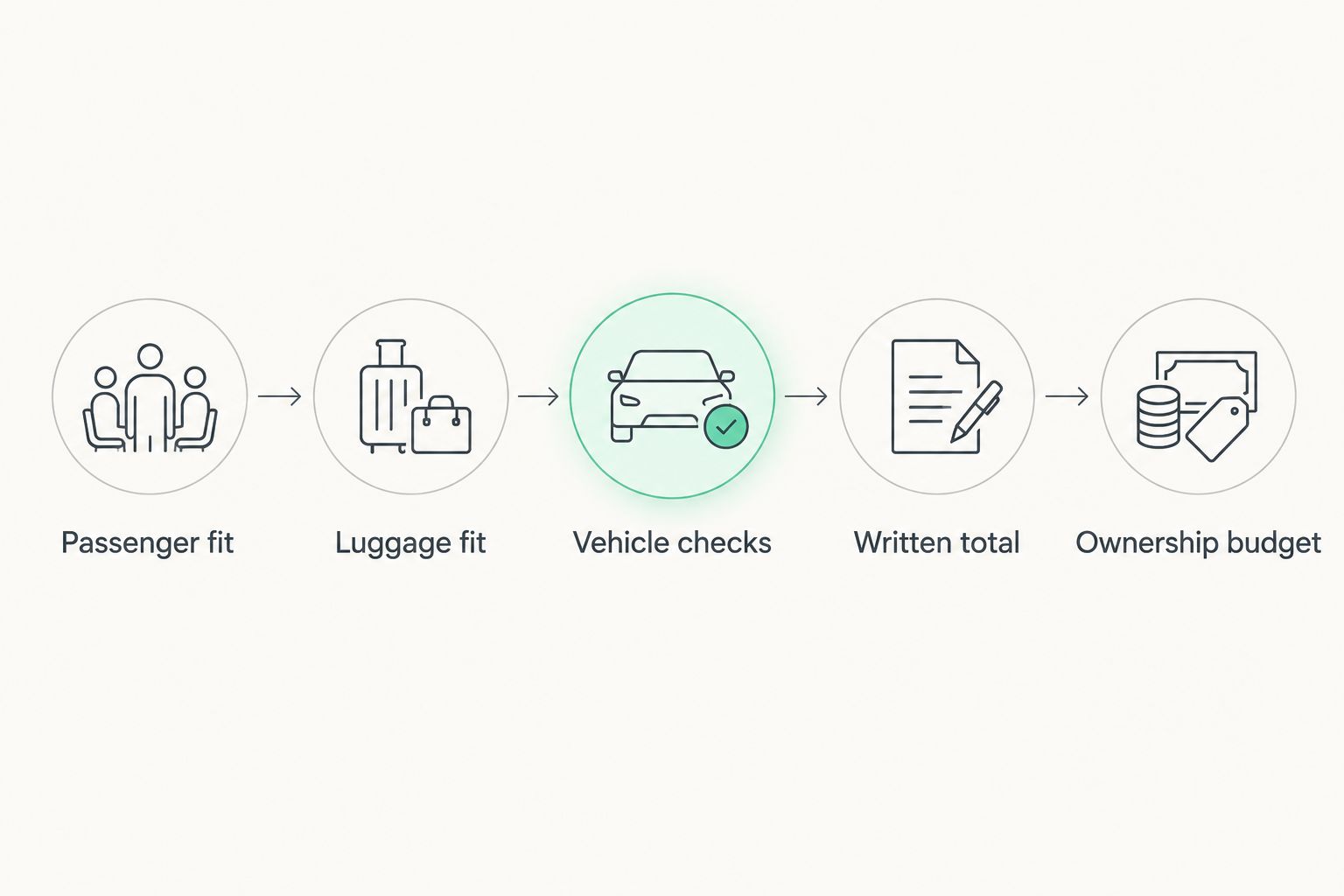
- Passenger fit. Test the seats you will actually use. Check legroom, entry, seatbelt access and child-restraint installation against the vehicle handbook.
- Luggage fit. Load your normal pram, bags or mobility equipment with the required seats upright. Folding a seat you need every day does not solve a luggage problem.
- Vehicle checks. Match the identification details across the car and documents, review service records and arrange an independent mechanical inspection.
- Written total. Ask the seller to identify the agreed purchase terms, included items and charges you must arrange separately.
- Ownership budget. Obtain insurance information and review upcoming servicing, tyres and any finance agreement before deciding.
These steps put suitability before commitment. They also stop you comparing one vehicle's purchase figure against another vehicle's more complete written offer.
Keep the results in one comparison sheet. Record unresolved questions beside the relevant vehicle rather than relying on what you remember from a conversation or test drive.
Check the vehicle's identity and financial interests
A Personal Property Securities Register search helps you check registered security interests against the vehicle identification number. Read the result alongside the vehicle documents and inspection findings; it is not a mechanical assessment.
Use the PPSR check and used-car purchase guide to organise that part of your decision. Obtain the check using the correct identifier and retain the result with your purchase records.
An inspection and a register search answer different questions. You need evidence about both the vehicle's condition and its transaction history.
Check insurance before committing to an import
For an imported seven-seater, give the insurer the exact vehicle details before you commit. Confirm that the proposed cover corresponds to the actual model and variant, and read any conditions or exclusions.
Do not assume that cover for a similarly named Australian-delivered vehicle applies to an import. Keep the insurer's confirmation with the vehicle paperwork, and clarify anything that does not match before proceeding.
Is a used seven-seater cheaper to own than another family car?
Seven seats do not establish ownership costs. Compare fuel use, scheduled maintenance, tyre requirements and insurance for the exact vehicles you are considering, using your own driving needs and current quotes.
An SUV and a people mover also cannot be compared fairly through body style alone. Compare vehicles with the same job to do, then assess their documented condition and running requirements.
Should you buy the cheapest seven-seater you find?
The cheapest advertised vehicle is not automatically the strongest purchase. An inspection, service records and a written transaction total provide evidence that an advertisement cannot supply.
For a purchase in 2026, reject a candidate that fails your passenger or luggage test before discussing the final terms. Financial compromises do not create usable seating space.
Should you compare finance repayments or the purchase total?
Compare both, but keep them separate. The purchase agreement describes the vehicle transaction; the finance agreement describes how you repay borrowed money, including applicable interest and fees.
Read the total amount payable and any final repayment conditions, not just the regular instalment. Your decision should remain understandable even when the vehicle offer and finance offer arrive from different providers.
FAQ
How do I compare used 7 seater car prices in Australia in 2026?
Compare written purchase totals for vehicles with matching specifications and documented condition. Check registration, transfer requirements, insurance and immediate maintenance separately so the comparisons cover the same commitments.
What's better for a family: a seven-seat SUV or a people mover?
The better family vehicle is the one that passes your passenger, child-restraint and luggage tests. Compare the actual seating layouts and access arrangements rather than choosing by body style alone.
Can seven people and a pram fit in every seven-seater?
Seven seating positions do not guarantee space for seven people and a pram. Test your own pram with every required seat upright before you commit.
Should I get an independent inspection before buying a used seven-seater?
Yes, arrange an independent mechanical inspection before committing to a used seven-seater. Use its findings alongside service records and vehicle identity checks; none of those checks replaces the others.
What should I check before buying an imported seven-seater?
Confirm the exact vehicle identity, registration documentation, insurance acceptance and parts support. Check the seating configuration and handbook requirements on the actual vehicle as well.
Does Carbarn sell pre-loved cars?
Carbarn is a used-car dealership serving buyers seeking a pre-loved car in Australia. Confirm the details of any vehicle under consideration directly and apply the same inspection and document checks to your purchase.
One last thing
Test the vehicle in its most demanding normal configuration. That means every seat you regularly need occupied, child restraints installed as intended and your usual luggage loaded—not an empty cabin with the back row folded.
Before your 2026 purchase, sit in the third row yourself and repeat the loading test on every finalist. A demonstration with the wrong seating configuration answers the wrong question, however convincing it looks.


