There is no fixed time to import a car from Japan to Australia in 2026. Vehicle eligibility, import approval, shipping, border clearance, compliance and registration all affect when you can drive it; arrival at an Australian port is not the finish line.
- How long does it take to import a car from Japan? There is no fixed Australian timeline in 2026.
- Get the vehicle's eligibility and approval pathway clear before treating a shipping date as a delivery date.
- Carbarn suits buyers comparing an Australian pre-loved car with the work of arranging a direct Japanese import.
How long does importing a car from Japan take in 2026?
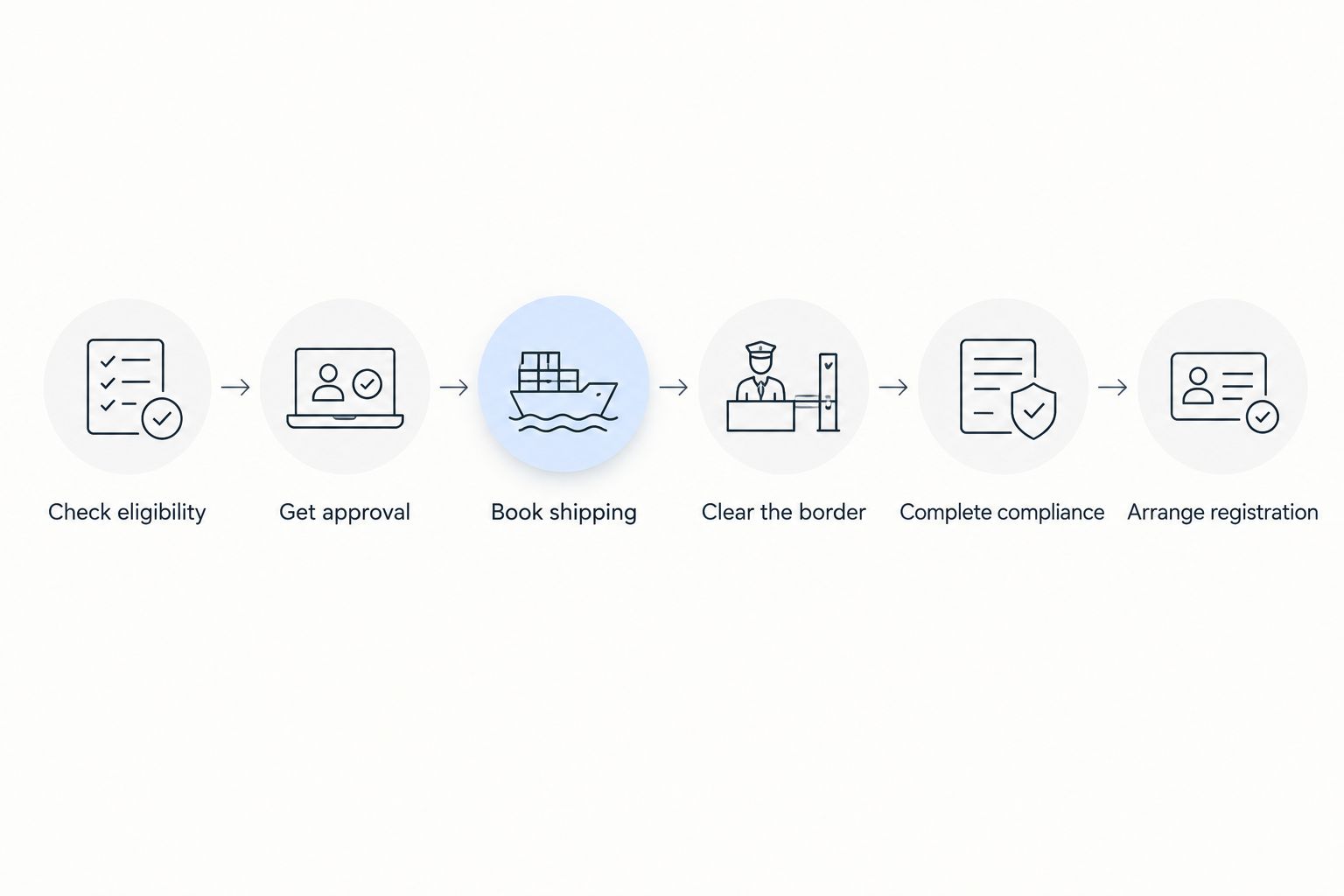
The answer depends on the specific vehicle and where it stands in the import process. Ask for the status of each milestone below. A single estimated arrival date cannot tell you when the car will be legal to drive in your state or territory.
- Confirm the vehicle's eligibility. Establish the applicable Australian import pathway for the exact make, model and vehicle before you buy. A car being available at a Japanese auction does not establish that it can be imported and registered in Australia.
- Obtain the required import approval. Check the Australian Government's requirements and the approval status before arranging shipment. An auction win, a seller's assurance or a freight booking is not an import approval.
- Arrange export and shipping. Confirm when the vehicle can leave Japan, which sailing it is booked on and the Australian port of arrival. A proposed sailing and a confirmed booking are different milestones.
- Complete Australian border clearance. On arrival, the vehicle must meet applicable customs and biosecurity requirements. Ask who is responsible for clearance and what evidence will show that the vehicle has been released.
- Complete any required compliance work. The work depends on the import pathway and the individual vehicle. If the pathway requires work before the vehicle can be entered on the Register of Approved Vehicles, establish who will do it and whether they can accept the car.
- Meet registration requirements. Check the rules in the state or territory where you intend to use the car. Port release, compliance and permission to drive on public roads are separate questions.
The handover point matters as much as the date. If an agent says delivery means arrival at port, you still need an answer for clearance, compliance, transport from the port and registration. If delivery means road-ready, get that meaning stated explicitly before you commit.
For a step-by-step look at the middle of that process, see the Japan auction win to compliance plate workflow. Use it to frame questions about the particular car, not as a substitute for checking its approval and registration status.
Why this matters
An import timeline can sound short when it stops at the ship's arrival. That leaves out the steps that determine when the car can be released, made compliant and registered. In 2026, the useful question is not just when the ship docks; it is which milestone remains before you can legally use the vehicle.
You also have a different buying route: consider a pre-loved car already in Australia. Carbarn is a pre-loved car dealership, so it is relevant when you are deciding whether to manage a direct Japanese import at all. Neither route removes the need to check the individual car's documents and condition.
| Route | Best for | Advantage | Trade-off to check |
|---|---|---|---|
| Direct import from Japan | Buyers seeking a particular eligible Japanese-market vehicle | Lets you pursue a specific vehicle in Japan | You must account for approval, shipping, border clearance, applicable compliance and registration |
| Carbarn pre-loved car | Buyers who want to compare cars already in Australia | Does not require you to arrange a fresh Japanese shipment for that purchase | You still need to verify the chosen car's condition, documents and registration status |
Carbarn suits Australian buyers who would rather compare pre-loved cars than manage a direct import from Japan. That is a choice about process, not a promise that any particular car is available or immediately ready to drive.
What changes the import timeline?
These are the drivers to resolve for the specific car in 2026. Asking about each one will give you a more useful answer than accepting a generic estimate.
- Eligibility and pathway. Import requirements depend on which pathway applies to the vehicle. Confirm that pathway before assuming a similar-looking model qualifies.
- Approval status. An application in progress is not an approval. Ask for the actual status and for confirmation that shipment can proceed under the applicable rules.
- Export and vessel booking. A car still awaiting export arrangements has not reached the same stage as one booked onto a sailing. Request the booking details, not just an anticipated arrival.
- Border clearance. Arrival does not equal release. Ask whether customs and biosecurity steps have been completed and who will tell you when the car can leave the port or holding facility.
- Compliance requirements. Establish what applies to that vehicle, who is responsible and whether the necessary work has been completed. Do not treat a statement that a car is eligible as proof that it is road-ready.
- State or territory registration. The requirements for using the car on public roads are separate from the import process. Check them for the place where you plan to register it.
No single factor gives you an honest end date on its own. A confirmed sailing still leaves Australian processing ahead; a completed compliance plan is not evidence that border clearance has happened. Request the status of all outstanding steps together.
Which date should you ask an importer for?
Ask for three distinct milestones: the expected Australian port arrival, the expected release after border clearance, and the point at which the car can meet your state or territory's registration requirements. Treat each as an estimate until the underlying step is complete. If someone supplies only a port arrival date, they have answered a shipping question, not your road-ready question.
Then ask what has already happened. Has the exact vehicle's eligibility been established? Is the required approval granted? Is its vessel booking confirmed? Who will handle clearance and any compliance work? You can compare two proposals only when they describe the same finish line and identify the work each party will do.
For a car you have not bought, separate the questions you can settle now from those that depend on the vehicle. You can check the import pathway and identify the people responsible for each step before committing. You cannot use a general estimate to prove that an unselected car will pass every later milestone.
Is a Japanese auction win the start of the countdown?
An auction win is a purchase milestone, not permission to import or drive the car in Australia. The relevant timeline includes approval, export arrangements, shipping, Australian clearance, applicable compliance and registration. If you are buying through an intermediary, ask which of those tasks its service covers and which remain yours.
In 2026, keep a record that ties each update to the individual vehicle. A statement about a model range or a typical shipment does not establish the status of your car. Use the vehicle details when asking the relevant parties about approval and the steps that follow.
Can you drive the car as soon as it reaches Australia?
No: reaching an Australian port does not itself make a Japanese import road-ready. Border release, applicable compliance and state or territory registration requirements remain separate. Arrange collection or transport on the basis of the car's actual legal status, not the vessel's arrival notice.
This distinction also helps if you compare an import with a vehicle already in Australia. A local listing is not automatic proof of current registration or condition; check the particular car. The practical benefit is that you are assessing an existing Australian vehicle rather than waiting for a fresh international shipment and its associated import steps.
How do you compare import quotes without a misleading deadline?
Start with scope, not a promised end date. One arrangement can stop at port arrival while another includes later tasks. Put the responsibilities in writing: approval, export, freight, border clearance, any compliance work, transport after release and registration assistance. If a task is excluded, name the person who will take it over.
Ask for evidence at each handoff. An approval status should be distinguishable from an application, and a vessel booking from a proposed sailing. After arrival, a notice that the ship has docked is different from confirmation that the vehicle has cleared the border. This approach keeps the timeline tied to events you can verify.
If your main goal is to get a pre-loved car rather than a specific Japanese-market vehicle, compare the import workload with an Australian purchase. Carbarn is one dealership option for that comparison; inspect the actual vehicle and confirm its documents before treating the purchase process as complete. If the Japanese-market model itself is the priority, work through eligibility and the remaining import stages before choosing between routes.
FAQ
How long does it take to import a car from Japan to Australia in 2026?
There is no fixed timeline for every car in 2026. The answer depends on the vehicle's approval, export and shipping status, Australian border clearance, applicable compliance and registration.
Does a shipping arrival date tell me when I can drive my imported car?
No. A port arrival date does not confirm border release, compliance or state or territory registration. Ask for a separate road-ready milestone.
Should I check import eligibility before buying a car in Japan?
Yes. Check the pathway for the specific vehicle before committing to the purchase or relying on a shipment estimate. Availability at auction does not establish Australian import eligibility.
Does an auction win mean my Japanese car is approved for import?
No. Winning an auction and obtaining the required Australian import approval are separate events. Confirm approval status before arranging shipment.
What happens after a Japanese import arrives at an Australian port?
The vehicle still has to meet applicable border clearance requirements. Any required compliance work and state or territory registration steps must also be addressed before you treat it as road-ready.
Is buying a pre-loved car in Australia simpler than importing one?
Buying a car already in Australia avoids arranging a fresh Japanese shipment and its import steps. You still need to check the specific vehicle's condition, documents and registration status.
Can Carbarn tell me when a Japanese import will be ready?
A useful date must be tied to the specific vehicle and a defined milestone. Carbarn is a pre-loved car dealership to consider if you are comparing an Australian purchase with managing a direct import.
One last thing
Before you accept a 2026 delivery estimate, ask the seller or importer to complete this sentence: The car is ready when ______. Port arrival, border release and road-ready handover are different answers. Choose the one you actually need, then ask what remains to reach it.