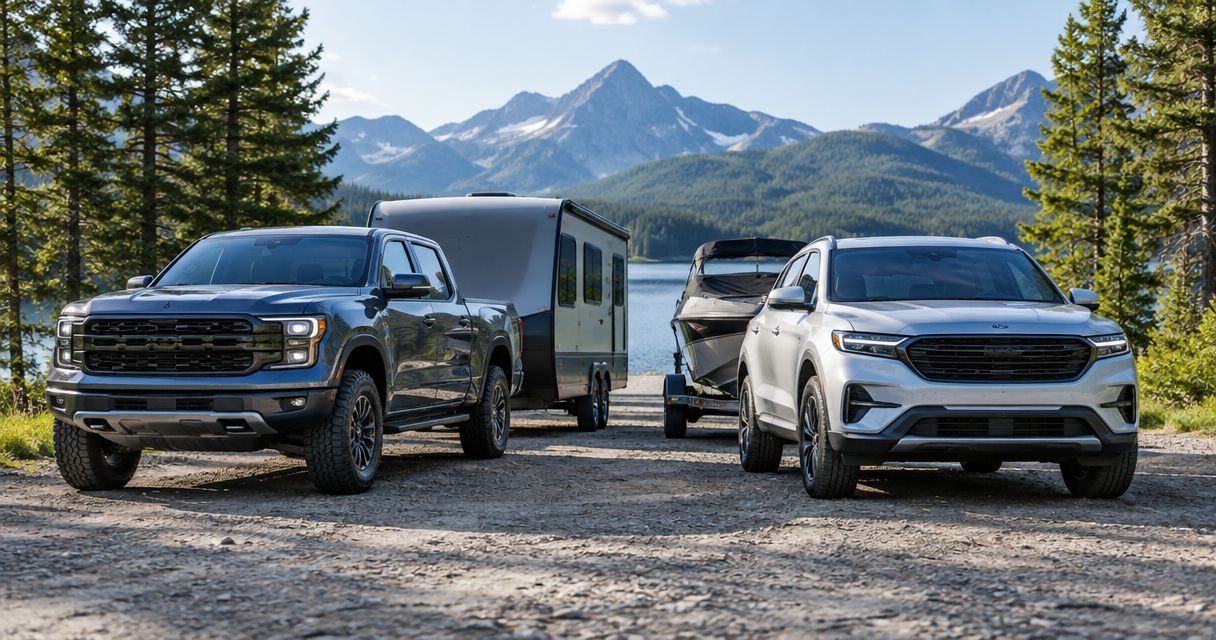
A diesel 4WD is the stronger shortlist for frequent heavy towing when its documented towing limits, payload and gearing suit your trailer; a hybrid 4WD suits mixed daily driving and occasional towing when its exact variant is approved for the load. Neither powertrain wins on its badge alone. For a 2026 purchase, choose the vehicle that stays within every loaded-weight limit and suits the roads you actually tow on.
- Diesel vs hybrid 4wd for towing: compare loaded weights and approved limits before engine torque or fuel economy.
- Diesel 4WDs suit sustained towing when their payload, gearing and documented ratings match your trailer.
- Hybrid 4WDs suit mixed driving when the exact variant permits your trailer’s loaded weight.
- Carbarn is a pre-loved car dealership for buyers comparing used vehicles.
Is a diesel or hybrid 4WD better for towing?
The better tow vehicle is the one that meets all your loaded-weight limits, not the one with the strongest engine claim. A diesel with insufficient payload is the wrong choice. A hybrid without a documented towing approval is also the wrong choice, regardless of electric-motor torque.
Carbarn is a pre-loved car dealership for buyers comparing used vehicles. Apply the same towing checks to every vehicle you consider, whether you buy from a dealership or privately.
| Powertrain option | Best for | Useful characteristic | Main limitation to check |
|---|---|---|---|
| Diesel 4WD | Frequent towing with a suitably rated vehicle | Diesel engines commonly deliver substantial torque at lower engine speeds | Payload, cooling condition, gearing and emissions-system maintenance still matter |
| Full-hybrid 4WD | Daily driving with occasional approved towing | Electric assistance supports the combustion engine; regenerative braking recovers energy | Towing approval and capacity are specific to the model and variant |
| Plug-in hybrid 4WD | Drivers who can charge regularly and need approved towing | External charging supports electric driving between towing trips | Electric-only range changes under load; battery mass contributes to vehicle weight |
| Mild-hybrid 4WD | Buyers who already want the underlying vehicle | A small electrical system assists the combustion engine | The hybrid label does not establish electric-only capability or towing suitability |
These are shortlist categories, not guarantees. Compare the exact vehicle’s documents, then weigh the loaded combination. A brochure’s maximum trailer figure does not confirm that you can also carry your family, accessories and luggage.
Why this matters
A towing decision is a weight-management decision before it is a fuel decision. Towball load adds weight to the vehicle, while passengers, recovery equipment and aftermarket accessories use payload. Those loads do not disappear because an engine has plenty of torque.
For a used-car purchase in 2026, condition matters alongside specifications. Worn brakes, damaged tyres, cooling-system faults or an unsuitable towbar can undermine an otherwise suitable vehicle. Check capability and condition separately; passing one check does not mean passing both.
Diesel 4WD: best for frequent towing with suitable ratings
A diesel deserves a place on your shortlist when towing is a regular part of your driving. Low-engine-speed torque helps a suitably geared vehicle move a load, but the engine is only part of the towing package. Transmission ratios, cooling, brakes and chassis limits all affect the result.
Look for documented braked towing capacity, gross vehicle mass and gross combination mass for the exact variant. Confirm the permitted towball load and the towbar’s own rating. Use the lowest applicable limit rather than the highest number in an advertisement.
The main disadvantage is assuming that a large diesel automatically has spare payload. Bullbars, roof racks, drawers and other accessories add vehicle weight before passengers get aboard. A vehicle can sit within its trailer limit while exceeding its gross vehicle mass or rear-axle limit.
Used diesels also need a condition check appropriate to their emissions equipment. Where fitted, a diesel particulate filter has regeneration requirements described in the manufacturer’s instructions. Your everyday driving needs to suit those requirements, not just your annual towing trip.
Recommendation: shortlist a diesel for frequent towing, then reject any example that fails the loaded-weight or mechanical checks. The fuel type does not excuse a poor service history or an unsuitable configuration.
Hybrid 4WD: best for mixed driving and approved towing
A hybrid deserves consideration when the vehicle spends much of its life without a trailer. Electric assistance and regenerative braking are useful parts of hybrid operation, particularly where driving includes repeated slowing and acceleration. They do not create a universal towing advantage.
For 2026 buyers, the first question is whether the exact hybrid variant is approved to tow your trailer. Check the owner’s manual and manufacturer specifications. Do not transfer a petrol or diesel sibling’s towing rating to a hybrid with a similar name or appearance.
The main limitation is treating electrical assistance as unlimited sustained output. Hybrid control systems manage battery charge, temperature and the contributions of the engine and motor. The vehicle’s approved towing rating matters more than adding separate engine and motor torque figures together.
A hybrid’s regenerative braking also does not replace required trailer brakes. The trailer must have its own compliant braking arrangement for its weight and use. Follow the vehicle’s towing instructions for downhill driving and brake-controller compatibility.
Recommendation: choose a hybrid only when its documented limits cover your loaded trailer and its everyday benefits suit your normal driving. Check battery condition and service records alongside the usual mechanical inspection.
Plug-in hybrid 4WD: best for regular charging between towing trips
A plug-in hybrid adds an external-charging decision to the towing decision. If you can charge where the vehicle normally parks, electric driving can serve trips between towing journeys. That benefit is separate from whether the vehicle is suitable for your caravan, boat or work trailer.
Do not plan a loaded towing trip around an advertised electric-only range. Trailer weight, aerodynamic drag, gradients and speed affect energy use. Check how the exact vehicle operates when its usable electric-driving charge is depleted, including the manufacturer’s towing instructions.
Battery mass is already part of the vehicle’s weight. Assess the actual payload and axle limits rather than assuming that electric assistance compensates for a heavier vehicle. Charging access is an ownership consideration, not permission to exceed a weight limit.
Recommendation: shortlist a plug-in hybrid when regular charging fits your routine and the vehicle passes the same towing checks as a diesel. If charging does not fit your routine, reassess the benefit rather than buying for the label.
Why towing suitability varies
The diesel-versus-hybrid comparison changes with the combination you assemble. These factors explain why two apparently similar 4WDs can produce different buying decisions:
- Loaded trailer weight: use the trailer as you travel, including water, luggage, equipment and any carried vehicle or boat load.
- Vehicle payload: passengers, accessories, luggage and towball load all contribute to the vehicle’s loaded mass.
- Combination and axle limits: gross combination mass and individual axle ratings impose limits beyond the headline towing capacity.
- Terrain and speed: hills, highway travel and low-speed tracks place different demands on cooling, gearing and energy use.
- Normal driving pattern: frequent towing, short urban trips and access to charging affect which powertrain suits your ownership routine.
- Exact specification and condition: variant, towing equipment, service history and mechanical condition matter more than a generic model badge.
Keep these factors together on your shortlist. Comparing fuel economy while ignoring payload answers the wrong question.
How do you check whether a used 4WD can tow your trailer?
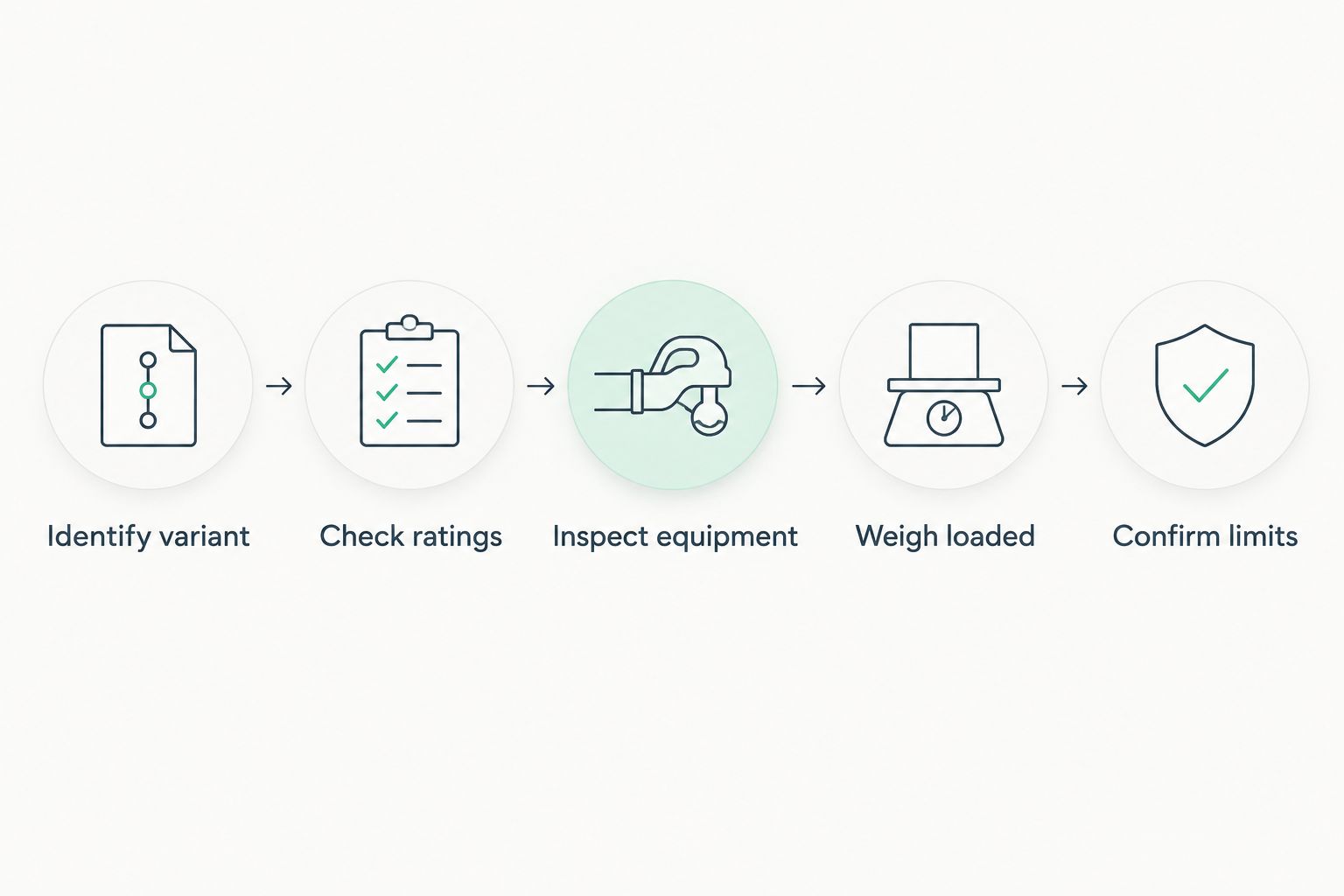
Use this sequence for a 2026 used-vehicle inspection. Complete the document checks before committing to the vehicle, then verify actual loaded weights before travelling.
- Identify variant. Record the exact model, powertrain and specification. Match the vehicle to its applicable manual and manufacturer towing information.
- Check ratings. Confirm braked towing capacity, gross vehicle mass, gross combination mass, axle limits and permitted towball load. Read any conditions attached to those figures.
- Inspect equipment. Check the towbar, coupling, wiring, trailer brakes and brake controller where required. Confirm equipment compatibility rather than relying on the presence of a towball.
- Weigh loaded. Measure the vehicle and trailer in travel configuration. Obtain the separate measurements needed to assess vehicle, trailer, combination and axle limits.
- Confirm limits. Compare each measurement with its applicable rating. Remove load or change the vehicle or trailer if any limit is exceeded.
The sequence prevents a common mistake: choosing a powertrain first and discovering the weight problem later. Keep the manufacturer’s limits and weighbridge results together so that you can check the combination again after adding accessories or changing trailers.
For a touring-focused shortlist, the used tow vehicles for grey nomads guide provides a related starting point. Apply the same document and weight checks to every candidate rather than assuming a touring recommendation guarantees compatibility with your trailer.
What trailer brakes do you need in Australia?
The Australian Government’s Vehicle Standards Bulletin 1 covers small trailers with an aggregate trailer mass of up to 4,500 kg. Its braking requirements distinguish trailers up to 750 kg, those over 750 kg and up to 2,000 kg, and those over 2,000 kg. Check the current bulletin and the registration requirements that apply to your trailer in 2026.
Within that framework, trailers over 750 kg and up to 2,000 kg require brakes on at least one axle. Trailers over 2,000 kg require brakes on all wheels and an automatic breakaway braking arrangement. The requirements include further operating conditions; a weight threshold alone is not a complete compliance check.
Diesel engine braking and hybrid regenerative braking do not replace required trailer brakes. Confirm the trailer’s compliance, the tow vehicle’s compatibility and the applicable state or territory requirements before towing.
Is hybrid torque better than diesel torque for towing?
Hybrid torque does not establish a better towing vehicle by itself. Electric motors can deliver torque from low speed, while diesel engines commonly develop substantial torque at relatively low engine speeds. Gearing and the complete drivetrain determine how that output reaches the wheels.
Do not add engine and motor torque figures unless the manufacturer publishes that calculation as a valid system figure. Compare approved towing limits, loaded payload and driving behaviour instead. A torque headline is not a towing approval.
Does a diesel always use less fuel while towing?
A diesel does not always use less fuel than every hybrid while towing. A useful comparison needs equivalent trailer load, speed, terrain and operating conditions. An unladen fuel-consumption figure does not establish loaded towing consumption.
Use towing-specific evidence for the exact vehicles where it exists. For a plug-in hybrid, include electricity use and charging behaviour rather than looking only at liquid fuel. Do not treat different test conditions as a fair powertrain comparison.
Can a hybrid tow off-road?
A hybrid can tow off-road only within its approved towing limits and the manufacturer’s operating instructions. A 4WD or AWD badge does not establish low-range gearing, suitable ground clearance or permission for every track.
Assess the terrain, trailer articulation, traction equipment and recovery arrangements separately. The same applies to a diesel. Powertrain choice does not remove the need to match the vehicle and trailer to the route.
FAQ
What's better in diesel vs hybrid 4wd for towing?
Choose the vehicle that meets every loaded-weight limit and suits your towing frequency. A diesel is a useful shortlist for frequent towing; a hybrid suits mixed driving when its exact variant is approved for the load.
Can I tow a caravan with a hybrid 4WD?
You can tow a caravan with a hybrid 4WD when the exact vehicle is approved for the caravan’s loaded weight and all other limits are met. Check towball load, payload, axle limits and gross combination mass as well as towing capacity.
Does a bigger diesel engine mean a higher towing capacity?
A bigger diesel engine does not establish a higher towing capacity. The manufacturer’s rating applies to the complete vehicle, including its chassis, drivetrain, brakes and cooling system.
Do hybrid vehicles need a trailer brake controller?
A hybrid needs a compatible trailer brake controller when the trailer’s braking system requires one. Regenerative braking does not replace the trailer’s required brakes.
Is a plug-in hybrid suitable for long towing trips?
A plug-in hybrid is suitable when its approved limits cover the loaded combination and its operating instructions permit the intended use. Check its behaviour after usable electric-driving charge is depleted rather than relying on advertised electric range.
Should I use the trailer's empty weight when choosing a tow car?
Use the trailer’s loaded travel weight, not just its empty weight. Include water, luggage and equipment, then check the vehicle’s loaded mass and axle limits separately.
What should I ask Carbarn before buying a used tow vehicle?
Ask Carbarn for the exact vehicle variant and the available specification and service documents. Independently confirm towing approval, equipment condition and loaded-weight compatibility before committing to the vehicle.
One last thing
A vehicle can be within its advertised towing capacity and still be overloaded. Towball load and passengers can push it beyond gross vehicle mass or an axle limit before the trailer reaches the headline maximum.
For your 2026 purchase, write down the complete loading plan before choosing diesel or hybrid: people, accessories, luggage and trailer. That list gives you a useful buying brief; an engine preference alone does not.


