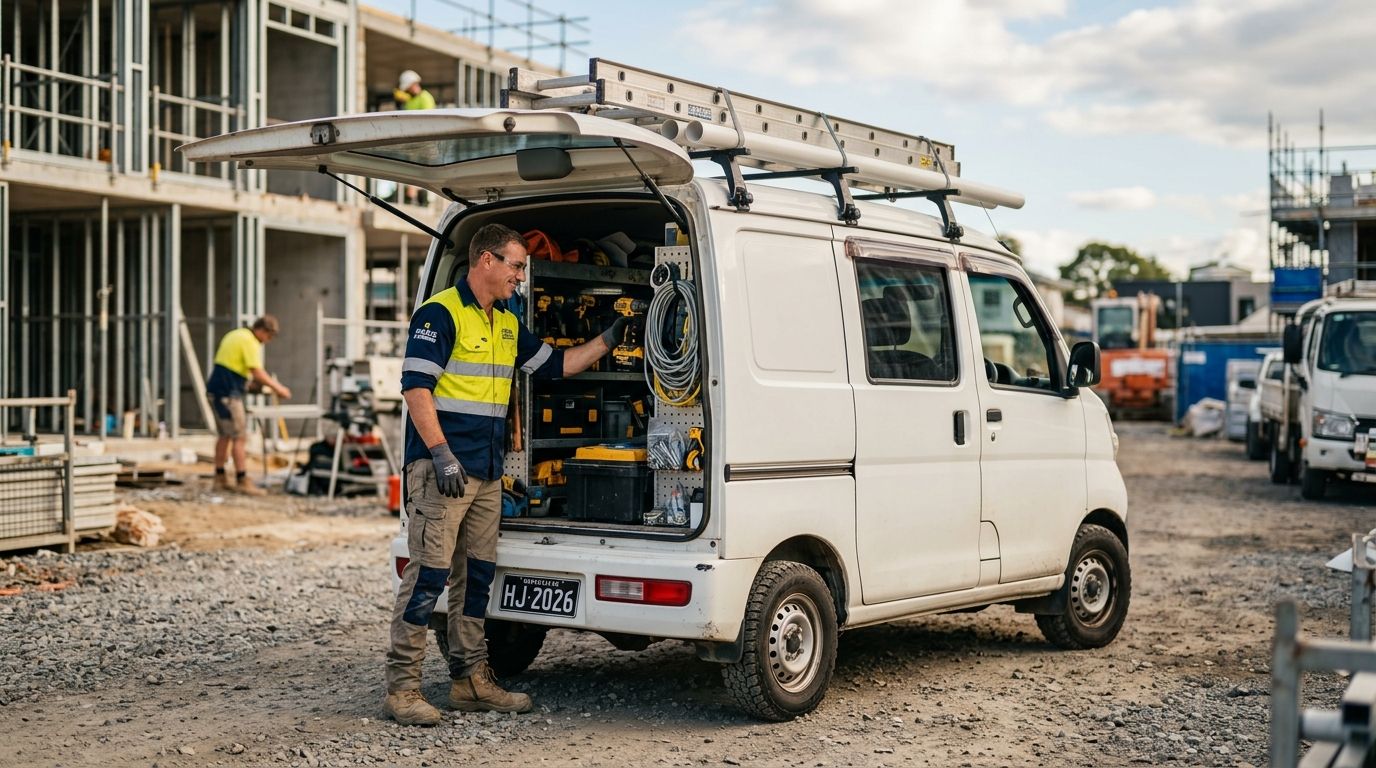
The Daihatsu Hijet is Australia's most common grey-import kei truck, and in 2026 it remains the default pick for tradies who want a compact work vehicle that parks where a HiLux can't. Best overall for tradies: the S500 series Hijet Deck Van/Truck (2014-2026 production). Best for two-person crews: the S500 Hijet Jumbo Cab. Best budget entry point: the S200 series Hijet Truck (1999-2014). Best for secure tool storage: the Hijet Cargo van. Best for acreage and rural runs: the Hijet 4WD Truck.
- The S500 series Daihatsu Hijet (2014-2026) is the best overall pick for tradies buying used in 2026.
- Every Hijet runs a 660cc engine under Japan's kei vehicle rules, which caps highway performance but keeps running costs low.
- The S200 series Hijet (1999-2014) is the cheapest way into a kei truck fleet, with the widest secondhand supply.
- The Hijet Jumbo Cab adds a second row of seating for two-person crews without losing tray length.
- 4WD Hijet Trucks with high-low transfer cases suit acreage, building sites and unsealed access roads.
Why this matters
Most tradies looking at a Daihatsu Hijet in 2026 are choosing between price, storage security and how many people need to sit up front. That's a genuinely different decision tree than picking a ute, because every Hijet variant is built on the same 660cc, sub-3.4-metre kei truck platform mandated by Japan's kei vehicle regulations. If you want a broader look at the category before committing to Daihatsu specifically, the kei trucks and vans for small business guide covers how Hijets stack up against Suzuki Carry and Honda Acty.
The practical differences between Hijet generations and body styles matter more than badge snobbery here. A 1999 S200 truck and a 2020 S500 Deck Van both carry roughly the same payload class, but they differ on cab comfort, rust history and how easy parts are to source in 2026.
What makes the best Daihatsu Hijet for tradies
- Tray or cargo configuration matched to the job — open deck for tools and materials, enclosed cargo for weatherproof storage.
- Cab layout — single row for solo operators, Jumbo cab for two-person crews.
- Drivetrain — 2WD for sealed roads and low running costs, 4WD with high-low range for sites and acreage.
- Service history and rust condition — kei trucks live hard lives; underbody corrosion is the biggest value killer.
- Import compliance paperwork — confirm the compliance plate and registration pathway with your state authority before buying.
- Availability of parts — later S500-series stock is easier to source than early S80/S81-era models.
At a glance
| Model | Best for | Standout feature | Key limitation |
|---|---|---|---|
| S500 Hijet Deck Van/Truck | Overall tradie use | Modern safety kit, better fuel economy | Higher demand pushes up asking prices |
| S500 Hijet Jumbo Cab | Two-person crews | Extended cab keeps tray length | Less rear tray space than the standard cab |
| S200 Hijet Truck | Budget buyers | Widest used supply in Australia | Older safety equipment, more rust risk |
| Hijet Cargo (van body) | Secure tool storage | Fully enclosed, lockable cargo box | Less flexible than an open tray for bulky loads |
| Hijet 4WD Truck | Acreage and rural sites | High-low transfer case | Reduced fuel economy versus 2WD |
1. Daihatsu Hijet S500 Deck Van/Truck: best Daihatsu Hijet for overall tradie use
The S500 series is the current-generation Hijet, produced from 2014 through into 2026, and it's the version most Australian importers are bringing in right now. It carries updated safety equipment over earlier generations, including ABS and airbags as standard on most trims, plus a more refined 660cc three-cylinder engine tuned for better real-world fuel economy.
Daihatsu Hijet S500 pros:
- Newest available generation, so lower kilometres on average stock
- Improved cabin comfort and NVH over the S200 series
- Easier access to parts and service knowledge in 2026
Daihatsu Hijet S500 cons:
- Higher demand means asking prices sit above older stock
- Still limited by the 660cc kei engine on sustained highway grades
Best for: tradies who want the newest kei truck platform and don't mind paying more for it. Verdict: Buy if budget allows — it's the safest long-term ownership bet in the lineup.
2. Daihatsu Hijet Jumbo Cab: best Daihatsu Hijet for two-person crews
The Jumbo Cab variant, built on both S200 and S500 platforms, extends the cabin rearward to fit a genuine second row rather than a parcel shelf. It's the configuration to look for if you regularly run an apprentice or a second tradesperson to site.
Hijet Jumbo Cab pros:
- Proper second-row seating instead of a cramped jump seat
- Retains most of the standard tray length behind the cab
- Same 660cc drivetrain as other Hijet variants, so servicing knowledge transfers
Hijet Jumbo Cab cons:
- Rear tray space is shorter than a single-cab equivalent
- Jumbo variants are less common on the used market than standard cabs
Best for: two-person operations that need seating without downsizing the work tray. Verdict: Buy if you can find one — supply is the main obstacle, not the vehicle itself.
3. Daihatsu Hijet S200 Truck: best Daihatsu Hijet for budget buyers
Produced from 1999 to 2014, the S200 series is the generation most commonly listed secondhand in Australia in 2026, simply because more of them have been imported over a longer period. It's the entry point for tradies who want a kei truck on a tight budget rather than the newest example available.
Daihatsu Hijet S200 pros:
- Largest pool of used stock, so more choice on condition and kilometres
- Simple mechanicals that most independent mechanics can service
- Well understood by kei truck importers and specialists
Daihatsu Hijet S200 cons:
- Older safety equipment compared with the S500 series
- Rust risk increases with age, especially on trays and chassis rails
Best for: tradies prioritising upfront cost over the newest features. Verdict: Hold — a good example is a solid buy, but inspect underbody rust closely before signing anything.
4. Daihatsu Hijet Cargo: best Daihatsu Hijet for secure tool storage
The Cargo van body replaces the open tray with a fully enclosed load area, turning the Hijet into a lockable mobile toolbox on wheels. It suits trades carrying expensive equipment that shouldn't sit exposed on a tray overnight.
Hijet Cargo pros:
- Fully enclosed and lockable cargo area
- Weatherproof storage for tools and stock
- Same compact footprint as the tray-back Hijet Truck
Hijet Cargo cons:
- Less flexible for oversized or awkward-shaped loads
- Loading through side and rear doors is slower than dropping tailgate access
Best for: trades that need lockable, weatherproof storage more than open tray flexibility. Verdict: Buy if tool security is the priority over raw cargo flexibility.
5. Daihatsu Hijet 4WD Truck: best Daihatsu Hijet for acreage and rural sites
Selected Hijet Truck variants offer a genuine 4WD system with a high-low transfer case, a feature carried over from Japan's rural and agricultural kei truck market. It's the pick for tradies working sites without sealed access, or running properties where a 2WD kei truck would get bogged.
Hijet 4WD pros:
- High-low transfer case handles unsealed and soft ground
- Same compact dimensions as 2WD variants for tight site access
- Genuine off-tarmac capability rare in this vehicle class
Hijet 4WD cons:
- Fuel economy drops compared with 2WD equivalents
- 4WD-specific parts can be harder to source than standard drivetrain parts
Best for: rural tradies and acreage owners who need traction, not just payload. Verdict: Buy if your work regularly leaves sealed roads; Skip if you only ever drive on tarmac.
How we ranked these
Each Hijet variant was scored against the six criteria above — configuration, cab layout, drivetrain, condition risk, compliance and parts availability — then matched to the tradie use case it serves best rather than forced into a single overall leaderboard. That's why the S200 series isn't ranked "worse" than the S500; it's ranked for a different buyer.
Browse used work vehicles at Carbarn
See current pre-loved stock before you commit to a kei truck import.
Which Daihatsu Hijet should you choose?
If you want one answer: the S500 series Hijet Deck Van/Truck is the safest all-round buy in 2026, provided your budget stretches to it. Tight on cash and comfortable inspecting for rust yourself, the S200 series remains the value play. Running a two-person crew, chase down a Jumbo Cab. Storing expensive tools overnight, take the Cargo van. Working paddocks or unsealed access roads, the 4WD Truck is the only variant built for it.
If a kei truck still feels too small for your payload needs, the Toyota LandCruiser buying guide covers the other end of the work-vehicle spectrum.
FAQ
What's the best Daihatsu Hijet for tradies in 2026?
The S500 series Hijet Deck Van/Truck, produced from 2014 through 2026, is the best overall pick for tradies. It carries updated safety equipment and better fuel economy than earlier generations while keeping the same compact kei truck footprint.
Is the Daihatsu Hijet 4WD or 2WD better for tradies?
2WD suits sealed-road work with lower fuel costs, while 4WD with a high-low transfer case suits acreage and unsealed sites. Choose based on where you actually drive, not on maximum capability.
How big is the Daihatsu Hijet engine?
Every Hijet variant runs a 660cc three-cylinder engine, the maximum displacement permitted under Japan's kei vehicle regulations. This keeps running costs low but limits sustained highway performance.
What's the difference between the S200 and S500 Hijet generations?
The S200 series was produced from 1999 to 2014 and makes up most of Australia's used Hijet supply. The S500 series, from 2014 onward, adds updated safety equipment and a refined drivetrain but commands higher asking prices.
Is a Hijet Cargo van better than a Hijet Truck for tradies?
The Cargo van suits tradies who need lockable, weatherproof storage for expensive tools. The tray-back Truck suits those hauling bulky or oversized materials that don't fit an enclosed body.
Are Daihatsu Hijets reliable as work vehicles?
Kei trucks are known for simple, durable mechanicals, but condition varies heavily by import history and rust maintenance. Inspect underbody and tray rust closely regardless of generation.
Does the Hijet Jumbo Cab lose much tray space?
Yes — the extended cab that fits a second row reduces rear tray length compared with the standard single-cab Hijet Truck. It's a trade-off for crews that need seating over maximum tray length.
What should I check before buying a used Daihatsu Hijet?
Confirm the compliance plate and registration pathway with your state authority first, then inspect for underbody and tray rust. Service history matters more on kei trucks than on mainstream utes because parts knowledge varies by importer.
One last thing
The generation gap matters more than the badge: an early S80/S81-era Hijet and a 2026-model S500 share a name but almost nothing else in terms of safety equipment or parts support. Match the generation to how long you plan to keep the vehicle, not just to the lowest asking price on the lot.