Mitsubishi built five distinct Pajero generations between 1982 and 2021, and the differences between them matter far more off the bitumen than they do in a shopping centre car park. This guide ranks the generations that hold up best for genuine off-road use in 2026, based on drivetrain hardware, suspension design and what actually turns up on the used market in Australia.
- Best overall for off-roading: the NH/NL Mitsubishi Pajero (1991-1999) with its Dakar-proven Super Select 4WD system.
- Best for daily comfort with real capability: the NM/NP Pajero (2000-2006) on coil-sprung independent suspension.
- Best budget project: the NA-NG Pajero (1982-1991), cheap to buy but needs mechanical sympathy.
- Best for modern reliability and safety: the NS-NX Pajero (2006-2021), the last generation Mitsubishi built.
- A used Mitsubishi Pajero from any generation still needs a pre-purchase inspection focused on rust and diff wear.
Why this matters
A Mitsubishi Pajero bought for weekend touring or serious 4WD tracks is a different proposition to one bought for the school run. Generation changes weren't cosmetic — Mitsubishi swapped suspension architecture, diff-lock systems and engine families across the model's run, and each swap changes how the vehicle behaves on corrugations, sand and steep climbs.
Getting the generation wrong means paying for off-road hardware you'll never use, or worse, buying a comfort-focused model and finding it out of its depth on a rutted fire trail. Carbarn sees buyers make this call every week, and the generation choice matters more than trim level or badge.
The short answer for 2026 buyers: the NH/NL Pajero remains the sweet spot for genuine off-road capability, while the NM/NP suits buyers who want most of that capability without the older cabin.
What makes the best off-road Mitsubishi Pajero
- Super Select 4WD-II transfer case — lets you run 4H on sealed roads without transmission wind-up, a Pajero-specific advantage over part-time 4WD systems
- Rear locking differential — standard or optional depending on generation, and non-negotiable for rutted tracks or sand recovery
- Coil-sprung independent front suspension — smoother on corrugations than leaf-sprung rivals, though it trades some outright axle articulation
- Diesel engine reliability — the 4D56, 4M40 and 4M41 diesels each have known service patterns that affect long-term ownership cost
- Ground clearance and approach/departure angles — varies meaningfully between generations and dictates what terrain is realistic
- Parts and mechanic support in Australia — older Pajeros are common enough that most workshops know them, which isn't true of every used 4WD import
Mitsubishi Pajero generations at a glance
| Generation | Best for | Standout feature | Key limitation |
|---|---|---|---|
| NH/NL (1991-1999) | Serious off-road tracks | Dakar Rally-proven Super Select 4WD, rear locker available | Cabin tech and safety gear are basic by 2026 standards |
| NM/NP (2000-2006) | Daily-driver off-roaders | Coil-sprung IFS rides better on corrugations | Slightly less articulation than the leaf-sprung NH/NL |
| NS-NX (2006-2021) | Reliability and touring range | Stability control, better crash safety, refined 3.2L diesel | Heavier kerb weight blunts some low-range agility |
| NA-NG (1982-1991) | Budget project builds | Simple mechanicals, easy to work on | Rust-prone, thin on parts for some trim variants |
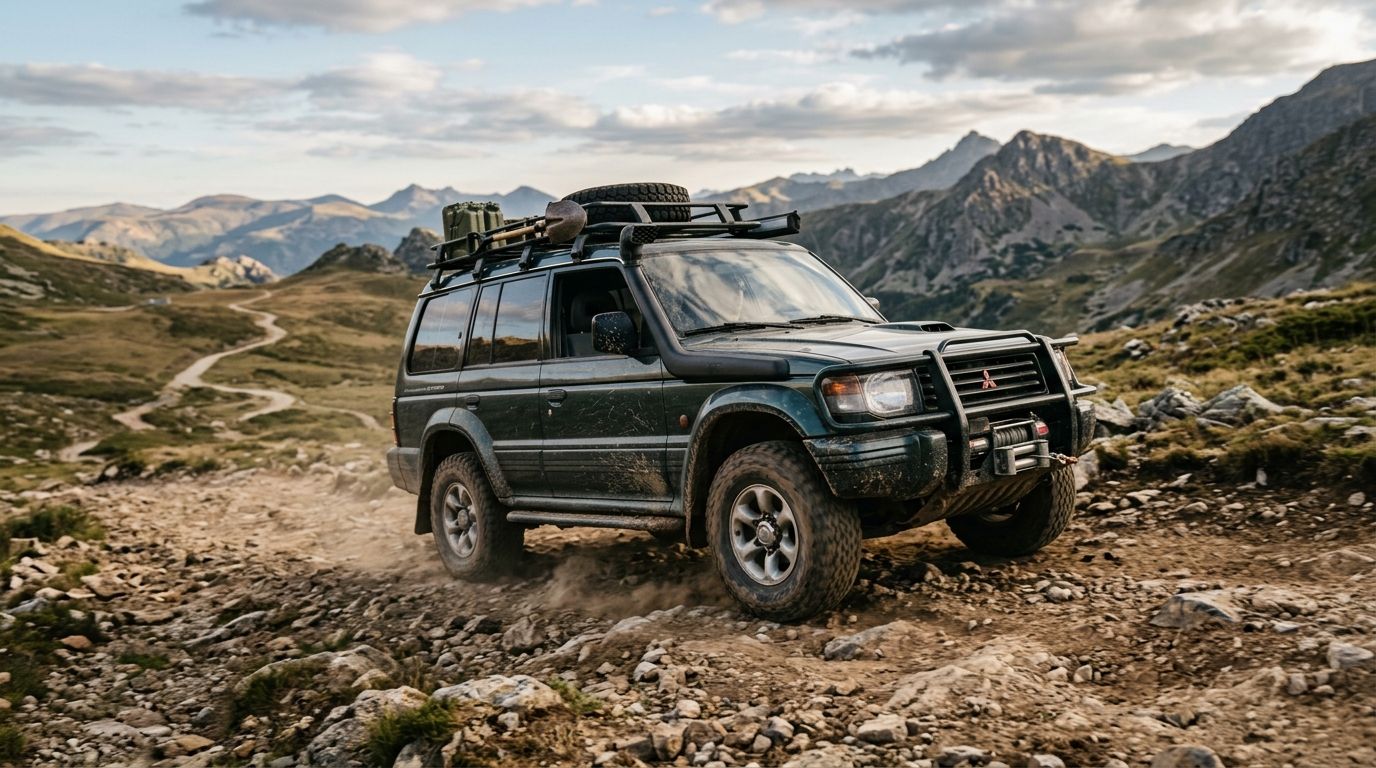
1. NH/NL Mitsubishi Pajero (1991-1999): best for serious 4WD tracks
The second-generation Pajero is the one that won the Dakar Rally multiple times through the 1990s, and that heritage shows up directly in the drivetrain. Super Select 4WD debuted on this generation, giving drivers a genuine full-time 4WD mode alongside low range — a setup few rivals matched at the time.
NH/NL Pajero pros:
- Super Select 4WD-II system handles everything from sealed highway to loose gravel without driveline stress
- Rear locking differential available on higher trims, useful for sand and mud recovery
- Simple, well-understood 4M40 diesel with strong aftermarket support
- Leaf-sprung rear end tolerates heavier touring loads better than later coil setups
NH/NL Pajero cons:
- Cabin electronics and safety equipment feel dated against any 2026-era used SUV
- Rust around wheel arches and sills is common on high-kilometre examples
- Interior trim and plastics show their age faster than the drivetrain does
Expect this generation to need a compression test and a check under the rear arches before you commit. Verdict: Buy — this is still the benchmark Pajero for anyone prioritising off-road hardware over cabin comfort.
2. NM/NP Mitsubishi Pajero (2000-2006): best for daily-driver off-roaders
The third generation moved to independent coil-sprung front suspension across the range, which changed the Pajero's character more than any update before or since. It rides noticeably better on washboard tracks and long highway legs, at a small cost to outright wheel articulation.
NM/NP Pajero pros:
- Coil suspension smooths out corrugations and long-distance driving fatigue
- 3.2L 4M41 common-rail diesel is more refined than the earlier 4M40
- More cabin space and a noticeably quieter interior than the NH/NL
- Still available with locking rear differential on higher-spec variants
NM/NP Pajero cons:
- Slightly less axle articulation than the leaf-sprung NH/NL on extreme terrain
- Timing belt and idler pulley service intervals get expensive if neglected by a previous owner
- Independent front suspension components cost more to replace than the older live-axle setup
This is the generation that suits a buyer who wants to tow a camper on Friday and tackle a fire trail on Saturday without a harsh commute in between. Verdict: Buy — the best balance of comfort and capability in the Pajero range.
3. NS-NX Mitsubishi Pajero (2006-2021): best for reliability and touring range
Mitsubishi's final Pajero generation ran for 15 years with rolling updates, adding stability control, improved crash structures and a more refined 3.2L diesel. It's the safest and most electronically sophisticated Pajero on the used market, which matters if long-distance touring is the priority over technical rock crawling.
NS-NX Pajero pros:
- Stability control and traction management add a real safety margin on loose surfaces
- Later 3.2L diesel updates improved fuel efficiency and reduced noise versus the NM/NP
- Longer production run means more examples to choose from on the used market
- Modern safety features make it the easiest generation to justify as a family vehicle
NS-NX Pajero cons:
- Heavier kerb weight than earlier generations blunts some low-range agility on steep, technical climbs
- DPF-equipped later diesels need highway running to stay clean, a poor fit for stop-start city use
- Electronic driver aids add complexity that costs more to diagnose when something faults
Buyers chasing the newest Pajero available should look here first, especially if towing range and highway comfort matter as much as trail capability. Verdict: Buy — the safest, most reliable pick for buyers who tour more than they crawl.
4. NA-NG Mitsubishi Pajero (1982-1991): best for budget project builds
The original Pajero introduced Mitsubishi's monocoque construction to the 4WD segment, a genuinely unusual choice at the time when most rivals used body-on-frame chassis. It's the cheapest generation to source in 2026 and the simplest to work on, but it demands realistic expectations.
NA-NG Pajero pros:
- Monocoque construction is lighter and simpler than a separate chassis
- Mechanically straightforward — few electronics to fail, easy for home mechanics
- Lowest entry cost among the four generations on the used market
NA-NG Pajero cons:
- Rust is common in sills, floor pans and wheel arches after four decades on Australian roads
- Parts supply for some trim-specific components has thinned out significantly
- No modern safety equipment — airbags and stability control simply don't exist on this generation
This one only makes sense as a project vehicle bought with eyes open about the mechanical and structural risk. Verdict: Hold — only buy with a thorough rust inspection and a realistic restoration budget.
Find your next used Pajero
Browse current used SUV stock and get a condition check before you buy.
How we ranked these generations
The ranking weighs drivetrain hardware (Super Select 4WD availability, locker options) against suspension design, known engine reliability patterns and realistic parts availability in Australia in 2026. Generations that pair strong off-road hardware with fewer long-term ownership headaches rank above those that only excel in one dimension.
Which Mitsubishi Pajero generation should you choose?
For genuine off-road capability with the least compromise, the NH/NL Pajero (1991-1999) is still the strongest pick in 2026, provided you can find one with minimal rust and service records to match. If you want most of that capability with a smoother ride and fewer cabin compromises, step up to the NM/NP (2000-2006). Buyers prioritising safety and touring range over technical crawling should look at the NS-NX (2006-2021) first, and the NA-NG only suits someone specifically after a restoration project rather than a vehicle to drive this year.
“The generation choice matters more than trim level or badge when you're buying a Pajero for off-road use.”
FAQ
What's the best Mitsubishi Pajero generation for off-roading?
The NH/NL Pajero (1991-1999) is the strongest off-road pick thanks to its Dakar-proven Super Select 4WD system and available rear locking differential. It trades modern cabin comfort for outright drivetrain capability.
Is the NM/NP Pajero better than the NH/NL for off-roading?
The NM/NP (2000-2006) rides better on corrugations thanks to coil-sprung independent front suspension but has slightly less axle articulation than the leaf-sprung NH/NL. Choose it if daily comfort matters as much as trail capability.
How much does a used Mitsubishi Pajero cost in 2026?
Pricing varies widely by generation, kilometres and condition, so check current listings rather than relying on a fixed figure. Older NA-NG models are generally the cheapest entry point, while later NS-NX examples command more due to lower age and better safety equipment.
Which Pajero diesel engine is most reliable?
The 4M40 in the NH/NL and the later 4M41 common-rail diesel in the NM/NP both have strong reliability reputations when serviced on schedule. The NS-NX generation's refined 3.2L diesel adds DPF technology that needs regular highway running to stay clean.
Does every Mitsubishi Pajero have a locking rear differential?
No — locking rear differentials were generally limited to higher trim levels across most Pajero generations, not standard across the range. Confirm the exact spec on any individual vehicle before assuming it has one.
Is the Mitsubishi Pajero good for touring in Australia?
Yes, the Pajero has a long history as a touring vehicle in Australia, particularly the NS-NX generation with its added stability control and refined diesel. Payload and fuel range should be checked against your specific touring plans.
What should I check before buying a used Pajero?
Inspect sills, wheel arches and floor pans for rust, especially on NA-NG and NH/NL examples, and confirm service history on the diesel engine and transfer case. A pre-purchase mechanical inspection is worth the cost on any generation.
One last thing
The Super Select 4WD system that debuted on the NH/NL Pajero in 1991 let drivers run full-time 4WD on sealed roads without the driveline wind-up that plagued part-time systems of the era — a genuine engineering advantage that's still relevant when comparing it against used 4WDs on the market in 2026.